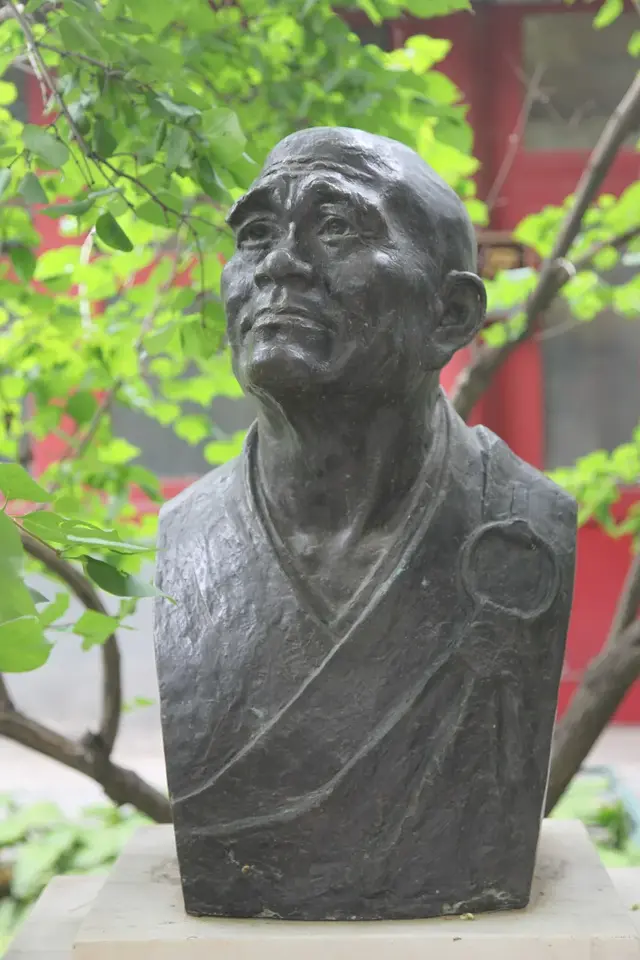
Biographical Narrative
Illustrious Heritage and the Precocious Prodigy
Shi Yixing was born in 683 (the second year of the Yongchun era of Emperor Gaozong of Tang) in Changle County, Wei Prefecture (present-day Nanle County, Henan). His lineage was exceptionally illustrious: he was the direct great-grandson of Zhang Gongjin, Duke of Zou (posthumously Duke of Tan), one of the twenty-four founding heroes honored in the Lingyan Pavilion under Emperor Taizong. Zhang Gongjin had played a decisive role in the Xuanwu Gate Incident and served as deputy commander under Li Jing during the northern punitive campaign that captured the Eastern Turkic ruler Illig Qaghan.
Yixing's grandfather, Zhang Dasu, served as Chief Clerk of Huai Prefecture during the Longshuo era of Emperor Gaozong, authoring imperial histories and astronomical treatises including History of the Later Wei and Continuation of the Kaihuang Calendar; his father, Zhang Shan, served as Magistrate of Wugong. Born into this prominent family combining statecraft with scholarly erudition, Yixing exhibited astonishing precocity from childhood. He immersed himself in private study, mastering not only the Confucian Five Classics and dynastic histories, but developing a profound fascination with astronomy, the calendar, Yin-Yang cosmology, algorithmic mathematics, and Changes philosophy.
During his youth, Yixing exhibited an extraordinary capacity for complex mental calculation, penetrating the intricate rhythms of celestial bodies. Reading Yang Xiong's Classic of Great Mystery and the Classic of Changes, he investigated the mathematical laws governing cosmic creation and celestial cycles. Before reaching twenty years of age, Yixing drew upon his advanced mathematical acumen to author the single-volume Dayan Xuan Tu (Mystic Chart of the Great Expansion) and Yi Jue (Explications of the Changes), synthesizing the mathematical permutations of the Great Expansion with astronomical seasonal rhythms.
Yin Sizhen, Chief Minister of the Court of the Imperial Clan and a distinguished scholar of the era, read Yixing's treatise and leaped from his seat in astonishment. Inviting the young scholar to his mansion for an extensive dialogue on the mysteries of astronomy, Yin Sizhen found Yixing's knowledge flowing like a mighty river, displaying effortless mastery over celestial degrees, the historical evolution of calendars, and mathematical cosmogony. Overwhelmed with admiration, Yin Sizhen declared to assembled court ministers: "This young man is truly a modern reincarnation of Yan Hui!" Thenceforth, Yixing's intellectual renown resonated throughout the capital.
Renouncing Secular Glory for the Monastic Path
During the middle and later years of Wu Zetian's reign, the Wu imperial clansmen monopolized supreme power. Wu Sansi, Prince of Liang, wielded absolute authority at court and acted with unchecked arrogance. Seeking to burnish his cultural prestige and recruit political followers, Wu Sansi learned of Yixing's dazzling intellect and dispatched trusted envoys bearing lavish gifts to form an intimate alliance with the young scholar.
Yixing possessed an uncompromising, proud character, deeply detesting the corruption and cruelty of the Wu clan. He recognized that accepting Wu Sansi's patronage would drag him into dishonorable factional intrigue, yet he also understood that openly defying the tyrant within the capital would inevitably invite lethal retribution upon his entire household.
Faced with this perilous dilemma, the twenty-one-year-old scholar made a life-altering decision. At dawn on an autumn day in 703 (the third year of the Chang'an era), he quietly departed from his family, donned rough monastic robes and straw sandals, and scaled the mountain trails of Mount Song. Mount Song had long served as a sacred sanctuary where Confucianism, Daoism, and Buddhism converged; at that time, Chan Master Puji, the premier disciple of the Northern Chan patriarch Shenxiu, was residing at Shaolin and Huishan monasteries.
Prostrating himself before Master Puji, Yixing articulated his resolve to renounce worldly fame to seek ultimate enlightenment. Discerning his profound spiritual bearing, Puji joyfully shaved his head, conferring upon him the monastic name "Yixing" (meaning "Single Practice"), drawn from the Mañjuśrī Prajñā Sūtra: "To dwell in the single reality of the Dharma realm, anchoring the mind in the Dharma realm, is called the Single Practice Samādhi (Yixing Sanmei)." In the mountains, Yixing practiced seated meditation while gathering firewood and carrying water, purging all aristocratic vanity.
Wandering the Monasteries and Mastering Indian Astronomy
Following his tonsure, Yixing refused to confine his intellect to cloistered temple walls. Believing that Buddhist compassion must be united with empirical scientific inquiry, he embarked on an extensive journey across China to seek out authentic masters of the sciences and the Dharma.
In 710 (the fourth year of Jinglong of Emperor Zhongzong), Chancellor Wei Anshi attempted to compel Yixing to enter imperial administration. To evade bureaucratic entanglements and pursue deeper scholarship, Yixing traveled south to Mount Dangyang in Jingzhou, residing at Yuquan Monastery, the ancestral seat of Tiantai founder Zhiyi. There, he studied under Vinaya Master Huizhen, practicing the precepts rigorously and establishing an unshakeable foundation in monastic discipline.
Subsequently, determined to master the mathematical astronomy of ancient India, Yixing journeyed south to Guoqing Monastery on Mount Tiantai in Zhejiang.
At that time, an anonymous Indian master well-versed in the Navagraha (Nine Planets) calendar and esoteric mathematical sciences resided at Guoqing Monastery. Yixing attended him daily in the courtyard, listening intently to the master calculate planetary movements with counting rods. One day, the old master sighed inside his chamber: "Today a true sage has traveled thousands of miles from the north to seek the Dharma; my mathematical arts can no longer be concealed!" Opening his door, he beheld Yixing standing respectfully in the corridor. Delighted, the master transmitted to Yixing the complete corpus of Indian mathematical astronomy, eclipse computation algorithms, and celestial mechanics.
Through these years of travel across Henan, Hubei, and Zhejiang, Yixing synthesized Northern Chan contemplation, Tiantai calming and contemplation, Vinaya discipline, and both Indian and Chinese mathematical astronomy, completing his transformation into an intellectual giant.
Imperial Favor in Chang'an and Inventing Astronomical Clocks
In 717 (the fifth year of Kaiyuan), Emperor Xuanzong inaugurated the glorious High Tang era. Hearing of Yixing's peerless erudition, Xuanzong dispatched Yixing's paternal cousin, Vice Director of Rites Zhang Qia, to Jingzhou bearing an imperial decree inviting Yixing back to Chang'an.
Recognizing that an enlightened sovereign now ruled and that his knowledge could serve the empire, Yixing returned to the capital. Emperor Xuanzong granted him an audience in the palace, deeply impressed by his dignified presence and intellectual brilliance. The emperor accommodated him at Sanxue Monastery and later Huayan Monastery, frequently consulting him on statecraft, astronomy, and border defense, treating him with the highest reverence as Imperial Preceptor.
In 721 (the ninth year of Kaiyuan), the Imperial Astronomical Bureau reported that the official Linde Calendar, compiled by Li Chunfeng under Emperor Gaozong, had developed severe prediction errors. During a solar eclipse in the seventh month, the Linde Calendar predicted an eclipse of three-quarters, yet no obscuration occurred in the sky. Outraged by these inaccuracies, Xuanzong commanded Yixing to direct a comprehensive calendar reform.
Taking command of the project, Yixing reviewed centuries of calendrical history, articulating a revolutionary scientific principle: "Ancient astronomers calculated solely through dusty texts and speculative numbers, never anchoring their work in rigorous contemporary observation. To formulate an accurate calendar, we must first invent precision instruments and establish rules entirely upon empirical measurement!"
To construct new instruments, Yixing partnered with Liang Lingzan, an engineering official renowned for mechanical ingenuity. Yixing directed the astronomical calculations and mathematical proportions, while Liang Lingzan supervised artisans in constructing wooden scale models.
In 723 (the eleventh year of Kaiyuan), a revolutionary bronze astronomical instrument—the "Ecliptic Armillary Sphere" (Huangdao Youyi)—was completed and installed in the palace. Unlike previous armillary spheres whose ecliptic rings were permanently fixed to the equatorial ring, Yixing's instrument featured a movable ecliptic ring that could slide along the equator, allowing astronomers to adjust for axial precession.
Observing stellar coordinates with this instrument, Yixing discovered that the relative positions of the twenty-eight lunar mansions had shifted compared to ancient records, becoming the first astronomer in world history to identify empirical evidence of stellar proper motion.
In 725, Yixing and Liang Lingzan achieved an even greater mechanical marvel: the "Water-Driven Armillary Sphere" (Shuiyun Huntianyi).
Driven by the regulated flow of water from a clepsydra, waterwheels propelled an intricate train of bronze gears, rotating an astronomical globe once every day to mirror the heavens. Most miraculously, Yixing designed the world's very first mechanical escapement mechanism (pingxing liandong zhi), enabling automated wooden figurines to strike a drum every quarter-hour (fifteen minutes) and ring a bell every double-hour (two hours). This clock predated similar European mechanical escapement clocks by over six centuries.
Refuting Ancient Fallacies and Measuring the Meridian
Having perfected his instruments, Yixing confronted the greatest theoretical obstacle in traditional astronomy: the blind adherence to the ancient dogma recorded in the Zhoubi Suanjing claiming that "the sun's shadow changes by one inch for every thousand leagues on a flat Earth" (riying qianli cha yicun). Traditional astronomers had calculated astronomical distances using this false constant, generating catastrophic mathematical errors.
Guided by empirical scientific skepticism, Yixing concluded that the thousand-league rule was a baseless myth. In 724 (the twelfth year of Kaiyuan), he submitted a historic memorial proposing a nationwide geodetic survey across the Tang Empire.
Emperor Xuanzong fully endorsed the plan, appointing Director of the Imperial Astronomical Bureau Nangong Yue and astronomical official Daxian Yuanzhe to lead expedition teams equipped with Yixing's specialized sighting instruments (fuju) and standard eight-foot gnomons.
The scientific expedition established thirteen observation stations spanning thousands of miles, extending north to the Tiele tribes (south of Lake Baikal) and south to Linyi (central Vietnam). In the far north at Tiele, summer nights were so brief that roasting mutton remained warm until dawn; in the far south at Linyi, the summer solstice shadow fell to the south, shattering ancient Chinese geographic assumptions.
The primary measuring line was established across four baseline stations in the Henan plain directed by Nangong Yue: Baima (modern Hua County), Junyi (modern Kaifeng), Fugou (modern Fugou), and Shangcai (modern Shangcai). Across this 500-league north-south baseline, surveyors leveled the ground with water troughs, simultaneously measuring the midday shadow of eight-foot gnomons on the summer solstice and observing the Polaris altitude angle at night.
The empirical data revealed: Baima shadow measured 1.57 feet (Polaris altitude 34.8 degrees); Junyi measured 1.53 feet (34.3 degrees); Fugou measured 1.61 feet (33.7 degrees); and Shangcai, 526 leagues to the south, measured 1.96 feet (32.8 degrees).
Synthesizing this data at Huayan Monastery in Chang'an, Yixing applied plane trigonometry and right-triangle geometry. He calculated that across a north-south distance of 526 leagues and 270 paces, the Polaris altitude differed by exactly two degrees. Consequently, one degree of celestial latitude corresponded to a ground distance of 351 leagues and 80 paces (approximately 129.22 kilometers in modern units).
This marked the very first time in human history that the length of an arc of the meridian was measured empirically! This milestone preceded the Abbasid Caliph al-Ma'mun's survey in Mesopotamia in 827 by 103 years and European surveys by over eight centuries, overthrowing the thousand-league fallacy and laying the foundation for spherical geodesy.
Formulating the Dayan Calendar and Defining Celestial Motions
Having established accurate empirical coordinates, Yixing commenced the drafting of the new calendar at Huayan Monastery in 725.
Synthesizing the mathematical philosophy of the Great Expansion from the Classic of Changes with empirical astronomical observations, Yixing produced the fifty-two-volume Dayan Calendar. The work comprised twelve divisions, including mathematical tables and formulas covering every aspect of celestial motion.
In the Dayan Calendar, Yixing solved the complex challenge of the sun's non-uniform apparent motion. Recognizing that the sun traveled fastest at the winter solstice and slowest at the summer solstice, he advanced the interpolation methods of Zhang Zixin and Liu Chuo, inventing the world's earliest non-equal interval quadratic polynomial interpolation formula (Jiufu Guiying).
Furthermore, Yixing compiled the world's first table of solar zenith distances incorporating trigonometric tangent functions. His calculations of solar and lunar eclipses, tracking both magnitude and geographic visibility boundaries, reached the supreme pinnacle of medieval mathematical astronomy, permanently resolving Tang calendrical debates.
Transmitting Esoteric Buddhism and the Commentary on the Mahāvairocana Sūtra
Simultaneously, Yixing fulfilled an equally momentous mission as a founding master of Chinese Esoteric Buddhism.
In the early Kaiyuan era, Indian masters Subhakarasimha and Vajrabodhi arrived in Chang'an carrying primary Tantric texts. Recognizing Yixing's bilingual mastery and vast philosophical erudition, Subhakarasimha requested his assistance as chief translator and editor.
In 724, Subhakarasimha and Yixing collaborated at Dafuxian Monastery in Luoyang, translating the seven-volume Mahāvairocana Sūtra (Da Ri Jing), the foundational text of the Womb Realm (Garbhadhātu). Following the translation, Subhakarasimha secretly transmitted the esoteric initiations and mudras to Yixing. Working through the night, Yixing authored the twenty-volume Commentary on the Mahāvairocana Sūtra (Da Ri Jing Shu).
In this masterwork, Yixing integrated Indian Tantric doctrine—centered on the Six Great Elements, the Threefold Mandala, and mantras—with classical Chinese concepts of cosmic harmony and innate purity of mind. He synthesized the core doctrine: "Bodhicitta is the cause, Great Compassion is the root, and Skillful Means is the ultimate." When Vajrabodhi and Amoghavajra transmitted the Diamond Realm (Vajradhātu) texts, Yixing assisted in the translation, becoming the sole master possessing the dual lineages of both the Womb and Diamond realms.
Demise at Huayan Monastery and Imperial Mourning
The crushing intellectual labor of compiling the fifty-two-volume Dayan Calendar, drafting the twenty-volume Da Ri Jing Shu, building astronomical instruments, and directing national surveys exhausted Yixing's physical health.
In the summer of 727, as the final draft of the Dayan Calendar was completed, Yixing collapsed from terminal respiratory illness and exhaustion.
On November 25, 727 (the seventeenth day of the tenth month of the fifteenth year of Kaiyuan), Yixing passed away peacefully in the meditation posture at Huayan Monastery in Chang'an at the age of forty-five.
Informed of his master's death, Emperor Xuanzong wept openly in the palace, lamenting: "Why has Heaven snatched away My Imperial Preceptor so swiftly!" The emperor suspended court audiences for three days, allocating 500,000 copper cash from the imperial treasury for a lavish state funeral.
Xuanzong posthumously conferred upon him the title Chan Master Dahui (Great Wisdom Chan Master), personally drafting and carving his funerary stele at Tongren Plain on Mount Shenhe. In 728, visiting Huaqing Palace, Xuanzong stopped before Yixing's stupa and wept again. In 729, the Dayan Calendar was officially promulgated, serving as the imperial calendar for decades and being adopted by Japan and Silla. Yixing's brilliant contributions illuminate world history across astronomy, geodesy, engineering, mathematics, and philosophy.
Major Achievements
Executing the World's First Scientific Measurement of the Meridian
Yixing's crowning scientific achievement was directing the first empirical measurement of the length of a degree of the meridian in human history.
In 724, discarding the thousand-league myth, Yixing organized a nationwide geodetic survey across thirteen stations spanning from Lake Baikal to central Vietnam.
Synthesizing summer solstice shadow lengths and Polaris altitude angles across four baseline stations in Henan (Baima, Junyi, Fugou, Shangcai), Yixing calculated that one degree of celestial latitude equaled 351 leagues and 80 paces (129.22 kilometers). Preceding Islamic surveys by a century and European efforts by eight centuries, this marked the true inception of empirical spherical geodesy.
Formulating the Fifty-Two-Volume Dayan Calendar
Commissioned by Emperor Xuanzong in 721, Yixing devoted six years of empirical observation and calculation to author the fifty-two-volume Dayan Calendar.
He resolved the non-uniform motion of the sun, inventing non-equal interval polynomial interpolation and compiling the world's earliest tangent function tables.
The calendar's accuracy in predicting solar and lunar eclipses, planetary movements, and geographic eclipse paths represented the absolute peak of medieval astronomy. In 733, Japanese envoy Kibi no Makibi brought the Dayan Calendar to Japan, where it was adopted as the official imperial calendar for nearly a century.
Inventing the Ecliptic Armillary Sphere and Mechanical Clock Escapement
To anchor calendrical reform in empirical observation, Yixing collaborated with engineering genius Liang Lingzan to invent two landmark astronomical instruments.
The "Ecliptic Armillary Sphere" (723) introduced a sliding ecliptic ring that enabled Yixing to discover the empirical phenomenon of stellar proper motion for the first time in human history.
The "Water-Driven Armillary Sphere" (725) utilized clepsydra waterflow and precision gears to mirror celestial revolutions, incorporating the world's first mechanical escapement mechanism to drive automated figures striking drums every quarter-hour and bells every double-hour. British historian of science Joseph Needham lauded this instrument as the direct ancestor of all mechanical clocks, preceding European escapements by over six centuries.
Translating the Mahāvairocana Sūtra and Founding Chinese Esoteric Buddhism
In Buddhist philosophy, Yixing was the paramount founding theorist of Chinese Esoteric Buddhism.
Collaborating with Indian masters Subhakarasimha and Vajrabodhi, he translated the seven-volume Mahāvairocana Sūtra and core Vajraśekhara Sūtra scriptures.
Yixing independently authored the twenty-volume Commentary on the Mahāvairocana Sūtra, synthesizing Indian Tantric rituals, mandalas, and mantras with Chinese Buddha-nature ontology. Establishing the core doctrine that "Bodhicitta is the cause, Great Compassion is the root, and Skillful Means is the ultimate," he provided Chinese Esoteric Buddhism with an enduring philosophical architecture.
Synthesizing Eastern and Western Astronomical Traditions
As the supreme intellectual mind of the High Tang, Yixing's genius lay in his cosmopolitan capacity to synthesize ancient Chinese mathematics with Indian astronomical science.
During his tenure at the Imperial Astronomical Bureau, he incorporated the Navagraha algorithms introduced by Indian scholars, harmonizing parallax corrections with China's traditional solar terms.
Breaking down barriers between astronomy, geodesy, and mechanical engineering, he forged an integrated scientific methodology that reflected the extraordinary cultural zenith of the High Tang civilization.