Birth in Guizhou
Born into a scholar-official family in Niuchang Town, Pingyuan Prefecture, Guizhou Province.
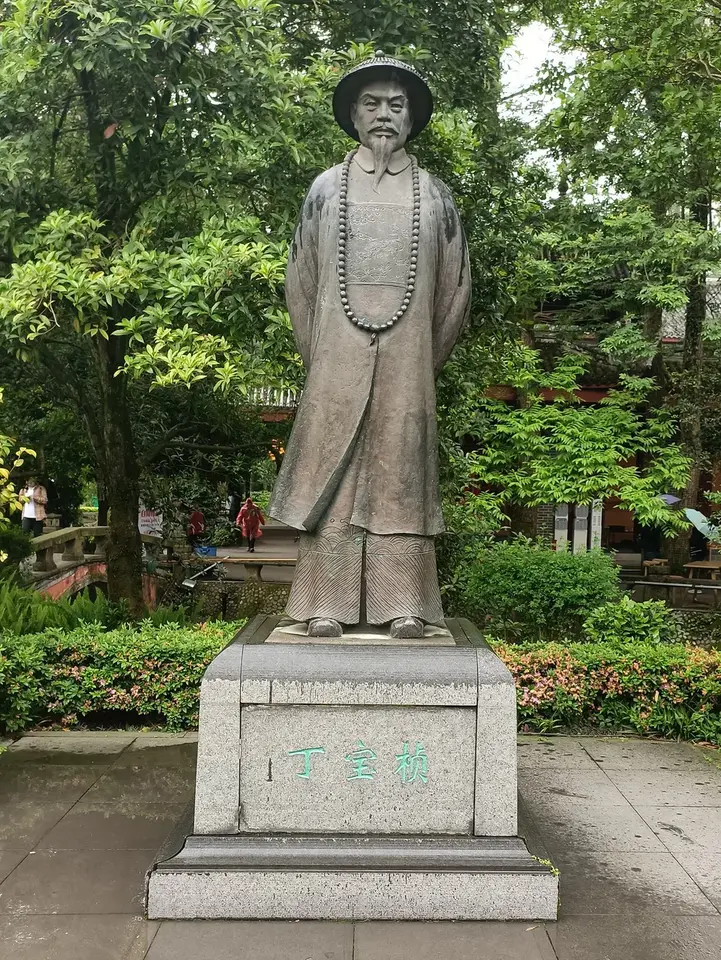
丁宝桢
Ding Baozhen (丁宝桢, 1820–1886), courtesy name Zhihuang, was a native of Niuchang Town, Pingyuan Prefecture, Guizhou Province (modern Zhijin County, Guizhou Province), with ancestral roots in Linchuan, Jiangxi. He was a distinguished late Qing statesman, military strategist, eminent figure of the Self-Strengthening Movement, and incorruptible regional viceroy celebrated as Lord Ding Wencheng. Passing the imperial examinations…
Ding Baozhen (丁宝桢, 1820–1886), courtesy name Zhihuang, was a native of Niuchang Town, Pingyuan Prefecture, Guizhou Province (modern Zhijin County, Guizhou Province), with ancestral roots in Linchuan, Jiangxi. He was a distinguished late Qing statesman, military strategist, eminent figure of the Self-Strengthening Movement, and incorruptible regional viceroy celebrated as Lord Ding Wencheng. Passing the imperial examinations as a jinshi in 1853, Ding was selected as a Bachelor in the Hanlin Academy. During ancestral mourning, he spent his personal fortune raising local militias to defend his homeland against insurgencies. After serving as Prefect of Yuezhou and Changsha, he rose to become Governor of Shandong in 1867. During his decade governing Shandong, he defeated the Western Nian rebels to relieve the capital, repaired catastrophic Yellow River breaches by constructing the formidable 250-li Zhangdong Dike, established the Shangzhi Academy and Shandong Arsenal, and famously executed the arrogant imperial eunuch An Dehai in Jinan in 1869, winning nationwide acclaim for moral bravery. In 1876, Ding was promoted to Governor-General of Sichuan. Over ten years in Sichuan, he carried out radical salt monopoly reforms through the "Government Transport and Merchant Sales" policy, completed a monumental stone overhaul of the ancient Dujiangyan irrigation system, established the Sichuan Arsenal, and mobilized garrisons to resist French aggression during the Sino-French War. Known for his complete financial incorruptibility, he died in office burdened with personal debts contracted to fund public works. The Qing court posthumously awarded him the title of Grand Guardian of the Heir Apparent and the posthumous name Wencheng.
Born into a scholar-official family in Niuchang Town, Pingyuan Prefecture, Guizhou Province.
Passed the metropolitan and palace examinations; admitted to the Hanlin Academy as a Bachelor.
During mother's mourning, spent family resources to recruit eight hundred militia to suppress the Yang Longxi rebellion.
Retained in Guizhou military campaigns by Governor Jiang Weiyuan; conferred the rank of Hanlin Compiler and recaptured Pingyue and Dushan.
Appointed Prefect of Yuezhou; disbanded volunteer troops and placed his remaining personal silver on the table to appease unpaid soldiers.
Transferred as Prefect of Changsha, securing military logistics and regional peace.
Promoted to Shandong Surveillance Commissioner; demanded equal seating before Prince Sengge Rinchen, winning wide admiration.
Succeeded Yan Jingming as Governor of Shandong; vigorously defended subordinate commanders against Li Hongzhang's blame-shifting.
Rushed 4,000 elite troops over hundreds of leagues to intercept Nian forces outside Beijing, earning the title of Junior Guardian of the Heir Apparent.
Arrested the empress dowager's favorite eunuch An Dehai for unlawful travel and executed him in Jinan, thrilling the empire.
Personally supervised the emergency breach sealing at Yuncheng; later constructed the 250-li Zhangdong Dike to protect against flooding.
Established the Shandong Machinery Bureau in Jinan, introducing modern weapons production.
Promoted to Governor-General of Sichuan; Empress Dowager Cixi bestowed upon him an imperial calligraphy banner reading "Guo Zhi Baozhen."
Overhauled the Sichuan salt administration through government-run transport, and established the Sichuan Arsenal in Chengdu.
Rebuilt the Dujiangyan irrigation network using permanent cut-stone embankments rather than perishable bamboo crates.
Mobilized over twenty battalions of Sichuan troops to Yunnan and dispatched reinforcements to Taiwan during the Sino-French War.
Died at the viceregal yamen in Chengdu at age sixty-six; buried in Jinan upon the appeal of Shandong citizens.
Ding Baozhen was born in 1820 in Niuchang Town, Pingyuan Prefecture (modern Zhijin County, Guizhou Province), into a prominent lineage tracing its ancestry to Linchuan, Jiangxi. His grandfather Ding Birong had served as Magistrate of Zhaohua in Sichuan, and his father Ding Shifen was an educational inspector in Zhenyuan. Raised in a tradition of pragmatic Neo-Confucian scholarship, Ding earned his provincial juren degree in 1843.
In 1853, thirty-three-year-old Ding passed the metropolitan and palace examinations, attaining the prestigious jinshi degree and being selected as a Bachelor in the Hanlin Academy. Shortly thereafter, his mother passed away, compelling him to return to Guizhou to observe mourning rites. At that juncture, the Taiping Rebellion inflamed southwestern China, and local rebel leader Yang Longxi mobilized impoverished peasants in Zunyi to overrun surrounding counties. Confronted with the impending devastation of his ancestral district, Ding exhausted his personal family wealth to recruit and train an eight-hundred-man militia, erecting defensive redoubts and protecting local villages.
In 1856, upon the expiration of his mourning period, widespread Miao insurrections broke out across Guizhou. Recognizing Ding's battlefield prowess and tactical leadership, Governor Jiang Weiyuan petitioned the throne to retain him in military service. The Xianfeng Emperor issued an imperial decree appointing him Compiler in the Hanlin Academy. Ding expanded his forces to four thousand men, leading them across mountainous terrain to recapture key prefectural strongholds such as Pingyue and Dushan, earning widespread renown.
In 1860, Ding was commissioned as Prefect of Yuezhou in Hunan. Prior to his departure, he was required to demobilize his Guizhou volunteer army. However, prolonged fighting had depleted public coffers, leaving back-pay arrears totaling tens of thousands of taels of silver. Ding collected his personal savings, placed his last five hundred taels of silver on the yamen desk, and tearfully addressed the assembled soldiers: "We have braved death together for years. Today the public treasury is barren; it breaks my heart to see you return home empty-handed!" Deeply moved by his selflessness, the soldiers wept openly, replying: "You ruined your personal estate to save the country; how could we dare demand more?" The soldiers dispersed peaceably, diffusing a volatile military mutiny through sheer moral rectitude. In 1862, Ding was reassigned as Prefect of Changsha, where he fortified city walls and secured vital food transport routes.
In 1863, Ding was elevated to Shandong Surveillance Commissioner. At the time, the Mongol prince Sengge Rinchen commanded imperial armies suppressing Nian rebels across Shandong and Henan. Renowned for his haughty arrogance, the prince refused to provide chairs for provincial commissioners, requiring them to stand obsequiously in his presence.
Upon arriving at military headquarters, Ding submitted his calling card and instructed the guards: "Inform the Prince that if he provides a chair, Ding will enter; if not, Ding departs immediately!" The attendants turned pale with terror, but Sengge Rinchen was deeply impressed by Ding's fearless resolve. The prince ordered the central gates thrown open, prepared a formal seat, and treated Ding with profound respect. Shandong Governor Yan Jingming was astonished by Ding's fortitude and rode out to the suburbs to welcome him in person, thereafter consulting Ding on all major provincial matters.
In 1864, Ding advanced to Shandong Administration Commissioner. In May 1865, Sengge Rinchen was ambushed and killed by Nian rebels at Gaolouzhai near Caozhou. Factional censors accused local Shandong officials of negligent coordination, and Ding was subjected to bureaucratic sanctions. However, imperial commander Zeng Guofan conducted a thorough inquiry and submitted a forthright memorial vindicating Ding of all wrongdoing.
In 1867, Yan Jingming resigned due to illness, recommending Ding as his successor as Governor of Shandong. That same year, Nian forces advanced toward the coastal districts, and Imperial Commissioner Li Hongzhang proposed building containment walls along the Jiaolai River. When the Eastern Nian breached defenses at the Wei River due to premature retreats by Huai Army units, Li attempted to deflect responsibility by demanding the execution of regional commander Wang Xin'an. Ding boldly memorialized the throne, detailing how Anhui commanders had abandoned their posts and condemning Li's self-serving dishonesty. The court spared Wang Xin'an and admonished Li Hongzhang.
In the spring of 1868, Western Nian cavalry swept toward Dingzhou, directly threatening Beijing. Without waiting for central mobilization orders, Ding personally led a relief column of 1,000 cavalry and 3,000 elite infantry, carrying only five days of rations, across hundreds of leagues to shield the capital. The Nian retreated south, and Ding pursued them relentlessly through Xiongxian, Renqiu, and Shenzhou, liberating the fortress of Raoyang. For this daring relief of the capital, the throne conferred upon him the title of Junior Guardian of the Heir Apparent.
In the autumn of 1869, Ding engineered the most daring act of judicial punishment of the late Qing period. Chief Eunuch An Dehai, a confidential favorite of Empress Dowager Cixi since the Xinyou Coup of 1861, wielded immense palace influence, extorting bribes and meddling in dynastic politics. Flushed with arrogance, An obtained informal permission to journey southward under the pretext of procuring imperial wedding robes for the young Tongzhi Emperor. Under Qing dynastic statutes, eunuchs were strictly forbidden from exiting the capital without official permits under penalty of death. An traveled down the Grand Canal in ostentatious dragon-bannered barges, extorting fortunes along his route.
On August 2, An entered Tai'an in Shandong. Dezhou Magistrate Zhao Xin immediately alerted the governor. Ding resolved to rid the dynasty of this corrupt parasite. He secretly ordered Tai'an Prefect He Yijing to dispatch cavalry to arrest An Dehai and escort him to Jinan. Ding interrogated An, confirmed that he possessed no imperial clearance documents from the Ministry of Rites, and transmitted an urgent memorial to the court denouncing An's illegal travels and extortion.
Before Cixi could intervene, Prince Gong and Empress Dowager Ci'an issued an immediate decree authorizing summary execution. On August 7, 1869, Ding had An Dehai executed outside the west gate of Jinan. The execution electrified the empire; scholars and commoners hailed Ding's courage, praising him as China's most resolute governor. Though Cixi harbored secret resentment, dynastic law and universal public applause shielded Ding from retribution.
Beyond military and judicial achievements, Ding's governance in Shandong was defined by hydraulic mastery. In 1871, the Yellow River burst its banks at Houjialin in Yuncheng, submerging dozens of counties. Ding rushed to the frontlines, sharing hardship with laborers in the freezing floodwaters, and successfully sealed the breach within two months.
In 1873, an even more catastrophic breach occurred at Jiazhuang. The Ministry of Revenue had budgeted 980,000 taels of silver for repairs. Ding exercised strict financial austerity, supervising the works day and night, and completed the breach closure for merely 540,000 taels. Ding subsequently mobilized regional laborers to erect the 250-li Zhangdong Dike, standing fourteen feet high and thirty feet wide. This colossal earthwork protected the plains of northwestern Shandong from major flooding for nearly a century, celebrated by regional communities through the Zhangdong Dike Stele.
Ding was equally dedicated to modernization and education. In 1869, he founded the Shangzhi Academy in Jinan, introducing mathematics, astronomy, and geography alongside classical learning, producing famous "Shangzhi Hall" book editions. In 1870, he established the Shandong Official Press and assisted in printing Ma Guohan's massive 100-volume compilation of lost classical texts, Yuhan Shanfang Jiyishu. In 1875, he founded the Shandong Machinery Bureau in Jinan, introducing modern steam-powered artillery manufacturing to northern China.
In 1876, the Qing court appointed Ding as Governor-General of Sichuan, conferring the titles of Vice Minister of War and Left Censor-in-chief. Prior to his departure, Empress Dowager Cixi presented him with an imperial calligraphy banner reading "Guo Zhi Baozhen" ("A Precious Pillar of the Realm"), signaling imperial trust.
Arriving in Chengdu, Ding confronted a province crippled by rampant banditry, administrative corruption, and depleted coffers. He cracked down ruthlessly on highway robbery, executing major brigands and rapidly restoring public safety across Sichuan.
To tackle the fiscal insolvency caused by illicit salt smuggling and merchant cartels, Ding spearheaded his celebrated salt administration reform known as "Government Transport and Merchant Sales" (Guan Yun Shang Xiao). He abolished the centuries-old merchant monopoly franchises, establishing public bureaus to purchase well-salt directly from Zigong and transport it aboard official river barges to major depots in Sichuan, Hubei, and Guizhou, where local retailers sold it at regulated prices. This eliminated exploitative middlemen, provided affordable and hygienic salt to millions of impoverished peasants, and generated an annual surplus of over one million taels of silver for the Sichuan treasury. Ding codified these technical procedures into the monumental, richly illustrated Gazetteer of Sichuan Salt Laws (Sichuan Yanfa Zhi).
In late 1876, Ding inspected the ancient Dujiangyan irrigation system in Guan County. Constructed in the third century BCE by Li Bing, the waterworks had suffered centuries of neglect: embankments were crumbling, and channels were choked with silt. Ding mobilized provincial resources for a comprehensive reconstruction.
Overcoming winter blizzards, Ding personally surveyed over seventy li of river channels. He discarded the traditional, perishable method of bamboo crates filled with cobblestones, introducing permanent masonry embankments crafted from massive dressed stone blocks bonded with molten iron. The overhaul excavated over 400,000 cubic meters of silt, laid 12,000 fathoms of stone dikes, and rebuilt the critical Yuzui water-divider and Renzi Dike. The restored waterworks irrigated millions of fertile mu across fourteen counties, permanently safeguarding the Chengdu Plain against drought and inundation.
In industry and frontier defense, Ding established the Sichuan Arsenal in Chengdu in 1877, the first modern military industrial enterprise in southwestern China, producing breech-loading rifles, cannons, and water turbines. When the Sino-French War erupted in 1884, Ding recognized the strategic vulnerability of China's frontiers. He dispatched over twenty battalions of Sichuan troops under General Bao Chao to reinforce Yunnan, while transferring five elite artillery battalions to assist Liu Mingchuan in defending Taiwan against French invasion. Simultaneously, he vigorously rejected British envoy Colman Macaulay's scheme to open an overland trade route through Tibet into Sichuan, firmly preserving southwestern sovereignty.
Despite governing wealthy provinces for more than two decades and overseeing tens of millions in state revenue, Ding lived an ascetic life. His official salary was consistently devoted to river repairs, school construction, charitable relief, and military industries. When the throne awarded him 40,000 taels of silver for repairing the Yellow River, he transferred the entire sum to Guizhou to finance roads, bridges, and academies.
During his final years in Chengdu, Ding repeatedly borrowed money from private merchants to finance public deficits at Dujiangyan and the arsenal. In the spring of 1886, exhausted by decades of relentless labor, Ding fell critically ill in Chengdu. On his deathbed, he drafted a final memorial to the throne, poignantly writing: "Your servant has held viceregal commands for twenty years. The tens of thousands borrowed from merchants have all been dedicated to state affairs; now, terminally ill, I cannot repay these debts in this life and must await the next world to reward my creditors."
On April 24, 1886, Ding passed away at his viceregal yamen at the age of sixty-six. Upon inspecting his estate, subordinates discovered that he possessed not a single spare tael and was burdened with heavy debts, leaving his family unable to purchase a coffin or transport his body home. Moved to tears, provincial civil and military officials raised personal contributions to fund the funeral cortege.
When news of his death reached Shandong, gentry and commoners petitioned the court to allow their former governor to be buried in Jinan. The Qing court issued imperial decrees granting the petition, posthumously elevating Ding to Grand Guardian of the Heir Apparent, conferring the posthumous name Wencheng ("Cultured and Resolute"), allocating 3,000 taels for funeral expenses, and authorizing dedicated shrines across Shandong, Sichuan, and Guizhou. In the autumn of 1887, his coffin arrived in Jinan, where tens of thousands of citizens lined the roads in mourning before laying him to rest at the foot of Mount Huabuzhu.
Ding's execution of Chief Eunuch An Dehai in Jinan in August 1869 was the most audacious enforcement of dynastic discipline during the late Qing period. Exploiting the intimate favor of Empress Dowager Cixi, An flouted dynastic statutes forbidding eunuchs from exiting the capital, extorting regional officials with impunity.
Ding acted with decisive courage, arresting An the moment he crossed the provincial border and executing him upon receiving imperial confirmation. This bold strike shattered eunuch interference in imperial statecraft, delighted the populace, and established a permanent historical standard of ministerial integrity and moral fearlessness.
Governing Shandong during catastrophic flood crises, Ding demonstrated exceptional organizational brilliance in hydraulic engineering. He personally commanded emergency breach-sealing operations at Yuncheng in 1871 and Jiazhuang in 1873, completing repairs under budget and saving the state hundreds of thousands of taels.
He then spearheaded the construction of the monumental 250-li Zhangdong Dike. Engineered to exceptional structural standards, the dike withstood Yellow River crests for nearly a century, permanently protecting millions of farming families across western Shandong and commemorated by the historic Zhangdong Dike Stele.
Ding's renovation of Dujiangyan between 1876 and 1877 represents one of the greatest civil engineering achievements of nineteenth-century China. Confronted with silted waterways and collapsing earthen banks, Ding personally inspected channels through winter storms and instituted the revolutionary "Stone for Bamboo" policy.
He replaced perishable bamboo-gravel crates with massive dressed stone blocks anchored by molten iron, excavating 400,000 cubic meters of sediment and building over 12,000 fathoms of permanent dikes. His repairs revitalized the ancient irrigation network across fourteen counties, ensuring lasting agricultural prosperity for the Chengdu Plain.
Confronted with bankrupt provincial finances, predatory merchant cartels, and rampant salt smuggling, Ding instituted the groundbreaking "Government Transport and Merchant Sales" system across Sichuan.
By stripping hereditary merchant syndicates of exclusive transport rights and establishing official shipping bureaus to transport salt directly to major depots, he guaranteed uniform pricing and eliminated predatory markups. This reform made affordable salt accessible to ordinary families while generating an annual fiscal surplus of over one million taels of silver for Sichuan, systematically documented in his Gazetteer of Sichuan Salt Laws.
Ding was a committed leader of the Self-Strengthening Movement who championed modern technology to resist foreign imperialism. He founded the Shandong Machinery Bureau in Jinan in 1875 and the Sichuan Arsenal in Chengdu in 1877, creating the first modern defense industrial installations in northern and southwestern China.
During the Sino-French War, he adopted a resolute military posture, mobilizing twenty-five battalions to Yunnan and Taiwan to repel French forces. He also successfully blocked British attempts to establish an overland trade route through Tibet, vigorously defending the territorial integrity of China's frontiers.
Ding's culinary refinement bequeathed to global culture the famous Chinese dish Kung Pao Chicken (Gongbao Jiding). While serving in Shandong and Sichuan, his household chefs blended northern stir-fry techniques with Sichuan chili peppers and peanuts to create this beloved poultry dish. Because Ding held the imperial title of Junior Guardian and later Grand Guardian of the Heir Apparent, popularly known as "Gongbao," the dish was named in his honor.
Ding's family letters to his eldest son Ding Tichang were compiled into Family Letters of Lord Ding Wencheng, outlining an ethical framework centered on public devotion, incorruptibility, and diligent governance that remains a model of Chinese family instruction.
FIGURES ASSOCIATED WITH THIS DYNASTY