Birth in Kuaiji
Born in Kuaiji, Zhejiang, into an impoverished scholar-gentry household.
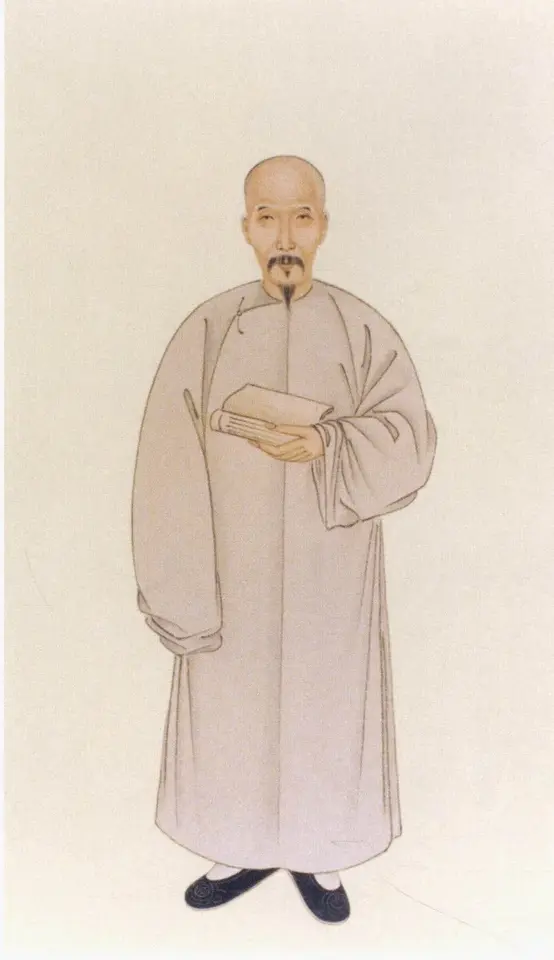
章学诚
Zhang Xuecheng (章学诚, 1738–November 29, 1801), courtesy name Shizhai, art name Shaoyan, was a towering historiographical theorist, philosopher of history, local gazetteer master, and bibliographer of the mid-Qing dynasty. Celebrated by modern scholars as the definitive compiler of the East Zhejiang Historical School, he was hailed by Liang Qichao as "the solitary master of historiography in the Qing dynasty." Originating from…
Zhang Xuecheng (章学诚, 1738–November 29, 1801), courtesy name Shizhai, art name Shaoyan, was a towering historiographical theorist, philosopher of history, local gazetteer master, and bibliographer of the mid-Qing dynasty. Celebrated by modern scholars as the definitive compiler of the East Zhejiang Historical School, he was hailed by Liang Qichao as "the solitary master of historiography in the Qing dynasty." Originating from a modest scholar-gentry household in Kuaiji, Zhejiang, he accompanied his father through administrative posts, experiencing repeated setbacks in imperial examinations before earning his jinshi degree in 1778 at the age of forty-one, serving as Director of Books in the National University. Unwilling to flatter bureaucratic superiors, he spent most of his adult life traveling across North and Central China as an itinerant lecturer at academies and directing provincial gazetteer bureaus. Living during the heyday of the Qianjia evidential school, Zhang Xuecheng observed that pedantic textual critics were losing sight of statecraft by detaching themselves from moral philosophy and contemporary reality. Resurrecting the practical historical ethos of Huang Zongxi, Wan Sitong, and Quan Zuwang, he formulated the revolutionary philosophical thesis that "The Six Classics are all history" (Liujing jie shi), demolishing centuries of dogmatic Confucian metaphysics by asserting that the ancient classics were historical institutional archives of the Western Zhou. In his monumental treatise Wenshi Tongyi (General Principles of Literature and History), he formulated the indispensable qualifications of the historian—historical talent, erudition, discernment, and moral virtue—pioneering the concept of "historiographical virtue" (shide). In local history, he codified the principle that "gazetteers are authentic histories," establishing the threefold format of local records in his Fangzhi Lueli; in bibliography, he authored Jiaochou Tongyi, proposing that cataloging must "distinguish scholarship and trace intellectual lineages." Impoverished and completely blind in both eyes in his final years, he died in obscurity in 1801 at the age of sixty-four. His profound historical insights were rediscovered in the twentieth century by Naito Torajiro and Hu Shi, winning global recognition as an intellectual pinnacle of Chinese historiography.
Born in Kuaiji, Zhejiang, into an impoverished scholar-gentry household.
Accompanied his father to administrative posts in Yingcheng, Hubei, observing local governance and legal archives.
Traveled to Beijing to study at the National University, associating with scholars Zhu Yun and Dai Zhen.
Passed the Shuntian provincial examinations as a juren; accepted as a disciple by examiner Zhu Yun.
Invited by Magistrate Liu Changcheng to compile the Gazetteer of Hezhou, formulating early gazetteer principles.
Passed the metropolitan examinations at forty-one, receiving appointment as Director of Books in the National University.
Authored Jiaochou Tongyi, establishing the foundational canon of historical bibliography.
Entered the retinue of Henan Governor Bi Yuan, lecturing at Wenzheng and Lianchi academies.
Compiled the Gazetteer of Bozhou, finalizing the tripartite gazetteer framework of annals, archives, and literary anthologies.
Printed initial woodblock fascicles of Wenshi Tongyi, elaborating the doctrine that the Six Classics are all history.
Lost his eyesight completely due to cataracts, continuing to dictate essays such as East Zhejiang Scholarship.
Passed away in poverty at his residence in Kuaiji on November 29 at age sixty-four.
Zhang Xuecheng was born in 1738 in Kuaiji, Shaoxing Prefecture, into an impoverished scholarly family. His father, Zhang Wenfeng (Zhang Biao), served as a minor judicial clerk in Yingcheng and Tianmen in Hubei, living as an itinerant legal secretary. During his childhood, Zhang was physically frail and possessed a sluggish memory, unable to memorize classical texts easily and considered clumsy by his kin. However, he possessed a penetrating gift for synthetic philosophical deduction, demonstrating an instinctive grasp of structural historical change.
In 1751, at the age of fourteen, Zhang accompanied his father to official residences in Hubei. Living within magistrate yamuns, he spent long days reading administrative archives, land registers, and local litigation dockets, gaining firsthand exposure to the realities of grassroots rural society. This background saved him from the detached bookishness typical of lower Yangtze literati, anchoring his intellectual concerns in practical administrative statecraft. In 1760, at age twenty-three, he journeyed north to enroll as a student in the National University in Beijing. Immersing himself in the writings of Gu Yanwu and Huang Zongxi, he resolved to revive the East Zhejiang historical tradition and establish an enduring theoretical system of historical criticism.
In 1765, after repeated examination failures, Zhang finally passed the Shuntian provincial examinations as a juren. The assistant examiner, Hanlin compiler Zhu Yun, marveled at Zhang's examination essays, recognizing an intellectual heir to the great Han-dynasty statesmen Jia Yi and Liu Xiang, and enrolled Zhang as his close disciple. Through Zhu Yun's salon, Zhang became acquainted with intellectual titans including Dai Zhen, Shao Jinhan, and Zhou Yongnian, beginning his lifelong contemplation of historiographical methodology and intellectual history.
Following his provincial success, Zhang met repeated defeats in the metropolitan jinshi examinations. To support his family, he spent over twenty years traveling across North China and the Huai River basin, accepting invitations from governors and magistrates to edit local gazetteers. In 1771, invited by Magistrate Liu Changcheng of Hezhou, Anhui, Zhang assumed directorship of the Gazetteer of Hezhou. Examining past gazetteers, he was appalled by their chaotic organization, noting that they had degenerated into trivial descriptions of scenic spots or uncritical scrapbooks of local poetry, abandoning the core duty of recording factual local history.
Zhang revolutionized the genre, establishing the fundamental principles that "local gazetteers are authentic histories" and "their format should conform to historiographical methods." He argued that a local gazetteer was the comprehensive history of a region, worthy of standing beside dynastic annals, and should be organized into annals, tables, monographs, and biographies. In 1773, while in Ningbo, Zhang met the evidential philologist Dai Zhen. Dai asserted that gazetteers should strictly record geography, rivers, and natural products while eschewing human biographies and evaluative essays. Zhang vigorously resisted Dai's mechanistic views, debating him face-to-face for days and asserting that historical human action and moral statecraft constituted the very essence of local history.
In 1778, at the age of forty-one, Zhang finally attained his jinshi degree, receiving appointment as Director of Books in the National University. The office was an uninfluential sinecure charged with maintaining library registers. Realizing that his unbending candor and disdain for sycophancy unfitted him for court politics, Zhang quickly took leave from the capital to lecture at regional academies. During this prolific period, he completed his seminal four-volume work on bibliographic classification, Jiaochou Tongyi, alongside essays outlining his gazetteer methodology.
In 1788, the distinguished scholar-official and Governor of Henan, Bi Yuan, invited Zhang to Kaifeng to preside over the Wenzheng Academy and assist in compiling the Continued Comprehensive Mirror to Aid in Government (Xu Zizhi Tongjian) and the Henan Provincial Gazetteer. Under Bi Yuan's generous material patronage, Zhang experienced the most intellectually fertile period of his life.
In 1789, invited by Magistrate Pei Zhen of Bozhou, Anhui, Zhang directed the compilation of the Gazetteer of Bozhou. In this work, he realized his mature theoretical ideal by establishing the tripartite gazetteer model: dividing the work into "annals" (zhi, recording structural administrative institutions), "historical archives" (zhanggu, preserving official decrees, dockets, and tax registers), and "literary anthologies" (wenzheng, collecting local inscriptions and essays). This innovation brilliantly reconciled stylistic conciseness with exhaustive archival preservation. Zhang considered the Gazetteer of Bozhou his finest practical masterpiece, extracting its methodological principles to compose Fangzhi Lueli.
Concurrently, Zhang poured his philosophical genius into his masterwork, Wenshi Tongyi. Utterly dismayed by contemporary Qianjia evidential scholars who buried themselves in philological minutiae while evading critical political issues, Zhang launched an unsparing philosophical critique against academic pedantry. He articulated the revolutionary doctrine that "The Six Classics are all history," demonstrating that the Confucian canon was not a collection of timeless dogmas, but the administrative record of the Western Zhou state. He composed seminal chapters including Original Dao, Original Learning, and Historiographical Virtue, erecting a grand architectural system of classical historical criticism.
In 1794, Bi Yuan was transferred to Huguang and subsequently suffered political disgrace during the White Lotus Rebellion. Deprived of his patron, Zhang was cast back into severe poverty. During his final decade, he drifted between Baoding, Beijing, Kaifeng, and Hangzhou, subsisting on meager literary stipends. Mainstream scholar-officials, infatuated with examination rhyming and antiquarian pedantry, regarded Zhang's soaring historical theories as eccentric and ridiculed him as a madman.
Despite the near-total absence of contemporary recognition, Zhang persevered with tranquil fortitude. In 1795, he assembled the manuscript of Wenshi Tongyi, printing several fascicles at his own expense. By 1800, decades of exhausting labor took their toll, and cataracts blinded both his eyes. Immersed in absolute darkness, Zhang drew upon his colossal memory to dictate historical treatises from his sickbed, while his devoted son Zhang Xuefa transcribed every word by candlelight. He composed brilliant retrospectives such as East Zhejiang Scholarship and Alternative Biography of Shao Yutong, urging disciples to avoid pedantry and comprehend the sweeping currents of historical change.
On November 29, 1801, Zhang Xuecheng passed away in an unheated room in his native Kuaiji at the age of sixty-four. He left behind no financial estate, bequeathing only trunks of unpublished manuscripts. His sons carefully preserved these papers, eventually publishing them as the Posthumous Works of Master Zhang. In the late nineteenth century, Zhang Zhidong recommended Wenshi Tongyi as indispensable reading in his Bibliography of Recommended Books; in the early twentieth century, Japanese sinologist Naito Torajiro and Chinese philosopher Hu Shi published definitive biographies, recognizing Zhang Xuecheng as the supreme intellectual bridge between classical Chinese historiography and modern critical historical philosophy.
Zhang Xuecheng's most profound philosophical breakthrough was his proposition in Wenshi Tongyi that "The Six Classics are all history" (Liujing jie shi). For two millennia, the imperial state and orthodox literati had venerated the Six Classics as transcendental repositories of eternal moral truth handed down by heaven. Zhang demolished this metaphysical dogma by demonstrating that the Classics were the governmental archives, legal statutes, and historical records of the Western Zhou dynasty. He posited that moral principles (dao) cannot exist detached from physical institutions (qi), asserting that truth is immanent within historical processes. This historicist thesis liberated scholarship from scriptural fundamentalism, providing nineteenth-century reformers with a powerful intellectual tool to justify institutional evolution.
Zhang Xuecheng's Wenshi Tongyi represents the supreme theoretical monument of classical Chinese historiography, complementing Liu Zhiji's eighth-century Shitong. While Liu examined historical methodology and style, Zhang explored historical philosophy and ethics. He formulated the doctrine of "Historiographical Virtue" (shide), asserting that intellectual brilliance (cai), erudition (xue), and analytical judgment (shi) are hollow without ethical integrity. In his treatise Historiographical Virtue, he defined this virtue as the absolute liberation of the historian's mind from personal vanity, factional malice, and worldly profit, demanding objective fidelity to truth. His systematic integration of historical meaning (shiyi), structural form, and critical philosophy established the definitive paradigm of pre-modern Chinese historiographical thought.
Zhang Xuecheng was the undisputed founding patriarch of systematic gazetteer studies (Fangzhixue). Prior to his work, local records were uncritical geographic compilations. Operating through extensive practical experience in compiling the Hezhou, Bozhou, and Yongqing gazetteers, he authored Fangzhi Lueli, establishing the principle that "gazetteers are authentic regional histories." He pioneered the tripartite division of gazetteers into annals (structural synthesis), archives (unaltered primary documents), and anthologies (literary inscriptions). Furthermore, he prophetically advocated establishing permanent municipal gazetteer offices to preserve local archives, a visionary blueprint that serves as the administrative standard for modern Chinese municipal gazetteer institutions.
In the discipline of historical bibliography, Zhang Xuecheng authored the four-volume Jiaochou Tongyi, elevating book cataloging from mechanical clerical inventory into an advanced tool of intellectual history. Rejecting the superficial recording of book dimensions and titles, he declared that the ultimate mission of bibliography was to "distinguish scholarship and trace intellectual lineages" (bianzhang xueshu, kaojing yuanliu). He established innovative methodologies including critical annotations, analytical cross-referencing, and structural taxonomy to reveal the evolutionary trajectory of philosophical schools. His work remains the foundational classic of Chinese evidential bibliography.
FIGURES ASSOCIATED WITH THIS DYNASTY