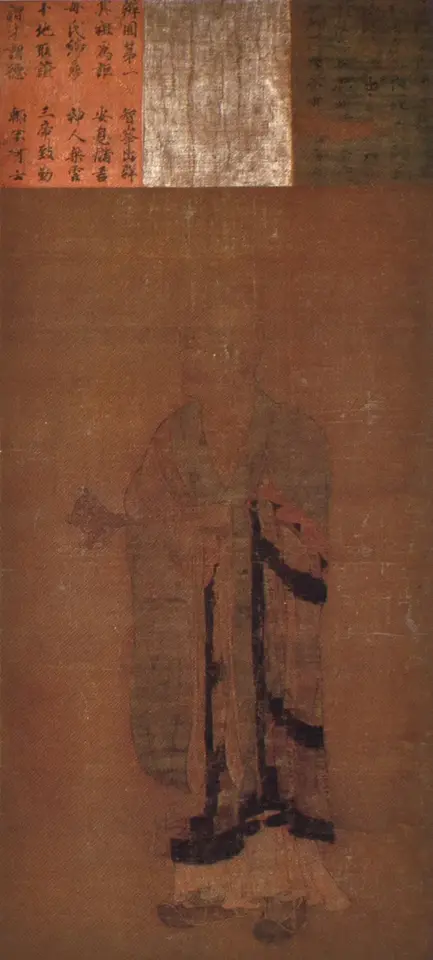
Biographical Narrative
Foreign Heritage and Naming by Paramārtha
Shi Jicang's ancestral roots lay not in indigenous Chinese soil, but in the distant Parthian Empire (the Arsacid Dynasty of Persia, known in Chinese records as Anxi). During the Han and Wei eras, his ancestors fled blood feuds in Central Asia, embarking on maritime voyages along the Maritime Silk Road to settle as merchants in the Nanhai region between Jiaozhou and Guangzhou. During the Liu Song, Southern Qi, and Liang dynasties, the An family utilized their vast commercial wealth and cosmopolitan connections to relocate to Jiankang (modern Nanjing), the bustling imperial capital of the Southern Dynasties.
In 549, amid the catastrophic siege and devastation unleashed upon Jiankang by the rebel Hou Jing, Jicang was born into this turbulent capital. His father was not only a successful merchant versed in Sino-foreign trade, but also an ardent devotee of Mahayana Buddhism. Shortly after Jicang's birth, his father took monastic vows, adopting the Dharma name Daoliang.
From early childhood, Jicang displayed extraordinary spiritual perception and an unusually dignified, solemn demeanor. When he was only several years old, his father took him to pay homage to the celebrated Indian translation master Paramārtha, who was translating Buddhist canons in southern China. Paramārtha gazed upon the child for a long time, discerning that his bright countenance and penetrating eyes revealed the vessel of a supreme master of the Dharma. Overjoyed, Paramārtha placed his right hand upon the child's head to administer lay blessings, conferring upon him the auspicious Buddhist name "Jicang" (meaning Auspicious Treasury), prophesying that the boy would grow to master the vast Buddhist canon and illuminate the world.
Apprenticeship under Falang and Mastery of the Three Treatises
In 556, at the tender age of seven, Jicang accompanied his father Daoliang to the celebrated Xinghuang Monastery in Jiankang. At that time, the abbot of Xinghuang Monastery was Master Falang, the undisputed master of Madhyamaka philosophy in southern China.
The Sanlun (Three Treatise) tradition traced its origin to the fundamental Indian Madhyamaka texts authored by Nāgārjuna (Mūlamadhyamakakārikā and Dvādaśamukha-śāstra) and Āryadeva (Śata-śāstra). Translated into Chinese by Kumārajīva during the Eastern Jin, this lineage had been transmitted through Sengzhao, Senglang of Liaodong, and Sengquan of Mount She before reaching Master Falang, who established it as the premier philosophical school of the Chen Dynasty, teaching at Xinghuang Monastery for twenty-five years before vast assemblies.
The seven-year-old Jicang was formally tonsured as a novice monk under Falang. Under Falang's rigorous tutelage, Jicang immersed himself in prajñā emptiness doctrines. He not only memorized vast sutras, but also achieved an intuitive mastery of Indian Madhyamaka dialectics, which systematically eradicated fourfold propositions and hundredfold negations to reveal transcendent truth. At age fourteen, Jicang undertook the study of the notoriously abstruse Śata-śāstra, dissecting its refutations of non-Buddhist heresies with effortless clarity.
By 567, the nineteen-year-old Jicang had mastered the Buddhist canon. Recognizing that his disciple's erudition was complete, Master Falang frequently instructed Jicang to ascend the teaching seat on his behalf during major assemblies or when incapacitated by illness. Addressing thousands of scholars, Jicang spoke with dazzling eloquence, elucidating the subtleties of Madhyamaka with unassailable logic. Monks and nuns folded their hands in veneration, while Chen royal dignitaries such as Prince of Guiyang Chen Bomou became his devoted disciples, establishing Jicang's fame throughout the southern realm.
Residing at Jiaxiang Monastery and Establishing the Sect
In 589 (the 3rd year of Zhenming of Chen), Emperor Wen of Sui dispatched his son Yang Guang leading imperial armies south across the Yangtze, capturing Jiankang and overthrowing the Chen Dynasty to reunite China under Sui rule. The sudden conquest shattered the existing monastic and aristocratic society of the southern capital. Seeking refuge from military chaos and a quiet haven for contemplation, Jicang led his disciples eastward across the Sanwu region to settle at Jiaxiang Monastery, nestled beneath Mount Qinwang in Kuaiji, Zhejiang.
During his fifteen years of residence at Jiaxiang Monastery, Jicang's philosophical system attained its full maturity, crystallizing into an independent Buddhist sect.
At Jiaxiang Monastery, Jicang threw open his doors, reviving the Madhyamaka lineage inherited from Mount She and Xinghuang. He lectured on the Mūlamadhyamakakārikā, Śata-śāstra, Dvādaśamukha-śāstra, Mahāprajñāpāramitā-upadeśa, Avataṃsaka Sūtra, Lotus Sūtra, and Suvarṇaprabhāsa Sūtra. Monks and scholars flocked to his mountain monastery, with attendance routinely exceeding a thousand disciples. Armed with razor-sharp prajñā wisdom, Jicang swept away the superficial Neo-Daoist accommodations prevalent among southern Chengshi and Nirvāṇa schools, erecting the independent conceptual edifice of the Sanlun School centered on "dependent origination, emptiness of self-nature, and the true mark of the Middle Way." Because of his fifteen years of teaching at this temple, historians and Buddhists forever remembered him as "Master Jiaxiang," and his school was known interchangeably as the "Jiaxiang School" or "Sanlun School."
While in Kuaiji, Jicang developed profound reverence for the universal one-vehicle teachings of the Lotus Sūtra. In 597 (the 17th year of Kaihuang), displaying deep intellectual humility, Jicang penned a letter to Mount Tiantai, inviting Master Zhiyi, the founder of the Tiantai School, to lecture on the Lotus Sūtra at Jiaxiang Monastery. Bedridden with terminal illness, Zhiyi was unable to make the journey and passed away shortly thereafter. Profoundly grieved, Jicang turned to Zhiyi's chief disciple Zhang'an Guanding, humbly studying Tiantai doctrines under him and integrating Tiantai's perfect-sudden teachings into his own Sanlun philosophy, creating a synthesis that combined the absolute negation of the Madhyamaka with the total inclusion of the Lotus.
The Great Debate in Yangzhou and Fame in the Two Capitals
During the late Kaihuang era, while garrisoning Jiangdu as Prince of Jin, Yang Guang (the future Emperor Yang of Sui) vigorously recruited premier monks. He established the celebrated "Four Daochang" in Yangzhou, including the renowned Huiri Daochang, to gather elite thinkers from across the north and south.
In 606 (the 2nd year of Daye), Emperor Yang issued an imperial edict inviting Jicang to assume the leadership of Huiri Daochang, providing luxurious imperial stipends. During his residence at Huiri Daochang, Jicang systematically compiled his lifelong philosophical insights, authoring the masterwork Profound Meaning of the Three Treatises (Sanlun Xuanyi), which served as the philosophical manifesto of the Sanlun School.
Around this time, Master Sengcan, an eminent scholar celebrated for his forensic eloquence throughout the southern Buddhist world, arrived at Huiri Daochang with his disciples to challenge Jicang. The two engaged in a public theological debate on the nature of emptiness, existence, and the two truths. Sengcan launched consecutive argumentative assaults with formidable classical citations; Jicang remained utterly calm, applying the unique refutational logic of Madhyamaka to expose the internal contradictions of his opponent's premises. The debate raged for over forty intense rounds. Jicang's arguments were impregnable as bronze walls, wielding prajñā logic like a vajra scepter, ultimately forcing Sengcan into total verbal defeat and prompting him to acknowledge Jicang's supremacy. This monumental debate resonated throughout the empire, elevating Jicang's renown to the very summit of Chinese intellectual life.
In the mid-Daye era, Emperor Yang relocated to Luoyang and constructed the grand metropolis of Daxing (Chang'an). Commissioning the construction of the imperial Riyan Monastery in Chang'an, the emperor dispatched envoys to summon Jicang to the capital to serve as abbot. Following Jicang's arrival, Riyan Monastery became the paramount northern academy for Madhyamaka philosophy. Aristocrats from Guanzhong, court ministers, and eminent northern monks flocked to his lectures, spreading southern Sanlun thought across the north and catalyzing a profound integration of northern and southern Chinese Buddhism.
Honors under the Tang and Entombment at Mount Zhongnan
In the late Daye era, widespread rebellions shattered the Sui Empire. Li Yuan, Duke of Tang, marched from Taiyuan, captured Chang'an, and established the Tang Dynasty. Knowing that Jicang's moral authority spanned two dynasties, Emperor Gaozu treated him with supreme reverence.
In 619 (the 2nd year of Wude), to restore administrative discipline to the nation's monastic community following years of civil war, Emperor Gaozu issued an imperial decree selecting ten of the most venerated Buddhist masters in the realm to establish the council of "Ten Great Virtuous Monks" (Shi Dade), charging them with governing monastic discipline and clerical ethics nationwide. Jicang, celebrated for his immense scholarship and unblemished integrity, was placed at the head of the council, continuing to reside at Riyan Monastery while assisting the imperial court in stabilizing religious society.
During his final years, Jicang dedicated himself to teaching. Among his pupils was Hyegwan (Huiguan), an eminent monk from Koguryo who studied under Jicang for over a decade, fully assimilating Sanlun philosophy. Following Jicang's demise, Hyegwan traveled across the sea to Japan in 625, lecturing on Jicang's Sanlun Xuanyi and Zhonglun Shu at Gangoji in Nara. He formally established the Japanese Sanron School as one of the celebrated Six Nara Schools, extending Jicang's intellectual influence across East Asia.
In the fifth month of 623 (the 6th year of Wude), Master Jicang sensed that his earthly mission was complete. Purifying himself and lighting incense, he sat upright in his quarters at Riyan Monastery, composed a farewell essay to his disciples, and peacefully entered final Nirvana in the meditation posture at the age of seventy-five, with sixty-eight monastic rains retreats.
Following his passing, Emperor Gaozu expressed deep mourning, bestowing imperial eulogies and funerary honors. Thousands of monastics, officials, and lay disciples in white mourning robes joined the funeral procession. His disciples escorted his holy remains to the foot of Guifeng Peak on Mount Zhongnan, constructing a funerary stupa for perpetual veneration.
Major Achievements
Authoring the Sanlun Commentaries to Establish Chinese Madhyamaka Philosophy
Jicang's foremost contribution to Chinese intellectual history lay in synthesizing two centuries of Madhyamaka development since Kumārajīva and Sengzhao, authoring comprehensive commentaries on primary Indian treatises to establish the Sanlun School as the first highly systematic scholastic sect in Chinese Buddhism.
Devoting his life to philosophical writing, Jicang produced the monumental "Great Commentaries on the Three Treatises": twenty volumes on the Middle Treatise, six volumes on the Twelve Gate Treatise, and six volumes on the Hundred Treatise, alongside his two-volume theological manifesto Profound Meaning of the Three Treatises (Sanlun Xuanyi).
Liberating Chinese Buddhism from early dependencies on indigenous Daoist and Confucian terminology, he deployed strict Indian Madhyamaka logic to construct an uncompromising philosophy of emptiness, standing as the undisputed master who brought Chinese Madhyamaka to its highest theoretical peak.
Formulating the Fourfold Two Truths and the Eightfold Negation
In philosophical methodology, Jicang innovated the celebrated conceptual models of the "Fourfold Two Truths" (Sichong Erdi) and "Refuting Error and Manifesting Righteousness" (Poxie Xianzhen).
To overcome rigid, dualistic misunderstandings of Nāgārjuna's conventional (saṃvṛti) and ultimate (paramārtha) truths, Jicang constructed a four-tier dialectical ladder:
- Being is conventional truth; Emptiness is ultimate truth.
- Both Emptiness and Being are conventional; Neither Emptiness nor Being is ultimate.
- Dualism and non-dualism are conventional; Neither dualism nor non-dualism is ultimate.
- All linguistic dualities are discarded; transcendent ineffability without attachment constitutes supreme truth.
Through this relentless method of peeling back intellectual conceptualizations like layers of an onion, Jicang eradicated dogmatic attachment to language, elevating the Eightfold Negation (neither arising nor ceasing, neither permanent nor annihilated, neither identical nor differentiated, neither coming nor going) to an unprecedented level of cognitive transcendence.
Winning the Great Debate at Huiri Daochang to Unite Southern Scholasticism
Jicang's triumph in 606 during his public debate against Master Sengcan at Huiri Daochang in Yangzhou was an intellectual watershed of the Sui Dynasty.
Sengcan, arriving with immense oratorical prestige as the champion of southern Chengshi scholasticism, launched ferocious dialectical challenges. Applying Madhyamaka reductio ad absurdum logic, Jicang established no dogmatic stance of his own while methodically exposing the fatal theoretical fallacies inherent in his opponent's arguments across forty grueling rounds.
This victory not only compelled Sengcan to submit as a disciple, but permanently resolved the century-long schism between the Chengshi and Sanlun schools, establishing the Sanlun philosophy as the premier Buddhist doctrine across the unified Sui-Tang empire.
Synthesizing Sanlun Madhyamaka with Lotus Universalism
Although Jicang spent his life championing prajñā emptiness, he was never an sectarian ideologue, possessing an exceptionally broad, integrative philosophical vision.
He enthusiastically incorporated the universalist Lotus doctrines articulated by Tiantai master Zhiyi, authoring the ten-volume Profound Treatise on the Lotus Sutra, twelve-volume Commentary on the Lotus Sutra, and six-volume Outline of the Lotus Sutra, demonstrating that Madhyamaka deconstruction and Lotus universalism pointed toward the identical spiritual liberation.
By embedding Tiantai's one-vehicle sudden enlightenment within Madhyamaka's radical non-attachment, Jicang inaugurated the open, synthetic ethos characteristic of Sui-Tang Buddhism, laying essential philosophical groundwork for the subsequent maturation of the Huayan and Chan traditions.