Birth in Haizhou
Born into a military household in Haizhou, Liaodong, learning archery and horsemanship from his father Shang Xueli.
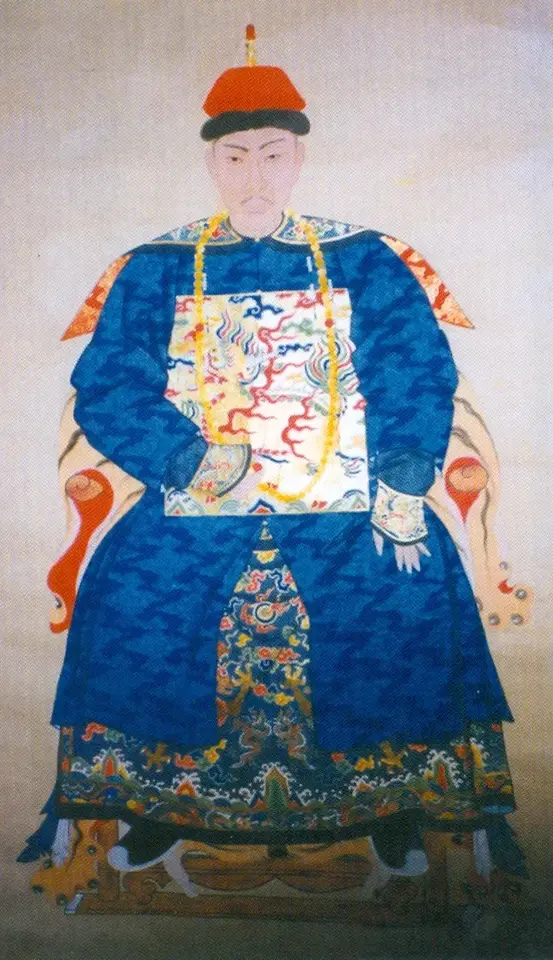
尚可喜
Shang Kexi (尚可喜, 1604–1676), courtesy name Yuanji, art name Zhenyang, and formerly known as Mao Yongxi, was a native of Haizhou in Liaodong (modern Haicheng, Liaoning). He was an illustrious military commander, founding pillar of the Qing dynasty, and one of the Three Feudatories who governed southern China. Initially serving in the Ming dynasty's Dongjiang naval defense sector under Left Chief Military Commissioner Mao…
Shang Kexi (尚可喜, 1604–1676), courtesy name Yuanji, art name Zhenyang, and formerly known as Mao Yongxi, was a native of Haizhou in Liaodong (modern Haicheng, Liaoning). He was an illustrious military commander, founding pillar of the Qing dynasty, and one of the Three Feudatories who governed southern China. Initially serving in the Ming dynasty's Dongjiang naval defense sector under Left Chief Military Commissioner Mao Wenlong, Shang Kexi was adopted as Mao's titular grandson and renamed Mao Yongxi. After his father Shang Xueli and elder brother Shang Keyi fell heroically fighting Later Jin armies, Shang Kexi assumed command of the unit, conducting daring amphibious raids across the Liaodong archipelago and rising to Assistant Regional Commander at Guanglu Island. In 1634, following the tragic slaughter of his family at Lushunkou and malicious factional framing by Dongjiang commander Shen Shikui, Shang Kexi sailed across the Bohai Sea with over ten thousand troops and hundreds of warships to defect to Hong Taiji. Highly gratified, Hong Taiji rode thirty li outside Mukden to welcome him personally, appointing him Regional Commander and conferring upon his crack forces the honorific title "Heaven-Assisted Army" (Tianzhu Bing). In 1636, Shang Kexi was enfeoffed as Prince Zhishun, leading his amphibious units in the subjugation of Joseon Korea and distinguishing himself during the decisive Battle of Songjin. Following the Qing conquest of Beijing in 1644, he pursued Li Zicheng's Shun forces across Henan and Hubei. Elevated to Prince of Pingnan in 1649, he spearheaded the southern expedition into Guangdong, taking Guangzhou after a brutal ten-month siege in 1650. Governing Guangdong for twenty-six years, Shang Kexi repelled multiple counter-offensives by Southern Ming general Li Dingguo, pacified local revolts, revitalized maritime trade, restored agriculture, and strictly forbade the predatory Manchu policy of land enclosure, securing long-term regional stability. In 1673, his petition to retire to Liaodong prompted the Kangxi Emperor's decree to abolish the feudatories, detonating the Revolt of the Three Feudatories. Resisting intense pressure from Wu Sangui, Shang Kexi executed rebel emissaries, anchored the Guangdong front to bottle up rebel armies, and was elevated to Prince of Pingnan of the First Rank. Betrayed and placed under house arrest by his rebellious eldest son Shang Zhixin in early 1676, Shang Kexi died of grief and illness in Guangzhou at seventy-three, posthumously honored by the Qing court with the name Jing.
Born into a military household in Haizhou, Liaodong, learning archery and horsemanship from his father Shang Xueli.
Enlisted under Mao Wenlong at Pi Island, adopted as an honorary grandson, named Mao Yongxi, and promoted for battlefield valor.
Lost hundreds of household members in the fall of Lushunkou; targeted for elimination by rival commander Shen Shikui.
Led over ten thousand troops and hundreds of warships from five islands to defect to Later Jin; Hong Taiji named his force the Heaven-Assisted Army.
Hong Taiji proclaimed the Qing dynasty and enfeoffed Shang Kexi as Prince Zhishun with imperial seals and princely retinue.
Played a decisive combat role in the Songjin campaign, deploying artillery to shatter Ming fortifications at Songshan and Jinzhou.
Followed the Qing armies through Shanhai Pass, pursuing Shun forces across Henan and capturing Xiangyang and Wuchang.
Re-enfeoffed as Prince of Pingnan by Emperor Shunzhi, commissioned to lead the southern expedition to conquer Guangdong.
Conquered Guangzhou after a ten-month siege utilizing heavy Dutch-style cannons, establishing complete Qing control over Guangdong.
Southern Ming general Li Dingguo besieged Xinhui and threatened Guangzhou; Shang Kexi orchestrated a crushing counter-attack.
Petitioned the throne to retire to Haicheng, Liaodong, inadvertently triggering the imperial decree to revoke the Three Feudatories.
When Wu Sangui and Geng Jingzhong rebelled, Shang Kexi executed Wu's envoys and fortified mountain passes to defend Guangdong for the Qing.
The Kangxi Emperor elevated Shang Kexi to Prince of Pingnan of the First Rank (Qinwang) to honor his steadfast loyalty.
His eldest son Shang Zhixin launched a palace mutiny, siding with Wu Sangui and placing the bedridden Shang Kexi under strict house arrest.
Passed away in despair at seventy-three in Guangzhou; posthumously granted the title Jing by an imperial decree from Emperor Kangxi.
Shang Kexi traced his ancestry to Hongdong County in Pingyang Prefecture, Shanxi. His ancestors were hereditary soldiers who relocated to Haizhou Guard in Liaodong (modern Haicheng, Liaoning) during the early Ming dynasty. Situated on the fertile plains of southern Manchuria, Haizhou served as a vital frontier bastion protecting the approaches to Beijing. Shang Kexi's father, Shang Xueli, was a resolute and experienced Ming military officer who rose to the rank of Major (Youji). During the catastrophic wars sparked by Nurhaci's conquest of Liaodong, the Shang household rendered unswerving martial service to the Ming dynasty. Following the disastrous Battle of Sarhu in 1619, Shang Xueli retreated with his remaining soldiers to defend Liaoyang.
In 1621, Later Jin armies stormed Liaoyang. Shang Xueli stood his ground amid flying arrows and cannonballs, falling heroically on the battlements. The seventeen-year-old Shang Kexi and his elder brother Shang Keyi broke through the encirclement with surviving retainers, taking refuge on offshore islands. In 1623, Left Chief Military Commissioner Mao Wenlong established the Dongjiang naval base on Pi Island (Gado), recruiting tens of thousands of displaced Liaodong refugees to launch amphibious guerilla attacks against the Later Jin rear. The Shang brothers sailed to Pi Island to enlist under Mao Wenlong's banner. Impressed by Shang Kexi's commanding physical stature, martial courage, and his father's sacrificial martyrdom, Mao Wenlong adopted him as an honorary grandson, bestowing the name Mao Yongxi and appointing him to senior military command.
Throughout the 1620s, Shang Kexi accompanied Mao Wenlong on amphibious raids across the Liaodong coast, retaking Gaizhou and interdicting Later Jin supply lines. In 1624, Shang Keyi was killed during an assault on Fuzhou, leaving Shang Kexi to inherit command of his father's and brother's veteran detachments. Following Mao Wenlong's execution by Yuan Chonghuan at Shuangdao in 1629, the Dongjiang command fractured into bitter factional rivalries. Shang Kexi navigated the treacherous factional currents, keeping his division intact. The Ming court promoted him to Assistant Regional Commander (Fujiang) and stationed him at Guanglu Island, placing him in operational command of the Changshan archipelago to anchor Ming naval supremacy in the northern Bohai Sea.
In 1633, the mutinous commanders Kong Youde and Geng Zhongming abandoned Dengzhou and sailed across the sea to surrender to Later Jin. The balance of naval power in the Bohai Gulf tilted drastically against the Ming. Following their defection, Shen Shikui assumed supreme command over the Dongjiang garrison, ruling with petty jealousy and actively plotting the purge of capable veteran commanders such as Shang Kexi. At that time, Shang Kexi's extended family, numbering several hundred members, resided at the fortress of Lushunkou.
Shen Shikui conspired with Ming civil officials in Dengzhou, dispatching naval officer Wang Yingxian to lure Shang Kexi into an ambush. Concurrently, when Later Jin legions launched a surprise amphibious assault on Lushunkou, Shen Shikui fled without offering battle, leaving Lushunkou undefended. In the ensuing carnage, Shang Kexi's stepmother, wives, children, and household retainers committed suicide or were slaughtered in the fires, leaving the Shang clan nearly exterminated. Furthermore, Shang Kexi learned that Shen Shikui had prepared a poisoned banquet to murder him at sea. Pushed into total desperation, Shang Kexi gathered his officers on Guanglu Island, revealed Shen Shikui's treacherous plots, and resolved to throw his allegiance to Later Jin.
In early 1634, Shang Kexi dispatched his trusted aide Wang Yuan on a clandestine mission to Mukden (Shenyang) to present his submission to Hong Taiji. In April, Shang Kexi mobilized the garrisons and populations of five strategic islands—Guanglu, Dachangshan, Xiaochangshan, Shicheng, and Lu Island. Commanding an armada of hundreds of sea-going warships carrying over ten thousand veteran marines and tens of thousands of family dependents, he sailed across the sea to land at the southern tip of the Liaodong Peninsula. Overjoyed by this geopolitical windfall, Hong Taiji rode thirty li outside Mukden accompanied by the imperial princes to conduct an exceptionally lavish welcoming banquet.
Hong Taiji comforted Shang Kexi over his family tragedy, appointed him Regional Commander (Zongbing), bestowed vast gold and silver reserves, and conferred upon his crack naval division the illustrious name "Heaven-Assisted Army" (Tianzhu Bing), signifying that Heaven had blessed Later Jin with the means to conquer the empire. Shang Kexi's defection irrevocably broke the maritime blockade that had hemmed in the Jurchens for fifteen years, delivering to the fledgling Qing state the naval armada, maritime navigators, and shipwrights essential for amphibious warfare.
In April 1636, Hong Taiji officially proclaimed the Qing dynasty in Mukden. Seeking to create a formidable cohort of Han client princes to spearhead future campaigns against the Ming, Hong Taiji enfeoffed the three foremost surrendered Ming generals: Kong Youde as Prince Gongshun, Geng Zhongming as Prince Huaishun, and Shang Kexi as Prince Zhishun (Prince Who Intelligently Obeys), granting them golden seals and autonomous princely administrations.
In the winter of 1636, Hong Taiji launched the massive Second Manchu Invasion of Korea (the Byeongja Horan). King Injo of Joseon withdrew behind the fortified ramparts of Namhansanseong, sending his queen, princes, and high ministers to take refuge on the tidal fortress of Ganghwa Island. Guarded by treacherous ocean currents and steep cliffs, Ganghwa Island appeared impregnable to Manchu cavalry. Shang Kexi and Kong Youde volunteered to spearhead the assault. Directing hundreds of naval craft from the Heaven-Assisted Army under heavy artillery and musket fire, Shang Kexi orchestrated a lightning amphibious landing, overrunning Ganghwa Island and capturing the royal family and hundreds of aristocratic hostages. The fall of Ganghwa shattered Joseon morale at Namhansanseong, compelling King Injo to emerge in sackcloth to submit to the Qing, thereby securing the Qing dynasty's eastern flank.
In 1641, the decisive Battle of Songjin commenced between the Ming and Qing empires. Ming governor-general Hong Chengchou concentrated 130,000 elite troops between Songshan and Jinzhou. Shang Kexi led his Heaven-Assisted Army alongside Hong Taiji's central forces. In critical phases of the siege, Shang Kexi deployed his heavy artillery against Ming fortresses at Xingshan and Gaogqiao, cutting off Ming supply lines from Ningyuan and exchanging devastating artillery volleys with Zu Dashou's defenders at Jinzhou.
In the spring of 1642, Songshan fell, Hong Chengchou was captured, and Zu Dashou surrendered Jinzhou. Throughout the bloody assaults on Songshan and Haizhou, Shang Kexi fought on the front lines, directing artillery barrages that shattered Ming defensive lines. His Heaven-Assisted Army was recognized as the foremost heavy-firepower assault force among the Han banner divisions.
In May 1644, Li Zicheng's Shun army captured Beijing, prompting Emperor Chongzhen's suicide, and Wu Sangui surrendered Shanhai Pass to Prince Regent Dorgon. Shang Kexi accompanied the Qing banner legions through the pass to conquer Beijing. He was immediately dispatched alongside Prince Ajige to pursue Li Zicheng's retreating forces across Shaanxi and Henan. Conducting exhausting campaigns across hundreds of miles, Shang Kexi crossed the Yellow River, captured Shan Prefecture and Xiangyang, and seized Wuchang, routing large Shun divisions and winning immense military renown.
In 1646, the Qing court reorganized the Three Princes into the Han Eight Banners, incorporating Shang Kexi's division into the Han Bordered Blue Banner, where it constituted the preeminent combat pillar. While the Southern Ming Hongguang and Longwu regimes fell swiftly, the Yongli regime maintained fierce resistance across the southwest, uniting with surviving Shun and Xi peasant armies.
In May 1649, the Shunzhi Emperor resolved to extinguish Southern Ming resistance in the south. He re-enfeoffed Shang Kexi as Prince of Pingnan (Prince Who Pacifies the South), bestowing an imperial gold seal, crimson banners, and twenty thousand taels of silver. Shang Kexi and Prince of Jingnan Geng Jimao were ordered to lead thirty thousand veteran troops of the Heaven-Assisted Army to conquer Guangdong. Setting out from Beijing, Shang Kexi's expeditionary force crossed Zhili, Henan, Hubei, and Jiangxi, breaching fortified mountain passes and arriving before Guangzhou in February 1650.
In the spring of 1650, Shang Kexi and Geng Jimao laid siege to Guangzhou. The metropolis was heavily garrisoned by tens of thousands of Southern Ming loyalists under general Fan Chengen, bolstered by formidable city walls, abundant food stocks, extensive artillery batteries, and naval flotillas patrolling the Pearl River. Loyal Ming defenders repulsed multiple frontal assaults, inflicting severe casualties on Qing assault battalions.
Realizing that direct storming would fail, Shang Kexi implemented a strategy of total operational encirclement. He constructed a double ring of deep trenches and fortified palisades spanning dozens of miles around the city, severing all external communications while bombarding the battlements day and night with heavy Western-style cannons. The siege endured for ten grinding months until food supplies inside Guangzhou were completely exhausted and all relieving Ming armies were crushed. On November 24, 1650, Shang Kexi concentrated his heavy guns against the northwestern corner of the city walls, blowing open a breach dozens of yards wide. The Heaven-Assisted Army charged through the rubble, and Guangzhou fell.
Following the capture of Guangzhou, Qing forces carried out the horrific Guangzhou Massacre, executing surviving Ming soldiers and civilian resisters across the metropolis, inflicting immense bloodshed on the southern capital. Following the fall of Guangzhou, Shang Kexi advanced east to capture Chaozhou and west to take Gaozhou and Leizhou, crushing the rebellion of Ming general Hao Shangjiu and eliminating Southern Ming regular forces across Guangdong, firmly securing the province for the Qing dynasty.
In 1654, famed Southern Ming general Li Dingguo, Prince of Jin, launched a massive counter-offensive into Guangdong with over one hundred thousand troops. Sweeping through western Guangdong, Li Dingguo besieged the critical bastion of Xinhui for months, directly threatening Guangzhou. Remaining calm, Shang Kexi strengthened the defenses of Guangzhou while leading elite cavalry and musketeers to relieve Xinhui. Collaborating with Geng Jimao and northern reinforcements, Shang Kexi smashed Li Dingguo's war elephants and cavalry formations in a coordinated hammer-and-anvil strike, slaughtering over ten thousand enemy troops and driving Li Dingguo back into Guangxi. This victory permanently ended Southern Ming hopes of retaking Guangdong.
In 1655, with Guangdong pacified, the Qing court authorized Shang Kexi to establish his princely capital at Guangzhou, granting him autonomous control over provincial civil and military administration. Shang Kexi constructed the grand Pingnan Princely Palace, organized forty-nine administrative wards, and controlled provincial salt taxes, customs duties, mining operations, and strategic passes, ruling as an autonomous warlord prince.
During his twenty-six-year rule, Shang Kexi adopted pragmatic policies to rehabilitate Guangdong's shattered economy. Crucially, he adamantly refused to enforce the predatory Manchu policy of land enclosure (quandi), strictly prohibiting banner officers from seizing local farmland and saving Guangdong peasantry from the mass evictions that afflicted northern China. He enacted tax holidays, distributed free seed to returning refugees, and repaired thousands of yards of sea dikes and irrigation sluices across the Pearl River Delta.
In commerce, Shang Kexi leveraged Guangzhou's maritime location, encouraging foreign merchants from Portugal, Southeast Asia, and Europe to conduct commerce at the port, which fostered the commercial foundations for the later Thirteen Factories system. Furthermore, Shang Kexi patronized local Confucian academies, restored the Guangzhou Temple of Confucius, and funded the reconstruction of renowned Buddhist monuments like the Guangxiao and Haichuang Temples, patronizing prominent local scholars such as Qu Dajun and Chen Gongyin to stabilize post-conquest Cantonese society.
In early 1673, the seventy-year-old Shang Kexi found himself increasingly incapacitated by illness and old age. Aware that the Qing court viewed the autonomous military fiefs of the Three Feudatories with growing suspicion, Shang Kexi made a momentous political decision. In March 1673, he submitted a formal memorial to Emperor Kangxi requesting permission to resign his military command and relocate his extended family and veteran Liaodong troops back to his ancestral hometown of Haicheng in Liaoning, while requesting that his second son, Shang Zhixiao, retain princely succession over Guangdong.
Shang Kexi's voluntary petition provided the precise catalyst the young Kangxi Emperor needed. Evaluating the imperial balance of power, the twenty-year-old emperor resolved to seize this historic opportunity to abolish all three southern feudatories simultaneously, issuing decrees ordering Wu Sangui in Yunnan and Geng Jingzhong in Fujian to dismantle their princely domains and return to their ancestral banners. Deprived of his autonomous satrapy, Wu Sangui revolted in Yunnan in November 1673, styling himself Generalissimo of All Armies and plunging the empire into the Revolt of the Three Feudatories.
Wu Sangui's forces swept across Guizhou and Hunan in months, while Geng Jingzhong revolted in Fujian and general Liu Jinzhong rebelled in Chaozhou. Wu Sangui dispatched personal letters to Shang Kexi, promising to partition the empire and deploying two armies toward Shaoguan and Zhaoqing to pressure the Pingnan prince into joining the insurrection.
Confronting immense rebel pressure, Shang Kexi displayed spotless fidelity toward the Qing dynasty. He executed Wu Sangui's emissaries in public, forwarded Wu's secret letters directly to Emperor Kangxi in Beijing, and mobilized his garrison forces to fortify the northern passes of Shaoguan and Pingshi. By transforming Guangdong into a fortress of resistance, Shang Kexi tied down tens of thousands of rebel troops, providing the Qing court with vital months to concentrate northern armies in Jiangxi. In January 1675, the Kangxi Emperor elevated Shang Kexi to Prince of Pingnan of the First Rank (Qinwang), honoring him as the supreme loyalist of the empire.
However, Shang Kexi's steadfast loyalty was destroyed by treason within his own household. His eldest son, Shang Zhixin, was a cruel, megalomaniacal commander who resented his father for favoring his second son, Shang Zhixiao. Observing Wu Sangui's sweeping victories across the south, Shang Zhixin concluded that the Qing dynasty was doomed and secretly plotted to usurp power.
On the night of March 22, 1676, taking advantage of his father's critical illness, Shang Zhixin launched a sudden palace mutiny. Mobilizing his personal bodyguards, he encircled the Pingnan Princely Palace, executed loyalist generals like Guo Rupi, seized the prince's gold seals, and announced his defection to Wu Sangui as Generalissimo of the Two Guangs.
Confined to his sickbed, Shang Kexi was shattered by his son's treason. Weeping toward the north, the old prince cried aloud: "I have received the supreme grace of three imperial reigns to become a prince of the first rank! How can I bear to face the late emperors in the underworld after this unfilial rebel's treason!" Shang Kexi grabbed a sword from the wall to slit his throat, but was physically restrained by weeping attendants. He then attempted to hang himself with his sash, but was again rescued. Throughout eight agonizing months of confinement, Shang Kexi refused all medicines, donned funeral mourning robes, and prostrated himself daily toward Beijing in silent grief.
On November 12, 1676, Prince Shang Kexi passed away in despair at his Guangzhou residence at the age of seventy-three. In his final testament, he commanded his attendants: "I could not repay my sovereign in life, but in death my bones must return to Haicheng, dressed in the official robes and cap of the Great Qing!" Emperor Kangxi wept upon receiving the news, bestowing rich funeral offerings and conferring the posthumous name Jing.
In 1681, following the suppression of the Three Feudatories, Shang Zhixin was ordered to commit suicide and his assets were confiscated. The Qing court fully exonerated Shang Kexi's unblemished reputation, escorting his casket from Guangzhou to be interred with imperial honors at Wensheng Street in Haicheng, Liaoning, where an ancestral temple was erected to honor his eternal loyalty. Across the violent transitions of the Ming-Qing transition, Shang Kexi remained an extraordinary military commander and a steadfast loyalist of his adopted dynasty.
During the early Chongzhen era, the Ming Dongjiang garrison held strategic control over the Bohai islands, bottling up Later Jin. Following the family tragedy at Lushunkou and Shen Shikui's treacherous machinations, Shang Kexi made a historic strategic decision.
In 1634, he sailed across the Bohai Sea with over ten thousand veteran marines and hundreds of warships from five islands to submit to Hong Taiji, who bestowed upon his troops the honorific name "Heaven-Assisted Army." This defection permanently dismantled the Ming naval containment perimeter, providing the Qing state with the indispensable naval fleet and artillery corps that ensured future triumphs in Korea and the Battle of Songjin.
From the Qing conquest of Beijing in 1644 to the capture of Guangzhou in 1650, Shang Kexi led his Heaven-Assisted Army across thousands of miles, proving himself a consummate frontline general.
Pursuing Shun forces through Shaanxi and Hubei, he subsequently spearheaded the pacification of the south as Prince of Pingnan. Overcoming formidable defenses during the ten-month siege of Guangzhou, his heavy artillery breached the battlements, ending Southern Ming regular resistance across Guangdong. In 1654, his decisive tactical victory at Xinhui smashed Li Dingguo's counter-offensive, securing Guangdong for the Qing dynasty.
Ruling Guangdong from Guangzhou for over a quarter century, Shang Kexi proved himself an enlightened provincial administrator who healed the deep scars of dynastic warfare.
He adamantly resisted the enforcement of predatory Manchu land enclosures in Guangdong, safeguarding local peasant property rights. He introduced agricultural tax amnesties, restored irrigation canals across the Pearl River Delta, and encouraged foreign maritime commerce, establishing the commercial foundations for the prosperity of Guangzhou's foreign trade system.
When Shang Kexi's petition to retire inadvertently triggered the Revolt of the Three Feudatories in 1673, he rejected Wu Sangui's lucrative offers to partition the empire.
He executed rebel emissaries, forwarded rebel correspondence to Beijing, and transformed Guangdong into a defensive bulwark that tied down massive rebel armies. Even when betrayed and imprisoned by his mutinous son Shang Zhixin, Shang Kexi attempted suicide and maintained unyielding devotion to Emperor Kangxi until his death, providing an enduring model of dynastic loyalty.
FIGURES ASSOCIATED WITH THIS DYNASTY