Birth in Eastern Palace
Born in the Eastern Palace; Emperor Gaozong inaugurated the Yongchun era, named him Imperial Grandson, and established his office.
李重润
Li Chongrun (李重润, 682 – October 8, 701), originally named Li Chongzhao (李重照) and renamed to observe the naming taboo of his grandmother Wu Zetian (Wu Zhao), hailed from Chengji in Longxi (modern Qin'an County, Tianshui, Gansu). He was the eldest grandson of Emperor Gaozong (Li Zhi) and Wu Zetian, and the only primary legitimate son of Emperor Zhongzong (Li Xian) and Empress Wei, posthumously honored as Crown Prince Yide.…
Li Chongrun (李重润, 682 – October 8, 701), originally named Li Chongzhao (李重照) and renamed to observe the naming taboo of his grandmother Wu Zetian (Wu Zhao), hailed from Chengji in Longxi (modern Qin'an County, Tianshui, Gansu). He was the eldest grandson of Emperor Gaozong (Li Zhi) and Wu Zetian, and the only primary legitimate son of Emperor Zhongzong (Li Xian) and Empress Wei, posthumously honored as Crown Prince Yide. Born in the first month of 682 in the Eastern Palace, Li Chongrun was deeply cherished by Emperor Gaozong as his first direct legitimate grandson. Upon his one-month celebration, Emperor Gaozong issued an empire-wide amnesty, inaugurated the new reign title Yongchun, and shattered centuries of dynastic ritual protocol by establishing a full administrative office and staff specifically for the infant Imperial Grandson while the Crown Prince was alive. However, his fortunes collapsed abruptly when Emperor Zhongzong was deposed by Empress Dowager Wu Zetian after reigning merely fifty-five days in 684. The two-year-old Li Chongrun was stripped of his titles, reduced to commoner status, and confined alongside his parents in the remote mountain outposts of Fangzhou and Junzhou for over a decade. In 698, after Wu Zetian summoned Li Xian back to Luoyang and restored him as Crown Prince, Li Chongrun was created Prince of Shao. As Wu Zetian favored her courtiers Zhang Yizhi and Zhang Changzong in her old age, the two brothers dominated palace administration, provoking deep indignation among the imperial clan. In October 701, nineteen-year-old Li Chongrun privately lamented the arrogance of the Zhang brothers with his younger sister Princess Yongtai and her husband Wu Yanji. Informants leaked the conversation, and an enraged Wu Zetian ordered their immediate deaths. Following Emperor Zhongzong's restoration in 705, Li Chongrun was posthumously honored as Crown Prince Yide, and in 706 his remains were transferred to Qianling with the supreme burial honors of "treating a tomb as an imperial mausoleum."
Born in the Eastern Palace; Emperor Gaozong inaugurated the Yongchun era, named him Imperial Grandson, and established his office.
As Emperor Gaozong traveled to Luoyang, the toddler prince was named nominal stay-behind governor of Chang'an under Liu Rengui.
Following Emperor Zhongzong's deposition, his grandson's office was abolished and he was reduced to commoner rank.
Renamed from Li Chongzhao to Li Chongrun to avoid the taboo of Empress Wu Zetian's personal name.
Endured over a decade of rigorous house arrest alongside his parents in Junzhou and Fangzhou.
Accompanied his father back to Luoyang following Di Renjie's petitions urging dynastic restoration.
Elevated to Prince of Shao after his father was reinstated as Crown Prince, gaining high acclaim among loyalists.
Executed on October 8 alongside Wu Yanji and Princess Yongtai for privately criticizing the corruption of the Zhang brothers; later rehabilitated as Crown Prince Yide and reinterred at Qianling.
Li Chongrun, originally named Li Chongzhao, was born in the first month of 682 in the Eastern Palace. His father, Li Xian, served as Crown Prince, while his mother, Lady Wei, was the Crown Princess. Having previously witnessed the premature deaths or demotions of his first two crown princes, Li Hong and Li Xian, the aging and chronically ill Emperor Gaozong found immense psychological solace and dynastic hope in the birth of his first legitimate grandson.
On the nineteenth day of the second month, marking the newborn's first full month, Emperor Gaozong issued an imperial edict declaring a nationwide general amnesty and changing the reign era to Yongchun. On the fifteenth day of the third month, Emperor Gaozong officially installed the two-month-old infant as Imperial Grandson. Doting upon the child, the sovereign proposed creating an independent administrative bureau and ministerial retinue for the infant, consulting Vice Minister of Personnel Pei Jingxun and Bureau Director Wang Fangqing. Wang Fangqing cited ancient precedents from the Western Jin and Southern Qi, arguing that while imperial grandsons had previously been appointed, establishing a separate administrative office while the reigning crown prince was alive was completely devoid of historical precedent.
Emperor Gaozong brushed aside all ritual objections, resolutely declaring that dynastic protocols should be initiated anew by his decree. He ordered the recruitment of preceptors, companions, literati, and registrars to staff the Imperial Grandson's office. In August 683, critically ill in Luoyang, Gaozong ordered Crown Prince Li Xian to attend his bedside, while appointing the nineteen-month-old infant Li Chongzhao as nominal stay-behind governor of the western capital Chang'an, paired with the venerable chancellor Liu Rengui as vice-governor. Li Chongrun thus became the youngest capital governor in Chinese history.
On December 27, 683, Emperor Gaozong died at Zhenguan Palace in Luoyang. On January 3, 684, Crown Prince Li Xian was enthroned as Emperor Zhongzong. In accordance with imperial lineage traditions, Li Chongzhao was expected to advance from Imperial Grandson to Crown Prince. However, Empress Dowager Wu Zetian retained complete control over the court, deliberately suspending the formal investiture.
Unwilling to remain a puppet, Emperor Zhongzong attempted to elevate his father-in-law Wei Xuanzhen to Grand Chancellor. On February 26, 684, seizing on Zhongzong's petulant remark that he could give the entire empire to Wei Xuanzhen, Empress Dowager Wu summoned the ministers to Qianyuan Hall, dethroning Zhongzong after only fifty-five days and degrading him to Prince of Luling. Two days later, an imperial decree dissolved the Imperial Grandson's bureau, stripped two-year-old Li Chongzhao of all ranks, reduced him to commoner status, and confined him in isolation.
The deposed imperial family was subsequently transferred under guard to the mountainous regions of Junzhou and Fangzhou. In 689, to observe the taboo of his grandmother's newly coined sovereign name Zhao, eight-year-old Li Chongzhao was renamed Li Chongrun. In 690, Wu Zetian proclaimed herself emperor, founding the Wu Zhou dynasty, and launched a reign of terror through secret police directors like Lai Junchen, systematically liquidating Tang imperial princes. Isolated in Fangzhou, Li Xian's family lived under suffocating surveillance; whenever imperial couriers arrived, Zhongzong feared execution orders and contemplated suicide. Through fourteen years of dread and isolation, the young Li Chongrun endured severe hardships, cultivating a reserved, solemn, and devoted character.
In the spring of 698, as the elderly Wu Zetian faced the inevitable dilemma of dynastic succession, her nephews Wu Sansi and Wu Chengsi schemed relentlessly to be designated imperial heirs. However, the populace and civil bureaucracy overwhelmingly yearned for the restoration of the House of Li. Senior ministers Di Renjie, Ji Xu, and Zhang Jianzhi repeatedly urged Wu Zetian to recognize that ancestral temples revere sons rather than nephews. Yielding to political reality, Wu Zetian secretly sent envoys to bring Li Xian's family back to the eastern capital Luoyang, reappointing Li Xian as Crown Prince in October.
With his father restored to the succession, seventeen-year-old Li Chongrun regained royal stature. In December 700, Wu Zetian invested him as Prince of Shao with a generous fief. Historical records describe Li Chongrun as handsome, imposing, refined, and noted from an early age for filial devotion. As the sole legitimate son of the crown prince, he commanded immense loyalty among Tang loyalists, Guanlong scholar-officials, and the imperial guards, standing as the undisputed legal successor to the dynastic throne.
However, the political atmosphere in Luoyang was fraught with peril. In her waning years, Wu Zetian became infatuated with Zhang Yizhi and his brother Zhang Changzong. Relying on imperial favor, the Zhang brothers exercised unchecked influence, swaggering through palace apartments, meddling in ministerial appointments, and extorting vast bribes. Powerful Wu princes like Wu Sansi competed to lead their horses in fawning submission. Even Crown Prince Li Xian was forced to display humiliating subservience toward the favorites.
Confronted with the spectacle of imperial power debased by palace favorites, the younger generation of the Tang royal family felt profound revulsion.
In October 701, the nineteen-year-old Prince of Shao met privately in his residence with his seventeen-year-old younger sister Princess Yongtai (Li Xianhui) and her husband Wu Yanji, the Prince of Wei's heir and commander of the Left Qianniu Guards. Discussing the deteriorating court atmosphere, the youths voiced bitter sorrow, remarking: "The Zhang brothers rely purely on seductive favor to disrupt the palace and state. How dare lowly favorites usurp sovereign prerogatives and manipulate succession! If the empire falls to such scoundrels, what will become of the dynastic altars!"
Unbeknownst to them, their private conversation was reported to Zhang Yizhi by a palace attendant. Alarmed that the crown prince's legitimate heir posed a mortal danger to their survival, Zhang Yizhi immediately petitioned Wu Zetian, fabricating charges that Li Chongrun and Wu Yanji were organizing a treasonous cabal to subvert the court.
Approaching seventy-seven years of age and fiercely paranoid about palace secrets, Wu Zetian flew into an uncontrollable rage. Bypassing standard judicial procedures, she ordered Li Chongrun and Wu Yanji immediately detained. On October 8, 701, under strict imperial command, nineteen-year-old Li Chongrun and his brother-in-law Wu Yanji were brutally executed by caning or forced to commit suicide in the inner palace. Princess Yongtai, advanced in pregnancy, perished in terror and grief the following day. The murder of the imperial heir shocked the empire, plunging the court into grief and silent fury.
In February 705, Chancellors Zhang Jianzhi, Cui Xuanwei, and General Li Duozuo launched the Shenlong Coup, storming Yingxian Palace, executing the Zhang brothers, and compelling Wu Zetian to surrender power. Emperor Zhongzong was formally restored to the imperial throne.
Upon his restoration, Zhongzong was consumed with anguish over his past inability to protect his eldest son. Exonerating Li Chongrun was made the first symbolic act of dynastic legitimacy. In April 705, Zhongzong issued an edict posthumously elevating Li Chongrun to Crown Prince with the prestigious posthumous name Yide (signifying Admirable Virtue).
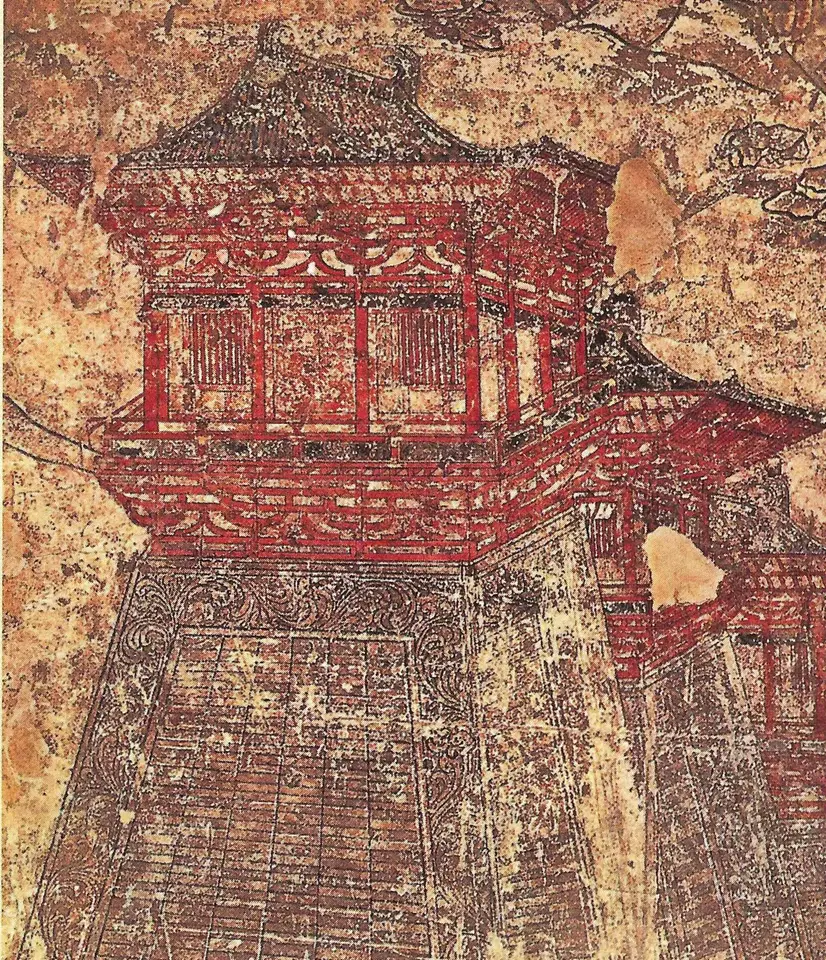
In the spring of 706, Emperor Zhongzong mobilized state resources to transfer Li Chongrun's remains from Luoyang to the imperial necropolis in Shaanxi, reinterring him beside Emperor Gaozong and Wu Zetian at Qianling. In an unprecedented honor, Zhongzong decreed that his tomb be designated as a full imperial mausoleum ("treating a tomb as a mausoleum"), naming it the Yide Prince Mausoleum. The subterranean tomb was constructed with majestic double-towered gates, high earthen mounds, and expansive vaulted chambers. The walls were adorned with masterwork frescoes depicting blue dragons, white tigers, triple-towered watchtowers, and imperial honor guards. Because Li Chongrun had died unmarried, Zhongzong arranged a ghost marriage with the deceased daughter of Court Secretary Pei Cui, interring her beside him in the stone sarcophagus.
Li Chongrun's birth in 682 represented the most significant symbol of imperial legitimacy during Emperor Gaozong's declining reign.
To defend his grandson's standing against Wu Zetian's encroaching authority, Emperor Gaozong broke centuries of imperial precedent by establishing a complete administrative bureau and personal retinue for the infant grandson while the crown prince was still reigning. This unprecedented ritual arrangement reflected Gaozong's desperate endeavor to construct an unshakeable institutional barrier defending the House of Li.
Li Chongrun's tragic life was inextricably intertwined with the violent dynastic convulsions of the early Tang.
Degraded from Imperial Grandson to commoner at two years of age, he spent fourteen years in desolate exile in Junzhou and Fangzhou, surviving the bloody purges directed against the imperial clan. Living under perpetual terror and surveillance, he stood beside his parents, witnessing the rise and decline of the Wu Zhou dynasty and the arduous struggle of loyalist ministers to preserve the Tang succession.
In 701, when the Zhang brothers dominated the imperial bedchamber and high ministers bowed in craven subservience, nineteen-year-old Li Chongrun demonstrated the unyielding moral courage of the imperial house.
His courageous denunciation of corrupt favorites exposed the administrative rot of late Wu Zhou governance. Though his protest cost him his life, his martyrdom galvanized the righteous fury of the imperial family, the Wu clans, and senior ministers, serving as the direct ideological prelude that ignited the Shenlong Coup four years later.
Following Emperor Zhongzong's restoration in 705, Li Chongrun was posthumously rehabilitated as Crown Prince Yide and granted the extraordinary distinction of "treating a tomb as a mausoleum" beside Qianling.
The excavation of the Yide Prince Mausoleum revealed magnificent murals of three-tier watchtowers, armored halberdiers, and hunting leopards, alongside thousands of painted ceramic figurines. These cultural treasures authentically preserve the pinnacle of early high-Tang court architecture, ritual protocol, and artistic mastery, standing as one of the most brilliant archaeological landmarks in Chinese historiography.
FIGURES ASSOCIATED WITH THIS DYNASTY