Birth in Xiangxiang
Born into a scholarly farming family in Baiyangping, Xiangxiang; developed a resolute and bold temperament.
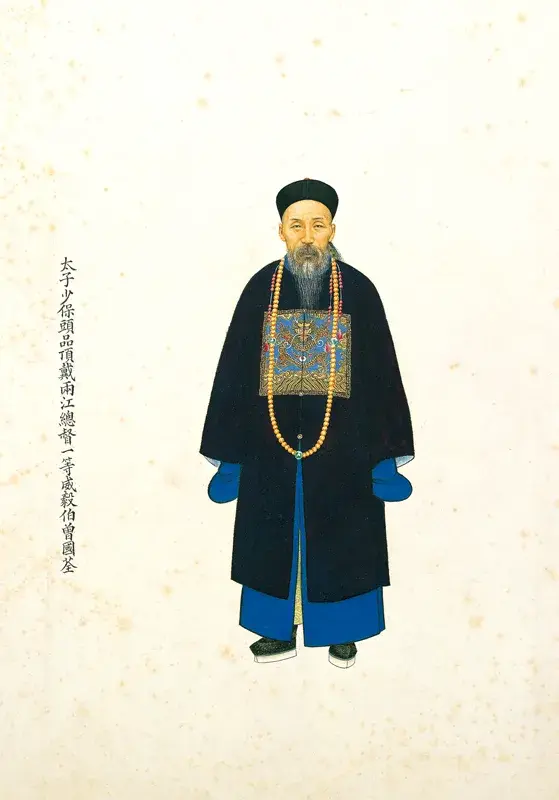
曾国荃
Zeng Guoquan (曾国荃, October 12, 1824 – November 13, 1890), courtesy name Yuanfu (沅甫), art name Shuchun (叔纯), and posthumously named Zhongxiang (忠襄), was a native of Xiangxiang County, Changsha Prefecture, Hunan (present-day Heye Town, Shuangfeng County). He was a paramount military commander of the Xiang Army and a prominent viceroy of the late Qing dynasty, rising to Viceroy of Liangjiang, Commissioner for Southern Coastal…
Zeng Guoquan (曾国荃, October 12, 1824 – November 13, 1890), courtesy name Yuanfu (沅甫), art name Shuchun (叔纯), and posthumously named Zhongxiang (忠襄), was a native of Xiangxiang County, Changsha Prefecture, Hunan (present-day Heye Town, Shuangfeng County). He was a paramount military commander of the Xiang Army and a prominent viceroy of the late Qing dynasty, rising to Viceroy of Liangjiang, Commissioner for Southern Coastal Trade, Associate Grand Secretary, Grand Guardian of the Crown Prince, and Count of First-Class Weiyi. The fourth brother of Grand Secretary Zeng Guofan, he ranked ninth among clan cousins and was widely known as "Zeng the Ninth" or "Ninth Marshal." Renowned for his tactical doctrine of digging deep trenches and building high breastworks to conduct prolonged siege warfare, he earned the fearsome battlefield moniker "Iron Tub Zeng." In 1852, Zeng earned the civil degree of Senior Tribute Student. When the Taiping Heavenly Army besieged his brother Zeng Guofan in Nanchang in 1856, he abandoned civil scholarship to recruit three thousand Hunan volunteers, creating the renowned "Ji Division." Demonstrating formidable tenacity, he captured Anfu and Ji'an before serving as the frontline assault commander in the pivotal Siege of Anqing. Defeating over one hundred thousand relieving troops under Taiping Prince Chen Yucheng, he stormed Anqing in 1861 via mine warfare, receiving the imperial warrior title Weiyong Baturu. In the spring of 1862, Zeng pushed his vanguard directly to the outskirts of the Taiping capital of Tianjing (modern Nanjing), establishing a fortified camp at Yuhuatai. Despite being surrounded and subjected to forty-six days of relentless assaults by three hundred thousand Taiping soldiers under Loyal King Li Xiucheng amidst a virulent epidemic, Zeng held his ground and broke the siege. In July 1864, after two years of total encirclement, his miners detonated a massive subterranean explosive beneath the Taiping Gate, breaching the massive stone walls and ending the fourteen-year Taiping Heavenly Kingdom. Facing imperial scrutiny over post-capture looting and the disappearance of the Taiping treasury, he retired on sick leave. Later recalled to public office, he served as Governor of Shanxi during the catastrophic Northern Chinese Famine of 1876–1879, where he donated his personal fortune, procured grain, and saved millions of starving citizens. In his final decade, as Viceroy of Liangjiang, he modernized coastal defenses, fortified the Yangtze River with Krupp heavy artillery, expanded modern armories, and patronized modern education. He died in office in Nanjing in 1890 at age sixty-seven, receiving the posthumous title Grand Guardian and the name Zhongxiang.
Born into a scholarly farming family in Baiyangping, Xiangxiang; developed a resolute and bold temperament.
Passed the provincial examination as a Senior Tribute Student, remaining home to drill regional militia as Taiping forces invaded Hunan.
Recruited 3,000 volunteers to create the Ji Division, rushing to Jiangxi to relieve his brother Zeng Guofan in Nanchang.
Encircled Ji'an with deep trenches and starved out the garrison, promoted to Prefect with intendant rank.
Invested the crucial Taiping fortress of Anqing, constructing concentric inner and outer trench barriers to hold off relieving forces.
Repelled Chen Yucheng's relief armies and detonated mines to seize Anqing, awarded the title Weiyong Baturu and made Financial Commissioner.
Sailed downriver to pitch camp directly outside Tianjing; survived a 46-day siege by 300,000 Taiping troops under Li Xiucheng.
Seized outer strongpoints including Jiangdong Bridge and Qiqiaoweng, completely sealing off Tianjing's water and land routes.
Detonated thousands of pounds of explosives to breach the Taiping Gate, capturing Li Xiucheng and ending the Taiping Rebellion; created Count.
Following political criticism over looting in Nanjing, submitted petitions for sick leave, returning to Hunan to disband the Ji Division.
Reappointed Governor of Hubei to intercept Nian cavalry raiders at Xiangyang, retiring shortly thereafter due to recurring illness.
Appointed Governor of Shanxi during the Great Famine, donating his own family funds and distributing grain to save millions of refugees.
Transferred to Governor of Shaanxi, supervising postwar reconstruction and solidifying northwestern frontier defenses.
Elevated to Viceroy of Liangjiang and Commissioner for Southern Coastal Trade, overseeing coastal defense modernization.
Died at his viceregal headquarters in Nanjing at age sixty-seven, posthumously awarded Grand Guardian and named Zhongxiang.
Zeng Guoquan was born in Baiyangping, Heye Town, Xiangxiang County, Changsha Prefecture, Hunan. His father, Zeng Linshu, was a modest rural village teacher who maintained a strict family tradition of farming and scholarship. Among his direct siblings, Zeng Guoquan ranked fourth, but within the extended clan cousinage, he was ninth, leading comrades and contemporaries to affectionately refer to him as "Zeng the Ninth" or "Ninth Marshal." Unlike his elder brother Zeng Guofan, who was known for scholarly introspection, patience, and moderation, Zeng Guoquan possessed a fiery, determined, and unyielding disposition, demonstrating immense daring and relentless willpower in moments of crisis.
In 1852, at the age of twenty-eight, Zeng earned distinction by passing the regional examinations as a Senior Tribute Student. Just as he prepared to travel to Beijing for the imperial court examinations, the Taiping Rebellion broke out, sweeping across the southern provinces and engulfing Hunan. Appointed by imperial edict to organize local defense, his brother Zeng Guofan established the Xiang Army in Changsha. Zeng Guoquan remained behind in Xiangxiang to organize local militia, secure food supplies, and drill defensive garrisons.
In the autumn of 1856, Taiping commander Shi Dakai led an aggressive westward counter-offensive that shattered Qing provincial forces in Jiangxi, trapping Zeng Guofan in the isolated walled city of Nanchang with communications severed. Determined to rescue his elder brother, Zeng Guoquan cast aside his scholarly books, returned to Xiangxiang, and mobilized three thousand local volunteers. He organized them into the "Ji Division," so named after the character Ji from his ancestral hall. Marching eastward into Jiangxi, Zeng led his newly raised regiments through mountain defiles between Anfu and Ji'an. Drilled under harsh discipline, his troops repelled multiple Taiping counter-attacks and successfully relieved the siege of Nanchang.
In 1857, Zeng led the Ji Division to besiege the strategic Taiping stronghold of Ji'an on the Gan River. Observing that previous attempts to storm the fortress had failed with heavy losses, Zeng devised his signature doctrine of "digging deep trenches and building high ramparts." He instructed his soldiers to excavate two concentric rings of massive moats: the inner trench, measuring several yards deep and wide, cut off all sorties from the garrison, while the outer trench faced outward, reinforced with earthworks and timber breastworks to defeat relieving armies. The garrison was systematically starved of supplies. In August 1858, following a year-long siege, Zeng spearheaded the final assault, storming the breached walls and wiping out the defending force. For this breakthrough, he was rewarded with the official rank of Prefect with intendant status.
In 1860, Zeng Guofan formulated the strategic campaign to capture Anqing, the gateway to the lower Yangtze and the forward shield of the Taiping capital at Tianjing. Zeng Guoquan's Ji Division, now expanded to ten thousand veteran troops, was assigned the frontline siege operations. Establishing his camp at Jixian Pass north of the city, Zeng encircled Anqing with a formidable network of trenches and gun batteries. Sensing mortal danger, the young Taiping military genius, Brave King Chen Yucheng, concentrated over one hundred thousand veteran troops to relieve the city.
Throughout the spring and summer of 1861, Chen Yucheng's armies launched desperate, continuous assaults against Zeng's outer breastworks. Musket balls and artillery fire devastated the earthworks, and casualties mounted rapidly. During the height of the bombardment, a stray bullet tore through Zeng's left cheek, causing heavy bleeding; wrapping his face in a rough bandage, he continued to walk the trench parapets, refusing to yield an inch. In August 1861, with all relieving forces beaten back, Zeng directed military sappers to dig tunnels beneath the northern gate of Anqing, packing the chambers with gunpowder. On September 5, the mines detonated, collapsing dozens of yards of stone ramparts. The Ji Division stormed through the breach, slaughtering the exhausted garrison and capturing Anqing. For this monumental triumph, Zeng was granted the Manchu warrior honor Weiyong Baturu and promoted to Financial Commissioner of Jiangsu.
Following the fall of Anqing, the supreme command favored a methodical, synchronized advance along the Yangtze. However, in the spring of 1862, when Li Hongzhang's newly formed Huai Army arrived in Shanghai by steamship, imperial edicts repeatedly demanded an immediate thrust toward the rebel capital. Eager to claim the final glory for the Xiang Army, Zeng Guoquan took the bold gamble of advancing deep into enemy territory. In May 1862, he sailed down the Yangtze with his elite regiments, landing directly beneath the southern walls of Tianjing and encamping at Yuhuatai.
Yuhuatai occupied a vulnerable, narrow ridge dominated by high city ramparts to the north and open terrain behind. Alarmed by the threat to their capital, Loyal King Li Xiucheng rushed back from Suzhou with thirteen veteran Taiping kings and over three hundred thousand frontline soldiers equipped with modern Western rifles and artillery. The Taiping host encircled Zeng's isolated camp, establishing dozens of siege batteries that subjected the Xiang Army to around-the-clock bombardment.
Compounding the crisis, a virulent outbreak of epidemic plague swept through Zeng's encampment, incapacitating ten thousand soldiers and leaving fewer than ten thousand able to bear arms. Despite the desperate odds, Zeng maintained iron calm, directing his troops to defend the concentric trenches day and night. Taiping infantry attempted over forty massed infantry charges, all repelled by grape-shot and heavy wall-guns. When Taiping sappers dug counter-mines beneath Zeng's central command pavilion, Zeng personally led guards with spades to intercept them underground, engaging in hand-to-hand combat beneath the earth. After forty-six days of furious fighting, having suffered immense casualties and facing freezing blizzards and food shortages, Li Xiucheng broke off the siege and withdrew. Zeng's successful stand against thirty times his numbers astonished the empire, and the court promoted him to Governor of Zhejiang.
Following the relief of Yuhuatai, Zeng tightened the siege around Tianjing. Throughout 1863, his troops captured outlying fortresses including the stone batteries at Yuhuatai, Jiangdong Bridge, and Qiqiaoweng. By late 1863, supported by the Xiang Army's river fleet, he severed all land and water communications between the city, Zijin Mountain, and the Yangtze, transforming Tianjing into an isolated enclave. Inside the walls, starvation reached horrific extremes, with defenders reduced to weeds and human flesh, yet they held out stubbornly under Li Xiucheng's direction.
In early 1864, with the siege dragging into its second year, the Qing court issued impatient edicts urging decisive action and ordering Mongol cavalry under Sengge Rinchen and imperial divisions to assist, while suggesting that Li Hongzhang's Huai Army join the siege. Viewing the capture of Tianjing as the exclusive honor of the Xiang Army, Zeng adamantly refused outside assistance, pushing his exhausted men to dig tunnels toward the Taiping Gate. Because the city walls were constructed from massive quarried boulders, previous mine shafts had been flooded or counter-dug by defenders. On July 16, a massive tunnel was completed and packed with over ten thousand pounds of black powder.
At dawn on July 19, 1864, the explosives were detonated, blowing a seventy-yard breach through the Taiping Gate in a colossal explosion of fire and debris. Zeng personally directed the assault at swordpoint as his vanguard stormed the burning rubble. Furious street-to-street fighting raged throughout the city before the garrison was overcome. The young Heavenly King Hong Tianguifu escaped during the confusion but was later captured, while Loyal King Li Xiucheng and Hong Renda were seized. The fourteen-year Taiping Heavenly Kingdom was finally extinguished.
The Qing court rewarded Zeng with the noble rank of Count of First-Class Weiyi, the title Junior Guardian of the Crown Prince, and the Double-Eyed Peacock Feather. However, upon entering the city, the undisciplined Ji Division engaged in widespread burning, looting, and massacre, reducing the historic metropolis to smoking ruins. Furthermore, when the imperial treasury failed to uncover the legendary Taiping royal hoards, rumors spread that Zeng had appropriated the treasure for his own family, attracting sharp imperial rebukes and hostile memorials from court censors. Recognizing the mortal danger of outshining the throne, Zeng Guofan ordered his brother to plead severe illness and resign. In the autumn of 1864, Zeng Guoquan relinquished his command and returned to Hunan, while the Ji Division was largely disbanded.
During his years of retirement in Xiangxiang, Zeng lived quietly, but his administrative and military talents were not forgotten. In late 1866, when the Northern Nian cavalry raided Hubei, the court recalled him as Governor of Hubei to fortify the Xiang River, but he soon stepped down due to recurring physical ailments.
In 1877, northern China was struck by the catastrophic "Dingwu Famine," the worst drought in centuries, affecting Zhili, Shandong, Henan, and Shanxi. Shanxi was the epicenter of the catastrophe: rivers dried up, crops withered, and over a third of the population perished amidst widespread cannibalism. After Governor Bao Yuanshen proved helpless, the court urgently transferred Zeng Guoquan to become Governor of Shanxi to oversee relief efforts.
Arriving in Taiyuan, Zeng wept openly at the sight of roads lined with corpses. Showing extraordinary administrative energy, he broke through regional bureaucratic inertia. He led by example, donating ten thousand ounces of silver from his own savings to establish relief funds. He repeatedly memorialized the throne, securing the total exemption of Shanxi land taxes and the transfer of millions of taels in customs revenue and tribute grain from coastal provinces. He cleared transport corridors through Tianjin and Henan, opened government granaries, established soup kitchens, and sheltered orphaned children, while employing hundreds of thousands of refugees in public waterworks projects. Through his relentless efforts, the famine was brought under control and millions of lives were saved. Deeply grateful, the people of Shanxi built living shrines in his honor, hailing him as a benevolent savior.
In 1881, Zeng was appointed Governor of Shaanxi, stabilizing the northwest following years of regional rebellions. In 1884, as hostilities flared during the Sino-French War, the Qing court appointed him Viceroy of Liangjiang and Commissioner for Southern Coastal Trade, granting him concurrent authority over the provincial administrations of Jiangsu, Anhui, and Jiangxi. Returning to Nanjing, the former battlefield of his youth, Zeng dedicated his remaining years to coastal defense and the Self-Strengthening Movement.
Aware of the immense superiority of Western naval firepower, Zeng focused on the fortification of the lower Yangtze. He supervised the construction of modern stone-and-concrete artillery fortresses along Mount Mufu and Swallow Rock in Nanjing, as well as Mount Jiao in Zhenjiang, outfitting them with dozens of heavy breech-loading Krupp rifled guns imported from Germany. He expanded the Southern Seas Fleet, purchased modern steam cruisers, and established the Wusong Torpedo Battalion and the Nanjing Naval Academy to train professional naval cadres.
Domestically, Zeng championed industrial development, expanding the machinery plants of the Jiangnan Arsenal and the Jinling Arsenal to manufacture modern repeating rifles, artillery shells, and smokeless powder. He also established modern academies in Nanjing, such as Xiyin Academy, to promote practical sciences alongside classical scholarship. In 1889, failing health prompted him to submit repeated retirement requests, but the Guangxu Emperor retained him, granting him the title Associate Grand Secretary. On November 13, 1890, Zeng Guoquan died at his viceregal yamen in Nanjing at the age of sixty-seven. The court bestowed upon him the posthumous title Grand Guardian, granted the name Zhongxiang, and ordered commemorative shrines erected in Nanjing, Shanxi, and his home province.
In 1856, Zeng Guoquan raised three thousand Hunan volunteers to establish the Ji Division, forging it into the premier shock-assault force of the Qing dynasty. Through strict discipline, generous rewards, and deep regional clan solidarity, he created a resilient combat formation.
From relieving Nanchang to the grueling campaigns at Ji'an, Anqing, and Tianjing, the Ji Division consistently spearheaded the most perilous assaults, breaking through heavily fortified positions and providing the decisive battlefield power that brought down the Taiping rebellion.
Zeng revolutionized traditional Chinese siege tactics by integrating deep-trench circumvallation with firearms defense. In his campaigns at Ji'an, Anqing, and Tianjing, he invariably dug concentric inner and outer trench lines upon arriving beneath enemy ramparts.
This strategy transformed offensive siege operations into fortified defensive battles of attrition, allowing smaller forces to neutralize superior enemy field armies and starve out defending garrisons with minimal friendly casualties, establishing an enduring model of position warfare.
Between 1862 and 1864, Zeng displayed extraordinary operational audacity by driving his vanguard straight to Yuhuatai, holding out against three hundred thousand relieving troops under Li Xiucheng despite plague and supply shortages.
Following a grueling two-year siege, he detonated subterranean mines beneath the massive walls of the Taiping Gate in July 1864, storming Tianjing and capturing the top leadership of the movement. This breakthrough ended fourteen years of destructive civil war, preserving the Qing dynastic order.
Serving as Governor of Shanxi during the horrific "Dingwu Famine" of 1877–1879, Zeng demonstrated peerless crisis management and humanitarian compassion. He donated his personal fortune, secured imperial tax exemptions, and coordinated the overland shipment of millions of piculs of tribute grain across provincial lines.
By establishing free soup kitchens, orphanages, and labor-for-grain public works programs, he saved millions of starving citizens from imminent death, earning universal veneration across northern China.
During his tenure as Viceroy of Liangjiang in the 1880s, Zeng made vital contributions to China's early modern naval and military modernization. He constructed an integrated network of artillery bastions along the Yangtze estuary equipped with German Krupp heavy guns.
He also expanded regional arsenals, acquired modern steam warships for the Southern Seas Fleet, and established technical naval training academies, laying the defensive and industrial foundations for late Qing maritime security.
FIGURES ASSOCIATED WITH THIS DYNASTY