Impoverished Origins
Born into an itinerant acrobatic family in Xiangyang, Hubei; orphaned of her father in early childhood.
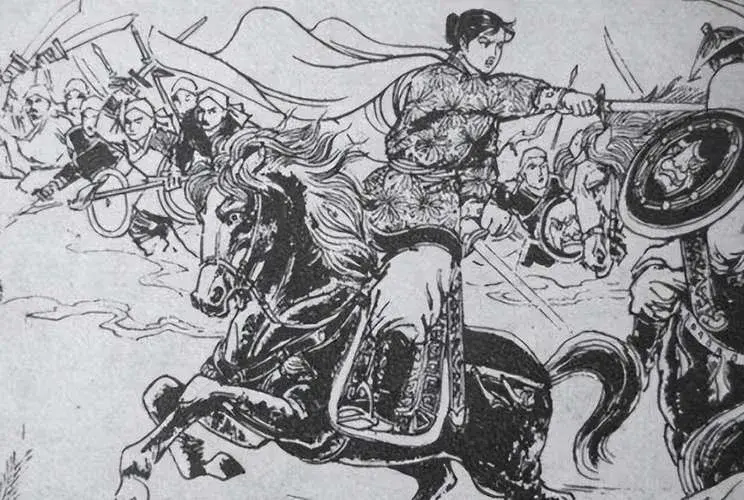
王聪儿
Wang Cong'er (王聪儿; 1777–1798), also known historically as Lady Qi (齐王氏) and Mistress Qi (齐二师娘), was a native of Xiangyang, Hubei, and the foremost female supreme commander and legendary military leader of the mid-Qing White Lotus Rebellion during the transition from the Qianlong to Jiaqing reigns. Born into an impoverished household of itinerant acrobats, Wang lost her father in early childhood and traversed rural market…
Wang Cong'er (王聪儿; 1777–1798), also known historically as Lady Qi (齐王氏) and Mistress Qi (齐二师娘), was a native of Xiangyang, Hubei, and the foremost female supreme commander and legendary military leader of the mid-Qing White Lotus Rebellion during the transition from the Qianlong to Jiaqing reigns. Born into an impoverished household of itinerant acrobats, Wang lost her father in early childhood and traversed rural market towns alongside her mother, mastering equestrian archery, martial arts, and knife-throwing. At age sixteen, she married Qi Lin, chief bailiff of Xiangyang County and principal master of the Shouyuan branch of the White Lotus religion. Following Qi Lin's execution in 1794 after an aborted insurrection plot was exposed, Wang shaved her head to hide in a Buddhist nunnery while secretly regrouping dispersed followers. In 1796, when Qi Lin's disciple Yao Zhifu launched the Xiangyang uprising, thousands of insurgent fighters acclaimed Wang as Supreme Teacher and Marshal of the Yellow Banner. Renowned for strict discipline, she executed insubordinate commander Zeng Dashou to protect civilian populations, subsequently capturing fortified towns and evading massive Qing cordons. In 1797, Wang led her elite divisions across the Han River into eastern Sichuan, descending unexpectedly upon Mount Baixiu in Xuanhan to crush the imperial forces under Delengtai and relieve besieged insurgent commanders Xu Tiande and Wang Sanhuai. At the subsequent general council of chieftains, Wang established the four-color banner organization (Blue, Yellow, White, Green) and was chosen as Supreme Commander of the allied insurgent armies. Deploying highly mobile guerrilla tactics—dispersing by hundreds, avoiding plains, and executing surprise flank strikes—she exhausted Qing Eight Banner and Green Standard forces across Hubei, Henan, Shaanxi, and Sichuan. In March 1798, cornered by elite imperial armies under generals Mingliang and Delengtai atop Mount Mao at Sanchaha in Yunxi, Hubei, the twenty-two-year-old commander fought until all ammunition was spent before leaping from the sheer precipice to her death, immortalized as an enduring symbol of heroic popular resistance against imperial despotism.
Born into an itinerant acrobatic family in Xiangyang, Hubei; orphaned of her father in early childhood.
Married Qi Lin, chief of the Shouyuan sect in Xiangyang, assisting in religious leadership as Mistress Qi.
Escaped arrest after Qi Lin was executed; shaved her head to hide in a nunnery while reorganizing followers.
Emerged from hiding as Supreme Teacher of the Yellow Banner; besieged Fancheng and advanced across Zhongxiang.
Executed insubordinate general Zeng Dashou to protect civilians; broke through imperial encirclements at Zhongxiang.
Rallied forces across Nanyang in Henan, utilizing rapid mobile warfare to disrupt Qing rear areas.
Crossed the Han River into Sichuan, executing a surprise assault that routed Delengtai and relieved Xu Tiande and Wang Sanhuai.
Presided over the restructuring of the Allied White Lotus forces into four color-coded banners; chosen as Supreme Commander.
Countered imperial scorched-earth blockades, crossing from Xixiang and Yangxian in Shaanxi into northwestern Hubei.
Besieged by Mingliang's forces atop Mount Mao in Yunxi; leapt from the precipice alongside her companions, dying at age twenty-two.
Wang Cong'er was born in 1777, the forty-second year of the Qianlong reign, into a destitute family of street performers in Xiangyang Prefecture, Hubei. Losing her father while still an infant, she was reared by her mother under conditions of constant wandering and hardship. Traversing market towns across Xiangfan and Nanyang, the two women earned precarious livelihoods by performing street acrobatics, rope-walking, equestrian stunts, and aerial knife displays. This arduous upbringing instilled in Wang extraordinary physical endurance, psychological fortitude, and exceptional combat skills. She attained mastery in horsemanship, archery, and dual broadsword techniques, earning local renown for her athletic agility and protective instinct toward the poor.
In 1793, at sixteen years of age, Wang married Qi Lin, the chief bailiff of the Xiangyang County magistrate's yamen and the revered supreme leader of the Shouyuan sect, a prominent regional offshoot of the White Lotus movement. Known within the community as Lady Qi, she served as Qi Lin's indispensable lieutenant. While Qi Lin was honored among adherents as "First Master," Wang was affectionately addressed as "Second Master" or "Mistress Qi." Utilizing their acrobatic troupe and medicinal distribution as convenient cover, the couple established secret cells across northern Hubei and southern Henan, preaching prophecies of dynastic renewal and cultivating a vast network among dispossessed tenant farmers and displaced laborers.
In the autumn of 1794, the Qing court initiated a sweeping campaign against religious heterodoxy across six provinces. Qi Lin organized thousands of adherents to stage an armed insurrection in Xiangyang on Lunar New Year's Eve. However, the plot was betrayed by an informant, and Qing authorities raided the Qi residence, arresting and executing Qi Lin alongside more than one hundred key organizers. Wang avoided capture through the desperate intervention of loyal followers. To evade manhunts, she shaved her head, assumed the Buddhist monastic name Degu, and concealed herself in a secluded suburban nunnery, where she quietly reconnected with surviving sect members and coordinated plans with Qi Lin's foremost disciple, Yao Zhifu.
In February 1796, peasant uprisings broke out in Yidu and Changle in Hubei. The following month, Yao Zhifu and Liu Qirong formally raised the standard of rebellion at Huanglongdang in Xiangyang. Thousands of destitute peasants rallied to the call. Yao Zhifu journeyed to the nunnery to invite Wang Cong'er to assume leadership. Relinquishing her monastic vows, nineteen-year-old Wang was unanimously proclaimed Supreme Teacher and Supreme Marshal of the insurgent armies, raising an apricot-yellow command flag emblazoned with the characters "Lady Qi."
Taking the field, Wang led elite assault units against Fancheng and laid siege to the fortified city of Xiangyang. Recognizing that her forces lacked heavy breaching cannon to batter down masonry ramparts, she refrained from costly frontal assaults, redeploying into the countryside to liberate districts across Zhongxiang, Suizhou, and Zaoyang. By confiscating feudal granaries to feed starving families, she expanded her fighting force to over one hundred thousand recruits within weeks.
Wang enforced rigorous martial discipline across her heterogenous forces. Distressed by rogue recruits who looted civilian properties, she instituted strict edicts against killing innocents, violating women, and robbing common households. When founding commander Zeng Dashou permitted his men to pillage civilian shops following an urban capture, Wang convened a court-martial before the entire army and personally ordered his decapitation, securing unswerving civilian loyalty. In June 1796, when imperial armies encircled the insurgents at Zhongxiang, Wang and Yao deployed decoy units to pin down the imperial vanguard, leading their main forces through rugged defiles by night to break out toward southern Henan.
In early 1797, as regional governors-general mobilized massive provincial garrisons to crush the rebellion in Hubei, Wang formulated the principles of mobile guerrilla warfare: "Do not form battle lines; do not meet the enemy head-on; avoid plains; operate in bands of hundreds; disperse and concentrate unpredictably; strike north and south at will." Leading her light infantry across the Central Plains, she lured imperial divisions into wild goose chases around Nanyang before wheeling south. Linking up with allied contingents under Wang Tingzhao in Shaanxi in April, she executed a rapid forced march across the Han River, descending directly into the mountain strongholds of eastern Sichuan.
At that moment, the main Sichuan insurgent forces under Xu Tiande and Wang Sanhuai were encircled at Mount Baixiu in Xuanhan by veteran banner general Delengtai. Blockaded behind wooden stockades, the defenders were exhausted of food and ammunition, facing imminent slaughter.
On June 23, 1797, Wang Cong'er and Yao Zhifu led their northern divisions through the mountainous terrain flanking Mount Baixiu, crashing into the rear of Delengtai's siege works. Wielding twin broadswords on horseback, Wang charged straight into the imperial command ranks. Observing the yellow banners advancing below, Xu Tiande and Wang Sanhuai rallied their troops to launch a coordinated counter-assault downhill. Caught in a lethal pincer movement, the Qing armies collapsed in disorder, suffering thousands of casualties. The relief of Mount Baixiu averted catastrophe and cemented Wang's standing across the southwest.
Following the victory at Mount Baixiu, the insurgent commanders held a council of war in Xuanhan to overcome tactical disunity. Demonstrating strategic vision, Wang instituted a comprehensive military reorganization, dividing the allied armies into four color-coded divisions: Wang Cong'er and Yao Zhifu led the "Xiangyang Yellow Banner," Wang Sanhuai headed the "Dongxiang White Banner," Xu Tiande led the "Dazhou Green Banner," and regional leaders commanded corresponding White and Blue divisions. The assembled chieftains unanimously affirmed Wang Cong'er as Supreme Commander of the Allied Armies.
With the unified banner structure established, Wang led the Xiangyang Yellow Banner back across the border, maneuvering through the rugged mountains connecting Hubei, Henan, Shaanxi, and Sichuan. Ambuscade units intercepted imperial supply trains along the Qinling defiles and raided garrison stations along the Han River, exhausting more than twenty first- and second-rank Qing commanders. Imperial Eight Banner and Green Standard forces were dragged through thousands of li of mountainous terrain, suffering heavy losses. To contain Wang's campaign, the Qing court expended tens of millions of silver taels, draining the imperial treasury and bringing the era of Qianlong prosperity to an end.
In early 1798, the Qing court implemented a ruthless scorched-earth policy, forcibly herding rural populations into fortified stone watchtowers and burning crops to deprive the insurgents of sustenance. Trapped without supplies, the insurgents were forced to subsist on mountain roots and tree bark.
In February, Wang and Yao led their surviving contingents across the Han River from Xixiang and Yangxian in southern Shaanxi, attempting to break back toward the Central Plains. Blocked by fortified mountain defiles, they were turned back toward northwestern Hubei. In March, Imperial Commissioner Mingliang and Senior Bodyguard Commander Delengtai mobilized tens of thousands of banner shock troops to ensnare the insurgents at Sanchaha near Yunxi.
On March 24, 1798 (the sixth day of the third lunar month), the remaining Yellow Banner forces were cornered atop the sheer pinnacle of Mount Mao on the Hubei-Shaanxi border. Supported by heavy artillery batteries deployed on surrounding heights, imperial infantry launched repeated uphill assaults. Wang and Yao directed their soldiers in desperate resistance, repulsing dozens of assaults until their ammunition was exhausted.
As imperial soldiers scaled the cliff edges shouting promises of immense rewards for her capture, Wang stood wounded upon the edge of the precipice. Refusing surrender, the twenty-two-year-old commander and ten female comrades jumped together into the abyss. Yao Zhifu similarly threw himself from the eastern cliff. Wang's self-sacrifice concluded her meteoric military career, establishing her legacy in popular folklore as a heroic symbol of resistance against dynastic tyranny.
Following Qi Lin's execution, Wang emerged from monastic refuge in 1796 to assume supreme leadership of the Xiangyang uprising.
She besieged Fancheng, captured Zhongxiang, and executed rogue officers to enforce civilian protection, unifying over one hundred thousand fighters into an organized anti-Qing army.
In the summer of 1797, Wang led her armies across the Han River into Sichuan to rescue the encircled forces of Xu Tiande and Wang Sanhuai.
Her coordinated assault crushed Delengtai's banner divisions at Mount Baixiu, reversing the course of the western campaign and preserving the core of the rebellion.
At the Xuanhan council of chieftains, Wang established the four-color banner organization to harmonize insurgent military command.
Elected Supreme Commander of the Allied Armies, she coordinated strategic operations across Hubei, Henan, Shaanxi, and Sichuan, transforming disconnected uprisings into a unified coalition.
Between 1796 and 1798, Wang developed fluid guerrilla doctrines that utilized mountainous terrain to evade frontal engagements and ambuscade imperial detachments.
Her maneuvers frustrated dozens of high-ranking Qing generals and inflicted severe financial strain upon the imperial treasury.
Trapped on the cliffs of Mount Mao in March 1798 by the forces of Mingliang and Delengtai, Wang fought to the last round before jumping into the abyss alongside her female warriors.
Her unyielding martyrdom at age twenty-two established her enduring status as one of the most celebrated heroines in Chinese military history.
FIGURES ASSOCIATED WITH THIS DYNASTY