Publishes Detailed Analysis
Printed a twelve-volume mathematical treatise in Zhejiang, annotating eighty classic problems and illustrating the binomial triangle.
杨辉
Yang Hui (杨辉, active mid-to-late 13th century), courtesy name Qianguang, was a native of Qiantang (modern Hangzhou, Zhejiang Province). He was an eminent mathematician and educator of the Southern Song dynasty, celebrated alongside Qin Jiushao, Li Ye, and Zhu Shijie as one of the "Four Great Mathematicians of the Song-Yuan Period." Yang Hui held local administrative offices such as Controller-General of Taizhou and devoted…
Yang Hui (杨辉, active mid-to-late 13th century), courtesy name Qianguang, was a native of Qiantang (modern Hangzhou, Zhejiang Province). He was an eminent mathematician and educator of the Southern Song dynasty, celebrated alongside Qin Jiushao, Li Ye, and Zhu Shijie as one of the "Four Great Mathematicians of the Song-Yuan Period." Yang Hui held local administrative offices such as Controller-General of Taizhou and devoted much of his career in Zhejiang to mathematical research and pedagogy. Building upon classic Chinese mathematical treatises, he methodically synthesized, reformed, and popularized computational techniques, producing five renowned treatises across twenty-one volumes, including Detailed Analysis of the Mathematical Art in Nine Chapters, Daily Use Mathematics, Origins and Developments of Multiplication and Division, Comparison and Shortcuts in Field Measurement, and Continuation of Ancient and Remarkable Algorithms. Yang Hui's scholarly contributions encompassed computational shortcut methods for counting rods, the summation of higher-order arithmetic series, numerical solutions for quadratic and higher-degree polynomial equations, and combinatorial mathematics. In Detailed Analysis of the Mathematical Art in Nine Chapters, he fully preserved Jia Xian's triangular array of binomial coefficients—today known as "Yang Hui's Triangle" (and in the West as Pascal's Triangle)—documenting the expansion coefficients four centuries ahead of European mathematicians. In Continuation of Ancient and Remarkable Algorithms, he systematically constructed and analyzed magic squares ranging from orders three to ten, along with concentric circle diagrams and complex combinatorial arrays, initiating the world's earliest purely mathematical investigation into magic squares. His "Syllabus for Learning Arithmetic" established a foundational curriculum in Chinese educational history. In the Ming dynasty, his treatises spread to Korea and Edo Japan, profoundly influencing the genesis of traditional Japanese mathematics (Wasan).
Printed a twelve-volume mathematical treatise in Zhejiang, annotating eighty classic problems and illustrating the binomial triangle.
Compiled a two-volume practical textbook using rhymed mnemonic verse and illustrated diagrammatic solutions.
Summarized practical rod-calculus shortcuts, introduced the syllabus for mathematics education, and refined division mnemonics.
Applied algebraic algorithms to agrarian surveying, extending Liu Yi's methods for solving quadratic and higher-degree equations.
Systematically cataloged and constructed diverse magic squares and formulated finite series summation formulas.
Yang Hui was born in Qiantang County near Lin'an, the imperial capital of the Southern Song dynasty. During this era, the commercial economy of the Jiangnan region flourished, marked by vigorous craft production, maritime trade, and sophisticated market exchanges. Everyday administrative duties, including tax conversion, grain storage accounting, land surveying, and labor requisition, created an urgent social need for rapid, practical mathematical techniques. Immersed in this mercantile and pragmatic cultural setting, Yang devoted his youth to mastering ancient mathematical treatises and studying contemporary commercial calculation manuals.
In his early studies, Yang not only examined the canonical "Ten Computational Canons," including the Zhoubi Suanjing, Jiuzhang Suanshu, and Haidao Suanjing, but also searched widely for rare mathematical manuscripts. He had the fortunate opportunity to study a surviving manuscript of Detailed Draft of Emperor Huangdi's Nine Chapters on Mathematical Procedures, composed by the Northern Song master Jia Xian. Deeply inspired by Jia Xian's pioneering Ruffini-Horner-type root extraction techniques and higher-degree binomial diagrams, Yang assimilated these algebraic insights, which established the foundational theoretical core for his later mathematical innovations.
Upon entering public service, Yang Hui served in local government posts, including Controller-General in prefectures such as Taizhou. In managing local administration, he routinely encountered practical engineering and fiscal challenges, such as land reassessment, tax grain commuting, embankment construction, and canal dredging logistics. He observed that traditional counting-rod arithmetic suffered from tedious procedural steps and prolonged operational time, which frequently resulted in human error during large-scale calculations.
To overcome these deficiencies, Yang devoted his leisure hours to standardizing and simplifying computational procedures. He consulted merchant accountants, village cadastral surveyors, and practical mathematics tutors, gathering empirical shortcut rules and mnemonic rhyming verses. His objective was to transform complex algorithmic theory into accessible, standardized, and user-friendly practical formulas that could be readily applied by civil clerks and ordinary subjects alike.
In 1261, during the second year of the Jingding era under Emperor Lizong, Yang completed his masterwork, Detailed Analysis of the Mathematical Art in Nine Chapters, in twelve volumes. Rather than merely repeating earlier annotations, he selected eighty representative problems from the commentaries of Liu Hui, Li Chunfeng, and Jia Xian, offering rigorous conceptual analyses and extensions. Breaking away from the rigid structural divisions of the original Nine Chapters, Yang prefixed introductory sections on calculation theory and diagrammatic demonstrations, concluding the treatise with a volume entitled "Categorization of Methods," which reorganized all mathematical problems according to their intrinsic algorithmic principles.
In 1262, Yang completed the two-volume Daily Use Mathematics. Focused on everyday household and commercial transactions, the work utilized practical scenarios involving scales, dry measures, cloth bolts, and agrarian plots. He composed thirteen didactic mnemonic poems and sixty-six diagrammatic problem sets, promoting mathematical literacy across mercantile and urban communities.
In 1274, during the tenth year of the Xianchun era under Emperor Duzong, Yang compiled Origins and Developments of Multiplication and Division in three volumes. In the opening volume, he introduced the famous "Syllabus for Learning Arithmetic," establishing a rigorous, progressive curriculum for beginners. Furthermore, he systematically formulated rules for substituting addition and subtraction for multiplication and division, standardizing the "Nine Return" division mnemonics and elevating rod-arithmetic efficiency to unprecedented heights.
In 1275, during the reign of Emperor Gong, Yang completed both the two-volume Comparison and Shortcuts in Field Measurement and the two-volume Continuation of Ancient and Remarkable Algorithms. In the former, he expanded upon Northern Song mathematician Liu Yi's treatise Source of Ancient Disquisitions, developing advanced numerical methods for quadratic and quartic equations with negative coefficients. In the latter, he cataloged over twenty distinct magic squares and combinatorial circles, formulating theoretical rules for their construction. Together with his 1274 work, these treatises became collectively known as Yang Hui's Methods, representing the pinnacle of Southern Song mathematical development.
Amid the turmoil of the Mongol conquest and the collapse of the Southern Song dynasty, specific details concerning Yang Hui's final years and exact death date went unrecorded in standard historical chronicles. Nonetheless, his scholarly works survived the dynastic transition, preserved through woodblock reprints and private manuscript transmissions during the Yuan and Ming dynasties. Portions of Detailed Analysis of the Mathematical Art in Nine Chapters were incorporated into the monumental Yongle Encyclopedia during the early Ming dynasty and later preserved in the Qing dynasty Yijiatang Congshu.
Crucially, copies of Yang Hui's Methods were exported to Korea and Japan during the fifteenth and sixteenth centuries through diplomatic and trade channels, becoming foundational textbooks for East Asian mathematicians. In Edo-period Japan, celebrated mathematician Seki Kowa and his contemporaries drew extensively upon Yang Hui's work on magic squares and algebraic equations, utilizing his algorithmic insights to establish the indigenous Japanese mathematical tradition known as Wasan.
In Detailed Analysis of the Mathematical Art in Nine Chapters, Yang Hui meticulously transcribed and illustrated the "Diagram of the Origin of the Method of Extracting Roots," originally formulated by Northern Song mathematician Jia Xian. Known in world mathematical history as "Yang Hui's Triangle," this symmetrical triangular array features unity along its outer legs, with each internal entry equal to the sum of the two numbers directly above it. The diagram accurately determines the binomial coefficients for expansions of arbitrary positive integer powers, anticipating Blaise Pascal's seventeenth-century work by more than four centuries. Beyond preserving this diagram, Yang elucidated the "Multiplication-Addition Extraction Method," an early algorithmic equivalent of the Ruffini-Horner method for extracting cube and higher roots.
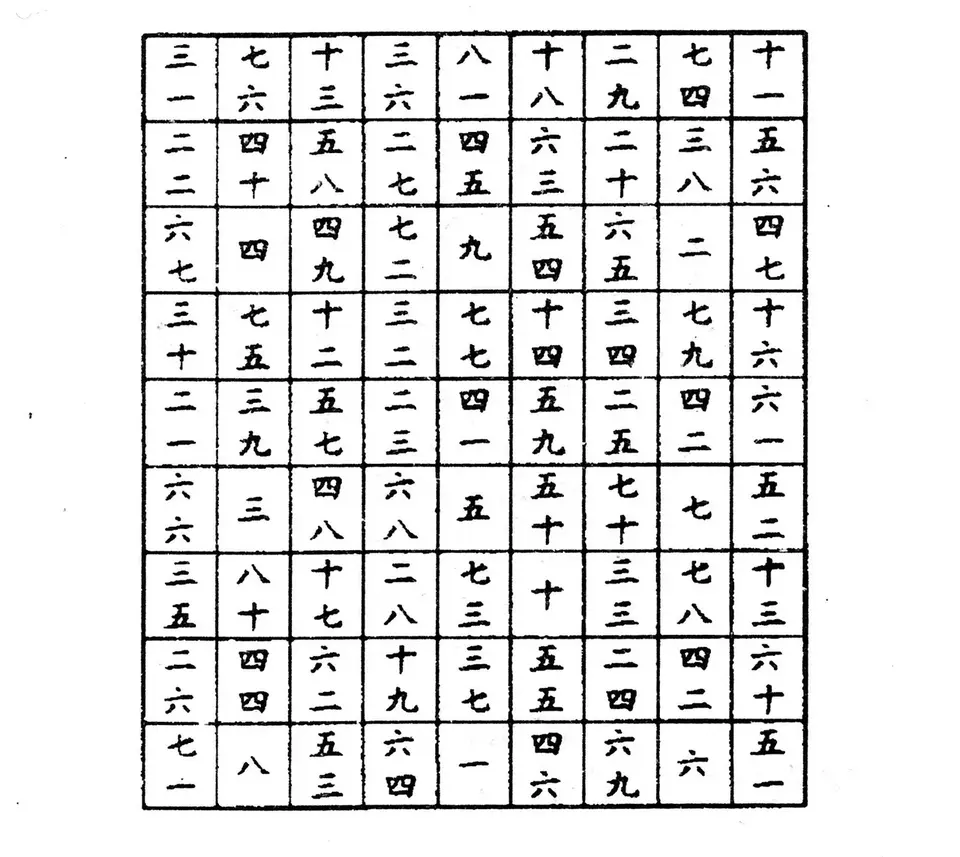
In Continuation of Ancient and Remarkable Algorithms, Yang coined the scientific term "Zongheng Tu" (magic square), initiating the world's first systematic mathematical study of these numerical grids. Stripping away the mystical and occult associations of Han-dynasty Nine Palaces divination, Yang constructed numerical squares ranging from order three up to order ten, including the famous hundred-element diagram (order ten magic square), concentric circles, eight-trigram patterns, and interlocking rings. Moreover, he formulated explicit construction rules, such as the diagonal arrangement, complementary inversion, and coordinate shifting procedures for generating order three magic squares, laying the foundation for Chinese combinatorial design and graph theory.
In works such as Origins and Developments of Multiplication and Division, Yang synthesized contemporary advances in counting-rod arithmetic. He formulated the "Six Methods of Multiplication" and established specialized techniques of additive multiplication and subtractive division, using factor decomposition and place-value shifting to replace cumbersome calculations with straightforward additions or subtractions. Furthermore, he popularized thirty-two standardized rhyming verses known as the "New Nine Return Formulas" for single-digit division. By accelerating computational speed and minimizing rod manipulation, these mnemonic formulas directly paved the way for the invention and rapid adoption of the Chinese abacus (suanpan) during the Yuan and Ming periods.
Building upon Northern Song polymath Shen Kuo's "Interstice Accumulation Method," Yang Hui investigated the summation of higher-order arithmetic progressions, establishing the "Method of Piling." In Detailed Analysis and Origins and Developments, he deduced summation formulas for tetrahedral piles (triangular layers of stacked spherical objects), square pyramid piles, and truncated pyramidal arrays. These formulas enabled the exact calculation of discreet items stacked in three-dimensional geometric formations, establishing a crucial bridge in the historical development from finite series summation toward higher-degree discrete mathematics.
Yang Hui was an enlightened educator who pioneered formal mathematical curricula. In the opening chapter of Origins and Developments, he designed the "Syllabus for Learning Arithmetic," outlining the sequence of canonical texts, estimated study periods, and graded problem sets required for novice students. Yang advocated for intuitive conceptual understanding over mechanical memorization, emphasizing that students must first test algorithms through simple introductory problems before tackling complex cases. His syllabus represents the earliest extant comprehensive syllabus for mathematics education in Chinese history.
Demonstrating intellectual rigor, Yang recognized the structural inconsistencies of the classic Nine Chapters on the Mathematical Art. In his supplementary volume "Categorization of Methods," he dismantled traditional chapter divisions and reorganized all 246 canonical problems into nine functional categories based on intrinsic algorithmic principles: Multiplication and Division, Fractions, Proportions, Exchanges, Proportional Distribution, Volumetric Accumulation, Surplus and Deficit, Simultaneous Linear Equations, and Right-Angled Triangles. Additionally, he rescued from oblivion the advanced polynomial methods of Northern Song mathematicians Jia Xian and Liu Yi, ensuring that landmark discoveries such as quadratic equations with negative coefficients were transmitted to posterity.
FIGURES ASSOCIATED WITH THIS DYNASTY