Biography
Youth and Defection to the Ming Cause
Zhao Desheng was born in 1325 in Haozhou (modern Fengyang County, Anhui Province). Originating from a humble military farming household, he was naturally blessed with an imposing and intimidating physical frame, a dark complexion resembling iron, and extraordinary arm strength. Within military circles, he was famous for his ability to brandish a heavy iron lance (shuo) at full gallop, routinely charging enemy lines with unstoppable ferocity, which earned him the fearsome battlefield moniker "Black Zhao Sui."
In the late Yuan dynasty, bureaucratic corruption and frequent natural calamities ignited widespread rebellions. In 1352, the Red Turban Uprising erupted across the Jiang-Huai river plains. At the age of twenty-eight, Zhao was selected by regional elders to serve as captain of a loyalist militia unit, formally operating under the command of Yuan general Wang Mangge. However, observing the chronic incompetence, venality, and cowardice of Yuan commanders, Zhao realized that the Mongol regime was beyond redemption.
In 1353, Zhu Yuanzhang captured Chuyang (Chuzhou). Because Zhao's mother was already residing within Zhu's liberated territory, Zhao made a momentous decision: abandoning his wife and possessions in Yuan-controlled territory, he rode south alone to pledge allegiance to Zhu Yuanzhang. Delighted by Zhao's martial bearing and moral resolve, Zhu personally bestowed his formal name upon him and designated him Front Vanguard (zhangqian xianfeng).
Zhao immediately demonstrated his value, leading assaults that captured Tiefegang, Sancha River, and Zhangjiazhai, while reducing enemy outposts at Quanjiao and Houhe. In October 1354, Zhao led an emergency relief force to Liuhe; in the chaotic hand-to-hand combat, he was struck by multiple stray arrows and nearly killed, yet he snapped the shafts and continued fighting, earning Zhu Yuanzhang's unbounded trust.
Campaigning Across the Yangtze and the Longwan Ambush
In 1355, Zhao participated in the offensive against Jilong Mountain and Wujiang, capturing Hezhou and Hanshan. When rival commander Chen Yexian attempted a treacherous surprise night attack against Zhu's camp, Zhao executed an immediate counter-ambush, overrunning Banmen and Tiechangguan and capturing Yizhen. For these exploits, he was promoted to Chief Vanguard of the General Command.
In June 1355, Zhu Yuanzhang launched his historic amphibious crossing of the Yangtze River. Zhao served as the vanguard of the assault, leading the first wave of landing troops ashore. Moving with relentless velocity, he participated in the reduction of Taiping, Wuhu, Jurong, Lishui, and Liyang.
Shortly thereafter, Zhao fought alongside veteran general Chang Yuchun at Caishi, routing the elite Yuan naval forces commanded by Manzi Haiya, and crushed Chen Zhaoxian's mountain camps at Fangshan, culminating in the triumphant capture of the southern metropolis of Jiqing (Nanjing). In this campaign, Zhao's personal kills and breaches exceeded those of all other officers.
In 1356, Zhao accompanied Xu Da in taking Zhenjiang, clearing out water stockades, and capturing Danyang, Jintan, and Ningguo. In July, he joined Chang Yuchun in relieving the siege of Niutang, recapturing Guangde and routing the eastern warlord Zhang Shicheng.
In 1357, Zhao accompanied Zhao Jizu in seizing Jiangyin, and in July assisted Xu Da in storming Changshu, where they captured Zhang Shicheng's formidable younger brother, Zhang Shide. When garrison troops mutinied in Yixing, Zhao marched back at lightning speed to restore order. In May 1358, while patrolling Shidai, Zhao encountered a strong probing force dispatched by Chen Youliang; charging into the melee with his lance, he personally captured enemy generals Qian Qing, Meng Youde, and Zhang Zundao, along with over four hundred prisoners. Recognizing his continuous field victories, Zhu Yuanzhang elevated him in 1359 to General of Huaiyuan and Left Vice Marshal of the Central Wing.
In 1360, Chen Youliang mobilized his entire naval fleet to strike Nanjing, precipitating the existential Battle of Longwan. Zhu Yuanzhang laid an elaborate trap, designating the narrow bottleneck of Hukoucheng as the primary kill zone. Entrusted with the vanguard ambush, Zhao positioned his elite shock troops in concealed ravines. When Chen's heavy vessels grounded in the mudflats, Zhao led his men out in a ferocious counter-charge, holding the shoreline against overwhelming numbers until ambushes converged from all sides. Chen's fleet was annihilated, and Zhao pursued the fleeing remnants, recapturing Taiping, storming Tongling, and taking Gaoyou. Promoted to Rear Wing Marshal in 1361, Zhao led the western river assault against Anqing, sweeping upriver to Xiaogushan within five li of Jiujiang, which caused Chen Youliang to abandon his regional headquarters in panic.
The Siege of Nanchang and Martyrdom
In 1362, Zhao campaigned across Jiangxi, reducing Ruichang, Linjiang, Ji'an, Fuzhou, and Xingan. Soon afterward, defected generals Zhu Zong and Kang Tai launched a bloody mutiny in Hongdu (modern Nanchang), slaughtering loyal officers and seizing the strategic hub. Zhao joined Xu Da in a forced counter-march to retake the city. During the assault, a heavy defensive boulder launched from the parapets struck Zhao's right shoulder, severely fracturing the bone; despite intense agony, Zhao wrapped his wound and directed the breach until Nanchang was restored. In recognition of his valor, Zhu Yuanzhang appointed him Associate Administrator of the Jiangnan Branch Bureau of Military Affairs and ordered him to garrison Nanchang alongside Supreme Commander Zhu Wenzheng and Deng Yu.
In April 1363, determined to reverse his strategic losses, Chen Youliang mobilized an immense force styling itself at 600,000 soldiers. Constructing monumental, multi-decked warships named "River-Mingling Dragon" (Hunjiang Long), Chen descended the Gan River and placed Nanchang under an impenetrable siege. The garrison numbered barely twenty thousand men. Allocated command of the most exposed northern and western sectors, Zhao took responsibility for Gongbu, Shibu, and Qiaobu gates.
In June, Chen personally directed his elite strike forces against Gongbu and Shibu gates, bringing massive siege towers against the brick ramparts. Confronted with desperate odds, Zhao refused passive resistance; he ordered the gates thrown open and led suicide squads into the open field, fighting with his back to the walls. In ferocious close-quarters combat, Zhao personally shot dead several enemy commanders, shattering the initial enemy momentum.
Enraged, Chen encircled the city in dense rings, pounding the defenses day and night with counterweight catapults. When sections of the ramparts collapsed, Zhao led his retainers to form a living wall, fighting off boarding parties by day while directing emergency masonry repairs through the night.
In late June, while seated on the gate tower observing enemy troop movements and directing archers, an enemy sniper fired an armor-piercing heavy crossbow bolt through the wooden railing. The iron quarrel struck Zhao in the waist, penetrating six inches into his flesh. His attendants carried him down in horror, but Zhao calmly grasped the quarrel and wrenched it from his body, releasing a torrent of blood. Recognizing the wound was mortal, he sighed deeply: "Since my youth I have campaigned across a hundred battlefields, pierced by stray arrows and bruised by stone catapults beyond counting, yet never suffered an injury such as this. A true man dies on the battlefield, wrapped in horsehide—what is there to regret! My only sorrow is that I cannot follow my lord to sweep clean the Central Plains and pacify the realm!" Upon finishing these words, he closed his eyes and expired at the age of thirty-nine.
Posthumous Honors and Imperial Memory
The news of Zhao Desheng's sacrifice plunged Nanjing into profound mourning. Zhu Yuanzhang wept openly upon hearing the report, lamenting the loss of his premier field commander. Zhao's heroic eighty-five-day defense of Nanchang had exhausted Chen Youliang's resources and demoralized his troops, providing Zhu Yuanzhang with the indispensable window of time required to assemble his armada for the decisive Battle of Lake Poyang, which permanently broke the Han state.
In October 1363, Zhu Yuanzhang issued an imperial edict posthumously elevating Zhao to Grand Master of Glorious Happiness, Chancellor of the Jiangxi Branch Secretariat, and Duke of Liang (Liang Guo Gong). In 1364, Zhu erected the Shrine of Loyal Ministers in Nanchang to commemorate the fallen martyrs of the siege, placing Zhao at the absolute head of the pantheon.
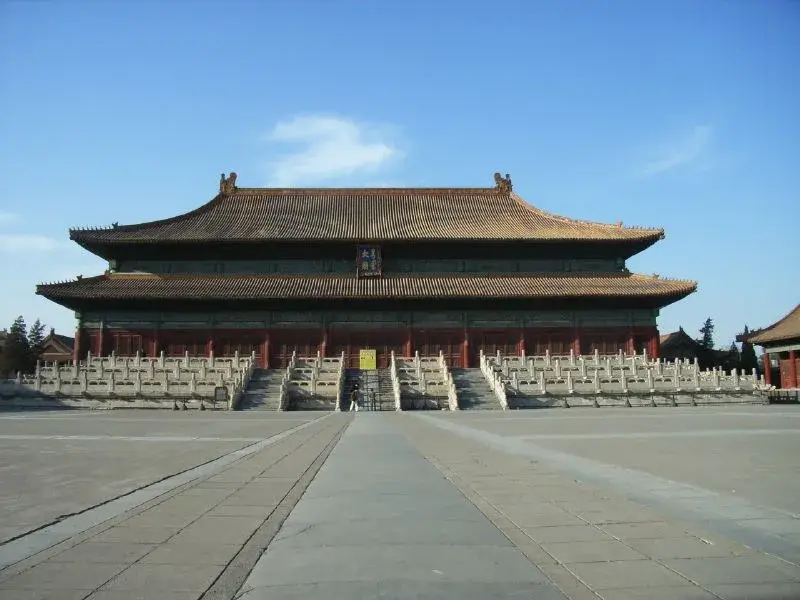
Following the founding of the Ming dynasty, Emperor Taizu decreed in January 1369 that Zhao be accorded shared worship in the Imperial Ancestral Temple (Tai Miao). In June of that year, Zhao's statue was installed in the newly completed Meritorious Officials Shrine (Gongchen Miao). In 1373, the emperor bestowed the posthumous name "Wuhuan", denoting military valor and unwavering steadfastness. His son Zhao Xian inherited the rank of Guard Vice Commander, and his fourth-generation descendant Zhao Fu earned the hereditary title of Marquis of Wujing for distinguished service during the Chenghua era.
Major Achievements
Indispensable Spearhead of the Founding Campaigns
Throughout Zhu Yuanzhang's rise from regional warlord to dynastic founder, Zhao Desheng functioned as the indispensable tactical vanguard. Renowned for his willingness to assault fortified positions under heavy fire, Zhao consistently spearheaded the most perilous engagements.
From early skirmishes at Chuzhou to the amphibious assault across the Yangtze in 1355 and the subsequent reduction of Jiqing, Zhao led from the front, wielding his cavalry lance to breach opposing lines. Zhu Yuanzhang repeatedly declared that among all his commanders, Zhao contributed the greatest individual battlefield merits in conquering the south.
Master of Operational Ambush at Longwan and Xiaogushan
Zhao played a decisive role in neutralizing the existential threat posed by Chen Youliang. In the 1360 Battle of Longwan, when Chen's armada descended upon Nanjing, Zhao anchored the central ambush position at Hukoucheng, absorbing the brunt of the assault and fixing the enemy fleet in position until encirclement was achieved.
During the 1361 counter-offensive, Zhao's relentless advance up the Yangtze bypassed outer fortresses, storming Anqing and appearing at Xiaogushan just five li from Jiujiang. This maneuver created mass panic within the Han leadership, forcing Chen Youliang to evacuate his capital without offering battle and transferring control of Jiangxi to Ming forces.
Epic Defense of Nanchang
The eighty-five-day siege of Nanchang in 1363 stands as one of the most celebrated defensive triumphs in Chinese military history. Defending against Chen Youliang's 600,000-man army with barely 20,000 troops, Zhao adopted an aggressive operational doctrine, launching spoiling attacks outside the gates to disrupt enemy siege preparations.
When stone catapults demolished the walls, Zhao defended the breaches with handheld weapons while directing immediate reconstructions under fire. His leadership ensured that Nanchang held until his death, denying Chen Youliang a strategic victory and altering the trajectory of the civil war in favor of the Ming dynasty.
Historical Evaluation
Zhao Desheng was revered by contemporaries and later dynastic chroniclers as the epitome of martial courage and incorruptible loyalty.
Emperor Taizu (Zhu Yuanzhang) recorded his ultimate tribute in the dynastic annals: "When Chen Youliang besieged the city, among all the generals defending the ramparts, Zhao Desheng contributed the greatest defensive merit."
The official editorial assessment in the History of Ming (Ming Shi) concluded: "Zhao Desheng was upright, resolute, and imposing, maintaining strict discipline over his subordinates. Although unlettered in the classics, his operational adaptations conformed naturally to the principles of ancient warfare. In daily conduct, he was as filial and fraternal as a cloistered scholar. The founding of the Ming dynasty commenced with the crossing of the Yangtze, fighting for supremacy across thousands of li in the southeast to dismantle Chen Youliang and Zhang Shicheng, before advancing north to conquer the Central Plains. The contributions of figures such as Liao Yong'an, Hu Dahai, and Zhao Desheng were monumental. Sacrificing their lives on the field of honor before witnessing the final fruition of the dynasty, their names were enshrined in the ancestral temples and recorded immortally in the historical records."
Ming historian He Qiaoyuan noted in The Vault of Renowned Mountains (Mingshan Cang): "Zhao Desheng was uncompromising and stern, commanding his troops with immaculate precision; at a single word or order, the entire army's banners adjusted in unison, ensuring continuous victories. Though he never studied texts, his strategic acumen was profound, naturally mirroring the finest generals of antiquity."
Historians universally observe that while many Ming founding generals eventually fell victim to factional purges during the late Hongwu reign, Zhao Desheng's untimely death atop the ramparts of Nanchang preserved his heroic memory untainted, securing his status as an eternal paragon of martial devotion.