Noble Birth in Jiankang
Born in the southern capital into the aristocratic Xie clan, his mother being Princess Changcheng.
谢朓
Xie Tiao (谢朓, 464–499), courtesy name Xuanhui, was an illustrious landscape poet, statesman, and core literary innovator of the Southern Qi dynasty. Hailing from the paramount aristocratic Xie clan of Chen Commandery, he was a maternal grandson of Emperor Xiaowu of Liu Song and a kinsman of the celebrated fifth-century poet Xie Lingyun; literary history consequently reveres them collectively as the "Greater and Lesser Xie."…
Xie Tiao (谢朓, 464–499), courtesy name Xuanhui, was an illustrious landscape poet, statesman, and core literary innovator of the Southern Qi dynasty. Hailing from the paramount aristocratic Xie clan of Chen Commandery, he was a maternal grandson of Emperor Xiaowu of Liu Song and a kinsman of the celebrated fifth-century poet Xie Lingyun; literary history consequently reveres them collectively as the "Greater and Lesser Xie." Due to his notable administrative tenure as Governor of Xuancheng, he was also widely remembered as "Xie Xuancheng." Serving in the Southern Qi imperial administration, Xie Tiao occupied prominent offices including Retainer of the Guard General, Literary Attendant to Prince Xiao Zilong of Sui, and Gentleman of Personnel Selection. As a leading light among the "Eight Friends of Jingling" alongside Shen Yue, he pioneered the "Yongming Style," introducing strict tonal euphony and metric symmetry that laid the technical foundation for Tang regulated verse. While governing Xuancheng, he constructed the Xie Pavilion at Mount Jingting, composing sublime landscape verses that integrated personal emotional melancholy with natural topography. Caught in the violent court purges following the accession of Xiao Baojuan, he refused to participate in the armed revolt of Xiao Yaoguang, was framed by treasonous rivals, and died in prison in 499 at the age of thirty-six. His luminous, fluid poetic idiom profoundly inspired Tang poetic masters including Li Bai and Du Fu.
Born in the southern capital into the aristocratic Xie clan, his mother being Princess Changcheng.
Entered officialdom following the founding of Southern Qi, receiving appointment as Erudite of the National University.
Appointed Literary Attendant to Prince Xiao Zilong of Sui, accompanying him to govern Jingzhou.
Recalled to Jiankang under imperial orders from Emperor Wu of Qi; reassigned to the retinue of the Prince of Xin'an.
Served through palace upheavals as Xiao Luan seized the throne, holding posts as Military Advisor and Drafting Drafter.
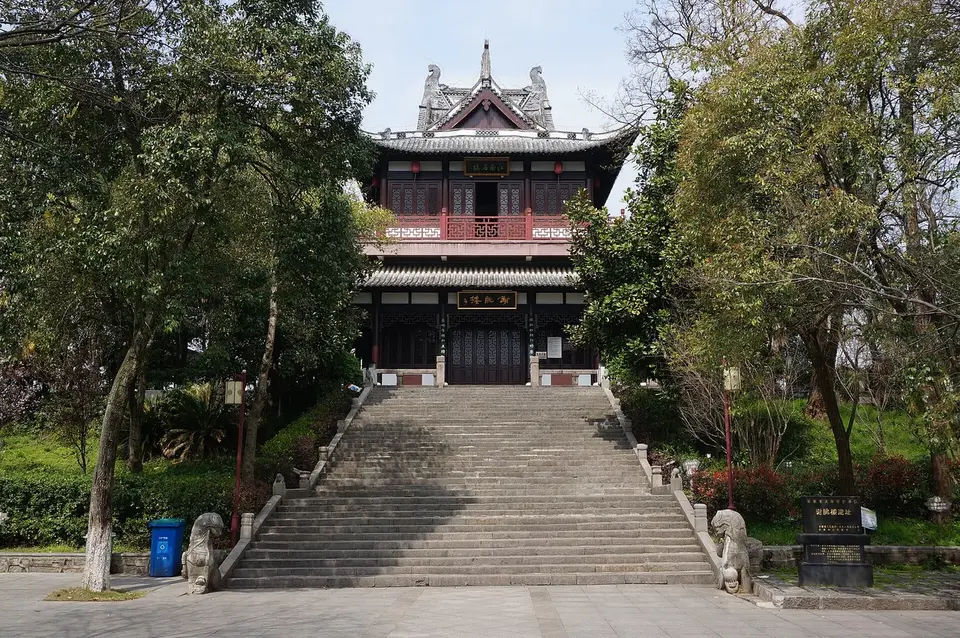
Appointed Governor of Xuancheng to escape capital factions, constructing the historic Xie Pavilion at Mount Jingting.
Recalled to Jiankang as Gentleman of the Ministry of Personnel, supervising court civil appointments.
Refused to join the dynastic overthrow plotted by Jiang Shi after Emperor Ming's death, reporting the conspiracy to the throne.
Coerced by the rebellious Prince Xiao Yaoguang, refused to participate, and died after being falsely imprisoned at age thirty-six.
Xie Tiao was born in 464 into the Chen Commandery Xie clan, one of the two most illustrious aristocratic lineages of the Southern Dynasties alongside the Wang clan of Langya. Since the legendary victories of Xie An and Xie Xuan during the Battle of Fei River, the Xie clan had held paramount cultural and political sway in Jiankang. His grandfather, Xie Shu, had served as Grand Master of Splendid Happiness and Governor of Jiangzhou during the Liu Song dynasty, while his mother was Princess Changcheng, the daughter of Emperor Xiaowu of Song. Blessed with immense familial prestige and precocious literary talent, Xie Tiao was thoroughly schooled in the Confucian classics, historical annals, and musical prosody from early childhood.
Entering officialdom in 482 as Erudite of the National University, Xie Tiao rapidly distinguished himself by his elegant writing style and refined personal grace. During the Yongming era of Emperor Wu of Qi, imperial patronage of literature reached its peak. Prince Xiao Ziliang of Jingling established his famous literary circle at the Western Mansion on Cockcrow Mountain, assembling the eight most dazzling literary intellects of the empire: Shen Yue, Xie Tiao, Wang Rong, Xiao Chen, Fan Yun, Ren Fang, Lu Chui, and Xiao Yan. Within this elite circle, Xie Tiao and Shen Yue analyzed phonetic tonal systems, pioneering the "Yongming Style" that integrated the four tones and eight tonal faults into verse, transforming Chinese prosody from archaic meter into melodious tonal verse.
In 491, Prince Xiao Zilong of Sui, the eighth son of Emperor Wu, was appointed Commander of Jingzhou military affairs and governor of the province, establishing his provincial headquarters at Jiangling. Xiao Zilong was an enthusiastic patron of letters and invited Xie Tiao to join his administration as Literary Attendant and Chief Clerk. Accepting the invitation, Xie Tiao sailed westward along the Yangtze River. The majestic waters, misty gorges, and ancient Chu cultural heritage of the middle Yangtze deeply expanded his poetic sensibilities.
Prince Xiao Zilong held Xie Tiao in extraordinary esteem, treating him less like a subordinate official than an intimate intellectual brother. They engaged in daily philosophical dialogues, sailed along the Han River, and composed verses together. During this prolific period, Xie Tiao composed immortal poems such as Ascending Three Hills in the Evening and Looking Toward the Capital. However, Xiao Zilong's burgeoning popularity and concentration of literary retainers provoked the intense jealousy of Emperor Wu and Crown Prince Xiao Changmao. In 493, fearing regional rebellion, Emperor Wu ordered the immediate disbandment of Xiao Zilong's literary circle. Xie Tiao was forcibly recalled to Jiankang and transferred to serve as Record Keeper to the Prince of Xin'an.
In late 493, Emperor Wu died, followed by the brief reign of the Young Prince of Yulin. Xiao Luan, Marquess of Xichang, executed bloody coups that wiped out numerous imperial princes, including Xiao Zilong, and ascended the throne as Emperor Ming. Experiencing extreme dread amidst these lethal dynastic purges, Xie Tiao sought to remove himself from the treacherous palace environment. In 495, he submitted an urgent memorial requesting a regional provincial post, securing appointment as Governor of Xuancheng.
Xuancheng was a picturesque territory endowed with limpid rivers and mist-shrouded peaks. As governor, Xie Tiao practiced lenient, benevolent governance, reducing arbitrary penalties and lightening labor exactions. Outside of his official duties, he traversed Mount Jingting, the Wan River, and Mount Baiti, erecting a picturesque high studio and the celebrated Xie Pavilion atop Mount Jingting. The two years spent in Xuancheng represented the creative zenith of his career. Transmuting his political anxieties into radiant nature poetry, he wrote masterpieces such as Gazing Out from Within Xuancheng Commandery. His poetry captured the pure spirit of southern Jiangnan, immortalizing Xuancheng as an iconic cultural landmark for later generations of Chinese poets.
In 497, having concluded his term in Xuancheng, Xie Tiao was recalled to Jiankang to serve as Gentleman of the Ministry of Personnel and Director of the Palace Library, overseeing civil appointments. In 498, Emperor Ming died, and the tyrannical sixteen-year-old Xiao Baojuan (the Marquess of Donghun) ascended the throne. Donghun indulged in mindless violence, executions, and bizarre market charades within the palace, throwing governance into complete chaos. Alarmed by the emperor's depravity, senior ministers Jiang Shi, Xu Xiaosi, and Liu Xuan secretly planned a palace coup to dethrone Donghun and enthrone Prince Xiao Yaoguang of Shi'an.
Seeking Xie Tiao's immense cultural prestige and military cooperation, Jiang Shi disclosed the plot to him. Recognizing that Jiang Shi and his collaborators lacked military competence and that premature insurrection would bring disaster, Xie Tiao was terrified of imperial retribution—especially given that his father-in-law, General Wang Jingze, had recently been executed for treason. Acting out of self-preservation, Xie Tiao secretly exposed Jiang Shi's conspiracy to the emperor, who swiftly executed the conspirators. While his disclosure temporarily preserved his life, Xie Tiao was intensely ostracized and despised by high officials for betraying his former friends.
In the autumn of 499, Xiao Yaoguang openly raised troops in rebellion at the Eastern Mansion. Desperate for legitimacy, Xiao Yaoguang sent armed officers to force Xie Tiao to draft rebel proclamations, promising him high ministerial office upon victory. Xie Tiao steadfastly and indignantly refused to comply with treason. Fearing that Xie Tiao's refusal would undermine morale, Xiao Yaoguang and Cao Hu falsely accused him of conspiring with general Liu Xuan to commit sedition. Emperor Donghun promptly arrested Xie Tiao and threw him into the Beidou Prison. Subjected to brutal treatment in the freezing, subterranean dungeons, Xie Tiao died in misery in September 499 at the young age of thirty-six.
Xie Tiao played a pivotal architectural role in the evolution of classical Chinese poetry from Han-Wei archaic forms toward the refined metric perfection of Tang regulated verse. Operating within the Yongming movement alongside Shen Yue, he was among the first poets to systematically apply phonetic principles—regulating pitch, caesuras, and level and oblique tonal patterns. His verse was celebrated for its smooth, round fluidity, described by contemporaries as rolling like a pearl. His renowned couplets, such as "Trailing clouds dissolve into brocade, the clear river lies quiet like silk," attained an unprecedented level of formal polish, becoming the foundational stylistic model for Tang prosody.
Xie Tiao fundamentally redefined the artistic scope of landscape poetry originally opened by Xie Lingyun. Whereas Xie Lingyun's verse often featured dense, encyclopedic descriptions of topography concluded by detached philosophical expositions on Daoism and Buddhism, Xie Tiao achieved a seamless fusion of natural scenery and lyrical melancholy. In his poetry, natural vistas are deeply infused with human sentiment, illuminating both the breathtaking beauty of the Jiangnan landscape and the author's solitary spiritual isolation amidst political terror. This breakthrough established the aesthetic ideal of "harmony between scene and emotion" that characterized classical Chinese lyricism for over a millennium.
During his tenure as Governor of Xuancheng, Xie Tiao created a legendary legacy through his administrative moderation and poetic devotion. The pavilions and balconies he constructed at Mount Jingting became holy ground for generations of literary pilgrims. Three centuries later, the Tang poet Li Bai traveled to Xuancheng seven times to walk in Xie Tiao's footsteps, composing celebrated verses such as "Looking at each other and never tiring, only Mount Jingting remains" and extolling him with the immortal phrase, "Between past and present, the Lesser Xie rises pure and luminous." Xie Tiao's poetic association elevated Xuancheng to its status as the revered "Poetic Mountain of Jiangnan."
FIGURES ASSOCIATED WITH THIS DYNASTY