Birth on the Coast
Born into a seafaring pirate household in Xin'an County, Guangzhou Prefecture, learning navigation from childhood.
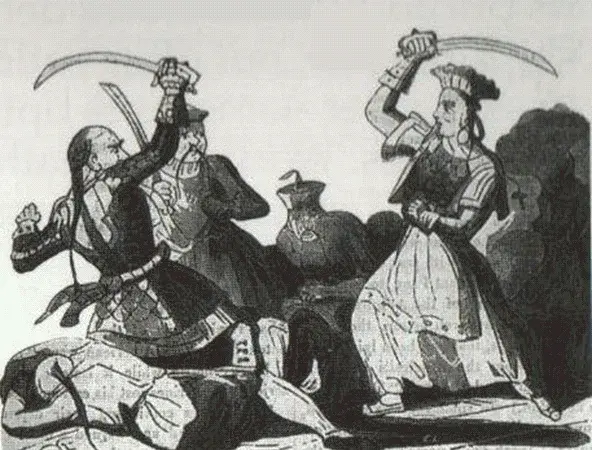
郑一
Zheng Yi (郑一, 1765 – November 16, 1807), original name Zheng Wenxian, also known as Zheng Yaoyi, was born into a maritime Dan boat-people family in Xin'an County, Guangzhou Prefecture, Guangdong Province (present-day Shenzhen and Hong Kong). He was a renowned maritime outlaw leader who operated across the coastal seas of southern China during the Jiaqing reign of the Qing Dynasty, the founder of the Red Flag Fleet, and…
Zheng Yi (郑一, 1765 – November 16, 1807), original name Zheng Wenxian, also known as Zheng Yaoyi, was born into a maritime Dan boat-people family in Xin'an County, Guangzhou Prefecture, Guangdong Province (present-day Shenzhen and Hong Kong). He was a renowned maritime outlaw leader who operated across the coastal seas of southern China during the Jiaqing reign of the Qing Dynasty, the founder of the Red Flag Fleet, and the first supreme chieftain of the South China Pirate Confederation. Coming from an established seafaring lineage reputed to descend from Zheng Jian, an officer under the Ming loyalist commander Zheng Chenggong, Zheng Yi navigated open ocean currents with his clan from early youth. During the middle and late Qianlong era, he led naval squadrons south to Annam (present-day Vietnam) to serve the Tây Sơn Dynasty, where he was commissioned as a naval Commander-in-Chief (Dudu), participating in the Vietnamese civil wars and acquiring extensive experience in large-scale fleet operations and oceanic artillery warfare. In 1801 (Jiaqing 6), shortly before the collapse of the Tây Sơn regime, Zheng Yi led his fleet back to the Guangdong littoral. Following the death of his cousin Zheng Qi in battle in 1802 (Jiaqing 7), Zheng Yi quickly rallied the dispersed fleet, integrating more than two hundred large war junks into the single most formidable pirate armed force along the South China coast. Confronting internecine factional warfare among maritime brotherhoods and persistent Qing naval campaigns, he demonstrated exceptional strategic foresight and diplomatic acumen. In 1805 (Jiaqing 10), he convened seven major pirate chieftains—including Wu Shi'er, Wu Zhiqing, and Guo Podai—on Lantau Island, forging a landmark covenant that established the Six-Flag Confederation, comprising the Red, Yellow, Green, Blue, Black, and White fleets, with himself elected as supreme confederation chief. His personal command, the Red Flag Fleet, stood at the core of the alliance, fielding six hundred to one thousand warships and between twenty and forty thousand armed mariners. Operating from twin headquarters on Naozhou and Weizhou islands off the Leizhou Peninsula and Lantau Island near Hong Kong, Zheng Yi dominated the Pearl River Estuary and South China Sea sea lanes. He levied transit protection fees on domestic and foreign commercial ships, becoming an autonomous maritime sovereign that rattled the Qing empire's southern defense. In the tenth lunar month of 1807 (Jiaqing 12), Zheng Yi drowned when he was swept overboard during a violent hurricane off the coast of Vietnam at the age of forty-two. Following his death, command of the Red Flag Fleet was assumed by his widow, Zheng Yi Sao, and his adopted son, Zhang Baozai, who continued to exert dominion over the southern maritime frontier.
Born into a seafaring pirate household in Xin'an County, Guangzhou Prefecture, learning navigation from childhood.
Commanded a squadron into Annam to assist the Tây Sơn ruler Nguyen Hue, receiving the rank of Naval Commander-in-Chief and mastering naval artillery combat.
Returned to Guangdong as Tây Sơn power waned; married Dan boatwoman Shi Yang (Zheng Yi Sao) to jointly organize naval operations.
After cousin Zheng Qi fell in battle in Vietnam, rallied his surviving followers and over two hundred war junks to become the premier pirate leader in Guangdong.
Initiated and presided over a general assembly of pirate chieftains, establishing the Six-Flag Confederation and being elected supreme commander.
Established twin headquarters in Leizhou and Lantau, enforcing naval discipline and collecting systematic maritime transit duties at the Pearl River Estuary.
On the seventeenth day of the tenth lunar month, swept overboard during a ferocious gale off Vietnam and drowned at the age of forty-two.
Zheng Yi was born in 1765 (Qianlong 30) into an impoverished Dan fishing lineage that had navigated the waters of Xin'an County, Guangzhou Prefecture, for generations. Under the imperial laws of the Ming and Qing dynasties, maritime boat-dwellers (Dan people) suffered severe social discrimination, being legally barred from settling permanently ashore or sitting for the civil service examinations. They relied on nearshore fishing and maritime transport for survival, frequently turning to seafaring raiding in times of famine or coastal hardship. The Zheng family had operated along the waterways from Lingdingyang to the Qiongzhou Strait since the late Ming period, with family lore tracing descent back to Zheng Jian, an admiral under the southern Ming resistance leader Zheng Chenggong. By the mid-Qianlong period, as Qing coastal blockades and maritime exactions intensified, the Zheng clan utilized kinship networks to form armed fleets, emerging as a major seaborne power in South China.
During the late Qianlong era, the tumultuous Tây Sơn uprising erupted in Annam. To combat the forces of Nguyen Phuc Anh and resist Qing military intervention, the Tây Sơn monarch Nguyen Hue actively recruited South China pirates as privateer naval forces. Zheng Yi and his cousin Zheng Qi sailed their clan vessels to Annam, entering service under the Tây Sơn court. Renowned for rigorous fleet discipline and profound understanding of monsoon navigation, Zheng Yi scored repeated maritime triumphs, earning promotion to the high military rank of Commander-in-Chief (Dudu). Equipped with heavy European iron ordnance and swift multi-oared ocean junks, he spent more than a decade engaged in Vietnamese coastal warfare. This period provided him with sophisticated training in large-scale fleet maneuvers, naval artillery coordination, and logistical sustainability, elevating his prestige among maritime laborers.
By 1801 (Jiaqing 6), the Annam Tây Sơn regime faced imminent collapse before the combined assaults of Nguyen forces and French military advisors. Reading the changing geopolitical tide, Zheng Yi withdrew his core fleet of over one hundred vessels back to the Guangdong coastline. In 1802 (Jiaqing 7), his cousin Zheng Qi was captured and executed by Vietnamese royalist troops. Stepping into the leadership vacuum, Zheng Yi utilized his family prestige to unite the dispersed bands, absorbing Zheng Qi's two hundred war junks and thousands of experienced seamen under his unified command. This rapid consolidation positioned him as the most formidable pirate chieftain along the Guangdong seaboard. In the same year, he married Shi Yang (subsequently celebrated as Zheng Yi Sao), a woman of extraordinary intellect and administrative flair, whose shrewd management brought structured governance to the expanding fleet.
At that time, the South China littoral was fractured among numerous autonomous pirate bands, including Wu Shi'er, Wu Zhiqing, Li Xiangqing, Guo Podai, and Liang Bao. These rival factions clashed continuously over anchorages and merchant spoils, while Qing provincial fleets exploited their divisions to conduct targeted raids. Possessing genuine political ambition, Zheng Yi recognized that internal discord would inevitably lead to systematic destruction by imperial forces. In 1805 (Jiaqing 10), capitalizing on his overwhelming naval strength and moral authority, he initiated peace negotiations among the rival brotherhoods. Convening seven principal pirate leaders at Lantau Island and in the waters off Leizhou, he mediated long-standing disputes and achieved the historic South China Pirate Alliance Agreement.
Under Zheng Yi's leadership, the allied pirate fleets were reorganized according to flag colors into six major divisions: Red, Yellow, Green, Blue, Black, and White, historically known as the Six-Flag Confederation. Zheng Yi was unanimously elected supreme admiral of the confederation, while his personal command, the Red Flag Fleet, served as the operational backbone of the entire coalition. At its peak, the Red Flag Fleet alone deployed between six hundred and one thousand warships and mobilized twenty to forty thousand armed mariners, vastly outmatching the combined coastal squadrons of the Qing Guangdong and Guangxi provincial navies. Zheng implemented a visionary dual-headquarters strategy: Naozhou and Weizhou islands off the Leizhou Peninsula functioned as rear logistics strongholds securing the Qiongzhou Strait and Gulf of Tonkin, while Lantau Island and Lei Yue Mun off Hong Kong served as forward operational commands overlooking the Pearl River Estuary.
Zheng Yi instituted uniform codes of discipline across all allied squadrons, terminating the erratic plundering that had characterized traditional piracy. He strictly prohibited the looting of impoverished coastal hamlets and civilian fishing junks, imposed capital punishment for sexual violence against women, and enforced severe penalties for concealing plunder. Furthermore, he established a formalized transit protection regime across Lingdingyang and the main sea lanes of the South China Sea. Domestic and foreign merchant vessels were issued official confederation flags upon payment of an ocean transit tariff. Vessels flying the Red Flag banner enjoyed unmolested passage across all operational sectors. This institutionalized revenue model generated vast operational funds and secured consistent supplies of European arms and munitions, leaving Qing naval commanders powerless to intervene.
By 1807 (Jiaqing 12), Zheng Yi was at the height of his physical vigor and strategic influence. He harbored ambitious plans to forge a cross-regional alliance with Cai Qian's fleet in Fujian, aiming to establish coordinated mastery over the southeastern seaboard and challenge the Qing maritime defense apparatus entirely. However, fate intervened. On November 16, 1807 (the seventeenth day of the tenth lunar month), while cruising off Jiangping along the Vietnamese coast, his flagship was struck by a catastrophic hurricane. Amid towering swells and violent crosswinds, Zheng Yi was swept from the deck into the ocean and drowned (alternative accounts state he was felled by cannon fire during an engagement with Vietnamese royalist craft), dying at the premature age of forty-two.
The sudden demise of the supreme confederation chief threatened to fracture the alliance. In this perilous crisis, his widow, Zheng Yi Sao, leveraged her immense personal authority and political acumen to assume executive command of the Red Flag Fleet, while elevating Zheng Yi's adopted son, Zhang Baozai, to serve as operational naval commander. Far from disintegrating, the maritime empire Zheng Yi founded grew even more formidable under their joint direction. It continued to outmaneuver Qing Governor-General Bai Ling, eventually compelling the imperial court to offer honorable official surrenders and lavish noble appointments to resolve the maritime conflict.
Zheng Yi's paramount historical accomplishment lay in terminating decades of internecine bloodshed among South China pirate brotherhoods. In 1805 (Jiaqing 10), utilizing his towering prestige and strategic vision, he successfully brought rival pirate leaders together at Lantau Island to execute a unified peace treaty, founding the largest maritime coalition in Chinese history—the Six-Flag Confederation. Placing his Red Flag division at the center, Zheng established centralized command, shared plunder distribution, and cooperative operational doctrines. This transformed scattered maritime bands into a disciplined, semi-governmental ocean confederacy that shook the foundational security of Qing maritime rule.
The Red Flag Fleet created and commanded by Zheng Yi, commanding up to one thousand armed junks and tens of thousands of mariners at its peak, represented the most powerful civilian naval force in early nineteenth-century East Asia. Zheng revolutionized traditional outlaw raiding by introducing an institutionalized maritime safe-conduct system, replacing erratic pillaging with lawful commercial transit tariffs throughout the Pearl River approaches and coastal corridors. This system maintained commercial maritime circulation while constructing an autonomous maritime society in open waters that effectively broke the imperial state's monopoly over ocean governance.
FIGURES ASSOCIATED WITH THIS DYNASTY