Birth in Shuozhou
Born into a local military lineage in Shanyang, Shuozhou; grew into a formidable warrior possessing immense physical strength and consummate lance-fighting skill.
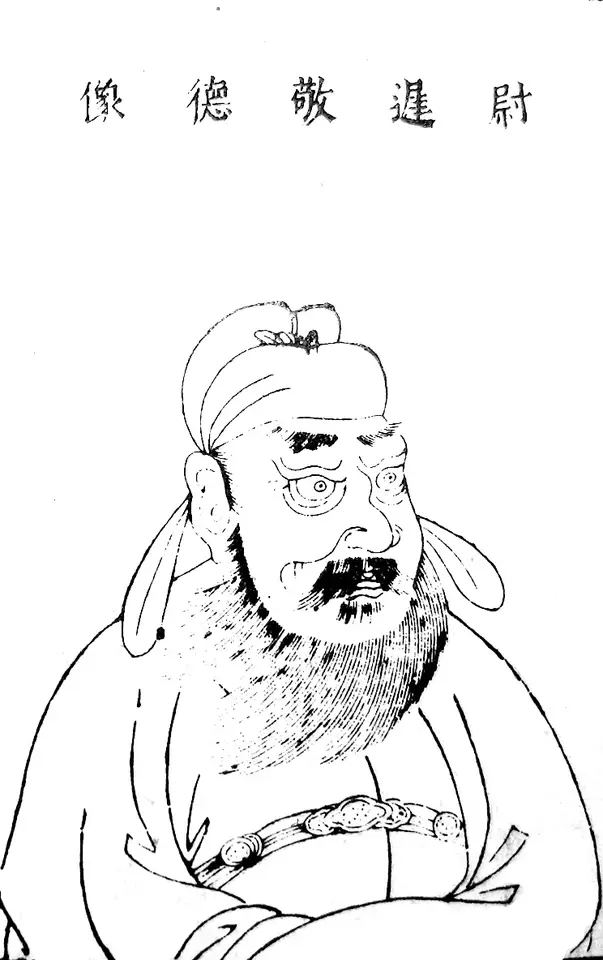
尉迟敬德
Yuchi Jingde (尉迟敬德, 585–658), originally named Yuchi Rong (尉迟融) and later granted the personal name Yuchi Gong (尉迟恭), courtesy name Jingde (敬德), was a native of Shanyang in Shuozhou (modern Shuozhou, Shanxi) and a premier founding general and military strategist of the Tang dynasty. Celebrated as one of the Twenty-Four Meritorious Statesmen of the Lingyan Pavilion, he began his career suppressing local rebellions before…
Yuchi Jingde (尉迟敬德, 585–658), originally named Yuchi Rong (尉迟融) and later granted the personal name Yuchi Gong (尉迟恭), courtesy name Jingde (敬德), was a native of Shanyang in Shuozhou (modern Shuozhou, Shanxi) and a premier founding general and military strategist of the Tang dynasty. Celebrated as one of the Twenty-Four Meritorious Statesmen of the Lingyan Pavilion, he began his career suppressing local rebellions before joining the northern warlord Liu Wuzhou as an auxiliary general, sweeping south to seize Jin and Hui Commanderies and capturing several prominent early Tang commanders. In 620, he surrendered to Li Shimin and received exceptional personal trust. During the climactic unification campaigns against Wang Shichong and Dou Jiande, he single-handedly unhorsed Shan Xiongxin with a lance to save Li Shimin's life at Yuke, and charged into opposing battle lines at Hulao to capture Wang Wan and retrieve the prized dapple charger of Emperor Yang of Sui. During the Xuanwu Gate Incident in 626, he fiercely advocated preemptive armed intervention, shot Prince of Qi Li Yuanji to death, and marched in full armor into the royal palace on the imperial lake to guard Emperor Gaozu, securing the dynastic succession for Li Shimin. He subsequently halted widespread reprisals against more than a hundred retainers of the Eastern Palace and Prince of Qi, being ranked first in meritorious service and enfeoffed as Duke of Wu. Soon afterward, he routed two hundred thousand invading Göktürk cavalry at Jingyang, beheading their vanguard commander. Renowned for unyielding bluntness, he refused to bear false witness against Tang Jian, and declined the hand of an imperial princess out of loyalty to his aging, humble wife. In his final sixteen years, he lived in serene seclusion studying Taoist alchemy and traditional music. He passed away at the age of seventy-four, was posthumously honored as Minister of Works, and was buried in the Zhaoling mausoleum. In Chinese folklore, he and Qin Qiong became revered as the classical martial Door Gods.
Born into a local military lineage in Shanyang, Shuozhou; grew into a formidable warrior possessing immense physical strength and consummate lance-fighting skill.
Promoted to Court Gentleman for Consultation while suppressing rebel bands; joined the insurrection of Liu Wuzhou as an auxiliary cavalry commander.
Advanced south under Song Jingang, capturing Taiyuan, Jinzhou, and Huizhou, and completely routed Tang forces at Xiaxian, taking Prince Li Xiaoji, Dugu Huai'en, and Tang Jian prisoner.
Held out at Jiexiu before surrendering to Li Shimin; released from wrongful suspicion by Li Shimin, who presented him with chest of gold and private lodging in his royal tent.
Dispatched during a hunt at Yuke when Wang Shichong ambushed the imperial party; charged forward alone to unhorse elite champion Shan Xiongxin and captured general Chen Zhilüe.
Shouted defiance at Dou Jiande's camp to draw out enemy forces; spearheaded a charge with Gao Zengsheng and Liang Jianfang into the enemy line to capture Wang Wan and seize Emperor Yang's prized dapple horse.
Broke through the encirclement of Liu Heita's army at Linming, rescuing Li Shimin and Li Daozong from imminent destruction; appointed Left Subordinate Protector of the Prince of Qin.
Rebuffed a cartload of gold and silver sent by Crown Prince Li Jiancheng to induce defection; left his residence gates wide open while sleeping, causing terrified assassins sent by Li Yuanji to flee.
Insisted on preemptive action against the Eastern Palace conspiracy; shot Li Yuanji to death at Xuanwumen, entered the lake pavilion in full armor to safeguard Gaozu, and halted bloody purges, ranking first in rewards.
Appointed Commander of the Jingzhou Campaign, executed a surprise cavalry attack at Jingyang, beheading Turkish commander Ashide Wumechuo and routing invaders.
Battered Prince of Rencheng Li Daozong's eye in a banquet dispute over protocol seating; severely admonished by Taizong using the fates of Han Xin and Peng Yue.
Refused Taizong's royal command to provide false testimony against Tang Jian in a chess dispute, earning high imperial praise for three virtues.
Supervised the construction of the imperial Taoist sanctuary at Mount Laojun, and was created Duke of E with hereditary prefectural rank.
When playfully queried by Taizong about false rumors of rebellion, angrily cast off his robes to expose dozens of battle scars, moving the emperor to tears of reassurance.
Retired from state office with the title of Granted Equal Ceremonial Honors; his portrait was placed seventh in the newly built Lingyan Pavilion.
Accompanied the Liaodong expedition as Left Cavalry Commander, breaking the main force of Goguryeo at Mount Zhubishan before resuming quiet retirement for sixteen years.
Died peacefully at his Chang'an residence at age seventy-four; honored with the posthumous title Zhongwu and buried alongside Emperor Taizong in the Zhaoling mausoleum.
Yuchi Jingde, originally named Yuchi Rong, was born into a prominent frontier clan of Xianbei descent in Shanyang, Shuozhou. Broad-shouldered, dark-complexioned, and endowed with tremendous physical strength, he displayed fierce valor from his youth. During the closing chaotic years of the Daye era of the Sui dynasty, banditry erupted across northern China. Yuchi Jingde enlisted in the imperial army at Gaoyang to suppress local uprisings. In numerous close-quarter engagements, his savage courage and exceptional tactical instincts earned him steady promotions, advancing him through military ranks to Court Gentleman for Consultation.
In the third month of the thirteenth year of Daye (617), Liu Wuzhou, Garrison Commander of the Mayi Falcon Guard, slew Regional Inspector Wang Rengong and raised open rebellion against Sui authority. Having long heard of Yuchi Jingde's incomparable bravery on the battlefield, Liu Wuzhou dispatched recruiters offering high emoluments and appointed him an auxiliary general in command of heavy cavalry.
In the spring of the second year of Wude (619), bolstered by military support from the northern Göktürk ruler Xieli Khan, Liu Wuzhou mobilized a hundred thousand troops for an all-out invasion southward into the Shanxi heartland. Serving as the primary spearhead under Commander-in-Chief Song Jingang, Yuchi Jingde swept through Taiyuan in Bing Province and pushed south to take Jinzhou. By the tenth month, his forces captured Huizhou, shattering Tang defensive corridors across Hedong. Concurrently, Lu Chongmao raised an insurrection at Xia County in coordination with Liu Wuzhou, inflicting a sharp defeat on Tang Chancellor Pei Ji.
Alarmed, Emperor Gaozu Li Yuan dispatched a substantial expeditionary force led by Prince of Yong'an Li Xiaoji, Minister of Works Dugu Huai'en, Area Commander Yu Jun, Palace Attendant Tang Jian, and General Liu Shirang to quell the revolt. Besieged by Tang forces, Lu Chongmao urgently petitioned Song Jingang for relief. Song Jingang dispatched Yuchi Jingde and Xun Xiang with elite cavalry to stage a pincer strike at Xia County. In a pitched battle outside the walls, Yuchi Jingde's cavalry struck like a thunderbolt, routing the Tang army and capturing all five senior Tang commanders, including Prince Li Xiaoji, Dugu Huai'en, Yu Jun, Tang Jian, and Liu Shirang. However, while transporting the prisoners back to Huizhou, Yuchi Jingde was ambushed at Meiliangchuan by Tang generals Yin Kaishan and Qin Shubao, suffering heavy losses and escaping with Xun Xiang back to Jiexiu.
In early 620, Prince of Qin Li Shimin established an entrenched camp at Baibi, confronting Song Jingang for several months in a war of attrition. When Song Jingang's supplies were exhausted, Li Shimin launched an immediate general pursuit through Queshu Pass, shattering the enemy army in eight consecutive engagements in a single day. Song Jingang fled to the Göktürks, but Yuchi Jingde rallied his surviving veterans and locked the gates of Jiexiu, resolved to defend the isolated stronghold to the death.
Admiring Yuchi Jingde's unyielding martial tenacity, Li Shimin sought to avoid destroying the general through assault and dispatched Prince of Rencheng Li Daozong and Yuwen Shiji to negotiate terms. Recognizing that Liu Wuzhou's cause was irretrievably lost, Yuchi Jingde and Xun Xiang surrendered the cities of Jiexiu and Yong'an. Delighted by his submission, Li Shimin grasped his hands warmly, appointed him Commander of the Right First Regiment, and assigned his original troops under his direct command to accompany the eastern expedition against Wang Shichong in Luoyang.
In the ninth month of 620, while Tang forces laid siege to Luoyang, Xun Xiang and several former officers of Liu Wuzhou deserted from the encampment. The Tang commanders fell into deep suspicion, concluding that Yuchi Jingde was equally untrustworthy. Subordinate officers seized Yuchi Jingde and cast him into prison chains.
Senior commanders Qutu Tong and Yin Kaishan pressed Li Shimin to execute him immediately, arguing that Yuchi Jingde had submitted only recently without inner devotion, possessed terrifying personal ferocity, and had been humiliated by wrongful imprisonment, making rebellion inevitable. Li Shimin dismissed their warnings, stating that had Yuchi Jingde intended to betray him, he would never have waited behind Xun Xiang. Li Shimin ordered his chains struck off, escorted the general alone into his private bedchamber, and presented him with a chest filled with gold and jewels. Li Shimin spoke with profound warmth, asserting that men of honor bond through mutual righteousness and must never let trivial suspicions sever trust. He assured Yuchi Jingde that he would never heed slander against a loyal officer, adding that if the general truly wished to depart, he was free to take the gold as traveling funds in memory of their shared service. Overwhelmed by such magnanimity, Yuchi Jingde wept and swore eternal fidelity to the Prince of Qin.
On the very afternoon of Yuchi Jingde's release, Li Shimin rode out with a small reconnaissance party of several dozen horsemen, including Yuchi Jingde, to inspect enemy defenses around Yuke north of Luoyang. Suddenly, Wang Shichong appeared from the city at the head of tens of thousands of infantry and cavalry, trapping the Tang reconnaissance party in a dense ring of steel. Shan Xiongxin, the foremost cavalry champion of the Zheng army, recognized Li Shimin and charged straight toward him with a long lance, closing within arm's length of the prince's horse.
In that fraction of a second, Yuchi Jingde urged his steed forward with a deafening war cry that startled the charging line. Leveling his heavy lance at full gallop, he struck Shan Xiongxin's horse squarely in the chest, unseating the champion with a shattering blow. As the Zheng cavalry hesitated in shock, Yuchi Jingde placed himself before Li Shimin, impaling ten enemy riders in rapid succession and cleaving a bloody corridor through the encirclement until Li Shimin was safely outside the trap.
Once clear, Yuchi Jingde rallied the Tang relief cavalry and mounted an immediate counter-offensive. Charging back into Wang Shichong's main infantry formations, he smashed their battle lines, captured the Zheng general Chen Zhilüe alive, and seized over six thousand armored cavalrymen. That evening, Li Shimin grasped Yuchi Jingde's hands before the assembled generals, remarking that just as doubters urged him to distrust the general, Heaven had arranged an immediate trial to vindicate his faith, proving how swiftly virtuous deeds receive divine recompense. He rewarded Yuchi Jingde with another chest of gold, and from that day on, the two shared meals and royal carriages.
Yuchi Jingde possessed singular mastery in mounted combat, particularly in dodging and disarming enemy lances. Whenever he charged alone into enemy formations, dozens of enemy lances thrust at him simultaneously, yet he twisted his body with fluid ease, deflecting every point while snatching the weapons from his opponents' hands and using their own lances to strike them down.
Prince of Qi Li Yuanji, who took fierce pride in his own equestrian lance prowess, doubted Yuchi Jingde's reputation and demanded a private duel before the Prince of Qin. To prevent fatal injury, Li Yuanji suggested removing the steel points from their lances. Yuchi Jingde laughed and insisted that the prince keep his sharp blade attached, assuring him that even a live spearhead could not graze his skin, though he would remove his own point out of respect for royal safety. Mounted on his warhorse, Li Yuanji charged repeatedly with all his strength, yet failed to touch even the hem of Yuchi Jingde's tunic. When Li Shimin asked whether evading or disarming a lance was more difficult, Yuchi Jingde replied that disarming was far harder. Li Shimin commanded him to demonstrate. Li Yuanji charged fiercely to impale his opponent, but within moments, Yuchi Jingde smoothly stripped the lance from Li Yuanji's hands three times in succession. While Li Yuanji praised the display outwardly, he harbored intense humiliation and bitter hatred.
In the spring of the fourth year of Wude (621), Dou Jiande marched over one hundred thousand troops to Banzhu to relieve Luoyang. To lure the cautious warlord into a decisive field engagement, Li Shimin and Yuchi Jingde rode directly to the enemy palisade with minimal escort. Li Shimin carried a bow while Yuchi Jingde held a lance, shouting loud insults at the ramparts. Provoked, Dou Jiande sent thousands of cavalry in furious pursuit. Li Shimin and Yuchi Jingde retreated in measured rhythm, killing leading pursuers with arrows and lance thrusts until the entire enemy vanguard was drawn into the ambushes prepared by Li Shiji and Qin Shubao, where they were annihilated.
During the climactic battle of Hulao, Wang Wan, nephew of Wang Shichong, rode out before the battle lines on a magnificent dapple charger once ridden by Emperor Yang of Sui, flaunting his glittering armor. Seeing Li Shimin admire the horse, Yuchi Jingde volunteered to seize it. Galloping out with Gao Zengsheng and Liang Jianfang, the three riders smashed straight into the enemy lines, seized Wang Wan from his saddle, and led the imperial stallion back to the Tang lines, while thousands of enemy soldiers looked on in paralyzed awe. In 622, when Liu Heita encircled Li Shiji at Linming, Li Shimin's relief column was surrounded. Yuchi Jingde led shock troops straight into the center of the trap, breaking the enemy lines and extricating Li Shimin and Li Daozong, for which he was made Left Subordinate Protector.
As Li Shimin's military prestige soared following the defeat of regional rivals, Crown Prince Li Jiancheng and Prince of Qi Li Yuanji felt their claims to the throne slipping away. They began systematically attempting to corrupt and detach key officers from the Prince of Qin's retinue. Recognizing Yuchi Jingde as Li Shimin's foremost martial defender, Li Jiancheng sent a secret emissary carrying a lavish letter accompanied by a cart filled with precious gold and silver vessels.
Yuchi Jingde rejected the gifts outright. He declared to the envoy that he was an ordinary soldier who had committed capital crimes in rebellion, but had been granted a second life through the grace of the Prince of Qin. He insisted that he owed his entire existence to his master and had done nothing to merit reward from the crown prince. He warned that if he abandoned his lord for private profit, he would become a contemptible turncoat whom the crown prince himself could never trust. Humiliated and furious, Li Jiancheng severed all relations.
Yuchi Jingde promptly informed Li Shimin of the bribe. Li Shimin was deeply moved, assuring him that his moral purity was taller than mountains and that even cartloads of gold could not bend his integrity. Soon after, Li Yuanji dispatched professional assassins to murder Yuchi Jingde in his residence. Having learned of the plot, Yuchi Jingde ordered the outer gates, courtyard doors, and hall portals of his mansion thrown wide open, while he lay in bed sleeping peacefully. Slipping through the silent courtyards, the assassins saw the gates wide open and the general resting without guard. Terrified by his utter fearlessness, they trembled in the courtyard and fled without daring to step into the bedroom. Failing in assassination, Li Yuanji slandered Yuchi Jingde before Emperor Gaozu, who ordered him imprisoned for execution, escaping death only through Li Shimin's desperate intercession.
In the sixth month of the ninth year of Wude (626), the dynastic rivalry reached a boiling point. The Eastern Palace faction arranged for Li Yuanji to command northern armies against the Göktürks, intending to ambush Li Shimin during the farewell banquet at Kunming Pool. Informed of the scheme, Yuchi Jingde and Zhangsun Wuji urged Li Shimin to strike first. Facing Li Shimin's reluctance to engage in fratricide, Yuchi Jingde argued passionately that human nature values survival and that eight hundred armored warriors were waiting to die for him. He warned that prioritizing personal fraternal love over the welfare of the dynastic altars was reckless folly, declaring that if the prince did not act, he and Zhangsun Wuji would flee into the mountains rather than wait to be butchered. Under his relentless urging, Li Shimin resolved to stage the coup.
When key advisors Fang Xuanling and Du Ruhui hesitated to answer summons for fear of imperial execution, Li Shimin handed his personal sword to Yuchi Jingde with orders to behead them if they delayed. Yuchi Jingde met them with persuasive eloquence, guiding them in Taoist disguises into the palace compound to finalize battle plans.
At dawn on June 4, the coup erupted at Xuanwu Gate. Li Shimin shot Li Jiancheng dead. Li Yuanji galloped into nearby woods, where Li Shimin pursued him on horseback, only to be thrown when his mount was tangled in tree branches. Li Yuanji sprang forward and grabbed Li Shimin's bow, preparing to strangle him with the bowstring. Yuchi Jingde galloped up, letting out a thunderous shout that caused Li Yuanji to drop the bow and sprint toward the Wude Hall. Yuchi Jingde drew his bow and shot Li Yuanji dead in mid-stride.
Moments later, Eastern Palace commanders Feng Li, Xie Shufang, and Xue Wanche attacked Xuanwu Gate with two thousand elite troops, killing the garrison commander. Yuchi Jingde mounted the battlements, displaying the severed heads of Li Jiancheng and Li Yuanji, causing the attacking army to disperse in panic. Clad in bloodstained armor and carrying his lance, Yuchi Jingde marched directly to the imperial lake where Emperor Gaozu was boating with courtiers. Gaozu was terrified, but Yuchi Jingde respectfully reported that the rebellious princes had been slain and that he had arrived to protect the emperor. He urged Gaozu to issue an imperial decree placing all military commands under the Prince of Qin, stabilizing the capital. When hardliners demanded the execution of more than a hundred retainers of the fallen princes, Yuchi Jingde intervened, arguing that justice had been met and that broader purges would destroy public peace, saving dozens of future statesmen like Wei Zheng. For his singular leadership, he was awarded the top rank of merit alongside Zhangsun Wuji, receiving the entire palace and wealth of the late Prince of Qi.
Following Li Shimin's accession as Emperor Taizong, Yuchi Jingde was appointed Right General of the Martial Guard and created Duke of Wu, sharing the highest reward of one thousand three hundred revenue households with Zhangsun Wuji, Fang Xuanling, and Du Ruhui.
Taking advantage of the dynastic transition, Göktürk rulers Xieli and Tuli Khans launched a massive invasion with two hundred thousand cavalry, penetrating into Jingzhou and Wugong within striking distance of Chang'an. Taizong dispatched Yuchi Jingde as Campaign Commander. At Jingyang, facing vast hordes of nomadic horsemen, Yuchi Jingde led light cavalry straight into the enemy vanguard, beheading the Turkish commander Ashide Wumechuo and routing their forward formations with over a thousand casualties. This sharp tactical victory blunted the enemy offensive, providing Taizong with the vital military leverage to negotiate the Treaty of Bian Bridge across the Wei River.
Yuchi Jingde possessed an intensely blunt and unpolished temperament, taking immense pride in his battlefield deeds. In the imperial court, whenever chancellors Fang Xuanling, Du Ruhui, or Zhangsun Wuji committed administrative oversights, Yuchi Jingde castigated them openly without tact, alienating civil officials. To relieve political friction, Taizong reassigned him as Area Commander of Xiangzhou and later Prefect of Tongzhou.
In the ninth month of the sixth year of Zhenguan (632), Taizong held a grand banquet for founding generals at Qingshan Palace in Luoyang. Observing that an official had been seated above him, Yuchi Jingde slammed the table and angrily demanded to know what achievements entitled the man to sit in a superior seat. Prince of Rencheng Li Daozong attempted to soothe his fury, whereupon Yuchi Jingde struck Li Daozong violently in the face with his fist, nearly blinding his eye.
Outraged, Taizong abruptly terminated the banquet. Addressing Yuchi Jingde before the assembled nobility, Taizong stated that he had always criticized Emperor Gaozu of Han for executing Han Xin and Peng Yue, desiring instead to preserve his own meritorious servants. However, seeing Yuchi Jingde repeatedly violate state statutes, he now understood that the execution of Han Xin was not Gaozu's fault. He warned that governance rested on rewards and punishments, that special grace could not be repeated, and urged the general to discipline his conduct before it was too late. Shaken to his core, Yuchi Jingde adopted far greater restraint thereafter.
In 637, his title was changed to Duke of E. While serving as Area Commander of Fuzhou in 639, Taizong playfully asked him about court rumors that he planned rebellion. Deeply grieved, Yuchi Jingde tore off his robes, flung them onto the palace floor, and exposed a torso covered with dozens of horrific scars from arrows, spears, and swords. Weeping, he asked if an old warrior who bore a hundred wounds for the realm could truly be suspected of treason in peace. Moved to tears, Taizong stepped down, helped him dress, and apologized warmly.
Despite his martial gruffness, Yuchi Jingde was defined by profound personal integrity. Once, during a game of chess with Minister of Personnel Tang Jian, Taizong grew furious over an argument and banished Tang Jian to Tanzhou. Still enraged, Taizong summoned Yuchi Jingde in private, commanding him to provide court testimony that Tang Jian had uttered treasonous disrespect so that he could execute him. Yuchi Jingde nodded compliance.
The following morning at court, Taizong demanded his testimony, but Yuchi Jingde knelt and declared firmly that he had never heard Tang Jian utter disrespectful words. Despite repeated furious questioning from the emperor, Yuchi Jingde refused to alter his testimony. Taizong hurled his jade sceptre to the floor in anger and left the court. Months later, Taizong acknowledged his own error at a banquet, praising Yuchi Jingde for three virtues: saving Tang Jian from wrongful death, sparing the emperor from the guilt of tyranny, and earning himself enduring fame for upright fidelity, rewarding him with a thousand bolts of silk.
Later, Taizong offered to marry an imperial princess to Yuchi Jingde as a mark of highest favor. Yuchi Jingde declined with deep reverence, stating that although his wife was aging and of humble birth, she had shared decades of hardship with him. Invoking ancient wisdom that an honorable man never abandons his faithful wife upon attaining wealth, he begged to decline the honor, earning Taizong's admiration.
During his tenures in Xiangzhou, Tongzhou, Fuzhou, and Xiahou, Yuchi Jingde was a conscientious administrator who strengthened border garrisons and expanded agricultural colonies along the desert frontiers, securing peace for Han and non-Han communities alike. Recalling an old debt from his youth when a scholar lent him money, he tracked down the impoverished elder and granted him thousands of strings of cash, distributing state gifts among friends from his humble days.
In the eleventh year of Zhenguan (637), Taizong honored Laozi as the divine ancestor of the Tang dynasty. Taizong commissioned Yuchi Jingde to supervise the construction of the imperial Taoist sanctuary on Mount Jingshi, renaming the peak Mount Laojun. Yuchi Jingde spent several years directing craftsmen and quarrying rock to construct majestic temples along the heights, establishing a renowned Taoist sanctuary.
In 643, feeling his vitality waning, Yuchi Jingde submitted a memorial requesting retirement. Taizong granted him the title of Granted Equal Ceremonial Honors with the Three Excellencies, requesting his attendance on imperial court days. That same year, Taizong commissioned the Lingyan Pavilion to commemorate twenty-four founding architects of the empire, placing Yuchi Jingde's portrait seventh in order of precedence.
In 645, when Taizong launched his expedition against Goguryeo, Yuchi Jingde opposed the march from his sickbed, pointing out that leaving the capital and crown prince in rear territories was perilous. Though the emperor did not heed his strategic advice, he appointed Yuchi Jingde Left Cavalry Commander. At the Battle of Mount Zhubishan, the sixty-one-year-old warrior charged into the ranks of one hundred and fifty thousand enemy troops alongside Li Shiji and Zhangsun Wuji, contributing to the capture of thirty-six thousand enemy troops.
Following the campaign, he withdrew into absolute seclusion. For sixteen years, he lived quietly within his private estate, studying Taoist alchemy, refining mica minerals, and playing traditional chamber music, refusing all political visitors.
In the eleventh month of the third year of Xianqing (658), Yuchi Jingde died peacefully at the age of seventy-four. Emperor Gaozong suspended court audiences for three days, ordered all officials above the fifth rank to attend the wake, posthumously promoted him to Minister of Works and Area Commander of Bingzhou, conferred the title Zhongwu, and granted him an imperial burial in Zhaoling.
Yuchi Jingde stands as one of the most celebrated individual combatants in Chinese military history. He elevated the art of mounted lance combat to an unmatched level, perfecting the ability to evade multiple weapons while stripping lances from opponents at full gallop. His single-handed unhorsing of Shan Xiongxin at Yuke and his daring sally to capture Wang Wan on Emperor Yang's horse demonstrated extraordinary martial composure. His battlefield heroics personified the legendary cavalry supremacy of early Tang shock armies.
When Prince Li Jiancheng attempted to bribe him with a cartload of gold and silver to abandon Li Shimin, Yuchi Jingde demonstrated incorruptible honor, declaring that no reward could buy his disloyalty. When assassins were dispatched by Li Yuanji, he left his gates wide open and rested peacefully, his absolute fearlessness driving the conspirators into terrified flight. This steadfast integrity under political bribery and lethal peril formed the moral core of his renown.
At the pivotal turning point of the Xuanwu Gate Incident, Yuchi Jingde provided the decisive impetus that catalyzed Li Shimin's action. By confronting the prince with the harsh realities of survival and political duty, he dispelled hesitations within the Qin camp. On the field of battle, his swift elimination of Li Yuanji and his armed entry into the palace on the lake secured immediate control over the imperial guard, averting a destructive civil war and laying the institutional foundations for the Zhenguan era.
Following the triumph at Xuanwu Gate, Yuchi Jingde displayed statesmanlike vision by checking the impulse toward bloody purges. While factional hardliners sought to exterminate more than a hundred retainers of the Eastern Palace and Prince of Qi, Yuchi Jingde intervened to demand amnesty for subordinate staff once the principal conspirators had fallen. This crucial restraint stabilized thousands of frightened officials, forestalled provincial revolts, and preserved indispensable talents such as Wei Zheng for the empire.
When the Göktürk khans advanced two hundred thousand cavalry to the doorstep of Chang'an at Jingyang, Yuchi Jingde executed a brilliant preemptive strike. Disdaining passive defense, he led light cavalry directly into the enemy center, decapitating the enemy vanguard general Ashide Wumechuo and shattering their momentum. This decisive victory broke the enemy's aggressive initiative, enabling Emperor Taizong to negotiate peace from a position of martial strength.
Yuchi Jingde's moral fiber extended to defying imperial tyranny. When an enraged Taizong commanded him to manufacture false testimony to justify the execution of Tang Jian, Yuchi Jingde chose to face imperial wrath rather than bear false witness. His unyielding refusal to compromise the truth pulled a high official back from wrongful death, earning the admiration of Taizong and demonstrating that true loyalty includes the courage to restrain one's sovereign.
After rising to supreme aristocratic prominence, Yuchi Jingde remained faithful to his modest familial ties. When offered an imperial princess in marriage, he declined the royal alliance, invoking the sacred principle that an honorable man never casts aside his faithful wife of impoverished days. This rejection of political advancement in favor of spousal loyalty stood in stark contrast to the opportunistic marriages common among the medieval aristocracy.
Following decades of relentless warfare, Yuchi Jingde chose total retirement over factional competition. In his final sixteen years, he disconnected from politics, absorbed himself in Taoist study, and enjoyed artistic pursuits. This disciplined disengagement preserved his life and shielded his lineage from the violent purges that consumed other prominent founders of the dynasty, leaving an enduring example of prudent retirement.
Yuchi Jingde's ferocious loyalty and indomitable courage transcended formal dynastic records to become embedded in Chinese folklore. Commemorating his nocturnal palace vigilance alongside Qin Qiong to protect Emperor Taizong from malevolent spirits, popular culture immortalized both generals as the traditional martial Door Gods. Bearing his iron staff and clad in dark armor, his image continues to adorn household gates across China as a timeless emblem of protective courage and righteousness.
FIGURES ASSOCIATED WITH THIS DYNASTY