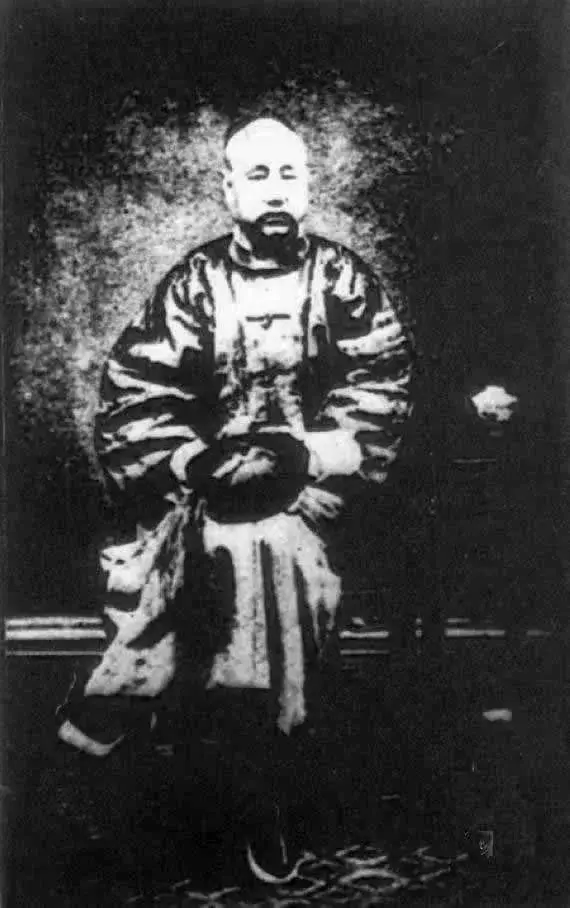
Biography
Noble Lineage and Imperial Adoption
Borjigit Sengge Rinchen was born on July 24, 1811, in the Horqin Left Wing Rear Banner in Jirim League (modern Tongliao City, Inner Mongolia). His ancestry was illustrious: he was a twenty-sixth generation direct descendant of Jochi Khasar, the younger brother of Genghis Khan, belonging to the Borjigin clan that had intermarried with the Qing imperial Aisin Gioro house since the founding of the dynasty.
However, over centuries of tribal branching, Sengge Rinchen's immediate family had fallen into penury as fourth-class minor nobles (taiji). In his early youth, he reportedly labored on pasturelands alongside his father and brothers, an austere upbringing that endowed him with imposing physical strength, equestrian mastery, and a resilient temperament.
In 1825, Jasagh Doroi Prince Sotnam Dobjai passed away in Beijing. Married to the Jiaqing Emperor's third daughter, Princess Zhuangjing, the prince held preeminent influence but left no biological male heir. The Daoguang Emperor decreed that an adoptive heir be selected from capable Horqin noble youths. The fourteen-year-old Sengge Rinchen impressed imperial examiners with his dignified bearing and martial aptitude. He was formally confirmed as the adoptive son of Sotnam Dobjai and Princess Zhuangjing, inheriting the rank of Jasagh Doroi Prince and moving to Beijing to enter palace service.
In 1834, at age twenty-three, Sengge Rinchen was appointed Imperial Attendant. Possessing unbending devotion to the Qing dynasty, he earned the deep trust of the Daoguang Emperor, who regularly invited him to accompany imperial hunts at Mulan and archery drills at the Western Grounds (Xiyuan). Promoted to Deputy Lieutenant-General of the Mongolian Bordered Blue Banner and Chamberlain of the Plain White Banner Guard, he was summoned to the Daoguang Emperor's deathbed in 1850 alongside Prince Gong Yixin, receiving solemn instructions to protect the nascent reign of the Xianfeng Emperor.
Repelling the Northern Expedition and the Lianzhen Campaign
In 1851, the Taiping Rebellion erupted in Guangxi, establishing its capital at Tianjing (Nanjing) in 1853. In May 1853, Taiping leaders dispatched veteran generals Lin Fengxiang and Li Kaifang with twenty thousand elite shock troops on a northern expedition. Advancing with astonishing rapidity through Anhui, Henan, and Shanxi, the northern expedition broke into Zhili, capturing Jinghai and Duliu, within seventy li of Beijing. The capital was paralyzed with terror; imperial princes fled, and the Xianfeng Emperor prepared contingency plans to evacuate the court to Rehe.
In this existential crisis, Xianfeng appointed Sengge Rinchen Assistant Grand Minister, commanding Eight Banners troops and over ten thousand Horqin and Chahar Mongol cavalry. Establishing headquarters at Yangcun and Duliu south of Tianjin, Sengge Rinchen recognized that while Taiping troops excelled at infantry spear assaults and sapping, they lacked mobile cavalry. Deploying Horqin cavalry to conduct continuous night ambushes and interdict supply columns, Sengge Rinchen halted the northern expedition outside Tianjin for over six months through bitter winter blizzards.
In early 1854, starved and frozen, the Taiping forces retreated southward to Lianzhen along the Zhili-Shandong border. Xianfeng demanded the total destruction of the invaders. Sengge Rinchen instituted a massive siege, mobilizing tens of thousands of laborers to erect the "Changsheng Rampart", a ten-mile earthwork encircled by deep moats, and diverting the waters of the Grand Canal to submerge Taiping defensive redoubts. For an entire year, Taiping defenders held out under terrible starvation, consuming tree bark and pack animals.
In February 1855, Sengge Rinchen led the Eight Banners in a general assault that stormed the timber barricades. General Lin Fengxiang fought from underground tunnels before being severely wounded and captured, subsequently executed in Beijing. Sengge Rinchen then advanced upon Fengguantun, where Li Kaifang was entrenched, diverting the Tuha River to submerge the garrison. In May 1855, Fengguantun fell and Li Kaifang was captured. The entire Taiping northern expedition was annihilated, securing the capital. In gratitude, the Xianfeng Emperor elevated Sengge Rinchen to Jasagh Prince Bodolgatai (Bodolgatai Qinwang) with hereditary status and awarded him the title Tuanduo Baturu, establishing his fame alongside Zeng Guofan as "South Zeng, North Seng."
Rebuilding Daku and the Coastal Victory of 1859
In 1856, Britain and France launched the Second Opium War, storming the Daku Forts in 1858 and compelling the signature of the Treaty of Tientsin. Disgraced by the vulnerability of the capital, the Xianfeng Emperor appointed Sengge Rinchen Imperial Commissioner directing maritime defenses at Tianjin.
Sengge Rinchen analyzed that European naval forces possessed overwhelming long-range firepower but suffered from shallow-water maneuvering vulnerabilities and poor close-combat infantry capabilities. Discarding obsolete open-air masonry batteries, he reconstructed six massive concealed semi-subterranean sandbag forts, naming them "Wei", "Zhen", and "Hai", housing 250 heavy brass and iron cannons camouflaged with reed matting. Across the mouth of the Hai River, he installed three defensive barriers: dozens of submerged iron-tipped wooden piles, four massive iron chains weighing tens of thousands of catties, and extensive mudflat obstacle zones packed with caltrops and hidden trenches.
In June 1859, British and French envoys Bruce and Bourboulon returned to Daku aboard an armada of over twenty gunboats commanded by British Admiral James Hope. Rejecting Chinese requests to exchange treaties via Beitang, Hope ordered gunboats to cut the river chains. On June 25, enemy vessels attempted to force the second chain, opening fire on the shoreline.
Remaining concealed within the earthworks, Sengge Rinchen held fire until the gunboats became ensnared between the iron chains and falling tides grounded their hulls on the mudflats. He then raised the command banner, and nearly a hundred concealed coastal guns opened simultaneous fire. Trapped in a crossfire, British vessels suffered devastating damage; the flagship HMS Plover was blown apart, Admiral Hope sustained severe chest and thigh wounds, and his second-in-command was killed. A night assault by six hundred British and French marines became bogged down in waist-deep mud, suffering heavy casualties under pre-sighted cannon fire. The Qing forces sank four gunboats, heavily damaged six others, and inflicted nearly five hundred casualties. The Second Battle of Daku Forts stood as the most brilliant coastal defense triumph achieved by Chinese forces against Western imperialist invaders during the nineteenth century.
Defeat at Baliqiao and the Fall of Beijing
The humiliation at Daku prompted Britain and France to mobilize twenty thousand veteran troops equipped with rifled Armstrong cannons and Enfield rifles in summer 1860, commanded by Lord Elgin and General Montauban. Learning from their previous failure, the allied forces bypassed the frontal defenses of Daku, landing unopposed at Beitang and outflanking the forts from the rear.
Following the fall of Daku and Tianjin, Sengge Rinchen withdrew his battered army to Tongzhou to make a final stand protecting the imperial capital. On September 21, 1860, the Battle of Baliqiao (Eight-Mile Bridge) erupted across the Tonghui Canal. Sengge Rinchen concentrated thirty thousand troops, including nearly ten thousand elite Horqin Mongol cavalry, deploying along the southern bridge approaches.
Confronting allied infantry squares supported by dense Armstrong artillery barrage, Sengge Rinchen ordered a general cavalry charge. The Mongolian horsemen charged with suicidal bravery, braving intense shellfire and riding within a hundred paces of the allied headquarters. French officers later wrote in awe that these Tatar horsemen charged fearlessly through devastating artillery fire that obliterated their ranks.
However, traditional cold-weapon cavalry could not overcome industrial firepower. Concentrated volleys of Minié rifle fire and canister shot cut down thousands of charging mounts. When allied artillery shattered the bridge defenders, the Qing line collapsed with over two thousand casualties, forcing Sengge Rinchen to retreat.
The defeat exposed Beijing to allied capture. The Xianfeng Emperor fled to Chengde, leaving Prince Gong Yixin to negotiate. Allied troops occupied Beijing, burned the Summer Palace (Yuanmingyuan), and extracted the Treaty of Beijing. The court stripped Sengge Rinchen of his princely titles and offices, but retained him as Imperial Commissioner to combat the escalating Nian Rebellion in central China.
Campaigning in Central China and Martyrdom at Gaolouzhai
In late 1860, Sengge Rinchen moved south to direct campaigns across Zhili, Shandong, and Henan against the Nian Army, a formidable peasant rebellion reliant on fast-moving light cavalry across the Central Plains. Between 1862 and 1863, Sengge Rinchen campaigned across Shangqiu, Bozhou, and Runan. In March 1863, he surrounded the Nian capital at Zhiheji in Anhui, destroying their base, capturing and executing supreme leader Zhang Lexing, and eliminating the treacherous warlord Miao Peilin. For these merits, the Tongzhi court restored him to Prince Bodolgatai with double stipends, placing him in supreme command over five provinces.
However, this victory bred fatal overconfidence. Following Zhang Lexing's death, surviving Nian forces unified with Taiping remnants under Lai Wenguang, adopting an elusive guerrilla strategy under leaders Zhang Zongyu and Ren Huabang. Abandoning static cities, they moved across Henan, Shandong, and Hubei, drawing Qing forces into exhausting chases.
Sengge Rinchen possessed an impetuous temperament, dogmatically believing that cavalry shock action could resolve any campaign. He drove his troops relentlessly without rest. From late 1864 to spring 1865, his cavalry pursued the Nian over thousands of li without shedding armor or removing saddles. Exhausted soldiers drank brackish alkaline water, contracting epidemics, while horses died by the thousands. Subordinate commanders pleaded for rest, but Sengge Rinchen threatened execution for hesitation.
On May 17, 1865, Nian leaders Zhang Zongyu and Lai Wenguang established a three-tiered ambush at Gaolouzhai near Caozhou (modern Heze, Shandong). Hiding forces within dense willow groves and sunken ditches, they sent feeble decoys to lure the pursuers. Blinded by fatigue and eager for victory, Sengge Rinchen led his advance guard straight into the trap.
At dawn on May 18, Nian cavalry charged from all directions, entangling the exhausted Qing horses in trip-wires and mud ditches. Generals Hengling and Chengbao fell in battle, and seven thousand imperial troops were wiped out. Wounded by multiple gunshots, Sengge Rinchen crawled into a wheat field with a few bodyguards. He was discovered by a sixteen-year-old Nian soldier named Zhang Lun, who cut him down and stripped his peacock feather and yellow riding jacket. The premier banner general of the late Qing perished in the fields of Caozhou at the age of fifty-five.
Posthumous Grief and Political Transformation
News of Sengge Rinchen's death plunged the court into profound shock. The young Tongzhi Emperor and the Two Dowager Empresses wept openly, declaring that the dynasty had lost its defensive pillar. The court declared three days of mourning, dispatched imperial princes to escort his remains, and granted the posthumous name Zhong, enshrinement in the Imperial Ancestral Temple, and portraits in the Ziguang Pavilion.
Sengge Rinchen's martyrdom at Gaolouzhai marked a profound historical watershed in modern Chinese history. The destruction of his army wiped out the last direct striking force possessed by the Manchu-Mongol Eight Banners. Deprived of imperial banner armies, the Qing court was forced to entrust supreme military command to Han regional armies, appointing Zeng Guofan as Imperial Commissioner directing northern operations. This shift permanently transferred military and administrative power to regional Han governors like Zeng Guofan and Li Hongzhang, accelerating the emergence of late Qing regional warlordism.
Historical Evaluation
As the most influential Manchu-Mongol military commander of the late Qing dynasty, Sengge Rinchen received complex assessments highlighting both his unbending loyalty and his strategic limitations.
The Tongzhi Emperor proclaimed in his funeral eulogy: "The Prince possessed natural wisdom and courage, serving the imperial guard with celestial loyalty. His victory at Daku shook the foreign oceans; his pacification of the Central Plains was a monumental merit. His death at Caozhou deprived the state of its great bulwark, an eternal grief that We shall never forget."
Colleague Zeng Guofan commented in profound shock: "Prince Seng was loyal, brave, and honest, truly an irreplaceable pillar of the state. Though his grand strategy suffered from occasional oversights, his solitary courage across thousands of li of frontier sandstorms is beyond reproach."
Li Hongzhang observed with analytical precision: "Prince Seng's battlefield fame shook the northern borders, his bravery unmatched among his contemporaries. Yet his fatal flaw lay in impetuous overconfidence and ignorance of mobile insurgent warfare; driving his men relentlessly without rest, he ultimately fell into their trap. With his death, supreme military command passed entirely to Han officials, as decreed by Heaven."
Qing reformist scholar Guo Songtao noted: "Prince Seng governed troops purely by martial daring without calculating grand strategy. In facing foes, he knew only advance and never retreat; he possessed the valor to slay enemy generals, but lacked farsighted vision. This was why he fell at Baliqiao and perished at Gaolouzhai."
British naval officers acknowledged his operational brilliance at Daku Forts, with officers noting that the concealed sandbag batteries and river booms reflected the sophisticated engineering mind of an accomplished tactician.
Modern historians regard Sengge Rinchen as the final sunset of traditional Mongol-Manchu warrior leadership, whose rise and tragic demise encapsulated the painful transition of imperial China before modern warfare and domestic upheaval.