Birth into Imperial Clan
Born in the imperial lineage as a great-grandson of Emperor Taizong and grandson of the deposed Crown Prince Li Chengqian.
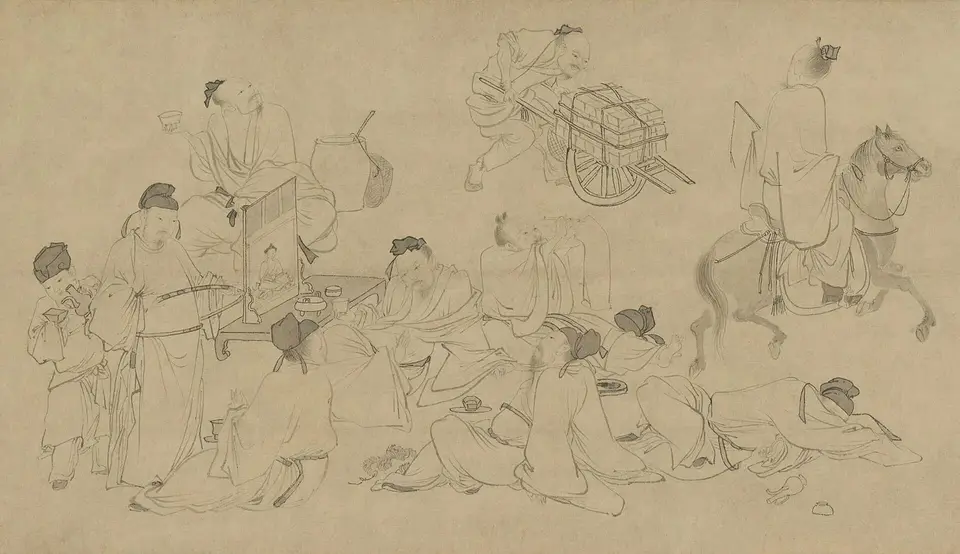
李适之
Li Shizhi (李适之, 694–747), originally named Li Chang (李昌), was an imperial kinsman, chancellor, and celebrated poet of the Tang dynasty. A great-grandson of Emperor Taizong and grandson of Crown Prince Li Chengqian, he entered the civil service following the restoration of Emperor Zhongzong, serving successively as Vice Magistrate of Jinzhou, General of the Right Palace Guard, Prefect of Tongzhou and Qinzhou, and Intendant of…
Li Shizhi (李适之, 694–747), originally named Li Chang (李昌), was an imperial kinsman, chancellor, and celebrated poet of the Tang dynasty. A great-grandson of Emperor Taizong and grandson of Crown Prince Li Chengqian, he entered the civil service following the restoration of Emperor Zhongzong, serving successively as Vice Magistrate of Jinzhou, General of the Right Palace Guard, Prefect of Tongzhou and Qinzhou, and Intendant of Henan. Characterized by relaxed, humane administration and legal clarity, he earned wide popular affection. While serving as Intendant of Henan in 736, he financed the construction of three major dikes along the Gu and Luo Rivers from imperial treasury reserves, permanently ending chronic flood disasters in the eastern capital and prompting Emperor Xuanzong to erect an inscribed stele honoring his hydraulic achievements. Later, as Military Commissioner of Youzhou, he successfully petitioned the throne to rehabilitate his grandfather Li Chengqian and father Li Xiang, securing their honorable reburial in the Zhaoling mausoleum. In 742, Li Shizhi succeeded Niu Xianke as Left Chancellor (Left Vice Director of the Department of State Affairs) concurrently serving as Minister of War, created Duke of Weiyuan. Endowed with an open, uncalculating temperament, he clashed with the treacherous Right Chancellor Li Linfu, repeatedly falling victim to subtle political snares, such as the Mount Hua gold mine trap, and gradually losing the emperor's confidence. In 746, as his political allies Wei Jian, Huangfu Weiming, and Han Chaozong were systematically purged and exiled, Li Shizhi resigned his chancellorship to avoid catastrophe, composing the famous poem On Leaving the Chancellorship. Denounced shortly thereafter for factional conspiracy, he was demoted to Prefect of Yichun. In 747, learning that the imperial censor Luo Xishi had executed Wei Jian and was approaching Yichun, Li Shizhi consumed poison to preserve his honor, dying at the age of fifty-four. Du Fu immortalized him as one of the Eight Immortals of the Wine Cup in his famous verse Song of the Eight Immortals of the Wine Cup.
Born in the imperial lineage as a great-grandson of Emperor Taizong and grandson of the deposed Crown Prince Li Chengqian.
Following the Shenlong Coup, Emperor Zhongzong favored Taizong's descendants; Li Shizhi was appointed Court Gentleman for Consultation and Vice Magistrate of Jinzhou.
Served as Governor of Tongzhou and Qinzhou, establishing widespread renown for humane administration without vexatious edicts; recommended to the court by Han Chaozong.
As Intendant of Henan, constructed the Shangyang, Jicui, and Yuepei dikes to eliminate Luo River flooding; honored with a public stele penned by imperial princes and promoted to Censor-in-Chief.
Appointed Military Commissioner of Youzhou; submitted a filial memorial requesting the rehabilitation of Li Chengqian and Li Xiang, obtaining an imperial decree for their reinterment at Zhaoling.
Succeeded Niu Xianke as Left Chancellor, concurrently heading the Ministry of War and Hongwen Academy, and created Duke of Weiyuan.
Entrapped by Li Linfu into proposing the mining of Mount Hua, resulting in an imperial reprimand from Xuanzong that undermined his standing at court.
Witnessing the purge of Wei Jian and Huangfu Weiming, resigned his chancellorship to become Junior Tutor to the Crown Prince, composing the celebrated poem on retirement.
Denounced by Li Linfu in the seventh month for factional alignment with Wei Jian; stripped of metropolitan rank and demoted to Prefect of Yichun.
Grieved and terrified as inquisitor Luo Xishi conducted executions of exiled officials and approached Yichun, Li Shizhi took poison and died at age fifty-four.
Li Shizhi, originally named Li Chang, was a great-grandson of Emperor Taizong of Tang. His grandfather Li Chengqian was initially invested as crown prince before being deposed and reduced to a duke following an abortive succession attempt in 643; his father Li Xiang lived under political suspicion during the reign of Wu Zetian, rising only to Vice Magistrate of Qichun. Due to these family misfortunes, Li Shizhi conducted himself with quiet prudence during his youth, applying himself to literature and administrative statecraft.
In the first year of Shenlong (705), Chancellor Zhang Jianzhi led the palace coup that restored Emperor Zhongzong. Grieved by the near-annihilation of the imperial house under Wu Zetian, Zhongzong initiated a dynastic revitalization policy, actively searching out and promoting the descendants of Emperors Gaozu, Taizong, and Gaozong to reinforce dynastic legitimacy. Under this policy, Li Shizhi entered official service, initially appointed Court Gentleman for Consultation and Gentleman of the Imperial Wardrobe, before taking up duties as Vice Magistrate of Jinzhou. He performed with distinction, earning the commendation of Inspector Bi Gou, who promoted him to Vice Magistrate of Huzhou, General of the Right Palace Guard, and Administrator of Wuling, subsequently governing Tongzhou and Zizhou.
In his provincial administrations, Li Shizhi rejected cumbersome bureaucratic red tape, favoring conciseness, personal accessibility, and swift judicial arbitration. Legal disputes were resolved without backlogs, bringing tranquility to the common people. Inspector Han Chaozong praised his competence to the throne, prompting Emperor Xuanzong to elevate him to Area Commander of Qinzhou, Prefect of Shanzhou, and subsequently Intendant of Henan, placing him in charge of civil and logistical operations in the eastern capital.
In the twenty-fourth year of Kaiyuan (736), the Gu and Luo Rivers overflowed their banks repeatedly, flooding residential wards and farmlands across Luoyang. The recurring disasters forced the imperial court to expend enormous corvee labor each year on emergency repairs. Emperor Xuanzong commissioned Intendant Li Shizhi to implement comprehensive flood control. Rather than conscripting impoverished farmers, Li Shizhi drew official funds from the imperial treasury to hire paid laborers, building three massive earthen and stone dikes known as Shangyang, Jicui, and Yuepei.
These hydraulic works permanently tamed the seasonal inundations of the Gu and Luo Rivers, securing peace for tens of thousands of households. Deeply pleased, Emperor Xuanzong ordered an imperial commemorative stele erected along the riverbank, commanding Prince of Yong Li Lin to brush the calligraphy and Crown Prince Li Ying to compose the stele title. For this signal achievement, Li Shizhi was promoted to Censor-in-Chief, heading the imperial supervisory organ.
In 739, Li Shizhi was concurrently appointed Chief Clerk of the Youzhou Superior Area Command, exercising military commissioner authority over the northern frontier. Building beacon redoubts and training cavalry along the border, he compiled significant frontier achievements. Reflecting upon his lineage, he was grieved that his grandfather Li Chengqian had been buried in obscurity following his demotion, while his father Li Xiang had been discarded during Wu Zetian's reign. Li Shizhi submitted an impassioned memorial to Emperor Xuanzong, requesting permission to reinter their remains within Emperor Taizong's Zhaoling cemetery.
Moved by his filial devotion, Xuanzong issued an imperial edict posthumously creating Li Chengqian Prince Min of Hengshan and elevating Li Xiang to Area Commander of Yuezhou and Duke of Xun, while conferring honors upon his uncle Li Jue and late brothers. The funeral cortege was escorted from Youzhou to Chang'an with full princely ceremonial honors, culminating in an elaborate state reburial marked by an engraved stele at Zhaoling. Soon afterward, Li Shizhi was named Minister of Justice and assistant chancellor.
In the seventh month of the first year of Tianbao (742), Left Chancellor Niu Xianke passed away. In the eighth month, Emperor Xuanzong appointed Minister of Justice Li Shizhi as Left Chancellor (Left Vice Director of the Department of State Affairs), concurrently serving as Minister of War and Academician of the Hongwen Academy, created Duke of Weiyuan. He shared ministerial leadership with Right Chancellor Li Linfu.
In office, Li Shizhi maintained an open, convivial disposition. He enjoyed hosting scholars and literary guests, regularly consuming vast quantities of wine throughout the night while arriving at his morning tribunal alert, energetic, and dispatching state business with flawless efficiency. However, his colleague Li Linfu was an intensely secretive, vindictive political operator who viewed Li Shizhi's imperial pedigree and literary popularity as an existential threat to his ministerial monopoly. Li Linfu set about systematically orchestrating his downfall.
On one occasion, Li Linfu approached Li Shizhi in private, whispering that Mount Hua concealed rich gold veins that could vastly enrich the imperial treasury, regretting that the emperor remained unaware of this wealth. Unsuspicious by nature, Li Shizhi took the suggestion at face value and presented a formal memorial at the next imperial audience urging the commercial extraction of Mount Hua's gold.
When Xuanzong turned to inquire whether Li Linfu had knowledge of the matter, Li Linfu bowed solemnly and replied that he had long been aware of the gold veins, but had refrained from speaking because Mount Hua was the sovereign's sacred astrological patron mountain and the seat of imperial dynastic energy, making excavation perilous to the throne. Xuanzong concluded that Li Linfu was a devoted subject while viewing Li Shizhi as reckless and ill-considered, sternly ordering Li Shizhi never again to submit state memorials without first consulting Li Linfu. Devastated by this calculated rebuke, Li Shizhi found his executive authority neutralized and his standing in the inner court gravely compromised.
To eradicate Li Shizhi's political circle, Li Linfu launched a sweeping inquisitorial purge. Prominent officials closely allied with Li Shizhi, including Military Commissioner Huangfu Weiming of Longyou, Minister of Justice Wei Jian, Minister of Revenue Pei Kuan, and Mayor Han Chaozong of Jingzhao, were all celebrated administrative figures of the Kaiyuan era. Li Linfu conspired with inner palace eunuchs to fabricate charges that Huangfu Weiming and Wei Jian were plotting to enthrone Crown Prince Li Heng, triggering a wave of arrests that saw these statesmen dismissed and exiled to distant southern outposts.
Observing his closest friends butchered or banished, Li Shizhi recognized that Li Linfu's next strike would target him directly. In the fourth month of the fifth year of Tianbao (746), he submitted a petition requesting relief from the chancellorship to assume a titular post. Xuanzong approved the request, relieving him of executive authority and granting him the sinecure of Junior Tutor to the Crown Prince.
Relieved of political responsibility, Li Shizhi mistakenly believed that he had escaped mortal danger. He invited intimate friends and relatives to a grand feast, drinking joyfully and composing his celebrated poem On Leaving the Chancellorship: "Having yielded to talent, I depart the chancellorship; joyfully toasting the sage ruler, I raise my cup. Let me ask the callers before my gate: how many still visit today?" His poetic verse combined detached philosophical tranquility with a sharp satire on the fickle hypocrisy of political society.
However, Li Linfu had no intention of allowing his rival to survive. In the seventh month of 746, Li Linfu instructed his henchmen to submit memorials accusing Li Shizhi of having colluded with Wei Jian and the former faction of the late Prince Li Ying. Xuanzong accepted the accusations, stripped Li Shizhi of his imperial honors, and banished him to the remote post of Prefect of Yichun in Jiangxi.
Living quietly in Yichun, Li Shizhi observed strict administrative neutrality. Yet in 747, Li Linfu resolved to eliminate all surviving political adversaries. He dispatched the ruthless inquisitor Luo Xishi as Imperial Censor with secret imperial instructions to tour southern provinces, compelling Wei Jian, Pei Dunfu, and Li Yong to commit suicide or undergo immediate beating to death.
Luo Xishi's brutal campaign terrified officials across the empire. Having murdered Wei Jian, Luo Xishi marched toward Yichun. When informed of Wei Jian's death and the censor's rapid approach, Li Shizhi recognized that Li Linfu would never grant him mercy. Refusing to endure torture and public humiliation at the hands of palace inquisitors, Li Shizhi drank poison in his official residence, dying at the age of fifty-four. His family later transported his remains back to the north, burying him at Wenquanli in Luoyang.
During his tenure as Intendant of Henan, Li Shizhi proved himself an exceptional civil engineer and humanitarian administrator. Faced with recurring catastrophic floods along the Gu and Luo Rivers that devasted Luoyang, he broke with exploitative administrative conventions by refusing to conscript unpaid peasant laborers. Instead, he secured imperial funding to employ wage laborers in building the Shangyang, Jicui, and Yuepei dikes. This massive infrastructure achievement permanently tamed the regional waterways, protected metropolitan agriculture, and stood as a celebrated model of enlightened Kaiyuan public works.
As the scion of the deposed Crown Prince Li Chengqian, Li Shizhi displayed unwavering filial loyalty to his deceased forebears. Leveraging his military prestige as Military Commissioner of Youzhou, he courageously petitioned Emperor Xuanzong to restore royal dignities to his grandfather and father. His principled appeal resulted in the posthumous creation of Li Chengqian as Prince Min of Hengshan and Li Xiang as Duke of Xun, culminating in an elaborate state reburial within Emperor Taizong's Zhaoling cemetery. This triumph healed a deep internal wound within the early Tang imperial lineage and set an enduring standard for Confucian ancestral devotion.
Li Shizhi occupies a luminous place in high Tang intellectual and poetic culture. Renowned for personal warmth, unpretentious manners, and immense capacity for wine, he conducted evening banquets that lasted until dawn while administering judicial and civil affairs each morning with effortless precision. Alongside cultural figures including He Zhizhang, Li Bai, Zhang Xu, and Prince Li Jin, he was celebrated as one of the Eight Immortals of the Wine Cup. Du Fu immortalized him in his classic poem, commemorating his generous spirit and his philosophical composure even upon stepping down from supreme ministerial power.
During the dark ascendancy of Li Linfu's ministerial autocracy, Li Shizhi stood as a prominent moral bulwark for bureaucratic justice within the Tang cabinet. Although outmatched by Li Linfu's duplicitous intrigues, Li Shizhi never compromised his moral principles or engaged in sycophancy. When targeted by inquisitors, he chose suicide over surrender to political dishonor, preserving the dignity of the imperial house and leaving an indelible reputation for righteous martyrdom that was celebrated by successive generations of historians.
FIGURES ASSOCIATED WITH THIS DYNASTY