Birth in Anhui
Born to an impoverished peasant family in Lujiang, Anhui; studied briefly in village school before herding livestock.
丁汝昌
Ding Ruchang (1836–1895), courtesy name Yuting, was a native of Lujiang County, Anhui Province. He was an eminent military and naval commander in the late Qing dynasty, the inaugural Admiral of the Beiyang Fleet, and a revered national hero of the First Sino-Japanese War. Born into rural poverty, Ding was caught up in the Taiping Rebellion in his youth, later defecting to the Qing forces under Cheng Xueqi and entering the…
Ding Ruchang (1836–1895), courtesy name Yuting, was a native of Lujiang County, Anhui Province. He was an eminent military and naval commander in the late Qing dynasty, the inaugural Admiral of the Beiyang Fleet, and a revered national hero of the First Sino-Japanese War. Born into rural poverty, Ding was caught up in the Taiping Rebellion in his youth, later defecting to the Qing forces under Cheng Xueqi and entering the Huai Army under Liu Mingchuan's Ming Division. As a daring cavalry commander during campaigns against the Taiping and Nian rebellions, he accumulated substantial battlefield achievements, rising to Expectant Provincial Commander-in-Chief and receiving the imperial warrior title Xieyong Baturu. In 1879, Viceroy of Zhili Li Hongzhang recruited Ding to oversee the modernization of northern coastal defense. In 1881, Ding led over two hundred officers and sailors to Newcastle, Great Britain, to take delivery of the cruisers Chaoyong and Yangwei, executing the first transoceanic voyage conducted by the modern Chinese navy. When the Beiyang Fleet formally came into existence in 1888, Ding was appointed its first Admiral. He diligently mastered modern naval science, oversaw rigorous British-style naval drills, directed the fortification of Lushunkou and Weihaiwei naval bases, and repeatedly led fleet goodwill tours to Vladivostok, Nagasaki, and Yokohama, presciently warning the court of rapid Japanese naval expansion. During the First Sino-Japanese War in 1894, Ding commanded the fleet from his flagship Dingyuan at the Battle of the Yellow Sea (Battle of the Yalu River). Despite sustaining severe burns and fractures when the flying bridge collapsed under initial gunfire, he refused to enter the armored sickbay, remaining seated on deck to inspire his crew throughout five hours of fierce combat. In early 1895, when Japanese ground forces overran the landward forts of Weihaiwei, trapping the fleet within Liugong Island, Ding organized a resolute defense under complete encirclement. Categorically rejecting surrender proposals from Japanese Admiral Ito Sukeyuki, Ding committed suicide by consuming opium on February 11, 1895, fulfilling his vow of dying for his country. His noble integrity was posthumously rehabilitated by the Qing imperial court in 1910.
Born to an impoverished peasant family in Lujiang, Anhui; studied briefly in village school before herding livestock.
Caught up in the Taiping Rebellion as rebel armies took Lujiang; served under Cheng Xueqi.
Followed Cheng Xueqi in defecting to Zeng Guofan's army at Anqing; incorporated into Liu Mingchuan's Huai Army division.
Appointed Expectant Provincial Commander-in-Chief and awarded the Xieyong Baturu title for crushing Nian cavalry.
Opposed reductions in cavalry units and clashed with Liu Mingchuan; resigned on medical grounds to return home.
Summoned to Tianjin by Li Hongzhang to supervise gunboats, transitioning to a modern naval career.
Led two hundred sailors to Great Britain to take delivery of the cruisers Chaoyong and Yangwei, sailing them to China.
Upon formal establishment of the Beiyang Fleet, appointed inaugural Admiral with first-rank status.
Led the fleet to visit Yokohama and Tokyo; warned the Qing court of rapid Japanese naval modernization.
Wounded on the flying bridge of Dingyuan, remained seated on deck directing the bloody engagement against the Japanese fleet.
Besieged on Liugong Island, he rejected Japanese surrender entreaties and committed suicide by consuming opium; posthumously rehabilitated and restored to rank in 1910.
Ding Ruchang was born on November 26, 1836, in Shitoutown, Lujiang County, Anhui Province. His family had farmed the land for generations in severe poverty. Ding briefly attended a local private school where he acquired basic literacy, but family hardship forced him to leave school around the age of ten to work as a farm laborer and herdsman. In 1850, catastrophic flooding struck the Yangtze and Huai river basins, destroying the Ding household and leading to the deaths of both of his parents from famine and disease. Orphaned at fourteen, Ding struggled to survive amid widespread social chaos.
In 1854, Western Expedition forces of the Taiping Heavenly Kingdom captured Lujiang. The eighteen-year-old Ding was swept into the Taiping ranks, serving under Cheng Xueqi. Under Cheng's strict and courageous leadership, Ding proved nimble and brave in combat, rising quickly to squad leader. In 1861, as imperial armies under Zeng Guofan closely invested the key Taiping stronghold of Anqing, Cheng Xueqi surrendered the city to the Qing. Recognizing the caliber of Cheng's soldiers, Zeng incorporated them into the imperial army.
When Li Hongzhang raised the Huai Army in Anqing, Cheng's troops were transferred to the new force and deployed to relieve Shanghai. Ding participated in intense fighting at Jiading, Qingpu, and Suzhou. Following the capture of Suzhou, Ding's equestrian skill led to his transfer into the Ming Division commanded by Liu Mingchuan, the premier striking formation of the Huai Army, where he was appointed cavalry commander.
Following the fall of Nanjing in 1864, Ding accompanied Liu Mingchuan to North China to fight the mobile cavalry of the Eastern and Western Nian rebellions. Nian horsemen were legendary for rapid long-distance raids. Ding lived on horseback for years, perfecting rapid flanking sweeps and encircle-and-strike tactics. In 1867, at the critical Battle of Yinlong River, Liu Mingchuan's main column was surrounded by Nian cavalry; Ding led his horsemen in a ferocious countercharge, turning the tide of battle. In 1868, when the Western Nian was finally extinguished in northern Shandong, Ding was promoted to Expectant Provincial Commander-in-Chief and awarded the Manchu warrior honor Xieyong Baturu.
In 1874, facing postwar fiscal exhaustion, the Qing court ordered large-scale demobilization. Liu Mingchuan proposed disbanding three cavalry battalions under Ding's command. Cherishing the veteran soldiers who had bled with him through dozens of campaigns, Ding vehemently objected to Liu, arguing that reckless disbandment destroyed military cohesion. The proud Liu furiously reprimanded Ding for insubordination. Disillusioned by factional friction, Ding resigned on medical grounds and returned to his native village in Lujiang to farm in seclusion.
Ding lived quietly in Lujiang for five years. During this period, the strategic defense posture of the Qing Empire underwent a profound shift. The 1874 Japanese expedition to Taiwan exposed the vulnerability of China's coastal defense and lack of modern warships. An intensive debate between maritime and inland defense culminated in the imperial decision assigning Viceroy of Zhili Li Hongzhang the task of building a modern navy with steam-powered ironclad warships.
In assembling the leadership of the northern naval force, Li Hongzhang found that Fujian Arsenal Academy graduates possessed technical navigational expertise but lacked commanding field seniority to manage unruly troops and court politics. Conversely, traditional water-brave officers knew nothing of steam machinery and modern gunnery. Knowing Ding Ruchang to be incorruptible, resolute, and respected among veteran officers, Li summoned him to Tianjin in 1879.
Meeting Li Hongzhang in Tianjin, Ding expressed fervent willingness to serve the nation's new naval frontier. Li placed him in charge of training coastal gunboat crews, directing him to study Western naval administration and maritime technology. At forty-three, Ding applied himself tirelessly to master maritime warfare. He consulted with young Western-educated officers and foreign instructors, inspecting boiler rooms, steam engines, gun mountings, and rudder mechanisms by day, and studying naval regulations and formation manuals by night.
In 1880, the Qing government ordered two modern steel ramming cruisers, Chaoyong and Yangwei, from the Armstrong shipyard in Newcastle, Great Britain. In January 1881, Li Hongzhang appointed Ding mission commander, leading more than two hundred Chinese officers and seamen on a commercial passenger vessel to England. In Newcastle, Ding's disciplined deportment earned respect from British naval architects. He guided his crews through rigorous sea trials, gunnery tests, and machinery inspections.
In August 1881, Ding commanded Chaoyong and Yangwei on their voyage back to China. Navigating through the Atlantic, Mediterranean, Suez Canal, Red Sea, Indian Ocean, and Strait of Malacca, the Chinese crews covered more than ten thousand nautical miles over several months, arriving safely at Dagu in November. This mission was the first transoceanic voyage completed under Chinese command, boosting domestic confidence in coastal defense and establishing Ding's stature as the preeminent organizer of the fleet.
In 1882, the Imo Incident erupted in Korea, and Japan attempted to deploy troops to seize control of the peninsula. Ding quickly led Chaoyong, Yangwei, and Weiyuan to Incheon, covering the amphibious landing of General Wu Changqing's troops. His decisive blockade of the bay thwarted Japanese designs, demonstrating effective joint naval-military coordination.
During the Sino-French War in 1884, after the French Far East Squadron destroyed the Fujian Fleet at Mawei, Ding patrolled Lushunkou, Yantai, and Dagu to secure the approaches to Beijing. Following the war, the Qing court established the Naval Board in 1885 under Prince Chun, formalizing naval expansion. The arrival of the German-built 7,000-ton ironclads Dingyuan and Zhenyuan and the cruiser Jiyuan gave the Beiyang Fleet a formidable core.
In late 1888, the Beiyang Fleet was officially commissioned at Liugong Island, Weihaiwei. The court promulgated the Regulations of the Beiyang Fleet, appointing Ding Admiral with First Rank status. Ding focused relentlessly on training and logistical construction. He opened naval and gunnery academies on Liugong Island, retaining British Royal Navy officer William M. Lang as chief instructor to implement strict British fleet regulations.
Under Ding and Lang, the fleet drilled daily, practicing gunnery each morning and small-arms marksmanship in the afternoon, along with night maneuvers and signaling. Concurrently, Ding oversaw the construction of modern naval bases at Lushunkou and Weihaiwei, complete with dry docks, coastal artillery batteries, subterranean magazines, and signal stations. As a commander, Ding was known for frugality and care for his men. When a coal shipment was short ten tons, he issued five formal demands until the deficit was rectified; when sailors fell ill, he sent medicine and visited them personally, commanding high loyalty throughout the fleet.
In the summer of 1891, Ding led six capital ships—Dingyuan, Zhenyuan, Zhiyuan, Jingyuan, Laiyuan, and the armored cruiser Jingyuan—on a formal visit to Yokohama and Tokyo. The sight of two massive 7,000-ton ironclads produced widespread astonishment in Japan. However, Ding observed that Japan was mobilizing nationwide resources for naval expansion, purchasing advanced quick-firing cruisers and rallying public donations. Upon returning, Ding repeatedly warned Li Hongzhang and the court, pleading for appropriations to purchase modern quick-firing naval guns and fast cruisers. His appeals were blocked when Empress Dowager Cixi diverted naval funds to restore the Summer Palace, while Grand Secretary Weng Tonghe froze naval expenditures for two years, leaving the fleet technically outmoded on the eve of war.
In early 1894, the Donghak Peasant Rebellion in Korea provided Japan with a pretext to land thousands of troops at Incheon and Seoul. In July, Japanese forces attacked the Korean royal palace, making war inevitable. The Qing court was divided: the young Guangxu Emperor and belligerent censors clamored for an immediate offensive sweep across the Yellow Sea, while Li Hongzhang, aware of ammunition shortages and outmoded guns, pursued a cautious fleet-in-being doctrine to safeguard coastal portals.
Ding was caught in an intolerable dilemma. Fleet magazines lacked modern smokeless powder, and large-caliber armor-piercing shells were critically scarce; many ships were equipped only with training shells loaded with sand. On July 25, the Japanese Combined Fleet attacked an unescorted Chinese troop transport convoy off Pungdo, sinking the British-chartered transport Gaosheng and damaging the cruisers Jiyuan and Guangyi, formally launching the First Sino-Japanese War.
News of the setback at Pungdo produced outrage in Beijing. Censors ignorant of maritime warfare blamed Ding for cowardice and defeatism. The Guangxu Emperor stripped Ding of his peacock feather and official buttons, ordering him to redeem himself through victory. Ding bore this public humiliation with stoic dignity. Refusing to offer excuses, he spent day and night supervising modifications to his warships, directing crews to lash sandbags and timber along exposed decks and remove flammable woodwork, preparing for decisive battle.
On September 16, 1894, Ding led twelve warships and six torpedo boats to escort five merchant transports carrying elite Huai Army reinforcements to Dadonggou at the mouth of the Yalu River. Troop debarkation was completed smoothly on the morning of September 17. At 11:30 AM, dense columns of black smoke appeared on the southwestern horizon: the Japanese Combined Fleet under Vice Admiral Ito Sukeyuki was approaching in battle formation.
Facing a Japanese fleet equipped with rapid-firing artillery and superior speed, Ding ordered his ships to weigh anchor and engage. The Beiyang Fleet formed an inverted wedge formation with the heavy ironclads Dingyuan and Zhenyuan at the center, driving forward to penetrate the enemy line. At 12:50 PM, Dingyuan's 305mm main guns opened fire at a distance of 5,300 meters, initiating the combat.
Catastrophe struck at the opening moment. The shockwave from the maiden salvo fractured the aging flying bridge, throwing Ding to the main deck below. He suffered severe facial burns, fractured legs, and heavy bleeding. As British advisor William Ferdinand Tyler and shipboard crew rushed to carry him into the armored compartment, Ding refused, declaring that a supreme commander could not abandon his post before the enemy. Bandaged and seated on an open chair on deck under continuous enemy fire, Ding remained in plain sight throughout the engagement, providing steady courage to his men.
The engagement was ferocious. The Japanese First Flying Squadron, led by cruisers Yoshino and Takachiho moving at nineteen knots, bypassed the center and enveloped the weaker Chinese right wing. As flag signaling collapsed after mast damage, each Chinese vessel fought autonomously. Captain Deng Shichang of Zhiyuan, with his ship listing and shells exhausted, attempted to ram Yoshino before his vessel was sunk by an exploding torpedo. Captain Lin Yongsheng of the cruiser Jingyuan fought until killed on his burning bridge.
Despite severe losses, the ironclads Dingyuan and Zhenyuan displayed extraordinary resilience. Absorbing hundreds of heavy hits, their thick armor kept them afloat. A 305mm shell from Dingyuan scored a devastating direct hit on the ammunition room of the Japanese flagship Matsushima, igniting cordite and knocking the ship out of action with heavy casualties. By 5:30 PM, unable to sink the Chinese ironclads and low on ammunition, Ito broke off contact and withdrew southwards to avoid night torpedo attacks. The Beiyang Fleet had lost five cruisers, while five Japanese warships were heavily damaged. Although badly battered, Ding's fleet retained its capital ironclads, preserving the maritime defense perimeter around Lushunkou.
Following the Battle of the Yellow Sea, the damaged fleet withdrew to Lushunkou for repairs. Rather than supporting the beleaguered fleet, court censors renewed attacks on Ding, accusing him of losing warships. The Guangxu Emperor ordered Ding dismissed and brought to Beijing in chains; only urgent appeals from Li Hongzhang saved him from execution, permitting him to remain in temporary command at Weihaiwei.
In late October 1894, the Japanese Second Army landed on the Liaodong Peninsula, capturing Dalian and storming Lushunkou. With Lushun's docks lost, Ding withdrew the remaining fleet—including Dingyuan, Zhenyuan, Jingyuan, Laiyuan, and Weiyuan—into the harbor of Weihaiwei on the Shandong Peninsula. Weihaiwei was effectively isolated, with the warships anchored under the protective artillery of Liugong Island.
In January 1895, Japanese ground forces landed at Rongcheng, sweeping inland to envelop the landward defenses of Weihaiwei from behind. Ding had repeatedly warned General Dai Zongqian and Shandong Governor Li Bingheng to fortify the landward approaches and destroy shore batteries before abandoning them. The coastal garrisons collapsed rapidly, Dai committed suicide, and fleeing infantry left twenty heavy Armstrong coastal guns intact. The Japanese immediately turned these guns inward, subjecting the fleet trapped within Liugong Island to continuous crossfire alongside the offshore Combined Fleet.
Surrounded by land and sea, Ding resolved to perish with his command. Shifting his flag to the cruiser Jingyuan, he directed the surviving ships and island batteries against relentless Japanese assaults. On the night of February 5, Japanese torpedo boats breached harbor booms; Dingyuan was struck by a torpedo and grounded. Ding used the immobilized vessel as a floating battery until its shells were spent, ordering it scuttled with gunpowder to prevent capture. On February 9, Jingyuan was sunk by coastal fire; Ding sought to sink with the vessel but was dragged ashore by crew members.
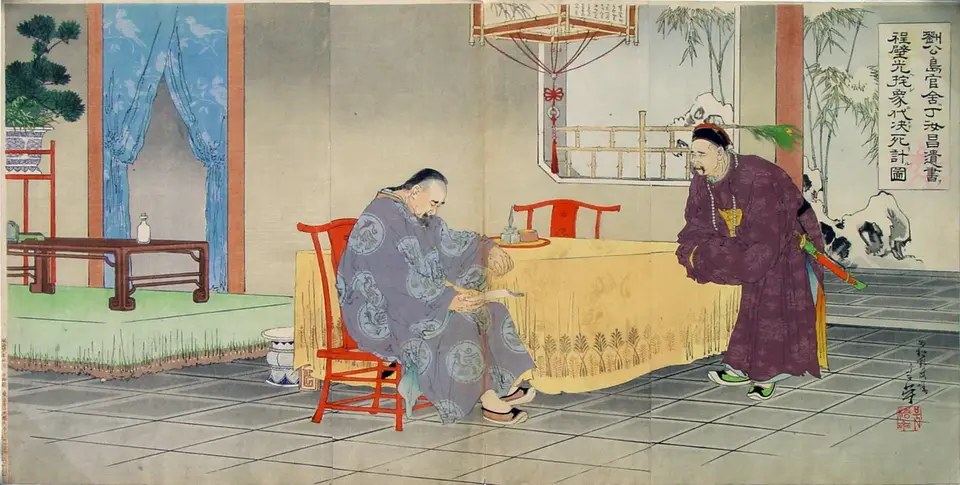
By mid-February, Liugong Island had become an inescapable tomb: casualties were catastrophic, food and fresh water were exhausted, and continuous bombardments raked the island. On February 5, Japanese Admiral Ito Sukeyuki sent an emissary with a personal letter urging Ding to surrender. Ito praised Ding's professional brilliance and invoked ancient historical precedents, urging him to seek temporary refuge in Japan until China embarked on modernizing reforms. Ding tossed the letter aside, declaring to his staff: "I shall never abandon the great duty owed to my state; today I have only death to fulfill my office."
On the morning of February 11, local civil intendant Niu Changbing and military officers, terrified of annihilation, conspired with foreign advisors to incite mutinous soldiers and sailors. A mob surrounded the naval headquarters, brandishing weapons and demanding that Ding sign a capitulation. Ding faced the mutineers without fear, rebuking their betrayal. Knowing that the situation was entirely hopeless and refusing to violate his oath, Ding retreated to his inner quarters. He consumed a fatal dose of raw opium, dying for his country at the age of fifty-eight.
Following Ding's death, Vice Admiral Liu Buchan and coastal fort commander Zhang Wenxuan committed suicide. Niu Changbing and his co-conspirators forged Ding's official seal to sign the Weihaiwei Capitulation, and the remnants of the fleet fell into Japanese hands. Deeply moved by Ding's unbending chivalry and sacrifice, Admiral Ito Sukeyuki refused to confiscate the unarmed training vessel Kangji. Instead, he permitted Chinese naval officers under Sa Zhenbing to transport the coffins of Ding Ruchang and other martyred commanders back to Yantai, while Japanese warships fired naval salutes as the funeral ship departed harbor.
However, the Qing imperial court reacted with vindictive scapegoating. Seeking to deflect public wrath over the humiliation of the Treaty of Shimonoseki, the Guangxu Emperor issued an edict confiscating Ding's personal property and forbidding his burial. Ding's black-lacquered coffin, bound in iron chains, was left in a dilapidated temple outside his native village for fifteen years, while his descendants were driven into impoverished exile.
Worldwide public opinion, however, acknowledged his bravery. Major Western newspapers, including The New York Times and Reuters, published extensive tributes honoring Ding's unwavering patriotism and tragic end, designating him the noblest commander of the conflict.
In 1910, the newly established Ministry of the Navy took up his cause. Veteran naval officers Sa Zhenbing and Tan Xueheng, joined by Navy Minister Prince Zaixun, submitted detailed memorials recounting Ding's battlefield heroism, refusal to surrender, and martyrdom. The Qing court formally rescinded the confiscation order, restored Ding's first-rank titles, and permitted an honorable burial in his ancestral home. Surviving naval personnel donated three days' pay to erect the Ding Temple on Liugong Island to commemorate his eternal loyalty. Ding Ruchang's devotion to naval defense and his ultimate sacrifice remain honored chapters in modern Chinese history.
FIGURES ASSOCIATED WITH THIS DYNASTY