Birth in Dangkou
Born into a distinguished scholarly lineage in Dangkou, Jingui County (modern Wuxi, Jiangsu).
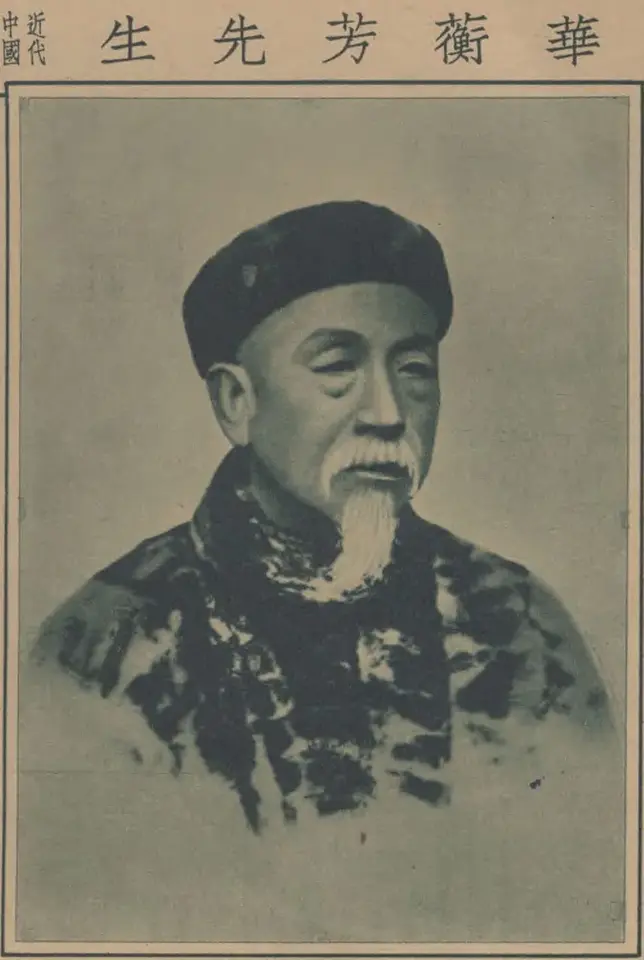
华蘅芳
Hua Hengfang (华蘅芳, 1833–1902), courtesy name Ruoting, was an eminent mathematician, mechanical engineer, scientific translator, and educator of the late Qing dynasty. Born into an elite scholar-gentry lineage in Dangkou, Wuxi, he demonstrated early mathematical genius, turning away from conventional civil service examinations to master traditional Chinese mathematical treatises alongside European astronomy and mathematics.…
Hua Hengfang (华蘅芳, 1833–1902), courtesy name Ruoting, was an eminent mathematician, mechanical engineer, scientific translator, and educator of the late Qing dynasty. Born into an elite scholar-gentry lineage in Dangkou, Wuxi, he demonstrated early mathematical genius, turning away from conventional civil service examinations to master traditional Chinese mathematical treatises alongside European astronomy and mathematics. Forming close lifelong intellectual partnerships with Li Shanlan and Xu Shou, he dedicated his life to scientific advancement. In 1861, Hua Hengfang and Xu Shou were recruited by Viceroy Zeng Guofan into the Anqing Inner Armory to study modern steam mechanics. In 1865, working without access to Western prototypes or engineering blueprints, Hua and Xu successfully engineered the Huanghu (Yellow Falcon), China's very first domestically designed and manufactured steam-powered wooden vessel. In 1868, Hua joined the Translation Department of the Jiangnan Arsenal in Shanghai, where he labored for over two decades in close collaboration with British scholars John Fryer and D. J. Macgowan. Translating over 160 volumes of seminal Western scientific texts—including Elements of Algebra, Differential and Integral Calculus, Probability, and Principles of Geology—he was the first to systematically introduce calculus, probability theory, and modern geology to China. In his later years, he directed science instruction at the Tianjin Military Academy, Shanghai Gezhi College, and Wuchang Ziqiang Institute, authoring Mathematical Manuscripts of the Xingsuxuan and Conversations on Mathematics. He died in 1902 at the age of seventy, remembered as a foundational patriarch of modern Chinese engineering and science.
Born into a distinguished scholarly lineage in Dangkou, Jingui County (modern Wuxi, Jiangsu).
Fled the Taiping Rebellion to Shanghai, forging an intimate friendship with mathematician Li Shanlan.
Recruited alongside Xu Shou into Zeng Guofan's Anqing Inner Armory to study modern steam machinery.
Successfully built China's first operational high-pressure steam engine model, commended in Zeng Guofan's diary.
Completed the Huanghu, China's first domestically built steamship, successfully launching it at Anqing.
Entered the Translation Department of the Jiangnan Arsenal, initiating a monumental translation project with John Fryer.
Completed the Chinese translation of Loomis's Calculus, systematically introducing differential and integral calculus to China.
Appointed Senior Mathematics Instructor at the Tianjin Military Academy by Viceroy Li Hongzhang.
Oversaw examinations and lectures in the physical sciences at the Shanghai Gezhi College.
Invited by Viceroy Zhang Zhidong to serve as Head Instructor of the Ziqiang Institute in Wuchang.
Declined imperial appointments to the Imperial University of Peking due to advancing age, retiring to teach in Wuxi.
Passed away peacefully at his residence in Dangkou, Wuxi, at age seventy, leaving the Xingsuxuan Sanguo.
Hua Hengfang was born in 1833 in Dangkou Town, Jingui County, near Wuxi, into an illustrious and prosperous scholar-official family. His father, Hua Yilun, was a local magistrate well-versed in historical annals and water control administration. From early childhood, Hua Hengfang showed remarkable precocity in quantitative calculation. At the age of eight, upon reading ancient classics such as the Nine Chapters on the Mathematical Art and Zhoubi Suanjing, he intuitively grasped the geometric logic of traditional rod calculation. He quickly felt revulsion toward the formulaic, sterile eight-legged essays demanded by the imperial examination system, immersing himself in celestial kinematics, trigonometry, and algebra.
In 1853, the armies of the Taiping Heavenly Kingdom captured Nanjing, plunging southern Jiangsu into violent warfare. Seeking refuge, Hua Hengfang moved to the treaty port of Shanghai. In Shanghai, Western scientific treatises were being translated and published through the Mohai Shuguan (London Missionary Society Press). During this period, Hua established contact with Li Shanlan, the preeminent Chinese mathematician of the era, who was then translating the final nine books of Euclid's Elements and Loomis's algebraic treatises alongside Alexander Wylie. Hua studied these drafts with boundless enthusiasm, marveling at the deductive rigor of Western mathematical analysis, and resolved to master modern natural sciences to revive the nation.
In 1860, as Taiping forces overran Changzhou and Wuxi, Hua Hengfang and his close associate Xu Shou fled into the mountains of southern Anhui. At that juncture, Viceroy Zeng Guofan of Liangjiang was establishing the Anqing Inner Armory, seeking indigenous mechanical talent capable of comprehending Western machinery. On the recommendation of Rong Hong and Li Hongyi, Zeng Guofan formally summoned Hua Hengfang and Xu Shou to his Anqing military headquarters in late 1861. Observing Hua's flawless understanding of mechanics and celestial calculations, Zeng placed him in charge of machinery research.
Confronting an absolute void of modern machine tools, industrial blueprints, or physical steamship models, Hua Hengfang and Xu Shou relied upon an abbreviated woodcut diagram published in Benjamin Hobson's Treatise on Natural Philosophy. Hua assumed responsibility for calculating steam cylinder pressure limits, piston displacement, and transmission gear ratios. In the autumn of 1862, they successfully assembled an operational high-pressure steam engine model, delighting Zeng Guofan.
In 1865, backed by provincial funding, Hua and Xu began constructing China's first indigenous wooden steam-powered vessel, named the Huanghu (Yellow Falcon). Measuring over fifty-five feet in length with a displacement of twenty-five tons, the ship was built entirely by local craftsmen under Hua's mathematical guidance. Late that year, the Huanghu launched successfully into the Yangtze River at Anqing, achieving a speed of more than twenty li per hour against the current. Zeng Guofan boarded the vessel for an inspection tour, recording in his personal diary that Westerners who witnessed the trial marveled at the feat, marking the birth of China's modern shipbuilding industry.
In 1867, Zeng Guofan and Li Hongzhang expanded the Jiangnan Arsenal in Shanghai, inaugurating an internal Translation Department. In 1868, Hua Hengfang was recruited to join the department, embarking on an extraordinary twenty-four-year collaboration with British sinologist John Fryer and American physician D. J. Macgowan.
The methodology of nineteenth-century scientific translation was intensely demanding. Foreign scholars orally rendered Western texts into spoken Chinese, while Chinese scholars translated and transcribed them into classical literary prose. Hua Hengfang transcended the passive role of a scribe. Drawing upon his profound mathematical knowledge, he recalculated every theorem, algebraic equation, and geometric proof orally presented by Fryer, demanding clarification whenever discrepancies arose. He also worked with Xu Shou to coin hundreds of precise Chinese scientific terms that remain in standard use today, such as "calculus" (weiji) and "probability" (jueli).
During his tenure at the Arsenal, Hua translated seventeen major treatises across more than 160 volumes. In mathematics, he translated Augustus De Morgan's Elements of Algebra, Elias Loomis's Elements of Analytical Geometry and of the Differential and Integral Calculus, and Thomas Galloway's Treatise on Probability, systematically introducing higher calculus and probability theory to East Asia for the first time. In natural history, he translated Charles Lyell's Elements of Geology and James Dwight Dana's System of Mineralogy, introducing modern tectonic theories, crystallography, and evolutionary stratigraphy. His monumental translation corpus represented the high-water mark of scientific transmission during the Self-Strengthening Movement.
In 1887, Viceroy Li Hongzhang founded the Tianjin Military Academy to modernize imperial defense, appointing Hua Hengfang as Senior Mathematics Instructor. Over five years, Hua structured an innovative curriculum combining Euclidean geometry, trigonometry, ballistics, and surveying, training a new generation of technologically proficient military officers.
In 1892, Hua took charge of scientific lecturing and testing at the Shanghai Gezhi College, promoting practical experimentation over rote recitation. In 1896, Viceroy Zhang Zhidong established the Ziqiang Institute (the historical predecessor of Wuhan University) in Wuchang, appointing Hua as Head Instructor and Director of Mathematics. Now in his sixties, Hua oversaw the institute's transformation into a major center of higher technical learning along the middle Yangtze.
During the Hundred Days' Reform in 1898, Imperial Minister Li Duanfen recommended Hua to direct mathematics at the Imperial University of Peking. However, plagued by failing hearing and physical exhaustion, Hua declined the honor, resigning his post in Wuchang to return to his ancestral home in Wuxi. In his final years, he compiled his lifelong mathematical findings into the twenty-six-volume Mathematical Manuscripts of the Xingsuxuan, formulating original solutions in combinatorial mathematics and finite differences. He died peacefully in Wuxi in the autumn of 1902 at the age of seventy.
Hua Hengfang's co-creation of the Huanghu in 1865 stood as an epochal breakthrough in Chinese industrial history. Overcoming the technological embargo maintained by foreign powers, Hua solved complex mechanical challenges involving piston pressure, gear pitch, and hydrodynamics purely through mathematical deduction. The successful launch of the Huanghu demolished the colonial myth that Chinese minds could not master modern industrial engineering, directly inspiring the foundation of the Jiangnan Arsenal and launching modern Chinese maritime engineering.
Hua Hengfang's translation career at the Jiangnan Arsenal laid the conceptual foundations of modern Chinese mathematics. His translation of Loomis's Calculus (Weiji Suoyuan) in 1874 introduced the concepts of limits, differentials, and integrals to Chinese scholars, unlocking the language of modern physics and mechanics. Furthermore, his translation of Galloway's Treatise on Probability (Jueyi Shuxue) introduced probability theory and mathematical statistics to East Asia. His elegant terminology provided modern Chinese scientific discourse with a systematic technical vocabulary.
Hua Hengfang was an exceptionally creative theoretical mathematician. In his Mathematical Manuscripts of the Xingsuxuan, he synthesized traditional Chinese root-extraction methods from the Nine Chapters on the Mathematical Art with modern binomial expansion theorems in his treatise Ancient Meaning of Root Extraction (Kaifang Guyi). In Root Extraction and Ladder Calculation (Shugen Tisuan), he formulated innovative recursive techniques for high-order arithmetic progressions and finite difference equations, winning acclaim from contemporary scholars as a master who seamlessly integrated ancient Chinese algorithmics with Western higher mathematics.
Hua Hengfang was an indispensable pioneer of modern science pedagogy in late nineteenth-century China. At the Tianjin Military Academy and the Wuchang Ziqiang Institute, he dismantled the millennia-old monopoly of literary examination essays, instituting rigorous laboratory exercises, field surveying, and quantitative examinations. His lucid textbook Conversations on Mathematics (Xuesuan Bitan) demystified Western mathematical principles for thousands of aspiring scholars, nurturing the pioneer generation of Chinese engineers who built the railroads, naval vessels, and telegraph networks of the early twentieth century.
FIGURES ASSOCIATED WITH THIS DYNASTY