Birth in Chaozhou
Born into a prominent Hakka family in Tangkeng, Fengshun County, Chaozhou Prefecture; demonstrated exceptional early aptitude in mathematics, geography, and military treatises.
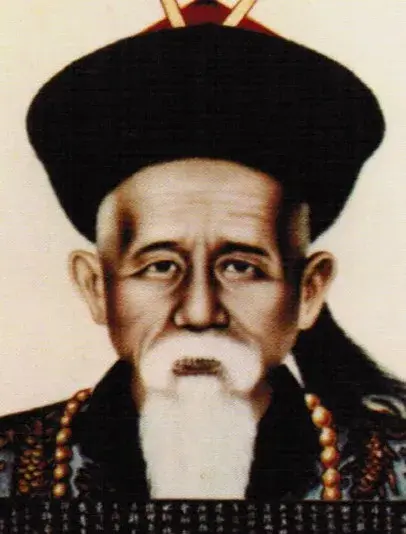
丁日昌
Ding Richang (丁日昌, July 8, 1823 – February 27, 1882), clan name Renshou, courtesy name Chijing, art name Yusheng, was a native of Tangkeng Town, Fengshun County, Chaozhou Prefecture, Guangdong Province (modern Meizhou, Guangdong Province), who settled in Rongcheng, Jieyang County in his later years. He was a distinguished late Qing statesman, military reformer, preeminent pioneer of the Self-Strengthening Movement, naval…
Ding Richang (丁日昌, July 8, 1823 – February 27, 1882), clan name Renshou, courtesy name Chijing, art name Yusheng, was a native of Tangkeng Town, Fengshun County, Chaozhou Prefecture, Guangdong Province (modern Meizhou, Guangdong Province), who settled in Rongcheng, Jieyang County in his later years. He was a distinguished late Qing statesman, military reformer, preeminent pioneer of the Self-Strengthening Movement, naval strategist, and celebrated bibliophile, honored as one of the Eight Worthies of Hakka heritage. Beginning his career by organizing local defense militias against regional secret societies, Ding served in the military secretariats of Zeng Guofan and Li Hongzhang. Appointed Intendant of the Su-Song-Tai Circuit (Shanghai Intendant) in 1864, he recognized the imperative to transition from artisanal handcraft to automated manufacturing, purchasing the American-owned Russell & Company Machine Works to establish China's first modern large-scale military manufacturing facility—the Jiangnan Machinery Manufacturing Bureau (Jiangnan Arsenal)—in 1865. Elevated to Governor of Jiangsu in 1868, he purged administrative corruption, cleared an astonishing backlog of 270,000 legal dockets, created Western-drilled provincial trained units (Lianjun), and tested naval grain transport by steamship. As Director-General of the Foochow Arsenal and Acting Governor of Fujian, he directed coastal defense and Taiwanese governance, overseeing the construction of China's first self-built telegraph line (connecting Qihou to Tainan and Anping), developing the Keelung coal mines, and inaugurating Taiwan's early modernization. A strategist of exceptional foresight, Ding formulated the "Three Oceans Fleet" naval doctrine advocating modern ironclads, facilitated China's first educational missions sending students to the United States and naval cadets to Europe (including Yan Fu and Liu Buchan), and accurately forecasted Japanese and French imperialist expansions in the western Pacific. He died in Jieyang in 1882, honored with state funeral rites and memorial shrines.
Born into a prominent Hakka family in Tangkeng, Fengshun County, Chaozhou Prefecture; demonstrated exceptional early aptitude in mathematics, geography, and military treatises.
Earned the xiucai degree; admitted to the secretariat of Circuit Intendant Li Zhangyu to study practical administration.
Led three hundred Tangkeng militia volunteers across Lingjiao Pond, shattering Triad rebel camps at Dongjin and lifting the siege of Chaozhou.
Conferred the post of Educational Instructor in Qiongzhou, Hainan; reassigned the following autumn as Magistrate of Wan'an County in Jiangxi.
Governed Wan'an for four months with exemplary judicial integrity; tens of thousands of citizens burned incense to bid him farewell upon his departure.
Dismissed following the fall of Luling to Taiping forces; recruited by Zeng Guofan to assist in logistics and foreign armaments procurement.
Founded bomb-manufacturing bureaus in Guangzhou and Shanghai, producing explosive ordnance that aided the Huai Army in recapturing Changzhou.
Promoted to Su-Song-Tai Intendant and Customs Superintendent; acquired Russell & Company's Iron Works to develop indigenous machine tooling.
Formally established the Jiangnan Arsenal, serving as its first director-general; established the Pudong Artillery Academy; reassigned as Lianghuai Salt Commissioner.
Advanced to Jiangsu Administration Commissioner; submitted memorials to Zeng Guofan proposing the creation of a Three Oceans Naval Fleet.
Promoted to Governor of Jiangsu; launched trial steamship grain transport to Tianjin, and launched the steam warship Tianji.
Cleared 270,000 judicial backlogs across Jiangsu; resigned upon the death of his mother to observe traditional mourning in Jieyang.
Dispatched to Tianjin to assist Li Hongzhang; recommended by Shen Baozhen as Director-General of the Foochow Arsenal and Acting Governor of Fujian.
Inspected Taiwan across mountain frontiers; constructed China's first self-built telegraph line and established mechanized coal extraction in Keelung.
Conferred viceroy rank to manage southern naval defense and named Zongli Yamen Minister; submitted sixteen strategic maritime defense articles.
Died at his residence in Jieyang at the age of fifty-nine; the emperor granted imperial funeral funds and commissioned commemorative monuments.
Ding Richang was born on July 8, 1823, in Jinwuwei, Tangkeng, Fengshun County, Chaozhou Prefecture, Guangdong Province (modern Meizhou City). Descended from a prominent Hakka lineage, Ding was steeped in family learning from early childhood. Endowed with a keen intellect, he supplemented traditional Confucian classics with rigorous studies in Western mathematics, cartography, hydraulics, and artillery treatises. In 1842, at age twenty, he achieved the xiucai degree, earning a government stipend the following year.
In 1844, Ding was engaged as a private secretary by Li Zhangyu, Intendant of the Hui-Chao-Jia Circuit. During this secretarial apprenticeship, Ding acquired profound practical insight into grassroots administration and bureaucratic realities. In July 1854, Wu Zhongshu led tens of thousands of Triad insurgents to besiege the prefectural seat of Chaozhou. With imperial garrisons crumbling, Ding organized three hundred local militia volunteers from Tangkeng and rushed to relieve Chaozhou, stationing his force at Hanshan Academy. On the morning of September 18, Ding personally led his men across Lingjiao Pond, launching a dawn surprise attack against the rebel camp at Dongjin. His militia captured over one hundred rebel leaders, instantly lifting the siege on the eastern front. Later that year, when Tiandihui rebels threatened Jiaying Prefecture, Ding devised a scorched-earth defensive strategy that annihilated the attackers.
In recognition of his military contributions, the Qing court appointed Ding as Educational Instructor of Qiongzhou Prefecture on Hainan Island in 1857. In the autumn of 1858, he was promoted to Magistrate of Wan'an County in Jiangxi Province. Wan'an had suffered heavily from Taiping incursions; the local docket was overwhelmed by unresolved lawsuits, and corrupt clerks extorted litigants. Ding implemented an expeditious judicial system, examining case files deep into the night, strictly punishing predatory gentry, and eliminating wrongful indictments. When he was reassigned after four months, tens of thousands of grateful townspeople lined the roads, setting up banquet tables and burning incense to bid him farewell.
In 1861, Ding was appointed acting magistrate of Luling County. When Taiping general Lai Wenguang overran the city, Ding was dismissed from office in accordance with statutory regulations. Recognizing Ding's strategic acumen and mastery of weaponry, Imperial Commissioner Zeng Guofan invited him to join his headquarters at Qimen, Anhui, appointing him military secretary to supervise ordnance procurement, fiscal logistics, and foreign negotiations.
In 1862, Zeng Guofan sent Ding to Guangdong to supervise likin revenues. Arriving in Guangzhou, Ding demonstrated extraordinary technical skill in military engineering. Confronting Taiping forces equipped with Western firearms, Ding designed and manufactured thirty-six advanced short explosive mortars and two thousand explosive shells at Yantang in the Guangzhou suburbs, proving immensely effective in field trials.
In 1863, Ding established a formal munitions bureau at Yantang. Jiangsu Governor Li Hongzhang summoned him to Shanghai to establish the Shanghai Munitions Bureau, manufacturing 18-pounder and 48-pounder explosive artillery shells. These munitions were deployed by the Huai Army in recapturing Changzhou and Wuxi. For these achievements, Ding was promoted to Independent Sub-prefect and awarded the peacock feather.
During this period, Ding's strategic worldview underwent a profound transformation. He concluded that the domestic Taiping insurgency was nearing its end, while Western colonial empires advancing by sea posed an existential threat to China. In August 1864, he submitted a memorial to Li Hongzhang warning that Western powers exploited China's vulnerabilities through gunboat diplomacy, insisting that China must master foreign technology to counter foreign encroachment. In Shanghai, Ding familiarized himself with foreign factory methods, and Wang Tao's treatise Huoji Shuolüe deepened his understanding of steam-driven machine tools. Ding recommended Wang Tao to Li Hongzhang and advocated building modern shipyards rather than relying on manual labor.
Ding recognized the fundamental limitations of traditional craftsmanship: clay blast furnaces could not produce modern weapons-grade steel, and manual mold casting could not produce rifled barrels. When Yung Wing proposed purchasing foreign machine-building tools to create an indigenous manufacturing base, Ding passionately championed the concept.
In late 1864, as Su-Song-Tai Intendant, Ding purchased the American-owned Russell & Company Iron Works in Hongkou, integrating it with local munitions bureaus and installing modern machinery purchased by Yung Wing in the United States. In September 1865, China's first modern large-scale military industrial enterprise—the Jiangnan Machinery Manufacturing Bureau (Jiangnan Arsenal)—was formally inaugurated in Shanghai, with Ding serving as its first director-general. Ding established strict managerial regulations, hiring foreign technical instructors while ensuring Chinese artisans attained autonomous operational mastery. He also established an artillery school in Pudong to train specialized gunnery officers. In August 1868, the arsenal launched its first self-constructed steam-powered paddle-wheel warship, the Tianji, a 600-ton vessel armed with nine cannons whose performance surpassed contemporary vessels constructed at Japan's Yokosuka shipyard.
In October 1865, Ding was appointed Lianghuai Salt Distribution Commissioner. Confronting rampant smuggling and institutional corruption, he conducted undercover field investigations across coastal salt pans, authoring a meticulous 100,000-word survey. He promulgated the Lianghuai Salt Regulations and Northern Huai Summary, curbing illicit trading, prosecuting venal inspectors, and vastly increasing imperial salt revenues.
In January 1867, Ding became Jiangsu Administration Commissioner, and in January 1868, he was promoted to Governor of Jiangsu, based in Suzhou. Following a decade of devastation under Taiping occupation, Jiangsu was plagued by ruin, displaced refugees, and lawlessness. Ding launched a sweeping administrative restoration.
To reform the grain tribute and land taxation, Ding instituted examination evaluations for expectant officials and promulgated the sixteen-article Jiangbei Grain and Cash Regulations, prohibiting rural magnates from shifting tax obligations onto impoverished smallholders while abolishing customary yamen gratuities. He banned gentry-operated private prisons and personally reviewed accumulated dockets. Over his tenure, his administration cleared an extraordinary backlog of 270,000 civil and criminal cases, winning universal acclaim. The Shanghai Shen Bao praised his governance as rivaling Zhuge Liang's administration of Shu.
In military reform, Ding introduced the Western-drilled Lianjun (Trained Units) system to modernize the Green Standard Army. In 1869, he disbanded six hundred redundant troops from the governor's brigade, forming two elite battalions armed with breech-loading rifles and field guns. He translated Western tactical manuals, illustrating and publishing the Battalion Drill Manual (Yiying Caoyan Tushuo) and Platoon Drill Manual (Yishao Caoyan Tushuo), establishing the earliest standard Western drill system for Chinese armies.
In April 1868, Ding chartered nine modern steamships to transport 30,000 dan of tribute rice directly to Tianjin, pioneering modern maritime grain shipping. In July 1870, during provincial examinations in Nanjing, he dispatched the arsenal-built gunboats Caojiang and Tianji to transport candidates free of charge, dispelling traditional gentry prejudices against steamships. However, his aggressive reforms provoked fierce backlash from conservative courtiers like Wang Jiabi, who submitted three vitriolic memorials attacking him. Following the death of his mother in late 1870, Ding resigned to observe filial mourning in Jieyang for three years.
In June 1875, Ding was summoned to Tianjin to assist Li Hongzhang in maritime defense deliberations. In September, on Shen Baozhen's recommendation, the court appointed Ding Director-General of the Foochow Arsenal and Acting Governor of Fujian. Arriving in Fuzhou during catastrophic floods that submerged the provincial capital, Ding personally distributed flood relief aboard boats, rescuing tens of thousands of marooned residents.
Between 1876 and 1877, Ding made repeated inspection tours of Taiwan. Following the 1874 Japanese expedition to Mudan, imperial authorities recognized Taiwan's vulnerability. Ding traversed the island's mountainous terrain to oversee defense and administrative integration.
Ding launched an extensive pacification and development campaign across Taiwan. In southern Fengshan, he concluded pacification agreements with the Mudan, Shitou, and Guiwen indigenous tribes. For central indigenous settlements unaccustomed to wet-rice agriculture, the government distributed seed grain, hired experienced Han farmers to teach transplantation techniques, and established community schools. He abolished oppressive fishing duties across Taiwan. During examinations in Tainan, Ding discovered the thirteen-year-old child prodigy Chiu Feng-chia, naming him top of the examination list, presenting him with a seal inscribed "East Ning Prodigy," and sponsoring his advanced education, nurturing one of Taiwan's future patriotic leaders.
Ding spearheaded critical infrastructure development across Taiwan. Securing provincial funding, he surveyed and erected a 95-li telegraph line connecting Qihou (modern Kaohsiung) through Tainan to Anping. This project was the first telegraph line surveyed, engineered, and constructed entirely by Chinese personnel, inaugurating modern telecommunications in China. Earlier in Fujian, he negotiated with the Danish Great Northern Telegraph Company to acquire the Fuzhou-Luoxingta line as China's first state-owned telegraph installation. In northern Taiwan, Ding mechanized the Keelung coal mines, installing steam pumps and brick kilns, while drafting blueprints for a north-south trans-island railway.
Ding collaborated with Shen Baozhen and Li Hongzhang to select thirty-five outstanding cadets from the Foochow Arsenal Naval Academy for advanced training in Britain and France, cultivating prominent figures such as scholar Yan Fu and naval commanders Liu Buchan, Sa Zhenbing, Lin Taizeng, and Fang Boqian.
In diplomatic affairs, Ding defended national sovereignty with unwavering resolve. In Shanghai, he successfully negotiated the complete withdrawal of British and French garrison forces that had occupied urban sectors since 1860, and reclaimed the strategic Wusong Fort. In Fujian, he resolved the protracted Wushishan Church Dispute, reviewing historical land registries to prove that British missionaries had unlawfully encroached upon the scenic mountain, ultimately compelling the British church to relocate outside the city.
In August 1877, plagued by chronic respiratory illness and malarial fever contracted in Taiwan, Ding resigned to convalesce in Jieyang, establishing the Bailandan Hall library while monitoring international developments.
As early as 1867, Ding had submitted a visionary maritime defense memorial to Zeng Guofan, arguing that static shore batteries and wooden war-junks were obsolete against steam-powered ironclads. He maintained that true coastal defense required command of the sea, proposing the creation of a Three Oceans Fleet divided into Northern (Beiyang, protecting Zhili and Shandong), Eastern (Dongyang, guarding Jiangsu and Zhejiang), and Southern (Nanyang, defending Fujian and Guangdong) squadrons, each centered around six modern ironclads. This operational framework served as the foundational blueprint for the later Beiyang and Nanyang fleets.
Following Japan's formal annexation of the Ryukyu Kingdom in 1879, Ding submitted his celebrated Sixteen Articles on Maritime Defense, issuing a prophetic warning: "Japan's annexation of Ryukyu exposes its predatory ambitions; within three to five years, if it does not strike south against Taiwan, it will surely strike north against Korea." This brilliant strategic forecast was tragically confirmed during the First Sino-Japanese War of 1894–1895 and the subsequent seizure of Taiwan. Ding emphasized that "popular welfare is the true bedrock of coastal defense," urging the court to relieve peasant hardships.
In 1881, observing French colonial encroachment in Vietnam, Ding memorialized the Zongli Yamen, warning that if Vietnam fell, it would become another Ryukyu, and urged military cooperation with Vietnamese forces while supervising Chinese translations of French border surveys.
In 1879, the court conferred upon Ding the title of Viceroy and appointed him Southern Seas Defense Commissioner and Minister of the Zongli Yamen, but severe illness prevented his return to Beijing. On February 27, 1882, Ding died at his Jieyang residence at the age of fifty-nine. The Guangxu Emperor issued an imperial eulogy praising his lifelong devotion, allocating imperial funds for a state tomb in western Jieyang.
An avid bibliophile, Ding rescued over 40,000 volumes of rare Song and Yuan editions dispersed during wartime, assembling a private collection exceeding 100,000 volumes at his Bailandan Hall (Chijingzhai). Cataloged in the five-volume Chijingzhai Bibliography, his collection rivaled the Tianyi Pavilion and Haiyuan Pavilion, securing his place as one of the four great book collectors of the late Qing dynasty.
Ding's establishment of the Jiangnan Machinery Manufacturing Bureau in Shanghai in 1865 was a watershed moment in Chinese modern history. Ding was among the first statesmen to grasp the crucial importance of mechanized industrial production over artisanal handicraft.
By acquiring Russell & Company's Iron Works and incorporating domestic munitions shops, he created China's premier heavy industrial complex. He drafted China's first modern factory management codes and established the principle of employing foreign instructors to train native technicians. The arsenal produced advanced rifled artillery, gunpowder, and machine tools, launching the steam warship Tianji in 1868, laying the institutional and technological foundations of China's defense industry.
During his governance of Taiwan between 1876 and 1877, Ding laid the institutional foundations for Taiwan's modernization. Recognizing the strategic threat posed by foreign powers, he executed transformative civil engineering initiatives.
He surveyed, financed, and constructed a 95-li telegraph line from Qihou to Tainan and Anping, the first land telegraph network designed, engineered, and constructed entirely by Chinese hands. He expanded mechanized coal extraction in Keelung, introduced agricultural education for indigenous communities, drafted plans for a trans-island railway, and sponsored young talent such as Chiu Feng-chia, making him one of the foremost developers of nineteenth-century Taiwan.
Ding was an early pioneer in recognizing the strategic supremacy of modern naval power over static coastal forts. In detailed memorials submitted in 1867 and 1868, he formulated China's first comprehensive naval modernization doctrine.
He proposed the establishment of three coordinated regional fleets—the Northern, Eastern, and Southern Seas squadrons—each equipped with six modern ironclad warships and amphibious marine units. Ding's conceptualization provided the theoretical architecture for the later establishment of the Beiyang Fleet, transforming traditional passive coastal defense into a forward-operating naval doctrine.
Governing Jiangsu from 1868 to 1870, Ding spearheaded the earliest practical conversion of Green Standard Army units into modern rifle infantry.
He organized the Jiangsu Lianjun (Trained Units), equipping them with modern breech-loaders and artillery. Ding supervised the translation and compilation of Western drill manuals, authoring the Battalion Drill Manual and Platoon Drill Manual. These works provided the earliest standardized Western drill curriculum in China, establishing an operational model replicated across neighboring provinces.
Ding placed human capital at the core of national self-strengthening. When Yung Wing proposed sending young students to study in the United States, Ding joined Zeng Guofan and Li Hongzhang in overcoming conservative opposition, securing imperial sanction for the Chinese Educational Mission that produced railway pioneer Zhan Tianyou.
As Director-General of the Foochow Arsenal, Ding selected thirty-five naval cadets to attend premier naval academies and shipyards in Great Britain and France, directly training enlightenment thinker Yan Fu and naval commanders Liu Buchan and Sa Zhenbing, fostering the intellectual vanguard of late Qing modernization.
Ding was a tireless proponent of commercial shipping and modern mining. In 1864, he petitioned the Zongli Yamen to encourage Chinese merchants to invest in joint-stock steam navigation companies, and in 1868, he conducted trial voyages carrying tribute rice by steamship to Tianjin, directly inspiring the subsequent establishment of the China Merchants' Steam Navigation Company.
He strongly advocated developing the Kaiping Coal Mines in Zhili and Keelung Coal Mines in Taiwan to fuel naval fleets and commercial industries. He also championed civil service examination reform to include modern sciences, and advocated establishing overseas consulates to protect Chinese migrant laborers from exploitation.
Throughout his diplomatic career, Ding defended sovereign rights with firm determination. In Shanghai, he successfully negotiated the evacuation of British and French garrison forces and reclaimed the Wusong Fort. In Fujian, he resolved the Wushishan Church Dispute, enforcing municipal land boundaries against foreign encroachment.
His geopolitical foresight was extraordinary. In his 1879 Sixteen Articles on Maritime Defense, he predicted that Japan would strike south at Taiwan or north at Korea within five years, a warning vindicated by the First Sino-Japanese War. In 1881, he warned that French colonial advances in Indochina threatened southwestern China, demonstrating exceptional strategic acumen.
Beyond statecraft, Ding was one of the four great private book collectors of nineteenth-century China. Following the destruction of the Taiping wars, he rescued more than 40,000 rare Song and Yuan editions across the Jiangnan region, establishing the Bailandan Hall library holding over 100,000 volumes.
Working with bibliographers Mo Youzhi and Jiang Biao, he compiled the Chijingzhai Bibliography, preserving invaluable cultural heritage. He financed the reprinting of Sima Guang's Comprehensive Mirror in Aid of Governance (Zizhi Tongjian) and established community academies in Chaozhou and Fengshun, leaving an enduring scholarly legacy.
FIGURES ASSOCIATED WITH THIS DYNASTY