Born into Tangut Lineage
Born in Bao'an Commandery into a hereditary Tangut military family; second son of general Liu Yanqing.
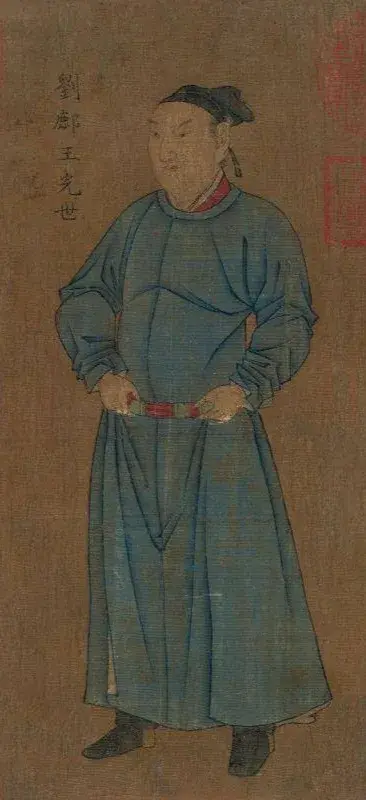
刘光世
Liu Guangshi (刘光世, 1089–December 2, 1142), courtesy name Pingshu, was a native of Bao'an Commandery (modern Zhidan County, Yan'an, Shaanxi). Born into a prominent hereditary Tangut military lineage serving the Song border defense, he was the second son of Liu Yanqing, Military Commissioner of Zhenhai. Reaching the pinnacle of military honors, he was celebrated alongside Yue Fei, Han Shizhong, and Zhang Jun as one of the "Four…
Liu Guangshi (刘光世, 1089–December 2, 1142), courtesy name Pingshu, was a native of Bao'an Commandery (modern Zhidan County, Yan'an, Shaanxi). Born into a prominent hereditary Tangut military lineage serving the Song border defense, he was the second son of Liu Yanqing, Military Commissioner of Zhenhai. Reaching the pinnacle of military honors, he was celebrated alongside Yue Fei, Han Shizhong, and Zhang Jun as one of the "Four Great Generals of Resurgence" (Zhongxing Sijiang) of the early Southern Song, later posthumously ennobled as the Prince of Fu, heading the seven posthumous princes of the Southern Song dynasty. Entering civil service through hereditary privilege, Liu accumulated early battlefield distinction in the late Northern Song, subduing the Fang La rebellion in southeast China and defeating Western Xia incursions at Xingzibao in 1126, which elevated him to Commander of the Cavalry Guards. Following the collapse of the Northern Song in the Jingkang Incident, Liu led his veteran troops to join Prince Kang (Zhao Gou) at Jining, becoming a founding pillar of the newly established Southern Song and the very first general to receive the rank of military commissioner (Jiedushi) under Emperor Gaozong. Throughout the Jianyan and Shaoxing eras, Liu commanded the defense of the Yangtze and Huai river basins, assisting in the suppression of the Miao-Liu rebellion, attaining the supreme ranks of Grand Commandant, Concurrent Chancellor, and Military Commissioner of Three Circuits. His command, the Left Campaign Guard Army, numbered over fifty thousand troops, forming one of the largest field armies of the early Southern Song. In frontier warfare against the Jurchen Jin and puppet Qi regimes, Liu proved adept at psychological warfare, famously casting special "Recruiting Trust Coins" (Zhaona Xinbao) to induce mass defections among Jin auxiliaries under Wanyan Chang. However, his overall generalship was heavily criticized by contemporaries and later historians for chronic cowardice, indulgence of undisciplined troops, inflation of military rolls for fiscal extraction, and frequent retreat from frontline engagements. In 1137 (Shaoxing 7), Prime Minister Zhang Jun secured his dismissal from military command, triggering the catastrophic Huaixi Mutiny in which his subordinate Li Qiong led forty thousand veteran soldiers to defect to the puppet Qi state. After brief subsequent reappointments without independent troops, Liu retired to Lin'an, passing away in 1142 at age fifty-four. He was posthumously granted the rank of Grand Preceptor and the title "Wuxi," later elevated to Prince of Fu.
Born in Bao'an Commandery into a hereditary Tangut military family; second son of general Liu Yanqing.
Followed his father to crush Fang La's insurgent strongholds in Quzhou and Wuzhou; promoted to Observation Commissioner.
Accompanied the campaign to capture Yizhou; failed to reinforce the vanguard during the assault on Yanjing, suffering demotion.
Decisively repelled a Western Xia invasion at the strategic defiles of Xingzibao; promoted to Cavalry Guard Commander.
Joined Emperor Gaozong with three thousand veterans at Jining; appointed Military Commissioner of Fengguo, the first under Southern Song.
Retreated across the Yangtze from Tianchang; assisted Han Shizhong in crushing the Miao-Liu rebellion, promoted to Grand Commandant.
Appointed Commander of Imperial Patrol Guards; held the Huai river defenses and deployed psychological currency against Wanyan Chang.
Appointed Pacification Commissioner of Jiangdong and Huaixi, establishing headquarters at Chizhou and Jiankang against puppet Qi invasions.
Concurrently granted the Baojing Circuit, becoming the second commander after Han Shizhong to govern three military circuits.
Attempted to abandon Luzhou during Liu Lin's offensive; forced by Zhang Jun to hold the lines, defeating Qi vanguards at Huoqiang.
Impeached by Zhang Jun for military inertia and relieved of command; subordinate Li Qiong led forty thousand troops to defect to Qi.
Recalled as Pacification Commissioner of the Three Capitals during the Jin invasion; lacked personal troops to achieve major victories.
Passed away in Lin'an on December 2 at age fifty-four; posthumously granted Grand Preceptor, title "Wuxi," and created Prince of Fu.
Liu Guangshi was born in 1089 (Yuanyou 4, Northern Song), receiving the courtesy name Pingshu. His ancestral home was Bao'an Commandery (modern Zhidan County, Shaanxi Province). The Bao'an Liu lineage was among the most celebrated Tangut tribal military families defending the northwestern frontier. Having submitted to the Song court during the reign of Emperor Renzong, they became loyal frontier guardians, adopting the imperial Han surname Liu. By the generation of his father, Liu Yanqing, the family stood as supreme leaders of the legendary Western Army (Xijun), with Liu Yanqing rising to Military Commissioner of Zhenhai. Raised in this martial environment, Liu Guangshi was schooled in horsemanship, archery, and cavalry tactics from early youth.
Leveraging his father's rank, Liu entered officialdom through hereditary shadow privilege as a minor staff officer, advancing through frontier posts to become Army Supervisor of Fuyan Circuit and Defense Commissioner of Qizhou. In 1121 (Xuanhe 3), when the Fang La rebellion erupted across southeast China, Liu Yanqing was appointed expeditionary commander-in-chief, taking Liu Guangshi south. Liu demonstrated notable tactical audacity, leading an unexpected flanking maneuver through rugged mountain terrain to capture Quzhou and Wuzhou, shattering the rebel lines. For this victory, he was promoted to Observation Commissioner of Yaozhou and Military Controller of Fuyan.
In 1122, the Song launched a massive northern expedition against the dying Liao Dynasty. Liu accompanied his father in capturing Yizhou, advancing to Senior Commission Commissioner. However, during the decisive battle to storm Yanjing, commander-in-chief Liu Yanqing ordered Guo Yaoshi to launch an urban commando raid, instructing Liu Guangshi to advance immediately with the main reserve. Liu hesitated and failed to arrive, leaving the vanguard isolated and precipitating a catastrophic Song rout. Consequently demoted three ranks, Liu redeemed his standing shortly afterward in Hebei, where he feigned retreat to lure rebel leader Zhang Di into an ambush, routing the insurgent army and regaining his full ranks.
In 1126 (Jingkang 1), the Jurchen Jin launched their initial siege of Bianjing. Simultaneously, Western Xia cavalry coordinated an invasion along the northern borders. The Xia host struck the strategic outpost of Xingzibao along the Xingzi River in northern Shaanxi. Recognizing the terrain's defensive value, Liu seized the twin rocky ridges overlooking the defile, unleashing massed crossbow volleys that decimated the invaders. For this victory, Emperor Qinzong elevated him to Commander of the Cavalry Guards, making him the second-ranking officer of the imperial cavalry.
In November 1126, Jin armies encircled Bianjing for the second time. Liu marched east with three thousand elite Western Army cavalry to relieve the capital. Mid-march, the imperial court issued a countermanding decree ordering relief armies to halt. In April 1127, while billeted at Weishi, Liu learned that Bianjing had fallen and both emperors were captured. Receiving directives from the grand marshalate, Liu marched to Jining, encountering Prince Kang (Zhao Gou) at Xinxingzhen as the prince journeyed toward Shangqiu to ascend the throne. His three thousand battle-hardened troops provided Emperor Gaozong with his most dependable initial bodyguard, earning Liu the vital post of Director of the Grand Marshal's Five Armies.
Following Emperor Gaozong's enthronement in May 1127, Liu was named Director of the Imperial Encampment and Metropolitan Inspector. In August, after suppressing rebel warlord Li Yu in Shandong and recapturing Jining, Gaozong rewarded him with the commission of Military Commissioner of Fengguo. Liu thus became the very first general of the nascent Southern Song dynasty to achieve the prestigious status of military commissioner.
In February 1129 (Jianyan 3), five hundred elite Jurchen cavalry made a lightning raid on Tianchang, compelling Emperor Gaozong to flee across the Yangtze in panic. Liu's army disintegrated without offering battle, fleeing south across the river. He was subsequently appointed Defense Commissioner of the Five Armies, tasked with garrisoning Zhenjiang to guard the Yangtze. In April, when palace officers Miao Fu and Liu Zhengyan staged a coup in Hangzhou, Liu joined Han Shizhong and Zhang Jun in launching a loyalist counter-offensive that suppressed the mutiny, earning promotion to Grand Commandant and Vice Commissioner of the Imperial Encampment. In September, when Jin forces under Wanyan Zongbi crossed at Huangzhou, Liu abandoned his posts at Taiping and Chizhou, retreating south toward Jiangzhou.
In 1130 (Jianyan 4), brigand leader Li Qiong surrendered to Liu with thousands of troops, becoming an officer in his vanguard. The court reorganized Liu's forces into the Imperial Patrol Guard, naming him Commander-in-Chief, Concurrent Chancellor, and Administrator of Zhenjiang. When Jin general Wanyan Chang besieged Chuzhou, Liu defied imperial decrees commanding relief, dispatching only minor cavalry detachments under Wang De and Li Qiong to harass enemy lines, passively watching Chuzhou fall.
However, during engagements against Wanyan Chang across the Huai River, Liu demonstrated sophisticated psychological warfare. Recognizing that the Jin army comprised northern Han conscripts who were weary of war, Liu minted special gold, silver, and copper coins inscribed with the characters "Zhaona Xinbao" (Recruiting Trust Coins). When Jin prisoners were captured, they were treated hospitably and given these coins with a pledge: "Any soldier carrying this token south will be granted safe passage and provisions to return to his family." Returned captives exhibited the coins throughout the Jin encampments, triggering massive desertions. Unable to halt the collapse of discipline, Wanyan Chang was forced to withdraw his army, demonstrating the efficacy of non-kinetic warfare.
During the Shaoxing era, the Southern Song military was consolidated into regional campaign armies. In June 1132, Liu was granted dual military commissions over Ningwu and Ningguo circuits. In 1135, his army was redesignated as the "Left Campaign Guard Army," garrisoned at Luzhou (modern Hefei, Anhui), expanding to over fifty-two thousand soldiers. In May 1136, following a minor victory by his officer Wang Shicheng, Gaozong granted him the Baojing Circuit, making Liu the second general alongside Han Shizhong to govern three military circuits simultaneously.
However, Liu's command culture was notorious for self-indulgence and military inertia. At Luzhou, he constructed lavish estates, hosting endless banquets while neglecting troop inspections. He practiced excessive leniency toward recruits, absorbing bandits and deserters while padding muster rolls with fictitious names to pocket immense treasury stipends. Whenever ordered to advance to the frontline, he manufactured excuses to remain stationary.
In October 1136, the puppet Qi ruler Liu Yu dispatched his son Liu Lin with a joint Qi-Jin invasion force across the Huai River, advancing directly on Luzhou. In panic, Liu ordered a total retreat across the Yangtze. Field Director and Prime Minister Zhang Jun was outraged, dispatching urgent couriers to rebuke Liu and forbid retreat beyond Caishi Ridge under penalty of death. Compelled by Zhang's wrath, Liu halted his retreat, dispatching commanders Wang De and Li Qiong to engage the enemy, checking the Qi vanguard at Huoqiang while Yang Yizhong routed the main force at the Battle of Outang.
Although the Huaixi campaign ended in victory, Liu's cowardice and insubordination convinced Prime Minister Zhang Jun that he could no longer hold supreme command. In December 1136, Zhang submitted a memorial to Emperor Gaozong: "Liu Guangshi is arrogant, lazy, and refuses to fight; he spends his days drinking and debauching, indifferent to national affairs, and shows total disdain whenever recovering the Central Plains is discussed. He cannot remain a commander-in-chief and must be dismissed to discipline our generals!" Left Chancellor Zhao Ding agreed that Liu was incompetent, but cautioned that Liu's army comprised devoted personal retainers and that an abrupt dismissal might trigger a mutiny.
In February 1137, Zhang Jun renewed his impeachment. Concurring with the necessity of reining in warlord autonomy, Emperor Gaozong issued an edict in April relieving Liu of his command, appointing him Junior Preceptor and Superintendent of the Wanshou Palace. Zhang Jun placed the Left Campaign Army directly under his own Bureau of Military Affairs, appointing Wang De as commander-in-chief and Li Qiong as vice commander.
This personnel decision provoked a catastrophe. Li Qiong harbored deep jealousy toward Wang De, refusing to submit to his rival. In August 1137, Li Qiong staged the massive Huaixi Mutiny, murdering imperial inspector Lyu Zhi and coercing the troops to defect. Over forty thousand elite soldiers, together with vast armaments and warhorses, crossed the Huai River to surrender to the puppet Qi regime, leaving only eight thousand troops under Wang De to return to the Song court. The entire Huaixi defense line evaporated overnight, inflicting the most severe military catastrophe on the Southern Song since the crossing of the Yangtze and forcing Zhang Jun to resign in disgrace. The mutiny was the direct consequence of Liu's years of lax discipline and personal patronage.
Following the mutiny, Emperor Gaozong recognized that Liu retained immense prestige among veteran officers and refrained from punishing him, choosing instead to lavish him with honors. In 1139, upon the conclusion of the first peace treaty with Jin, Gaozong granted Liu the honorific title "Harmonious and Assisting Statesman," ennobling him as Duke of Yong.
In May 1140, when Jin armies invaded anew, Gaozong briefly recalled Liu as Pacification Commissioner of the Three Capitals to reinforce Liu Qi at Shunchang. However, former subordinate Wang De refused to serve under him again, and Liu was assigned only secondary units under Li Xianzhong and Li Gui, accomplishing little. In April 1141, the court consolidated military power, relieving Han Shizhong, Zhang Jun, and Yue Fei of their commands; Liu was similarly relieved of all military commissions in June and reappointed Grand Defender and Superintendent of Wanshou Palace.
In October 1142, Liu was ennobled as Duke of Yang. On December 2, 1142 (November 13 of the lunar calendar), Liu Guangshi passed away peacefully at his Lin'an residence at the age of fifty-four. Emperor Gaozong suspended court audiences for two days, granting him the posthumous title of Grand Preceptor and the honorific "Wuxi." In 1172, Emperor Xiaozong created him Prince of Ancheng. In 1205, prior to the Kaixi Northern Expedition, grand councilor Han Tuozhou posthumously ennobled Liu as Prince of Fu, placing him at the head of the seven posthumous princes of the Southern Song.
During the collapse of the Northern Song in 1127, Liu Guangshi's prompt arrival with three thousand Western Army veterans provided Prince Kang (Emperor Gaozong) with his most dependable initial military foundation.
As the first general of the Southern Song to receive the commission of military commissioner, Liu deployed his troops to suppress regional insurgencies in Shandong and Jiangsu, securing the early territorial perimeter of the southern court.
Liu's defense against Jin general Wanyan Chang along the Huai River was an exceptional display of psychological warfare. By casting and distributing the "Recruiting Trust Coins" among enemy captives, he promised safe repatriation to northern conscripts.
This non-violent psychological strategy caused pervasive desertion and mutinous sentiment across the Jin ranks, compelling Wanyan Chang to abandon his siege without a pitched battle and providing a classic model of unconventional warfare.
As commander of the Left Campaign Guard Army, Liu organized the largest single military formation of the early Southern Song, numbering over fifty thousand troops.
Garrisoned at Luzhou and the Huai River corridor, this force established a vital territorial buffer that absorbed recurring northern incursions, providing the young Southern Song court with the geographic depth necessary to establish its capital at Lin'an.
Liu Guangshi's command career serves as a significant case study in the dangers of autonomous warlordism. His habit of inflating payrolls, evading combat, and pampering troops produced an undisciplined military culture.
His abrupt dismissal precipitated the disastrous Huaixi Mutiny of 1137, in which forty thousand soldiers defected to the puppet Qi, offering a permanent historical lesson regarding the necessity of institutionalized military accountability over personal patronage.
FIGURES ASSOCIATED WITH THIS DYNASTY