Inheritance of Dukedom
Succeeded his father Li Wenzhong as the Duke of Cao; participated in the northern campaign against Naghachu the following year.
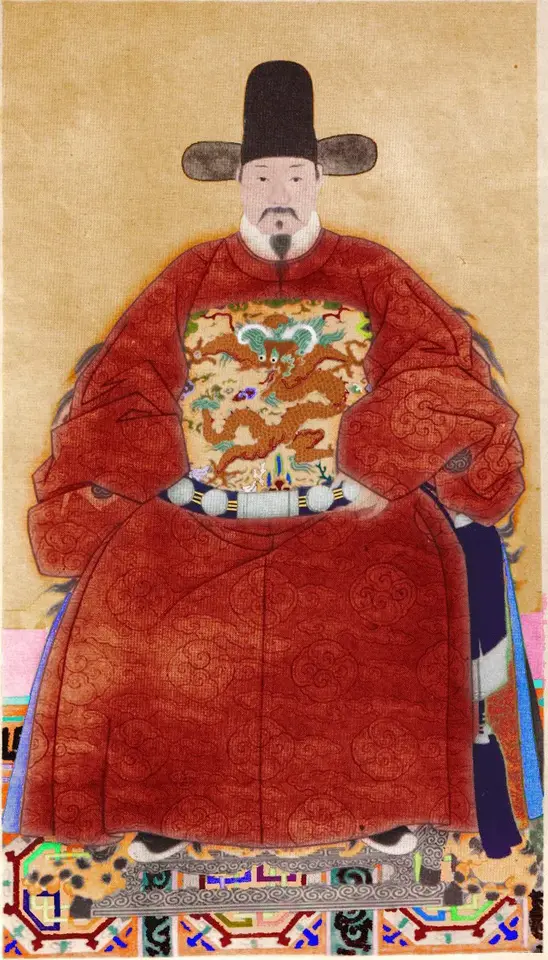
李景隆
Li Jinglong (李景隆, ?–1423), courtesy name Jiujiang (九江), was a prominent Ming Dynasty imperial relative, high nobleman, and the supreme commander of the imperial forces during the early phase of the Jingnan Campaign. Born in Xuyi, Fengyang, he was the eldest son of Li Wenzhong (Prince of Qiyang and Duke of Cao), the nephew of the founding Ming emperor, Zhu Yuanzhang (Emperor Taizu). Endowed with impressive physical stature,…
Li Jinglong (李景隆, ?–1423), courtesy name Jiujiang (九江), was a prominent Ming Dynasty imperial relative, high nobleman, and the supreme commander of the imperial forces during the early phase of the Jingnan Campaign. Born in Xuyi, Fengyang, he was the eldest son of Li Wenzhong (Prince of Qiyang and Duke of Cao), the nephew of the founding Ming emperor, Zhu Yuanzhang (Emperor Taizu). Endowed with impressive physical stature, refined manners, and extensive knowledge of classical military treatises, Li Jinglong inherited the dukedom of Cao in 1386. He trained provincial garrisons across Henan, Huguang, and Shaanxi, supervised the tea-horse trade with western frontier tribes, and directed the Left Chief Military Commission, earning the favor of Emperor Taizu. When the Jianwen Emperor (Zhu Yunwen) ascended the throne in 1398, Li Jinglong became a trusted confidant in the imperial court's aggressive campaign to curtail the autonomous powers of the imperial feudatories. He led an unexpected raid on Kaifeng, capturing Zhu Su, the Prince of Zhou. Following the outbreak of the Jingnan Campaign in 1399, veteran commander Geng Bingwen suffered initial setbacks at Zhengding. Supported by imperial advisor Huang Zicheng, Li Jinglong was elevated to general-in-chief and entrusted with supreme command over massive forces numbering between 500,000 and 600,000 troops. However, plagued by military incompetence, vanity, and tactical jealousy, Li Jinglong suffered crushing defeats at Beiping, Zhengcunba, and the Baigou River, squandering the central government's elite reserves and shifting the strategic momentum to the rebel Prince of Yan. In 1402, as rebel forces breached the Yangtze River and surrounded Nanjing, Li Jinglong's mission to negotiate a partition of the realm failed. Tasked with defending the Jinchuan Gate, he conspired with Zhu Hui, the Prince of Gu, to open the gates without firing a shot, allowing Zhu Di's armies to seize the capital and causing the mysterious disappearance of the Jianwen Emperor. While Zhu Di initially rewarded him with senior court rank and elevated his precedence above all ministers, Li Jinglong was subsequently impeached by feudatory princes and civil officials for treasonable intentions in 1404. Stripped of his noble titles and ancestral estates, he spent his remaining two decades under strict home confinement until his death in 1423.
Succeeded his father Li Wenzhong as the Duke of Cao; participated in the northern campaign against Naghachu the following year.
Supervised military training in Henan and Huguang; managed the vital tea-horse exchange on the northwestern frontiers.
Executed Jianwen's secret order to surround Kaifeng and seize Prince Zhu Su under the pretext of border defenses.
Replaced Geng Bingwen as supreme commander; led 500,000 troops north following ceremonial send-off by Jianwen.
Failed to capture Beiping and was shattered by Zhu Di's returning cavalry at Zhengcunba, abandoning vast stockpiles of supplies.
Reinforced to 600,000 troops with absolute imperial authority; suffered a catastrophic defeat at Baigou River and retreated to Jinan.
Dispatched to sue for peace; opened the Jinchuan Gate to admit Zhu Di's forces, ending Jianwen's reign.
Awarded the rank of Grand Preceptor of the Crown Prince and placed at the head of civil and military officials.
Accused of bribery and subversion by Prince Zhu Su and senior ministers; stripped of titles and placed under house arrest.
Passed away after nearly twenty years of domestic confinement, marking the decline of the original Cao dukedom lineage.
Li Jinglong hailed from Xuyi in Fengyang Prefecture. His father, Li Wenzhong, was the son of Emperor Taizu's elder sister and served as one of the preeminent founding generals of the Ming Dynasty, being honored with the posthumous title of Prince of Qiyang. In his youth, Li Jinglong was tall and handsome, with refined facial features and a commanding presence. He avidly studied military treatises, memorized historical precedents, and maintained aristocratic decorum. Whenever he attended imperial assemblies, his elegant demeanor drew frequent admiration from his granduncle, Emperor Taizu.
Following his father's demise in 1386, Li Jinglong inherited the hereditary title of Duke of Cao. In 1387, he accompanied General-in-Chief Feng Sheng on the expedition to northeastern frontiers to compel the submission of the Mongol commander Naghachu.
In subsequent years, Emperor Taizu placed immense confidence in the young nobleman, dispatching him to supervise army drilling and garrison preparedness in Henan, Huguang, and Shaanxi. Li Jinglong was also entrusted with the tea-horse trade across the northwestern borders, exchanging imperial tea for Tibetan and nomadic cavalry steeds to replenish imperial stables. Demonstrating organizational ability, he was promoted to manage the affairs of the Left Chief Military Commission and appointed Junior Preceptor of the Crown Prince, becoming a premier military aristocrat of the capital.
In June 1398, Emperor Taizu passed away, and his grandson Zhu Yunwen ascended the throne as the Jianwen Emperor. Intent on consolidating central imperial power, the young emperor and his key counselors, Qi Tai and Huang Zicheng, targeted the autonomous border principalities. Because Prince Zhu Su of Zhou possessed significant strategic resources in Henan, the court resolved to eliminate him first, selecting Li Jinglong as the primary instrument of the covert strike.
In July 1398, Li Jinglong moved an expeditionary detachment northward under the cover of reinforcing frontier outposts. Marching swiftly into Kaifeng, he caught the princely palace completely off guard, surrounding the estate and arresting Zhu Su and his immediate household. The royal family was escorted in chains to Nanjing, where Zhu Su was stripped of his rank and reduced to commoner status. The success of this swift coup cemented Jianwen's absolute faith in Li Jinglong's administrative and operational capabilities.
In July 1399, Zhu Di, the Prince of Yan, rebelled in Beiping under the banner of the Jingnan campaign. When veteran commander Geng Bingwen suffered tactical defeats at Zhengding, Huang Zicheng vigorously urged the emperor to appoint Li Jinglong as supreme commander. Although Minister of War Qi Tai fiercely objected, Jianwen embraced Huang's counsel.
In August 1399, the emperor conferred upon Li Jinglong the seal of General-in-Chief, mobilizing a gargantuan force of 500,000 troops. In an elaborate ceremony on the Yangtze riverbank, the emperor personally wheeled the general's carriage forward, presented him with an exquisite rhinoceros-horn belt, and granted him absolute discretionary command over imperial armies.
When news of Li Jinglong's appointment reached Beiping, Zhu Di rejoiced openly, telling his generals that the court had chosen a modern Zhao Kuo—an armchair theoretician lacking practical battle experience. Zhu Di pointed out five fatal weaknesses in Li's command: lax discipline, vulnerability of southern soldiers to northern blizzards, overextended supply lines, arrogance masking inner timidity, and self-serving stubbornness that alienated veteran subordinates.
In September 1399, Li Jinglong reached Dezhou and concentrated his forces at Hejian. While Zhu Di executed a daring flanking march toward Daning to incorporate Ning prince's cavalry and the elite Uriankhai riders, Li Jinglong invested Beiping with his entire host. Defended skillfully by Zhu Di's eldest son, Zhu Gaochi, Beiping withstood numerous assaults.
During the siege, imperial commander Qu Neng led a furious assault on the Zhangye Gate, nearly breaching the city defenses. However, Li Jinglong, fearing that Qu Neng would claim supreme credit for the conquest, ordered an immediate halt and forced Qu to pull back. The defenders poured water over the walls overnight, creating impenetrable sheets of thick ice that permanently thwarted southern escalades.
In November, Zhu Di returned with veteran steppe auxiliaries, engaging Li Jinglong's host at Zhengcunba outside Beiping. Zhu Di's heavy cavalry repeatedly breached the imperial lines, while city defenders sallied out in coordinated assault. Paralyzed by panic, Li Jinglong ordered a chaotic nighttime withdrawal, abandoning his forward fortifications and leaving mountain-high stockpiles of military equipment and winter provisions to the victorious Yan forces.
Attempting to salvage the situation in early 1400, Jianwen granted Li Jinglong imperial battle-axes and complete punitive authority, reinforcing his army to 600,000 men. In April, Li Jinglong clashed with Zhu Di at the Baigou River. While the southern army initially resisted stoutly, sudden fierce gales snapped Li Jinglong's commanding banner, plunging his troops into pandemonium. Zhu Di ignited fires along the windward lines, utterly routing the imperial army. Li Jinglong fled in disorder through Dezhou to Jinan, losing hundreds of thousands of troops and permanently crippling the central government's offensive capacity.
Recalled to Nanjing in October 1400, Li Jinglong escaped capital punishment due to Jianwen's persistent indulgence. Censor-in-Chief Lian Zining, Fang Xiaoru, and Huang Zicheng pleaded repeatedly for Li's execution to appease the spirits of fallen soldiers, but the emperor refused to indict his cousin.
By the summer of 1402, Yan forces crossed the Huai River, crushed the southern field army at Lingbi, traversed the Yangtze barrier, and approached the gates of Nanjing. Desperate, Jianwen sent Li Jinglong, Minister of War Ru Chang, and Commander Wang Zuo to Zhu Di's encampment to offer territorial division along the Yangtze. Zhu Di scoffed at the proposal, rejecting any compromise.
On July 13, 1402, the Yan vanguard reached the Jinchuan Gate, where Li Jinglong and Prince Zhu Hui of Gu held command of the city ramparts. Rather than organizing resistance, Li Jinglong threw open the gates to welcome the invaders. Yan cavalry rode into the capital unopposed, the imperial palaces were consumed by flames, and the Jianwen Emperor vanished from recorded history.
Upon taking the throne as Emperor Yongle, Zhu Di showered Li Jinglong with lavish rewards for his surrender, styling it as secret cooperation with imperial providence. Li was created a Meritorious Servant, invested as Left Pillar of State, appointed Grand Preceptor of the Crown Prince, and granted an annual stipend increase of one thousand shi of grain. At court ceremonies, he occupied the absolute place of honor above veteran Jingnan commanders, provoking intense resentment across the military establishment.
This artificial prestige collapsed abruptly in 1404. Prince Zhu Su of Zhou submitted a formal indictment revealing that Li Jinglong had accepted extensive bribes during his initial raid on Kaifeng. Soon after, Minister of Justice Zheng Ci and veteran commanders Zhu Neng and Jian Yi lodged scathing accusations, asserting that Li Jinglong and his brother Li Zengzhi were amassing retainers and preparing insurrection.
Emperor Yongle stripped Li Jinglong of his merit titles and barred him from imperial audiences. Months later, Minister of Rites Li Zhigang accused Li Jinglong of compelling household servants to render him royal obeisance within his mansion. Yongle seized this pretext to revoke the dukedom of Cao, confiscate all ancestral wealth, and confine Li Jinglong, his brother, and several dozen kin to their private residence under armed guard.
Humiliated by his precipitous fall, Li Jinglong reportedly went on a ten-day hunger strike, but survived. He lived out his remaining years in obscurity under domestic arrest, dying in 1423 in the closing year of Yongle's reign.
Li Jinglong's generalship during the Jingnan Campaign was the single most consequential military factor enabling Zhu Di to overcome insurmountable numerical odds and overthrow the legitimate imperial government.
Entrusted with the largest standing army assembled in early Ming history, Li Jinglong possessed the logistical capacity and manpower to encircle and crush the Beiping rebellion. However, his inept tactical deployment, inability to maintain discipline in sub-zero winter temperatures, and professional jealousy of competent subordinates such as Qu Neng repeatedly rescued Zhu Di from strategic extinction.
The catastrophic collapses at Zhengcunba and the Baigou River destroyed the institutional core of the Ming field armies, shifting military initiative irreversibly into the hands of the northern cavalry and paving the way for the fall of the Jianwen government.
Li Jinglong's unilateral opening of the Jinchuan Gate in July 1402 remains one of the dramatic turning points in Chinese imperial history.
With the imperial capital heavily fortified, provisioned, and awaiting provincial relief forces, a protracted siege could have altered the campaign's ultimate conclusion. Li Jinglong's betrayal averted urban destruction but instantaneously ended the four-year reign of the Jianwen Emperor and ushered in the Yongle era.
While his surrender briefly secured him unprecedented honors, it cemented his historical legacy as an archetype of aristocratic disloyalty and military incompetence, culminating in his complete political purge and disgrace.
Li Jinglong's transition from high-born scion to disastrous commander and turncoat has generated near-universal censure from both contemporaries and later historians.
Zhu Di recognized his profound inadequacies before their first engagement: "Li Jiujiang is a coddled scion, short on strategy, arrogant, fierce in appearance but timid within, jealous, and self-opinionated. Unpracticed in actual warfare, placing five hundred thousand men in his hands is sheer self-destruction."
In the official History of Ming, compiled under Zhang Tingyu, his early promise was contrasted with his battlefield ignominy: "He was tall, with clear and handsome features, and radiated majestic presence. At morning assemblies, his movements were extraordinarily dignified, drawing repeated attention from Emperor Taizu. Yet Jinglong was an aristocratic dilettante ignorant of soldiering, consumed by self-importance so that veteran commanders refused to serve him wholeheartedly."
The late Ming and early Qing historian Zha Jizuo reflected critically in Zuiweilu: "Did Jiujiang truly preserve the dynastic altars by exchanging one sovereign for another? In the end, he was confined to his private rooms to die in disgrace, keeping the state intact while destroying his own clan. If he had loyalty to weep before spirits and righteousness to illuminate the sun, who could possibly believe it after the hasty surrender of the Jinchuan Gate?"
FIGURES ASSOCIATED WITH THIS DYNASTY