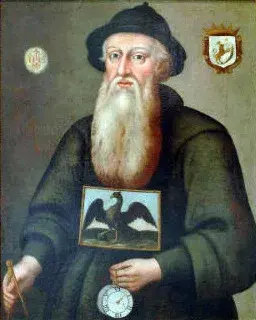
Life and Career
Journey to China and Ministry in Shaozhou
Niccolo Longobardi was born in 1559 into an aristocratic family in Caltagirone, Sicily. He received an elite classical education and entered the Society of Jesus in Messina in 1582, studying scholastic philosophy and Catholic theology before being ordained to the priesthood. Hearing accounts of the newly opened mission in East Asia, he volunteered for service in China.
In 1597, Longobardi arrived in Portuguese Macau aboard a merchant galleon. Under the guidance of Alessandro Valignano and Matteo Ricci, he applied himself to the intensive study of Chinese grammar, classical literature, and social etiquette. In 1598, he was dispatched to Shaozhou in northern Guangdong to relieve the ailing missionary Lazzaro Cattaneo.
In Shaozhou, Longobardi adopted Ricci's accommodation strategy, donning the robes and cap of a Confucian scholar and engaging with regional gentry. He traveled across rural districts, administering medical charity and mediating clan disputes. His composed, disciplined conduct won the respect of southern scholar-officials. During this period, he translated European daily devotional prayers into Chinese, publishing the text as Shengjiao Rike (Daily Office of the Holy Religion), which gained wide circulation among Chinese Catholic converts.
Succession as Superior General and Mission Governance
In May 1610, Matteo Ricci passed away in Beijing. Recognizing Longobardi's classical erudition, organizational resolve, and spiritual austerity, Ricci designated Longobardi in his testament as his successor as Superior General of the China Mission. Longobardi relocated to Beijing to oversee missionary endeavors across the provinces.
As Superior General, Longobardi demonstrated exceptional managerial capacity. In 1613, he dispatched the polyglot missionary Nicolas Trigault to Europe. Trigault's mission secured substantial financial patronage from European monarchs and the Holy See, and brought over seven thousand European volumes on astronomy, mathematics, medicine, engineering, and theology to China.
Under Longobardi's leadership, the mission expanded throughout Jiangnan and northern China. He dispatched scientifically trained Jesuits to Nanjing, Hangzhou, Shanghai, and Xi'an, fostering conversions among high-ranking officials such as Xu Guangqi, Li Zhizao, and Yang Tingyun. This elite network of scholar-converts provided vital social legitimacy and political protection for the expanding Church.
Theological Critiques and the Chinese Rites Controversy
Through his intensive study of the Confucian Classics and Song Neo-Confucian commentaries, Longobardi developed profound theological reservations regarding Ricci's accommodationist policy. Ricci had maintained that ancient Chinese classical references to Tian (Heaven) and Shangdi (Sovereign on High) referred to the personal, transcendent Creator God (Deus), and that ancestral veneration and Confucian rites were primarily civic, secular ceremonies permissible for Chinese Christians.
Longobardi arrived at a fundamentally different conclusion after studying Zhu Xi's commentaries. He argued that in Ming intellectual orthodoxy, Tian and Taiji (Great Ultimate) represented an impersonal, materialist cosmic principle (li and qi) devoid of divine personhood, will, or consciousness. Equating Deus with Tian or Shangdi, he contended, risked leading Chinese literati and commoners into pantheism or materialism. Consequently, Longobardi insisted that Deus should be phonetically transliterated as Dousi or referred to strictly as Tianzhu (Lord of Heaven).
Regarding ancestral rites, Longobardi observed that domestic ceremonies and spirit tablets involved petitions for worldly fortune and protection, conflicting with Christian monotheism. To resolve these contentious issues within the mission, Longobardi convened the historic Jiading Conference in Shanghai in 1628, gathering Jesuit missionaries including Trigault, Emmanuel Diaz, and Giulio Aleni, alongside Chinese Christian officials Xu Guangqi and Sun Yuanhua. Although the conference did not resolve internal divisions, Longobardi's reports to Rome provided the foundational framework for the subsequent Holy See investigations that shaped the century-long Chinese Rites Controversy.
Assisting Defense and Calendar Reformation
In addition to ecclesiastical administration, Longobardi contributed actively to late Ming scientific modernization. During the Chongzhen reign, when Later Jin assaults threatened the northern frontier, Grand Secretary Xu Guangqi and Shandong Governor Sun Yuanhua championed European artillery casting to strengthen border fortresses, introducing Longobardi and Emmanuel Diaz to the Ministry of War.
Longobardi assisted the Ming government in coordinating the translation of ballistic texts and artillery casting. In astronomy, with the traditional Datong and Muslim calendars repeatedly failing to predict eclipses accurately, Xu Guangqi was commissioned to reform the imperial calendar. Longobardi aided Xu, Li Zhizao, and subsequently Johann Adam Schall von Bell and Giacomo Rho in establishing the Astronomical Bureau, translating Tycho Brahe's astronomical works and verifying calculations for the Chongzhen Lishu.
Following the severe Beijing earthquake of 1624, which generated widespread superstitious panic, Longobardi responded to requests from Ministry of Rites officials by consulting Aristotelian natural philosophy in church libraries and composing Dizhen Jie, providing an empirical physical explanation of seismic activity for Chinese readers.
Final Years in Beijing and Burial at Zhalan Cemetery
In the spring of 1644, Beijing fell to Li Zicheng's forces, and the Qing dynasty soon established control of northern China. Amid widespread devastation, Longobardi declined to flee south with Ming loyalists, remaining at the Beijing mission alongside Schall von Bell to protect church properties, scientific instruments, and rare European books.
Following the Qing conquest, the Regent Dorgon and the Shunzhi Emperor treated the resident European scholars with high regard. Schall von Bell was appointed Director of the Imperial Astronomical Bureau, while Longobardi, then in his eighties, retired to an advisory role at the South Church (Nantang). In September 1654, Longobardi passed away peacefully in Beijing at the age of ninety-five.
The Shunzhi Emperor commended his decades of service, granting three hundred taels of silver for his funeral and assigning a burial plot at the Zhalan Cemetery outside Fuchengmen, where he was interred beside Matteo Ricci and Schall von Bell.
Major Achievements
Authoring Dizhen Jie: China's First Western Seismological Treatise
In May 1624, a powerful earthquake shook Beijing, causing extensive structural damage and widespread social anxiety. With court officials attributing the disaster to astrological omens and divine retribution, Minister of Rites Li Songyu approached Longobardi for a scientific explanation based on European natural philosophy.
Drawing from Aristotle's Meteorology and Renaissance geographic treatises in the mission's library, Longobardi compiled the one-fascicle Dizhen Jie (Treatise on Earthquakes). The book was organized into nine thematic chapters analyzing causes, types, locations, acoustics, magnitude, seasonality, duration, precursory signs, and seismic aftershocks.
Longobardi asserted that earthquakes were natural physical phenomena caused by subterranean vapor pockets expanding under heat and forcing fissures through the earth's crust. He distinguished between vertical, horizontal, and undulating seismic tremors and documented warning indicators such as water cloudiness and animal agitation. Published in Beijing in 1624 and reprinted in 1679, Dizhen Jie was the first text in Chinese to introduce Western empirical seismology, offering an objective alternative to supernatural theories of natural disaster.
Convening the Jiading Conference and Debating Rites
Longobardi's decisive historical initiative within the Catholic Church was the organization of the 1628 Jiading Conference, which initiated global intellectual debate over cross-cultural religious adaptation. The conference addressed four core dilemmas: whether to use classical terms like Tian and Shangdi or phonetic transliterations like Dousi; whether Chinese Christians could participate in civil Confucian veneration; whether ancestral spirit tablets were permissible in private homes; and how to interpret the burning of ritual money.
While missionaries like Trigault and Aleni defended Ricci's accommodationist stance, Longobardi presented extensive citations from Zhu Xi's commentaries to argue that Song Neo-Confucian metaphysics lacked personal divine attributes. He maintained that compromising theological boundaries risked fundamental syncretism. His comprehensive memoranda to the Congregation for the Propagation of the Faith in Rome became the foundational literature for the papal decrees that defined the Chinese Rites Controversy throughout the eighteenth century.
Translating and Publishing Cross-Cultural Philosophical Treatises
Longobardi produced a substantial body of religious and philosophical literature in Chinese. In Shaozhou, he compiled Shengjiao Rike and Sheng Ruose Fahangshi, introducing European allegorical narratives to Chinese readers with the stylistic assistance of scholar Zhang Geng.
In metaphysics, Longobardi composed Linghun Daoti Shuo, which was reviewed by Schall von Bell, Rho, and Jacques Furtado. Writing from the standpoint of Western scholasticism, he critiqued the Neo-Confucian concept of Daoti (the substance of the Way) for conflating spiritual and material realities. He argued that reducing the cosmos to impersonal qi negated the spiritual agency of the human soul. When translated into European languages, Longobardi's treatises sparked intense debates among European Enlightenment philosophers, including Gottfried Wilhelm Leibniz and Nicolas Malebranche, regarding Chinese metaphysics and natural theology.