Birth | Born at Shangyuan in Shengzhou; second ruler of Southern Tang and a lyric poet
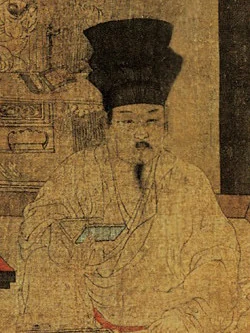
916 CE–961 CE
Historical figure
Li Jing
李璟
Li Jing (916–961), courtesy name Boyu, was the eldest son of Li Bian, founder of Southern Tang, and its second ruler. He is later known as the “Middle Ruler.” He succeeded his father in 943 (Shengyuan year 7, Southern Tang) and adopted the Baoda era name. Early in his reign, Southern Tang intervened in the turmoil of Min and Ma Chu and briefly held Jianzhou and parts of Hunan. Its attempt to take Fuzhou failed, however, and…
916 CE–961 CESouthern Tang
PROFILE
Li Jing (916–961), courtesy name Boyu, was the eldest son of Li Bian, founder of Southern Tang, and its second ruler. He is later known as the “Middle Ruler.” He succeeded his father in 943 (Shengyuan year 7, Southern Tang) and adopted the Baoda era name. Early in his reign, Southern Tang intervened in the turmoil of Min and Ma Chu and briefly held Jianzhou and parts of Hunan. Its attempt to take Fuzhou failed, however, and its position in Chu soon collapsed. From 955 (Baoda year 13, Southern Tang), Later Zhou launched successive campaigns against it. In 958 (Jiaotai year 1, Southern Tang; Xiande year 5, Later Zhou), Li Jing ceded the remaining lands north of the Yangtze and relinquished the imperial title. He moved to the southern capital in 961 (Jianlong year 2, Northern Song) and died there. His lyric poems were later collected with those of his son Li Yu in Nantang Erzhu Ci. Territorial expansion, military losses, and literary work are the main strands of his historical reputation.
- Other names
- Xu Jingtong, Xu Yao, Li Yao, Li Jing (his name later written Li Jing); later known as the Middle Ruler of Southern Tang
- Courtesy name
- Boyu
- Period
- Southern Tang
- Date of Birth
- 916
- Date of Death
- August 12 961
- State
- Southern Tang
- Position
- Second ruler of Southern Tang; poet
- Ancestral home
- Pengcheng, Xuzhou (present-day Xuzhou, Jiangsu)
- Birthplace
- Shangyuan, Shengzhou (present-day Nanjing), according to other accounts
- Era names
- Baoda, Zhongxing, Jiaotai; after 958 he observed Later Zhou's Xiande era
- Temple name
- Yuanzong
- Posthumous title
- Emperor Mingdao Chongde Wenxuan Xiao
- Tomb
- Shunling
- Predecessor
- Li Bian
- Successor
- Li Yu
- Principal activities
- Campaigned in Min and Ma Chu, fought the Later Zhou invasion and ceded the lands north of the Yangtze, and wrote lyric poetry
LIFE TIMELINE
After Li Bian founded Southern Tang | After Li Bian founded Southern Tang, Li Jing was made Prince of Wu and later Prince of Qi.
He became crown prince. | He became crown prince.
Li Bian died | Li Bian died; Li Jing succeeded him and adopted the Baoda era name.
Southern Tang troops took Jianzhou and captured Wang Yanzheng | Southern Tang troops took Jianzhou and captured Wang Yanzheng, ending the Min regime.
The campaign for Fuzhou failed. Li Jing considered the situation in the Central Plains aft | The campaign for Fuzhou failed. Li Jing considered the situation in the Central Plains after the Khitans destroyed Later Jin, but did not launch a northern conquest.
Bian Hao entered Tanzhou and the Ma family's Chu regime collapsed. | Bian Hao entered Tanzhou and the Ma family's Chu regime collapsed.
Liu Yan and others drove out Bian Hao | Liu Yan and others drove out Bian Hao; Southern Tang lost its main holdings in Hunan.
Later Zhou began its campaign in Huainan | Later Zhou began its campaign in Huainan, forcing Southern Tang onto the defensive.
Li Jing ceded territories north of the Yangtze | Li Jing ceded territories north of the Yangtze, dropped his imperial title, and ceased using Southern Tang's own era name.
Crown Prince Li Hongji died. Li Jing later chose Li Congjia | Crown Prince Li Hongji died. Li Jing later chose Li Congjia, the future Li Yu, as heir.
Li Jing moved to Nanchang Prefecture | Li Jing moved to Nanchang Prefecture, the southern capital, and died on 12 August; Li Yu succeeded him.
BIOGRAPHY
Biography
Heirship and accession
Li Jing was first named Xu Jingtong. When his father Xu Zhigao, later Li Bian, dominated the Southern Wu government, Li Jing held posts including Vice Director in the Bureau of Chariots, Minister of War, and participant in deliberation on state affairs. After his father established a base in Jinling, he remained in Guangling and took part in Southern Wu government. Li Bian founded Southern Tang in 937 (Shengyuan year 1, Southern Tang); Li Jing was first Prince of Wu and then Prince of Qi. He became crown prince in 940 (Shengyuan year 4, Southern Tang). On Li Bian's death in 943 (Shengyuan year 7, Southern Tang), Li Jing succeeded him. Lu You's Book of Southern Tang records that he initially tried to decline the throne. He then adopted the Baoda era name, honored his mother Lady Song as empress dowager, made Lady Zhong empress, and gave his brother Li Jingsui a role in government. This arrangement later intersected with disputes over the succession.
Campaigns in Min and Chu and the northern situation
Li Jing departed from Li Bian's comparatively cautious external policy. In 944 (Baoda year 2, Southern Tang), disorder in Min prompted a campaign against Jianzhou. Southern Tang troops captured its ruler Wang Yanzheng in 945 (Baoda year 3, Southern Tang), taking Jianzhou and nearby territory. Li Renda still held Fuzhou, however. Chen Jue and others launched an unauthorized attack, Wu-Yue intervened, and Southern Tang was defeated near Fuzhou in 947 (Baoda year 5, Southern Tang); it never gained complete control of the Min region. When the Khitans destroyed Later Jin, the situation in the north was fluid. Li Jing maintained contact with the Khitans and considered moving north, but the Book of Southern Tang says he called off the plan after learning that Liu Zhiyuan had entered Bianliang. An unrealized plan should not be presented as a completed northern campaign.
Around 950 (Baoda year 8, Southern Tang), internal conflict divided the Ma rulers of Ma Chu. In 951 (Baoda year 9, Southern Tang), Li Jing sent Bian Hao into Tanzhou and Southern Tang acquired part of Hunan. The following year Liu Yan, Wang Kui, and others rose against it; Bian Hao abandoned the city and Southern Tang's control quickly collapsed. The Book of Southern Tang also records heavier taxation by its occupation forces to meet military costs, which intensified resistance. The campaigns enlarged Southern Tang's reach for a time but also increased the cost of war and holding newly conquered areas.
War with Later Zhou and final years
In 955 (Baoda year 13, Southern Tang), Later Zhou attacked Southern Tang's Huainan territory. Li Jing repeatedly sent envoys seeking peace and offered concessions, but Shouzhou and other places were lost and his commanders suffered repeated defeats. In 958 (Jiaotai year 1, Southern Tang; Xiande year 5, Later Zhou), with Later Zhou forces near the Yangtze, he ceded the remaining northern districts, accepted the river as a boundary, dropped the imperial title, and adopted Later Zhou's Xiande era. Having submitted, he altered the written form of his name, both forms being read Jing, to avoid a Later Zhou ancestral name. The earlier plan for succession among brothers ended, and first Li Hongji and then Li Congjia became central to the question of who would succeed him.
Li Hongji died in 959 (Xiande year 6, Later Zhou), and Li Jing eventually designated Li Congjia as heir. Song replaced Later Zhou in 960 (Jianlong year 1, Northern Song), and Southern Tang continued to send tribute. In 961 (Jianlong year 2, Northern Song), Li Jing moved to Nanchang Prefecture, leaving Li Congjia to supervise Jinling. The southern capital's facilities proved too small for the court, and Li Jing died soon after the move. After succeeding him, Li Yu sought Song permission to restore his father's imperial title. Li Jing consequently received the temple name Yuanzong and a posthumous imperial title, and was buried at Shunling.
His Family, His Early Years, and His Accession
Li Jing, whose original name was Xu Jingtong and whose courtesy name was Boyu, was the eldest son of Li Bian, the founding emperor of Southern Tang. Li Bian had been the adopted son of the powerful Wu minister Xu Wen; Li Jing began as a bureau chief in the carriage department and rose by degrees to general of the several guards. After Xu Wen's death Li Bian took the government and made Li Jing minister of war and assistant in the government. In 937 Li Bian was enfeoffed prince of Qi and made Li Jing his heir; and when Li Bian was about to usurp the throne he recalled Li Jing to Jinling as vice commander-in-chief, and in the same year deposed Yang Pu, took the throne himself and founded Southern Tang, making Li Jing prince of Wu and afterwards prince of Qi. In the eighth month of 940 he was made heir apparent. In 943 Li Bian died and Li Jing succeeded, changing the era name to Baoda and honouring his mother lady Song as empress dowager and his consort lady Zhong as empress; he enfeoffed his brothers Li Jingsui, prince of Shou, as prince of Yan and Li Jingda, prince of Xuancheng, as prince of E, and Li Jingti, who had not been made a prince, as prince of Baoning. In the autumn of that year he changed Li Jingsui's fief to Qi with the titles of marshal of the armies of the several circuits, grand commandant and grand secretary, and made Li Jingda prince of Yan and vice marshal, and the brothers swore a covenant before Li Bian's coffin that they would succeed one another for generations; he also made his son Li Hongji prince of Nanchang and governor of Jiangdu.
The Destruction of the Rising of Zhang Yuxian
In the tenth month of 943 Southern Tang destroyed the rising of Zhang Yuxian. Zhang Yuxian had been a petty clerk of Boluo county in Xunzhou. It is recorded that a spirit had descended on a commoner's house in the county and that its predictions of fortune and misfortune were always right; and when Zhang Yuxian prayed to it the spirit said that Zhang Yuxian was an arhat and might stay to serve it. At that time Liu Bin, emperor of Southern Han, had but newly come to the throne and robbers had risen in Lingnan, more than a thousand of them with no leader; and when the robbers asked the spirit who should be their chief the spirit named Zhang Yuxian, and they all made him their leader. He styled himself king of the eight kingdoms of the middle heaven, changed the era name to Yongle, set up officials, dressed his followers all in crimson and plundered beyond the passes; and asking the spirit which way to go, he was told to cross the passes and take Qianzhou, whereupon he raided Nankang and the governor Jia Hao could not hold against him. Zhang Yuxian occupied the White Cloud cave and built palaces there, with more than a hundred thousand men, taking county after county. Li Jing sent the camp commandant of Hongzhou, Yan Si, and the master of guests Bian Hao with troops against him; and Zhang Yuxian asked the spirit, which no longer spoke, so that his followers were all afraid and he was taken and surrendered.
The Invasion during the Disorder of Min and the Fall of Min
In Min, Wang Yanxi had been murdered by Lian Chongyu and Zhu Wenjin, who made himself ruler; and at the same time Wang Yanxi's younger brother Wang Yanzheng made himself independent at Jianzhou under the dynastic name of Yin. The Wang brothers fought one another for years and Min fell into great disorder, and Li Jing took the occasion to send Zha Wenhui with the expectant officer Zang Xun against Jianzhou. Wang Yanzheng, hearing that Tang was about to attack, sent men to deceive Fuzhou with the tale that the Tang troops were coming to help him punish the rebels; and Fuzhou believed it and in 945 killed Zhu Wenjin and the rest and went over to Wang Yanzheng, who restored the dynastic name Min and sent his nephew Wang Jichang to hold Fuzhou. Zha Wenhui camped at Jianyang, and the Fuzhou commander Li Renda killed Wang Jichang and called himself acting commander, while the Quanzhou commander Liu Congxiao killed the prefect Huang Shaopo, both sending word to Zha Wenhui. In the eighth month of 946 Zha Wenhui, following up his victory, took the four prefectures of Jian, Ting, Quan and Zhang; Wang Yanzheng was beaten and Min fell. Li Jing carved the three counties of Yanping, Jianpu and Fusha into a new prefecture of Jian, moved Wang Yanzheng's family to Jinling and made him military commissioner of Raozhou, Li Renda commissioner of Fuzhou and Liu Congxiao commissioner of the Qingyuan army.
The Rule of the "Five Devils," and the Remonstrances of Chang Mengxi and Jia Chong
Li Jing made Feng Yansi and Chang Mengxi Hanlin academicians, Feng Yanlu a secretary of the secretariat, Chen Jue commissioner of the privy council and Wei Cen and Zha Wenhui his deputies. Chang Mengxi was on duty in the Xuanzheng hall with sole charge of secret orders, while Feng Yansi and the rest wielded power as wicked flatterers, and the people of Wu called them the "five devils"; and though Chang Mengxi said again and again that the five were not to be employed, Li Jing would not take it. In the twelfth month Li Jing ordered that the civil and military business within and without be referred to Li Jingsui, prince of Qi, for decision, and that only Chen Jue and Zha Wenhui should report business, no minister being admitted unless summoned. The supervising secretary Xiao Yan memorialized in sharp remonstrance and was not answered; and the commandant of the guard Jia Chong came to the inner apartments to see Li Jing, saying that he had served the late emperor thirty years and knew that his success had come of using the counsels of the worthy host, so that even the distant were brought near and nothing was blocked, and yet there was still business that did not reach above; and he asked whom the emperor now trusted, and why he at once cut himself off from his ministers, since he himself, an old general, would die and feared he might never see his face again. And weeping, he so moved Li Jing that he had him sit with him, gave him food and comforted him, and the orders he had issued were stayed.
The Reversals of the Campaign after Min, and the Opportunity Lost when the Qidan Destroyed the Later Jin
After the fall of Min Li Jing wished to withdraw his troops, but Zha Wenhui and Chen Jue said that the remnants under Li Renda were still there and that they should take all while the victory held; and Chen Jue said that he could bring Li Renda and the rest over without a single soldier. Li Jing made him commissioner to proclaim the imperial will and summoned Li Renda to Jinling, but he would not come; and Chen Jue, ashamed, went back to Jianzhou and, pretending to have Li Jing's order, called out the troops of Ting, Jian, Xin and Fu against him, while Wei Cen, then pacifying Zhang and Quan, on hearing of it sent troops of his own to join. Li Jing was furious, and when Feng Yansi and the rest said the troops having moved could not be checked, he made Wang Chongwen commissioner of pacification and Wang Jianfeng his deputy, added troops and joined them to Chen Jue and Wei Cen, with Feng Yanlu, Wei Cen and Chen Jue as army inspectors. Wu-Yue answered Li Renda with thirty thousand men; and Chen Jue and the rest, each seeking the credit, did not support one another, so that Feng Yanlu engaged the Wu-Yue army first, was heavily beaten and fled, and all the commands came back broken. Li Jing was very angry and sent envoys to bring Chen Jue and Feng Yanlu in chains to Jinling; but Feng Yansi being then chancellor and Song Qiqiu having been recalled from Mount Jiuhua as grand tutor, both pleaded for them, and Chen Jue was banished to Qizhou and Feng Yanlu to Shuzhou. Han Xizai memorialized sharply asking that Chen Jue and the rest be executed, and Song Qiqiu, hating him, degraded him to adjutant of Hezhou; and the censor-in-chief Jiang Wenwei impeached the chancellor Feng Yansi and the remonstrating grand master Wei Cen for disorder in the government and for escaping degradation though guilty with Chen Jue, in very plain and outspoken terms, at which Li Jing was furious, answered the memorial himself, degraded Jiang Wenwei to a military adjutancy at Jiangzhou and removed Feng Yansi to be junior tutor and Wei Cen to be groom of the heir. At this juncture the Qidan destroyed the Later Jin and the central plain was without a lord. The Qidan having long had dealings with Southern Tang, they sent word that the young lord of Jin had broken faith and brought deposition on himself, and that their own lord wished to renew with Tang the good relations of earlier generations and would invest Tang as lord of the central plain; and Li Jing sent men to decline politely, saying that Tang held the Huai and the Yangtze and its altars were already secure, shut off from Liang and Song, and that if their lord did not forget the old friendship and would send envoys it would be a great favour, but that he dared not accept the humiliation of any other command — and he sent the vice minister of war Jia Tan on a return mission to the Qidan. He asked the Qidan to let Tang send men to Chang'an to repair the tombs of the Tang emperors and was refused. Meanwhile the secretariat of Jin's Mi prefecture and the prefect of Dizhou, Wang Jian, fleeing the Qidan, came over with their people, and many bandit chiefs north of the Huai asked orders of Tang; but Chen Jue and the rest having worn out the army in the southeast, there was no leisure to look north, and Li Jing and his ministers all regretted it. After the Qidan withdrew northward Li Jing issued an edict that "the central plain, to which we look with affection, is the old land of this dynasty," and made Li Jinquan commissioner of the northern expedition to consider taking the central plain; but hearing that the military commissioner of Hedong, Liu Zhiyuan, had entered Bianliang, he had to abandon the northern campaign.
The Destruction of Chu and the Disorders that Followed
In the autumn of 951 the men of Chu imprisoned Ma Xie in Hengshan and set up his brother Ma Xichong, who attached himself to Li Jing, and Chu fell into great disorder. Li Jing sent the prefect of Xinzhou, Bian Hao, into Changsha, and Chu fell; he moved the whole Ma family to Jinling, making Ma Xie military commissioner of Hongzhou, Ma Xichong of Shuzhou and Bian Hao of Hunan. In 952 he carved the four counties of Gao'an, Qingjiang, Wanzai and Shanggao from Hongzhou into the new prefecture of Yun, and made Feng Yansi and Sun Ji left and right presidents of the secretariat and joint managers of state affairs. The emperor of Southern Han sent troops to contest the ground without success. The land of Chu being newly settled and the treasury empty, the chancellor Feng Yansi, making a merit of having taken Chu, did not wish to charge the cost to Southern Tang, and so laid heavier taxes on the people of Chu to maintain the army, at which they all resented him and rebelled; and when a Chu general attacked Bian Hao, Bian Hao could not hold and fled back to Tang.
The Southern Campaign of Shizong of Zhou and His Submission and Cession of Land
In 955 the Later Zhou marched south, their edict setting out Tang's offences, and Li Gu was made commissioner of the field army, beginning with the attack on Shouzhou. Li Gu said that they had no equipment for fighting on the water and that if the Huai troops cut the pontoon bridge at Zhengyang they would be attacked front and rear, and so burned his stores and withdrew to Zhengyang. Shizong of Zhou, coming in person and hearing at Weizhen that Li Gu had withdrawn, said that their own retreat would surely be pursued by Tang, and sent Li Chongjin hurrying to Zhengyang; and Liu Yanzhen and the rest, hearing that Li Gu had withdrawn, took it for fear and hurried in pursuit, and coming up at Zhengyang found Li Chongjin there before them and fought without time to eat, and were beaten. The Tang troops set sharp blades on frames and bound them with chains, carved wooden beasts which they called the "swift horse tablets," and strewed iron caltrops in leather bags on the ground as obstacles; and the Zhou, seeing these, knew their fear and beat them in one onset. Shizong camped north of the Fei and moved the pontoon bridge to Xiaca; Li Jing sent troops to contest it without success, and the Zhou took Chuzhou. Li Jing, afraid, sent the post commander of Sizhou, Wang Zhilang, to Xuzhou to say that the emperor of Tang sent a letter offering tribute and would serve as an elder brother, and Shizong made no answer. Li Jing's deputy of the eastern capital Feng Yanlu, the prefect of Guangzhou Zhang Shao, of Shuzhou Zhou Zuo and of Taizhou Fang Ne all abandoned their cities, and Feng Yanlu, shaving his head as a monk, was taken by the Zhou troops. When the adjutant of Qizhou, Li Fu, killed the prefect Wang Chengjun and went over to Zhou, Li Jing was the more afraid, and to avoid the name of the Zhou ancestor he changed his name to Li Jing, sent the Hanlin academician Zhong Mo with a memorial styling himself a subject, offering for the Zhou army five hundred oxen, two thousand shi of wine and several thousand pieces of gold, silver and gauze, and asking to cede the six prefectures of Shou, Hao, Si, Chu, Guang and Hai in return for the withdrawal of the troops. Shizong made no answer but sent troops to take Yangzhou and Taizhou by surprise; and Li Jing sent men with a letter hidden in a wax ball to the Qidan for help, who were caught by the frontier guards. In the third month of 956 Li Jing sent the minister of works Sun Sheng and the minister of rites Wang Chongzhi with a memorial in still humbler terms, and Shizong still did not answer; but Zhong Mo and the rest asked leave to go back for Li Jing's memorial offering the whole region north of the Yangtze, which Shizong allowed, sending Wang Chongzhi and Li Deming back, and only then sent a letter to Li Jing. Li Deming and the rest, returning, praised Shizong's martial spirit highly, at which Li Jing was displeased, and Song Qiqiu and Chen Jue held that the cession brought no advantage and said Li Deming was selling the state for gain, so that Li Jing in anger had Li Deming beheaded. He then sent the marshal, Li Jingda, prince of Qi, with Chen Jue, Bian Hao and Xu Wenzhen with troops to Shouchun, and Li Jingda's officer Zhu Yuan and others recovered the three prefectures of Shu, Qi and Tai. In the summer of that year, with heavy rain, the Zhou troops in Yang, Chu and He withdrew, and the Tang generals asked leave to strike them in the defiles; and Li Jing said that to attack them would deepen their hatred while to let them go would be a kindness, and warned his generals to close their camps and not fight, so that the Zhou troops all gathered at Shouzhou. Shizong camped at Wokou and wished to go again to Yangzhou and attack Shouchun with all his force; and he sealed the treasuries and handed them to the responsible officers, sending Li Jing's old officers to patrol within the city, so that they went away taking nothing by force, at which the men of the Huai were much pleased and brought provisions for the Zhou army. Li Jing then sent Zhu Yuan and the rest to camp at Zijin mountain and build a raised road to carry grain to Shouzhou; and in the second month Shizong marched south again, moved the Xiaca pontoon to Wokou, established the Zhenhuai army and built two cities to hold the Huai between them, breaking the camps at Zijin one after another. Li Jingda being the marshal but Chen Jue deciding all military matters, and Chen Jue having long hated Zhu Yuan, whom he thought a client of Li Shouzhen and therefore unreliable, Li Jing sent the general Yang Shouzhong to replace Zhu Yuan and recalled him; and Zhu Yuan in his fury went over to Zhou, and all the armies broke, Xu Wenzhen and Bian Hao being taken, and Li Jingda fled back to Jinling with his fleet. Liu Renshan, falling ill and near death, had his deputy Sun Yu surrender Shouzhou to Zhou, and Shizong withdrew his army.
The Renunciation of the Imperial Title, the Move of the Capital, and His Death
In the first month of 958 the Zhou attacked Chuzhou, whose commanders Zhang Yanqing and Zheng Zhaoye held the city firmly so that it was not taken in forty days of siege; and Shizong in person urged the troops to dig a tunnel into the city and burn it, the wall was breached, Zhang Yanqing and Zheng Zhaoye died in the fighting, and the Zhou troops in their fury killed almost all the people of the city. The Zhou took the four prefectures of Hai, Tai and Yang, and Shizong came to Yingluan town overlooking the Yangtze. Li Jing, knowing he could not hold out but ashamed to stoop to renounce his title himself, sent Chen Jue with a memorial to Zhou asking leave to pass the throne to his eldest son Li Hongji and to obey Zhou. The Zhou, having had no fleet when they marched south, had presently beaten Li Jing's armies again and again and taken his sailors, and had built several hundred warships and had the surrendered men teach their troops to fight on the water; and Li Jing's fleet was beaten repeatedly and his ships on the Huai all taken by Zhou. They also built several hundred Qiyun ships, which were too large to pass the Northern Spirit weir at Chuzhou, so that they cut the Old Stork river to join the waters and so reach the great river. Li Jing had at first relied on his fleet, thinking the Zhou no match and unable to reach the Yangtze; but when Chen Jue went on his mission and saw the fleet arrayed on the river in such strength, he thought it had dropped from heaven, and asked leave to return for Li Jing's memorial offering all the prefectures north of the river and observing the treaty; and Shizong allowed it and only then sent Li Jing a letter greeting him as "the lord of Jiangnan," comforting him for his hardships and nothing more. The prefectures of Yang, Tai, Chu, He, Shou, Hao, Si, Chu, Guang and Hai being by then in Zhou hands, Li Jing surrendered Lu, Shu, Qi and Huang and fixed the Yangtze as the boundary; and in the fifth month he ordered the imperial title abolished, taking that of lord of the state and the era name of Zhou. Shizong asked Sun Sheng about the real state of Jiangnan and Sun Sheng would not answer, at which Shizong in anger killed him; and Zhou having withdrawn, Li Jing gave Liu Renshan posthumously the title of grand preceptor and enfeoffed Sun Sheng posthumously as duke of Lu. Li Jing sent Zhong Mo and the rest to court, writing the memorial with his own hand to say that the kindness of heaven and earth and of parents could not be repaid, and asked that edicts be sent to him as to a garrison command, sending Zhong Mo to state in person that he wished to pass the throne to his eldest son; and Shizong sent Zhong Mo and the rest home with a gracious edict comforting Li Jing, who made Zhong Mo vice minister of rites and Feng Yanlu vice minister of revenue. Afterwards came the affair of Yan Xu: Chen Jue, having gone on a mission to Zhou, returned saying that Shizong thought the reason Jiangnan had not at once obeyed was Yan Xu's counsel, and urged Li Jing to kill him in atonement; and Li Jing, doubting it, had Zhong Mo go as envoy to Zhou to verify it, and since he had already ceded land and submitted, sent Zhong Mo to court to apologize, saying that the delay in ceding the land was not Yan Xu's counsel and asking that he be pardoned. Shizong was astonished and said that if Yan Xu could plan thus he was loyal to his master, and asked whether he, the emperor, would kill a loyal minister; and Zhong Mo, returning, said Chen Jue was treacherous, at which Li Jing in anger banished him to Raozhou and killed him, and Song Qiqiu, being guilty with him, was banished to Qingyang and given to die. He then made his grand uncle Li Jingsui military commissioner of Hongzhou and Li Hongji, prince of Yan, heir apparent. In the ninth month of 959 the heir Li Hongji died, and Li Jing made his sixth son Li Congjia prince of Wu and gave him the eastern palace; and when Zhong Mo said Li Congjia was frivolous and dissolute and asked that the duke of Ji be set up, Li Jing in anger degraded Zhong Mo to the office of instructor in the state academy and made Li Congjia heir. Shizong of Zhou had sent word to Li Jing that between himself and Jiangnan the great principle was now settled, but that he feared later ages would not hold him, and that he should while the emperor lived build walls and put the vital places in order for his descendants; and Li Jing therefore repaired the cities and planned to move his capital to Hongzhou, which none of the ministers wished, only the privy commissioner Tang Gao approving, so that Hongzhou was raised to be the southern capital. In 961, leaving the heir Li Congjia to conduct the government, Li Jing moved to the southern capital; but Hongzhou was cramped and neither palaces nor offices could be contained in it, and the ministers pined day and night to return and Li Jing repented and raged, while Tang Gao in shame and fear fell ill and died. Li Jing planned to move back to Jinling and fell ill before setting out, dying in the Changchun hall on the twenty-eighth day of the sixth month of that year at forty-six. The heir Li Congjia succeeded, brought the mourning back to Jinling and sent envoys to court asking that Li Jing's imperial title be restored, which the Song founder allowed, so that Li Jing was given the posthumous name of the enlightened, way-following, virtue-honouring, literary and filial emperor and the temple name Yuanzong.
Major Activities
The Min and Chu campaigns brought gains that Southern Tang could not fully retain. It took Jianzhou but not Fuzhou; it entered Tanzhou but soon lost most of Hunan. Later Zhou's invasion deprived it of its lands north of the Yangtze and changed its standing among neighboring states. Li Jing also ordered monetary measures. The Book of Southern Tang records the issue of large “Yongtong Quanhuo” coins in 959 (Xiande year 6, Later Zhou) and iron coins in 960 (Jianlong year 1, Northern Song). These measures were connected with military and fiscal pressure and cannot, on their own, be taken as evidence of prosperity.
In literature, Li Jing and his son Li Yu are known together as the “two rulers of Southern Tang.” Few of Li Jing's lyrics survive, but Tanpo Huanxisha and other pieces are known for restrained and evocative imagery; the line about a jade flute heard from a small tower comes from one of them. Historical sources also record his exchanges of poetry with courtiers and his calligraphy. His literary achievement is a distinct matter from the successes and failures of his government.
His Lyrics, His Coinage, the Abuses of His Appointments, and His Tomb
Li Jing was by temper weak and fond of letters, rather given to flattery, "always making songs and poems, all of them touched with the airs of the poets," and of considerable literary cultivation. He was constantly drinking and making poems with favourites such as Feng Yansi, so that the lyric suited to the banquet and the dancing floor found its chance to develop in Jiangnan; and his lyrics are sincere in feeling, fresh in style and unadorned in language, and had a certain influence on the lyric poetry of Southern Tang. Five of his lyrics survive, his work being collected in the Lyrics of the Two Lords of Southern Tang, and the line about "the cold of the jade flute blown through in the little tower" has come down through the ages; later critics of the lyric have said that in speaking of the craft one must first count three Li — Li Taibai of Tang, the two lords of Southern Tang and Li Yian of Song — and he is also commonly named together with his son Li Yu. The Complete Tang Poems says of him that his "bearing was lofty and elegant and he was skilled in writing," and the Comprehensive Mirror calls him "modest and careful by nature"; his poems are famous and his calligraphy by no means poor. In coinage, when pressed by war Li Jing had Zhong Mo cast large coins worth ten, inscribed "Ever-circulating fountain of goods," which were abolished when Zhong Mo fell into disgrace; and he had Han Xizai cast iron coins worth two. As to his appointments and government, later opinion is not of one mind: on one hand it is said that in policy he abandoned Li Bian's conservatism for active expansion, and that in his reign Southern Tang reached its greatest extent; on the other that he appointed men badly and decided badly, that he could not fully control the newly conquered lands and let slip the moment, when the Qidan destroyed the Later Jin, for dealing with the central plain, and that in his later years he employed favourites such as Feng Yansi, whom men of the time called the "five devils," so that official discipline decayed and the people's burdens grew — one account saying that "he lived in extravagance without measure, the government was corrupt, the people could not live and complaints were everywhere." As to the outcome of his reign, the conquest of Min and Chu carried the territory of Southern Tang for a time over parts of modern Jiangsu, Anhui, Jiangxi, Fujian and Hunan, its greatest extent since the founding; but through his failure to hold the newly taken lands and through the turn of events in the central plain, most of the gains of his expansion were lost in the war with the Later Zhou at the end of the Baoda era and in the cessions that followed. His tomb lies below the high mountain on the southwestern slope of the Qinling of Li Bian, was scientifically excavated between 1950 and 1951, and was declared a national key cultural relic in 1988. It stands west of Li Bian's Qinling and is of similar length and breadth, with three main chambers — front, middle and rear — and eight side chambers, but all of brick, without the reliefs of twin dragons and warriors at the entrance of the rear chamber, with a star map on its ceiling but no carved geographical map on the floor and no dragon relief on the coffin platform, which reflects the decline of Southern Tang when Li Jing submitted to the Later Zhou and gave up the imperial title for that of lord of the state; yet the walls of the three main chambers still have brick imitations of wooden beams, architraves, columns and bracket sets, painted likewise with peonies and scrolling grasses, though much effaced; and the grave goods are chiefly pottery figures and jade mourning tablets, inferior in quality and variety to those of the Qinling.
Personal Relations
- Li Bian was his father and predecessor, and Lady Song was his mother. Lady Zhong was his empress.
- Li Jingsui and Li Jingda were his brothers and figured in military and succession arrangements.
- Li Hongji, his eldest son, was made crown prince but died before him. Li Congjia, known as Li Yu, was his son and successor; Li Congshan was another son.
- Feng Yansi, Chen Jue, and Zha Wenhui served him. Bian Hao led the Chu campaign, while Liu Renshan and others defended Huainan. Historical writers criticized several close advisers, but the outcome of every campaign should not be assigned to a single official.
Historical Assessment
The Complete Tang Poems calls Li Jing refined and skilled in writing, while the Comprehensive Mirror to Aid in Government describes him as modest and cautious. Lu You's Book of Southern Tang and the New History of the Five Dynasties record both the opportunities and failures of the Min and Chu campaigns and the losses in the Later Zhou war. Later literary criticism values his lyric style; political histories emphasize territory that proved hard to hold, decisions about personnel, and the burden of war. Praise for his poetry does not erase the cost of his policies, while an assessment of Southern Tang's decline must also account for Later Zhou's military pressure.
FIGURES ASSOCIATED WITH THIS DYNASTY
Bibliography
- Lu You, Book of Southern Tang, “Annals of Yuanzong”; Ma Ling, Book of Southern Tang; Spring and Autumn Annals of the Ten Kingdoms (project local historical texts).