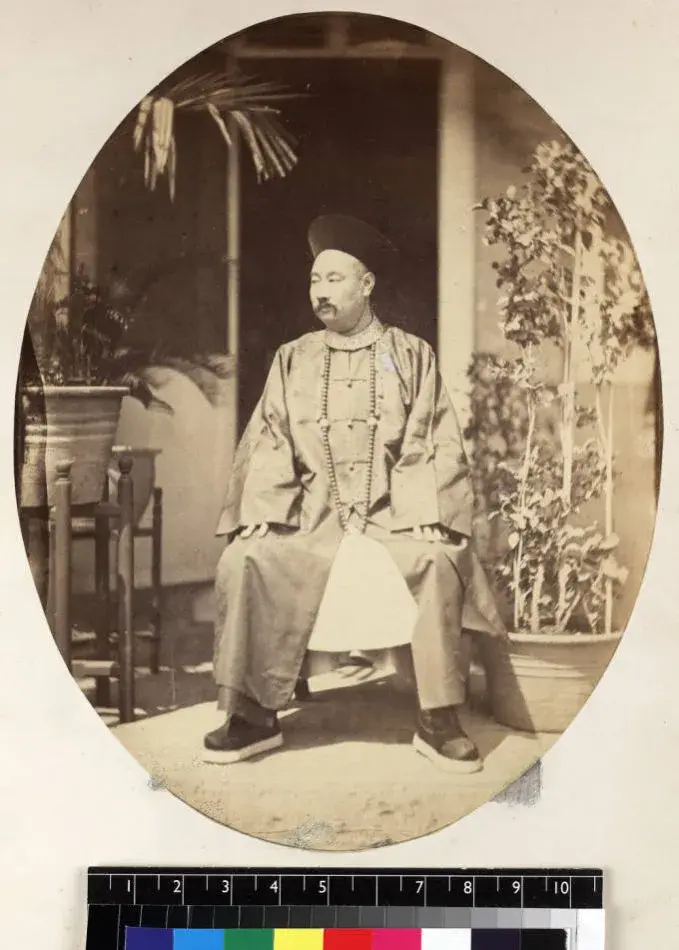
Biography
Imperial Lineage and Early Service as Guard Officer
Sushun was born on the eighth day of the tenth month of 1816 (Jiaqing 21), a seventh-generation lineal descendant of Jirgalang (Prince Zheng of the First Rank), one of the iron-cap princes of the dynastic founding. His father was Ulgung'a, the reigning Prince Zheng. Ulgung'a had numerous consorts and fathered eight sons, with Sushun ranking sixth and his third brother Duanhua eventually inheriting the princely title. Because his biological mother was a concubine from the Hujia clan, Sushun was regarded within the strict aristocratic hierarchy as a peripheral descendant of concubine birth, ineligible for hereditary peerage succession. Upon coming of age in 1832 (Daoguang 12), he left the ancestral princely estate and established a modest household in Pichai Hutong (modern Picai Hutong) in western Beijing, enduring modest economic circumstances.
These early financial constraints, however, fostered in Sushun a fiercely independent, proud, and pragmatic character. He associated freely with non-aristocratic scholars and martial artists, mastered Manchu-Mongol equestrian archery, and immersed himself in classical treatises on military strategy and legalist statecraft. In the twelfth month of 1836 (Daoguang 16), at age twenty-one, he passed clan martial examinations, earning the commission of Supporter General of the Third Class and appointment as an officer in the Imperial Bodyguard. Over the subsequent decade, Sushun discharged his duties with meticulous rigor. In 1844, he was assigned as an Imperial Guard at the Qianqing Gate; in 1848, he became Carriage Commissioner; and in the second month of 1849, he was promoted to Director of the Court of Imperial Parks (Fengchenyuan Qing), overseeing the Summer Palaces and royal gardens.
Rapid Promotion and Ascendancy under Emperor Xianfeng
In 1850, the Xianfeng Emperor (Yizhu) ascended the throne facing catastrophic domestic turmoil. The Taiping Rebellion erupted in Guangxi, sweeping through southern provinces, while regular Eight Banners and Green Standard formations collapsed without offering effective resistance. Determined to reassert dynastic vigor, Emperor Xianfeng was disgusted by the timid inertia of veteran court grandees and sought bold, capable talents. Sushun's perceptive strategic intellect, eloquent rhetoric, and fearlessness immediately captured the sovereign's favor.
Upon taking power, the emperor promoted Sushun to Academician of the Grand Secretariat concurrent Division Deputy Lieutenant-General and Commander of the Guards Division. When Taiping northern expeditionary columns advanced within striking distance of the capital in 1853, Sushun directed the metropolitan defense and civilian militia with admirable composure. In 1854, he advanced to Vice Minister of Works, cycling through the Ministries of Rites and Revenue, while commanding the elite Vanguard Battalion. In 1857, he was elevated to Censor-in-Chief, advancing in rapid succession to Banner Commander, Minister of the Lifan Yuan, and Minister of Rites. In December 1858, he assumed the crucial post of Minister of Revenue. In 1860, he was named Grand Minister of the Presence, Chamberlain of the Imperial Bodyguard, Minister of the Imperial Household, and Associate Grand Secretary. In a span of several years, Sushun ascended from a minor guard officer to the foremost imperial administrator, enjoying unprecedented intimacy with the monarch, of whom it was written: "Emperor Wenzong favored Sushun above all others, confiding in him without reserve."
Promoting Han Statesmen and Enforcing Strict Discipline
Operating at the apex of power, Sushun demonstrated a political prescience unmatched among contemporary Manchu aristocrats. Disgusted by the systemic indolence, corruption, and cowardice of banner descendants, he recognized that the dynasty could not survive without harnessing the military and intellectual vigor of the Han gentry class. In private and public gatherings, Sushun openly declared: "Our Manchu bannermen are mostly fools who know nothing of statecraft; if the empire is to be saved, we must rely upon Han talent!" Transcending two centuries of dynastic suspicion against Han officials, he consistently used his imperial influence to secure autonomous military and civil commands for Zeng Guofan, Hu Linyi, Zuo Zongtang, and Guo Songtao.
In 1859, Zuo Zongtang, then a key advisor to Hunan Governor Luo Bingzhang, was falsely accused of bribery and extortion by Brigade General Fan Xie, leading conservative court princes to demand his arrest and execution. When Guo Songtao pleaded for help in Beijing, Sushun stood up before the emperor, passionately defending Zuo's genius and coordinating with Academician Pan Zuyin to submit the celebrated memorial: "The state cannot spare Hunan for a single day, and Hunan cannot spare Zuo Zongtang for a single day." This intervention not only saved Zuo Zongtang from the execution ground but led to his promotion as Vice Minister of War in command of Zhejiang, inaugurating an era where Han viceroys dominated regional governance. Concurrently, Sushun opened his Beijing residence to recruit brilliant private scholars, employing literary luminaries like Wang Kaiyun, Gao Xinkui, and Sheng Kang to draft vital state edicts and policy initiatives.
In administrative discipline, Sushun applied uncompromising severity. In 1858, the Shuntian provincial examinations were engulfed by the explosive "Wuwu Examination Fraud Case," in which First-Rank Grand Secretary Bai Jun accepted bribes to swap examination papers. As Manchu nobles mobilized to plead for royal clemency, Sushun sternly insisted that the civil examination system was the sacred instrument for recruiting national talent, arguing that executing a grand secretary was essential to uphold the majesty of dynastic law. The emperor consented, ordering Bai Jun publicly decapitated, which sent shockwaves through the capital and halted corrupt collusion. Sushun subsequently audited the Board of Revenue's paper currency administration, uncovering widespread embezzlement and exiling dozens of corrupt senior clerks.
Defying Tsarist Demands and the Flight to Rehe
In foreign policy, Sushun rejected the craven appeasement of predecessors like Qishan, demonstrating resolute diplomatic fortitude. In 1858, while Anglo-French forces attacked the Dagu Forts, Russian Governor-General of Eastern Siberia Nikolay Muravyov coerced General Yishan into signing the unequal Treaty of Aigun, seizing vast lands north of the Amur River. When Tsarist envoy Nikolai Ignatiev arrived in Beijing to enforce these concessions, he deployed overt military threats to intimidate the court.
Commissioned to lead negotiations, Sushun scrutinized the treaty drafts, identifying multiple fraudulent border delineations inserted by Russian translators. Confronting Ignatiev's arrogance, Sushun slammed the conference table, fiercely rebuking the envoy's treachery. When Ignatiev insolently demanded to inspect original imperial edicts, Sushun cast the Russian draft back onto the table, retorting: "Imperial edicts reside within the palace and are not subject to your inspection; cease your insolence!" He refused to concede territorial rights, successfully blunting the Tsarist ultimatum. In August 1860, as Anglo-French forces routed imperial cavalry at Baliqiao and threatened Beijing, Sushun persuaded the emperor to take refuge at the Chengde Mountain Resort in Rehe, appointing Prince Gong to remain in Beijing to conduct negotiations. At Rehe, Sushun took command of all administrative and military affairs, firmly opposing premature returns to the occupied capital while reorganizing the imperial guards.
The Xinyou Coup and Public Execution at Caishikou
On the sixteenth day of the seventh month of 1861, the Xianfeng Emperor fell mortally ill at the Yanbozhishuang Hall in Rehe. In his final hours, the emperor designated his six-year-old son Zaichun as crown prince and commissioned eight ministers—including Prince Yi Zaiguan, Prince Zheng Duanhua, Jingshou, and Sushun—as Regent Ministers to govern the realm. Upon the sovereign's demise, acute conflict erupted between the regents and the two empress dowagers (Empress Dowager Ci'an and Zaichun's biological mother, Empress Dowager Cixi). Aware of Cixi's fierce political ambition, Sushun insisted upon ancestral statutes forbidding palace women from governing, successfully blocking petitions for a dowager regency and clashing directly with Cixi at court audiences.
However, Sushun's unbending autocracy alienated the resident princes in Beijing, notably Prince Gong (Yixin) and Prince Chun (Yixuan), as well as Mongol Generalissimo Sengge Rinchen and Grand Councillor Wenxiang, leaving the eight regents politically isolated. Traveling to Rehe under pretext of mourning, Prince Gong secretly forged an alliance with Cixi. On the twentieth day of the tenth month, the imperial cortège commenced its return march to Beijing; the empress dowagers and the infant emperor traveled by rapid mountain routes, while Sushun volunteered to escort the ponderous imperial hearse along the main highway.
On the night of October 26, as the funeral procession halted in Miyun County, Prince Chun and Prince Rui led an elite cavalry detachment to encircle Sushun's pavilion under secret dowager orders. Awakened from sleep, Sushun shouted in fury against the treasonous assault, but was overpowered, disarmed, and fettered in heavy chains. Arriving in Beijing, the dowagers issued imperial decrees charging Zaiguan, Duanhua, and Sushun with treasonous usurpation and defying royal authority. On November 8, 1861, Zaiguan and Duanhua were permitted to commit suicide, while Sushun was sentenced to summary decapitation. Paraded through the streets to the Caishikou execution ground, Sushun held his head high, defiantly cursing Cixi's treacherous conspiracy. While the families of corrupt officials he had prosecuted gathered to celebrate his death, frontline generals Zeng Guofan and Guo Songtao wept upon hearing the news, with Zeng lamenting: "This is a monumental injustice; the dynasty has demolished its own Great Wall!"
Major Achievements
Breaking Ethnic Barriers and Laying the Groundwork for the Tongzhi Restoration
Stationed at the pinnacle of power during an existential crisis for the dynasty, Sushun exhibited revolutionary political foresight. Discarding the foundational Qing policy of institutionalizing Manchu supremacy over Han scholars, he transferred executive command, taxation, and military authority to Han provincial leaders such as Zeng Guofan, Zuo Zongtang, and Hu Linyi. By intervening decisively to save Zuo Zongtang from judicial execution and promoting non-bannermen to viceregal commands, he mobilized the scholar-gentry class to preserve the empire, directly establishing the administrative infrastructure that made the Tongzhi Restoration possible.
Severe Anti-Corruption Governance and the Wuwu Examination Fraud Case
Confronting deep-seated institutional venality that had plagued the Qing bureaucracy since the late Qianlong era, Sushun was the most uncompromising anti-corruption reformer of the Xianfeng period. In prosecuting the 1858 Wuwu Examination Fraud Case, he withstood intense aristocratic pressure to send First-Rank Grand Secretary Bai Jun to the execution block, establishing an unprecedented judicial precedent of executing a cabinet prime minister for examination bribery. His relentless audits of treasury accounts and punishment of embezzlers temporarily restored fiscal rectitude to the capital bureaucracy.
Resolute Resistance to Tsarist Russian Territorial Coercion
During the Second Opium War, while traditional Manchu diplomats repeatedly conceded territory under pressure, Sushun displayed exemplary patriotic courage in negotiations with Russian envoy Nikolai Ignatiev. Exposing deliberate mistranslations and boundary fabrications in Tsarist drafts, he forcefully rejected imperialist ultimatums and defended sovereign territory with dignified resolve, providing a rare example of diplomatic resistance in late Qing history.
Resisting Dynastic Dowager Regencies and Tragic Fall
As the chief regent designated by the Xianfeng Emperor, Sushun demonstrated absolute fidelity to dynastic constitutional protocol during a delicate monarchical transition. Perceiving the grave perils of female palace rule, he resisted dowager interference to safeguard cabinet governance. However, his unyielding arrogance and failure to build coalitions with metropolitan princes left him vulnerable to the palace conspiracy of Cixi and Prince Gong, leading to his tragic downfall and opening the door to nearly half a century of autocratic dowager domination.