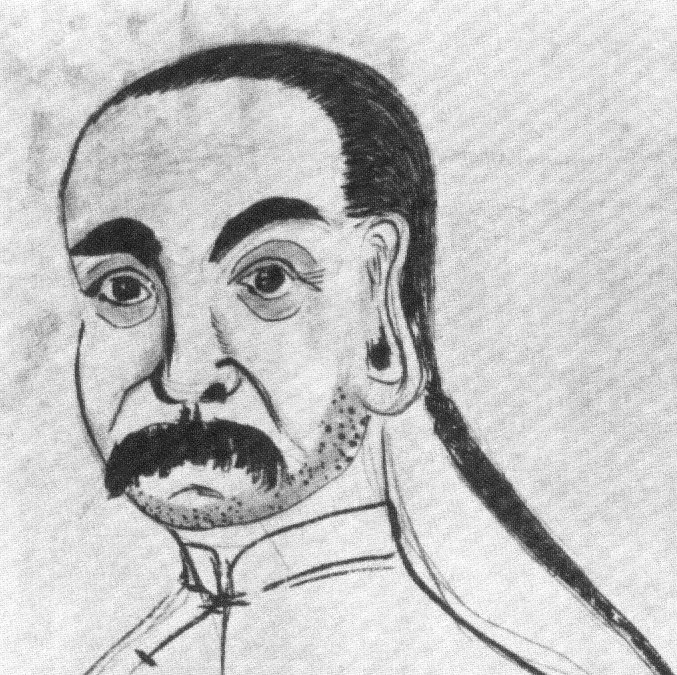
Biography
Impoverished Youth and Vagrant Life
Lin Qing was born in 1770 in Huangcun, Daxing County, Shuntian Prefecture. His ancestral home lay in Shaoxing, Zhejiang; his father, Lin Xianben, had migrated north to serve as a low-ranking scribe in the southern district inspection office of Daxing. Raised in modest circumstances, Lin entered the Jiurutang medicine shop at Danpailou in Beijing at seventeen. After completing a three-year apprenticeship, he was employed as a dispensary clerk in Sanlihe, but was discharged following a dispute with the proprietor, spending months as a nocturnal watchman outside Shunchengmen to avoid starvation.
Following his father's death, Lin assumed his father's yamen position in Huangcun. Within a year, he was dismissed by the county magistrate for embezzling labor compensation funds during levee maintenance along the Hunhe (Yongding River). Facing destitute circumstances, he operated a small teahouse, performed manual labor, traveled to Suzhou and Danyang as a personal retainer, and practiced itinerant healing across Jiangnan villages. Unable to maintain a livelihood, he hired himself out as a grain boat tracker along the Grand Canal, returning to Beijing on foot. In the capital, he peddled quails in temple markets and partnered with an imperial military officer to open a bird and flower stall outside Chongwenmen. These varied lower-class experiences exposed him to the corruption of the Qing administration and allowed him to cultivate connections across city underworlds and rural communities.
Consolidating the Eight Trigrams and Founding the Tianli Sect
In 1806, struggling to support his household, Lin was introduced into the Longhua Association (a branch of the Red Sun or Hongyang sectarian tradition) by his brother-in-law's kinsman, Dong Bowang. Demonstrating charisma and generosity, Lin established authority among local adherents, sidelining the original lodge leaders, Song Jinyao and Guo Junchao, to assume control of the association. He incorporated the Kan Trigram branch of the White Lotus Eight Trigrams network, becoming the principal sectarian leader in metropolitan Zhili.
In 1808, through fellow sectarian Niu Liangchen, Lin met Li Wencheng, the influential leader of the Zhen Trigram in Huaxian, Henan. The two formed a sworn pact. Lin led an armed contingent south to Huaxian, helping Li depose the incumbent leader Liang Jianzhong. With Li established at the head of the Zhen Trigram, the two leaders coordinated operations across western Shandong, northern Henan, and southern Zhili under a dual command arrangement known within the lodges as "Nine Palaces and Eight Trigrams, Lin and Li co-command."
In 1811, Lin united these diverse sectarian networks under the name "Tianli Sect" (Heavenly Principle Sect), declaring himself the supreme leader with the title "King of Heavenly Principle." To legitimize his spiritual authority, he claimed to be the reincarnation of Liu Zuochen, the early Qing founder of the Eight Trigrams tradition, adopting the religious designation "Later Heaven Patriarch." Distributing funds contributed by adherents to assist impoverished peasants, he gained thousands of dedicated followers who relied upon his network for famine relief.
The Conspiracy and Infiltration of the Imperial Palace
In the spring of 1812, Lin Qing, Li Wencheng, Niu Liangchen, and martial artist Feng Keshan convened in Daokou, Henan, to formulate an insurrectionary strategy. They established an administrative blueprint, outlining ranks such as Kings of the Eight Palaces, Counts of the Sixty-Four Chambers, Prime Ministers, and Generals-in-Chief. They prescribed white turbans and white sashes as sectarian uniform markers, circulating millennial prophecies: "In mid-autumn of the eighth month, yellow flowers will bloom across the earth."
Utilizing his flower and bird stall in Beijing to cultivate contacts among the imperial nobility and palace staff, Lin successfully infiltrated the Forbidden City. Through his follower Zhu Xian, he recruited high-ranking inner court eunuchs, including Liu Dechao, Liu Chengsheng, Gao Guangyou, and Yang Jinzhong. These converted eunuchs provided intelligence regarding imperial guard schedules and palace gate security, providing hand-drawn maps of the interior courts and pledging to unlock the gates when the assault commenced.
In early 1813, Lin and Li finalized their operational plans at Daokou, scheduling the uprising for October 8 (the 15th day of the 9th lunar month). The timing was chosen because the Jiaqing Emperor would be away at the Rehe summer palace conducting the annual imperial hunt, leaving Beijing garrisoned by minimal forces. According to their plan, Li would mobilize peasant forces across Henan and Shandong to seize regional towns, while Lin would storm the palace with a strike force, declare a new dynasty, and link up with southern armies.
The Attack on the Forbidden City (Guiyou Incident)
Before the coordinated date, security unravelled in Henan. On October 1 (the 7th day of the 9th lunar month), Magistrate Qiang Kejie discovered the plot in Huaxian, arresting and torturing Li Wencheng. Sectarian fighters stormed the county prison on October 4, liberating Li and triggering the revolt prematurely, which severed communications with the northern leadership.
Operating from his tactical headquarters in Huangcun, Lin proceeded on the designated date despite the silence from Henan. On October 7, over two hundred selected fighters disguised as vendors, peddlers, and laborers smuggled short daggers and white banners into Beijing inside produce crates. At noon on October 8, the strike force mobilized outside the Forbidden City, divided into two columns: one led by eunuchs Liu Dechao and Liu Chengsheng toward the Xihua Gate, and the second guided by eunuch Gao Guangyou toward the Donghua Gate.
The western column surprised the gate sentries, cutting down imperial guards and rushing through the Xihua Gate toward the Shangyijian and the Longzong Gate, advancing into the inner palace complex. The eastern column encountered resistance outside the Donghua Gate after quarreling with a passing official procession; the guards closed the gates, allowing only a handful of insurgents inside. Within the inner court, insurgent fighters attempted to breach the Longzong Gate to reach the Hall of Mental Cultivation. Hearing the tumult, Prince Minning (the future Daoguang Emperor) climbed the wall of the Hall of Mental Cultivation with an imported fowling gun, shooting and killing two rebels attempting to hoist white banners on the battlements. Prince Mian'en arrived with detachments from the Fire Arms Battalion and the elite Guards Division. Encircled inside the palace courts, the insurgent fighters fought hand-to-hand until they were overwhelmed and killed.
Capture and Retribution
While the assault was underway, Lin Qing remained in his residence in Huangcun, awaiting word from his palace operatives to enter the capital and assume the throne. In the aftermath of the palace fighting, captured eunuchs and sectarians disclosed the location of his headquarters under torture.
At dawn on October 10, imperial cavalry and infantry under Grand Secretary Tuojin and General Wenfu surrounded Lin's compound in Huangcun. Trapped without escape, Lin was arrested and transferred to the prison of the Board of Punishments in Beijing. During interrogation before senior imperial ministers, Lin provided details of the conspiracy, the palace infiltration, and the sectarian network. Following the Jiaqing Emperor's return from Rehe, the court ordered executions for all conspirators. On October 21, 1813, Lin was executed by slow slicing in public, his severed head mounted on the city thoroughfares, and his relatives banished to remote frontiers.
Major Achievements
Consolidating Northern Sectarian Networks
Lin Qing demonstrated administrative and organizational ability within the secret society movement of northern China. He integrated fragmented White Lotus traditions, merging the Red Sun, Longhua, and Eight Trigrams associations into the Tianli Sect. By establishing an organized leadership hierarchy and providing local famine assistance, he built a underground network across Zhili, Henan, and Shandong, creating a widespread anti-dynastic sectarian movement during the mid-Qing period.
Direct Assault upon the Imperial Throne
The 1813 Guiyou Incident was an exceptional event in imperial Chinese history: an armed commoner insurgency directly breaching the walls of the Forbidden City. By exploiting the temporary absence of the emperor and converting palace eunuchs into operational fifth-column agents, Lin struck directly at the heart of the imperial monarchy. Although the assault collapsed due to lack of coordination with southern forces, the presence of armed rebels fighting outside the Hall of Mental Cultivation exposed the vulnerability of the imperial guard.
Provoking the Imperial Penitent Edict and Exposing Dynastic Decline
Following the suppression of the palace assault, the Jiaqing Emperor observed bullet marks and broken arrowheads embedded in the plaque of the Longzong Gate. On October 16, 1813, the emperor promulgated a national Penitent Edict, characterizing the breach of the palace as an event without precedent since the Han, Tang, Song, and Ming dynasties. The emperor acknowledged that chronic official negligence, complacency, and administrative corruption had enabled sectarian rebels to threaten the inner chambers of the palace. This edict stood as an official recognition of the dynastic decline that accelerated through the nineteenth century.