Passed the presented scholar examination | Entered official life after passing the examination
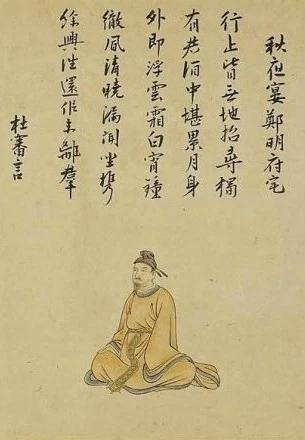
645 CE–708 CE
Poet and official
Du Shenyan
杜审言
Du Shenyan, courtesy name Bijian, was a Tang poet and official whose ancestral home was Xiangyang and whose family later lived in Gong County, Henan. He was the grandfather of Du Fu. In 670, the first year of the Xianheng era, he passed the presented scholar examination and subsequently served in county-level posts including commandant, assistant magistrate, and assistant registrar. In 698, the first year of the Wu Zhou…
645 CE–708 CETang Dynasty
PROFILE
Du Shenyan, courtesy name Bijian, was a Tang poet and official whose ancestral home was Xiangyang and whose family later lived in Gong County, Henan. He was the grandfather of Du Fu. In 670, the first year of the Xianheng era, he passed the presented scholar examination and subsequently served in county-level posts including commandant, assistant magistrate, and assistant registrar. In 698, the first year of the Wu Zhou Shengli era, he was demoted to Assistant Registrar of Jizhou after becoming involved in an offense. His son Du Bing later assassinated Zhou Jizhong, the military adjutant who had framed his father in Jizhou, and was himself killed. Du Shenyan was later recalled to the court. In 705, the first year of Shenlong, he was demoted to Fengzhou because of his association with the Zhang Yizhi brothers. After receiving amnesty he returned to the capital and died in 708, the second year of Jinglong. He was especially known for five-character regulated verse. His surviving poetry includes court compositions, landscapes, travel and exile poems, and farewell poems, and his work is regarded as an important part of the development of regulated poetry in the Early Tang.
- Courtesy name
- Bijian
- Other name
- Du Bijian
- Period
- Tang dynasty (Early Tang)
- Date of Birth
- Not recorded in historical sources
- Date of Death
- 708 CE(2nd year of Emperor Zhongzong)
- Dynasty / polity
- Tang
- Identity
- Poet and official
- Highest office
- Vice Director of the Bureau of Provisions (formerly magistrate of Gongxian in Luozhou and revenue officer of Jizhou)
- Ethnicity / affiliation
- Not reliably established in the available sources
- Native place
- Ancestral home in Xiangyang; later resident in Gong County, Henan
- Relationship to Du Fu
- Paternal grandfather
- Birthplace
- No reliable record in the available sources
- Place of death
- No reliable record in the available sources
- Major offices
- County Commandant of Xicheng; Assistant Magistrate of Luoyang; Assistant Registrar of Jizhou; Assistant Compiler; Vice Director of the Court of Imperial Banquets; Clerk at the Directorate of Education; Scholar-in-Attendance at the Institute for the Cultivation of Literature
- Major achievements
- Practiced five-character regulated verse and contributed to the development of regulated poetry; counted with Li Qiao, Cui Rong, and Su Weidao among the Four Friends of Writing
LIFE TIMELINE
First county appointment | Chronological material cited by he began official service as County Commandant of Xicheng; the specific month is unknown
County Commandant of Shuchuan | Transferred to Shuchuan and began associating with Song Zhiwen
Returned to Luoyang for selection | Left Shuchuan, returned to Luoyang for official selection, and wrote Zeng Su Weidao
Assistant Magistrate of Jiangyin | Served as assistant magistrate of Jiangyin County in Changzhou and left the post in the same year
Assistant Magistrate of Luoyang | Transferred to Luoyang County in Luozhou
Demoted to Jizhou | Convicted in an official matter and demoted to Assistant Registrar of Jizhou; Chen Ziang, Song Zhiwen, and others wrote poems to see him off
Du Bing revenge incident | Du Bing assassinated Military Adjutant Zhou Jizhong and was then killed; Du Shenyan was spared execution, removed from office, and returned to Luoyang
Recalled and appointed | Wu Zetian summoned him and appointed him Assistant Compiler; he was later promoted to Vice Director of the Court of Imperial Banquets
Demoted to Fengzhou | After the Shenlong Coup, he was demoted to Fengzhou because of his association with the Zhang Yizhi brothers
Returned under amnesty | Returned to the capital under amnesty and served as Clerk at the Directorate of Education
Death | In the fifth lunar month he was additionally appointed Scholar-in-Attendance at the Institute for the Cultivation of Literature; he died in the autumn and was posthumously granted the office of Gentleman Compiler
County assistant of Jiangyin | He served as county assistant of Jiangyin in Changzhou and left the post in the same year.
County assistant of Luoyang | He was transferred to be county assistant of Luoyang in Luozhou.
Service in Jizhou and the Du Bing Incident In 698 | ### Service in Jizhou and the Du Bing Incident In 698, the first year of Shengli, Du Shenyan was convicted in an official matter and demoted to Assistant Registrar of Jizhou.
In 699 | In 699, the second year of Shengli, Du Shenyan’s son Du Bing assassinated Zhou Jizhong and was immediately killed by guards.
Later Recall | ### Later Recall, Further Demotion, and Death In 702, the second year of Chang'an, Wu Zetian summoned Du Shenyan and ordered him to compose Huanxi Shi.
Aged fifty-eight | He was promoted to Vice Director of the Bureau of Provisions.
In 705 | In 705, the first year of Shenlong, after the Shenlong Coup, Du Shenyan was demoted to Fengzhou because of his association with Zhang Yizhi and Zhang Changzong.
In 707 | In 707, the first year of Jinglong, Du Shenyan returned north under an amnesty and became Clerk at the Directorate of Education.
Death | In the fifth lunar month of 708, the second year of Jinglong, he was additionally appointed Scholar-in-Attendance at the Institute for the Cultivation of Literature.
BIOGRAPHY
Biography
Family Background and Early Official Career Du Shenyan’s courtesy name was Bijian. His ancestral home was Xiangyang, and his family later moved to Gong County. His father Du Yiyi had served as magistrate of Gong County in Luozhou, and the Du family subsequently settled there. Du Shenyan’s year of birth is unknown. The Old Book of Tang states only that he died “at more than sixty years of age.” Later scholars have proposed different estimates on the basis of this statement and the dating of his poems. Neither one account nor another account presents any one proposed birth year as certain, so no specific birth year or age is supplied here. Du Shenyan passed the presented scholar examination in 670, the first year of Xianheng. Chronological materials cited Baike record that he successively served as County Commandant of Xicheng and County Commandant of Shuchuan and returned to Luoyang for selection in 679, the first year of Tiaolu. He later served as Assistant Magistrate of Jiangyin and Assistant Magistrate of Luoyang. Several dates for his early local service, including stages of recommendation and appointment, come mainly from modern chronological studies and include inferred elements. The timeline therefore marks some of them as approximate rather than presenting them as exact ages or appointment dates. Du Shenyan was skilled in five-character poetry and calligraphy. As a young man he was associated with Li Qiao, Cui Rong, and Su Weidao, and the four were known collectively as the Four Friends of Writing. The Old Book of Tang says that he “excelled in five-character poetry and was accomplished in calligraphy and letters, gaining a reputation for ability,” while also describing him as proud of his talent and arrogant in manner, which made him disliked by contemporaries. The record thus preserves both his literary reputation and a negative assessment of his character. ### Service in Jizhou and the Du Bing Incident In 698, the first year of Shengli, Du Shenyan was convicted in an official matter and demoted to Assistant Registrar of Jizhou. Chen Ziang, Song Zhiwen, and forty-three others composed poems to see him off. In the following year, while serving in Jizhou, he came into conflict with Guo Ruone, an assistant registrar outside the regular establishment, and Military Adjutant Zhou Jizhong. The Old Book of Tang records that the two framed Du Shenyan and had him imprisoned. In 699, the second year of Shengli, Du Shenyan’s son Du Bing assassinated Zhou Jizhong and was immediately killed by guards. Du Bing’s age as sixteen, while both the Old Book of Tang and the New Book of Tang give thirteen. Following the project’s source-priority rule, this article uses the source’s age and records the discrepancy in the source comparison. Du Shenyan was spared execution but dismissed from office and returned to Luoyang. He wrote a sacrificial text for Du Bing, Su Ting composed Du Bing’s epitaph, and Liu Yunji wrote another sacrificial text. The core sequence of the incident appears in the Old Book of Tang and in both encyclopedia accounts. Details of the case and the motives of the individuals involved are not expanded beyond what the sources establish. ### Later Recall, Further Demotion, and Death In 702, the second year of Chang'an, Wu Zetian summoned Du Shenyan and ordered him to compose Huanxi Shi. He was then appointed Assistant Compiler and later promoted to Vice Director of the Court of Imperial Banquets. Historical accounts emphasize Wu Zetian’s appreciation of his literary talent. In 705, the first year of Shenlong, after the Shenlong Coup, Du Shenyan was demoted to Fengzhou because of his association with Zhang Yizhi and Zhang Changzong. On the journey south he exchanged poems with Shen Quanqi, Song Zhiwen, and others. The sources do not fully agree on which of these compositions survive. In 707, the first year of Jinglong, Du Shenyan returned north under an amnesty and became Clerk at the Directorate of Education. In the fifth lunar month of 708, the second year of Jinglong, he was additionally appointed Scholar-in-Attendance at the Institute for the Cultivation of Literature. He died in the autumn of the same year and was posthumously granted the office of Gentleman Compiler.
Family, Fame and Early Career
Du Shenyan, styled Bijian, was of Xiangyang by ancestral home, his family later moving to (Gongxian). The Old History of Tang says he "was well skilled in five-character verse and in calligraphy, with a name for ability; but he was proud of his talent and arrogant, and much envied by his contemporaries," while the New History records that in youth he was one of the "four friends of letters" with Li Qiao, Cui Rong and Su Weidao, "known in the world as Cui, Li, Su and Du." His official career was long and twisting: in 666 he entered service, taken as a subordinate by the prefecture; in about 667 he passed the local examination; in about 668 he sat (the examination) at Chang'an; in 670 he passed as a presented scholar and in the tenth month was appointed by the board of personnel. In the spring of about 675 he was transferred to be assistant magistrate of Shuchuan county, and before leaving Chang'an first formed his friendship with Song Zhiwen; in 679 he gave up that post and returned to the eastern capital Luoyang; in 680 he was assistant magistrate in a county; in 688 he went to the capital for reassignment; in 689 he was at Luoyang, evidently in court office; in 690 he was at court and went with the grand master Li Sizhen on a mission of comfort to Hedong; in 693 he was made assistant magistrate of Jiangyin in Changzhou, resigning in the spring or summer, and in the seventh month saw Cui Rong off (to the frontier) at Luoyang; and in 697 he was promoted assistant magistrate of Luoyang county.
Exile to Jizhou, Du Bing's Vengeance, and the Empress's Summons
In 698 Du Shenyan was convicted of an offence and exiled to Jizhou (modern Ji'an in Jiangxi), forty-five men including Chen Zi'ang and Song Zhiwen writing poems to see him off. In the seventh month of 699, at his post in Jizhou, he offended the supernumerary registrar Guo Ruone and the adjutant Zhou Jizhong, who together concocted charges against him and had him imprisoned under sentence of death. The Old History records that "being at odds with his colleagues in the prefecture, the adjutant Zhou Jizhong and the supernumerary registrar Guo Ruone together framed charges against Shenyan and had him imprisoned, meaning to kill him in the course of the affair. Presently, while Zhou Jizhong and the others were feasting in the office, Shenyan's son Bing, aged thirteen, struck at him with a knife hidden on his person. Zhou Jizhong died of his wound, and Bing too was killed by the attendants." (On the boy's age the biography says thirteen, other accounts sixteen.) Du Shenyan thus escaped death but was dismissed and returned to Luoyang, where he "wrote a eulogy himself to sacrifice to Bing"; scholars and friends all mourned the boy's filial courage, Su Ting writing his epitaph and Liu Yunji his funeral address. Afterwards Empress Wu summoned Du Shenyan, meaning to employ him, and asked whether he was pleased; he danced in thanks, and the empress had him compose a "Poem of Joy," "admiring and esteeming his writing," and appointed him assistant author, later, in 703, promoting him to vice-director of the bureau of provisions.
Last Years, Exile to Lingnan, and His End
In the tenth and twelfth months of 703 he attended the empress back to Luoyang and (to the court). Afterwards, for attaching himself to the empress's favourites (Zhang Yizhi and Zhang Changzong), he was exiled to Fengzhou in Lingnan. In the spring of 707 he was pardoned and returned north as registrar of the National Academy; in the fifth month of 708 he was made a scholar of the Xiuwen institute, and in the autumn of the same year he died, Song Zhiwen writing his funeral address and (Li Qiao) his memorial tablet, and he was buried east of Shouyang in Yanshi county, Henan, receiving the posthumous (appointment of author). From the record of his offices, from assistant magistrate and county assistant to vice-director and scholar of the institute, he never rose above the middle and lower ranks, and all he had to rely on was a pen and a proud temper — a situation and a character that run through both his poetry and his fortunes.
Major Activities
Regulated Verse Du Shenyan was especially known for five-character poetry and particularly for five-character regulated verse. one account groups his surviving poems into categories including court compositions, frontier and farewell poems, landscapes, and poems of personal reflection. It cites works such as He Jinling Lu Cheng Zaochun Youwang, Chunri Jingzhong Youhuai, and Deng Xiangyang Cheng. His poetry combines court exchange, landscape imagery, travel and exile, and personal emotion and cannot be reduced to the work of a purely court-oriented poet. He Jinling Lu Cheng Zaochun Youwang presents early-spring scenery from the perspective of an official living away from home and combines landscape description with homesickness. Du Xiangjiang uses scenery to heighten the melancholy of a southward journey. Zeng Su Weidao and poems connected with envoys to the western frontier concern farewell, frontier conditions, and reflections on official life. These works and thematic descriptions are drawn from the literary discussion in the ; the article does not expand them into claims about the poet’s psychology that are not supported by the poems or sources. ### Contribution to the Development of Regulated Poetry Du Shenyan’s poetry makes use of regulated-verse features including parallelism, tonal patterns, linkage between couplets, and rhyme. Together with the writing of other Early Tang poets such as Shen Quanqi and Song Zhiwen, his work reflects the gradual maturation of regulated poetry. Describing him as “one of the founders” is a literary-historical assessment and should not be understood to mean that the rules of regulated verse were created by him alone. Modern studies cited Baike also emphasize his contribution to poetic subject matter, technique, and the relationship between form and content, but the degree of each contribution remains a matter of literary evaluation rather than a precisely measurable fact. Du Shenyan’s poetry includes court compositions, landscapes, and farewell poems. His court poems are not exclusively praise of the ruler; some focus on banquets, palace settings, and seasonal scenes. His landscape poems often use scenery to carry the emotions of travel and separation, while his farewell poems address friends departing on missions, frontier climate, and reflections on official life. This article summarizes only the categories clearly identified in the sources and does not reproduce extended encyclopedia commentary poem by poem. ### Transmission of His Poetry and Writings The Complete Tang Poems, volume 62, preserves his poetry. more than forty poems survive and notes that an annotated edition by Xu Dingxiang includes forty-three. Because the totals depend on edition and inclusion criteria, this article does not treat any single number as the uniquely correct count. Beyond his poetry, the available sources do not establish the survival of a separate prose collection that can be confidently identified as extant.
His Regulated Verse and Contribution to Prosody
Of Du Shenyan's works "what has survived is not much, but in both subject and content it shows extension and innovation": among the surviving poems are nine court poems, eight frontier and farewell poems, seventeen landscape poems and nine poems of sorrow. His court poems are marked by a "fresh style with little of the florid": in subject they broke with the traditional court poem's flattery or palace beauties for banquets, gatherings and palace buildings; in theme they broke with the aim of praising the sovereign for the peaceful plenty of the Great Tang; and in language they abandoned ornate and gaudy diction for fresh, lively and more intelligible words. In his "Harmonizing the Poem Presented at the Banquet in the Liangyi Hall on the Seventh Night," on the tale of the Herd Boy and the Weaving Girl, the meeting on the magpie bridge is no longer "thousands of magpies coming to build the bridge" but "the moon about to set," "the magpies ceasing to fly," a treatment "wholly unlike the traditional" and showing his boldness; what he sees is not the joy of meeting but "the grief of the contrast between the length of the waiting and the brevity of the meeting." In the "Great Feast" he writes the noisy joy of the people, "expressing his wish to rejoice with them and showing the strength of the state and the plenty of the people's life," the closing couplet praising Empress Wu for following the people's will and governing well, echoing the opening lines. His landscape poems "are innovative in the fusion of scene and feeling, of self and thing, with unrestrained emotion and a vigorous conception": in "Harmonizing Lu Cheng of Jinling's Early Spring Outing" he first states that he is "an official far from home," the single word "alone" bringing out the loneliness of exile, and though the ending is rather subdued it moves "from scene to feeling, stirred by the scene, with a most ingenious design," and has been praised as "the first five-character regulated poem of the early Tang"; in "Crossing the Xiang River" the first line describes the scene and from it recalls a former spring outing, transferring his feeling to the scene, "so that because of the sorrow in his heart all he sees is sorrowful," and using "flowers and birds" to set off "frontier sorrow," "vividly expressing his inner grief, plain in colour and deep in feeling, and opening a new manner for the poetry of the age." His frontier and farewell poems "have mostly a lofty note and no sound of weeping," as in "To Su Weidao," where the friend must bear both the harsh climate and the test of life and death yet gives his life for the frontier and the country, "lofty in tone and positive in spirit."
In the prosody of regulated verse Du Shenyan's contribution "does not lie in proposing or developing the theory of its rules" but "in his practice and its results": his practice "both demonstrated the scientific correctness of the theories of antithesis, tonal pattern, linkage and rhyme of predecessors such as Shangguan Yi, and provided Shen Quanqi, Song Zhiwen and others with rare examples and samples for the summing up, perfecting and raising of their theory, thus contributing greatly to the formation, enrichment, development and maturity of the theory of regulated verse." He is likewise exemplary in joining form and content: his contribution "lies also in the extension and enrichment of the content and subjects of poetry, and above all in promoting the perfect union of content and form." As a poet of the early Tang he supplied samples for the settling of regulated verse and, in his renewal of subject and language, left his mark on the course of Tang poetry.
Personal Relations
- Du Yiyi: father; served as magistrate of Gong County in Luozhou, and his appointment is connected with the Du family’s move to Gong County.
- Du Bing: son; in 699, the second year of Shengli, assassinated Zhou Jizhong in revenge for his father and was then killed.
- Du Xian: eldest son; served as Court Gentleman for Audience and Military Adjutant of Yanzhou and was the father of Du Fu.
- Du Zhuan: son; served as County Commandant of Kaifeng.
- Du Deng: son; served as County Commandant of Wukang.
- Du Fu: grandson; Tang poet and son of Du Xian.
- Li Qiao: poet; counted with Du Shenyan, Cui Rong, and Su Weidao among the Four Friends of Writing.
- Cui Rong: writer; one of the Four Friends of Writing with Du Shenyan.
- Su Weidao: poet and official; associated with Du Shenyan, who wrote Zeng Su Weidao for him.
- Song Zhiwen: poet; associated with Du Shenyan, wrote poems seeing him off when he was demoted to Jizhou, and later composed a sacrificial text after his death.
- Shen Quanqi: poet; exchanged poems with Du Shenyan during his journey to Fengzhou.
- Chen Ziang: poet; composed a farewell piece when Du Shenyan was sent to Jizhou.
- Guo Ruone: irregular Assistant Registrar of Jizhou; the Old Book of Tang records that he and Zhou Jizhong framed Du Shenyan.
- Zhou Jizhong: Military Adjutant of Jizhou; framed Du Shenyan and was later assassinated by Du Bing.
- Su Ting: Tang official and writer; composed Du Bing’s epitaph.
- Liu Yunji: Tang writer; wrote a sacrificial text for Du Bing.
Representative Works
- He Jinling Lu Cheng Zaochun Youwang: five-character regulated verse on early-spring scenery and the homesickness of an official away from home.
- Du Xiangjiang: depicts sights encountered while traveling and feelings of sorrow on the journey.
- Chunri Jingzhong Youhuai: uses spring scenery to express longing for home.
- Deng Xiangyang Cheng: a poem of ascent combining historical reflection with description of landscape.
- Zeng Su Weidao: a poem presented to a friend.
- He Li Dafu Sizhen Fengshi Cunfu Hedong: a long five-character regulated poem concerning an official mission and frontier travel.
- Shi Buyu Fu: listed by another account among Du Shenyan’s literary works; its transmission is reported as in the source and is not expanded into an unverified textual history. Du Shenyan once had a ten-juan Du Shenyan Ji, recorded in later bibliographies but now lost. The Complete Tang Poems, volume 62, preserves his poetry; the number of surviving works varies with the counting method, as noted above.
Anecdotes
The New Book of Tang, “Biography of Du Shenyan,” portrays him as exceptionally self-confident. It relates that he joked that Qu Yuan and Song Yu should serve as his subordinates in literature and that Wang Xizhi should defer to his calligraphy. The same biography attributes to him, while gravely ill, a remark that his colleagues would be relieved when he died because he had long overshadowed them, though he regretted not seeing a successor. These are anecdotes preserved in a biographical account; their exact wording and setting cannot be independently verified. The New Book of Tang itself frames them as examples of his boastfulness, so they are presented here as reported stories rather than verbatim transcripts.
Historical Assessment
Tang-Dynasty Records The Old Book of Tang: Biography of Du Shenyan states that he “excelled in five-character poetry and was accomplished in calligraphy and letters, gaining a reputation for ability,” while also criticizing him as “proud of his talent and arrogant, and therefore much disliked by his contemporaries.” The paired comments address both literary ability and personal conduct and show that the historical account did not assess his life solely through his poetry. In Song Ji Zhou Du Sihu Shenyan Xu, Chen Ziang described Du Shenyan as having “a great reputation throughout the realm” and as standing out at court, praising his literary reputation. Song Zhiwen’s Ji Xueshi Du Shenyan Wen praised the excellence and coherence of his writing. Du Fu later wrote that “my grandfather’s poetry surpassed antiquity,” reflecting a descendant’s recognition of Du Shenyan’s poetic talent. These texts are respectively a farewell preface, a sacrificial text, and a poem, and their different genres and contexts should be kept in view. ### Later Literary Assessments Later poetic criticism often discusses Du Shenyan’s achievement in five-character regulated verse through He Jinling Lu Cheng Zaochun Youwang. The Ming critic Hu Yinglin ranked it as the finest five-character regulated poem of the Early Tang; this was an individual critical judgment. Modern literary scholarship often places Du Shenyan together with Chen Ziang and others in studies of the transition from Early to High Tang poetic style, emphasizing his regulated-verse practice, expansion of subject matter, and formal experimentation. Such assessments do not justify attributing the formation of regulated poetry to any single poet.
FIGURES ASSOCIATED WITH THIS DYNASTY
Bibliography
- Liu Xu et al., Old Book of Tang, vol. 190A, “Literature I: Biography of Du Shenyan.” Online text:
- Ouyang Xiu, Song Qi, et al., New Book of Tang, vol. 201, “Literature I: Biography of Du Shenyan.” Online text: