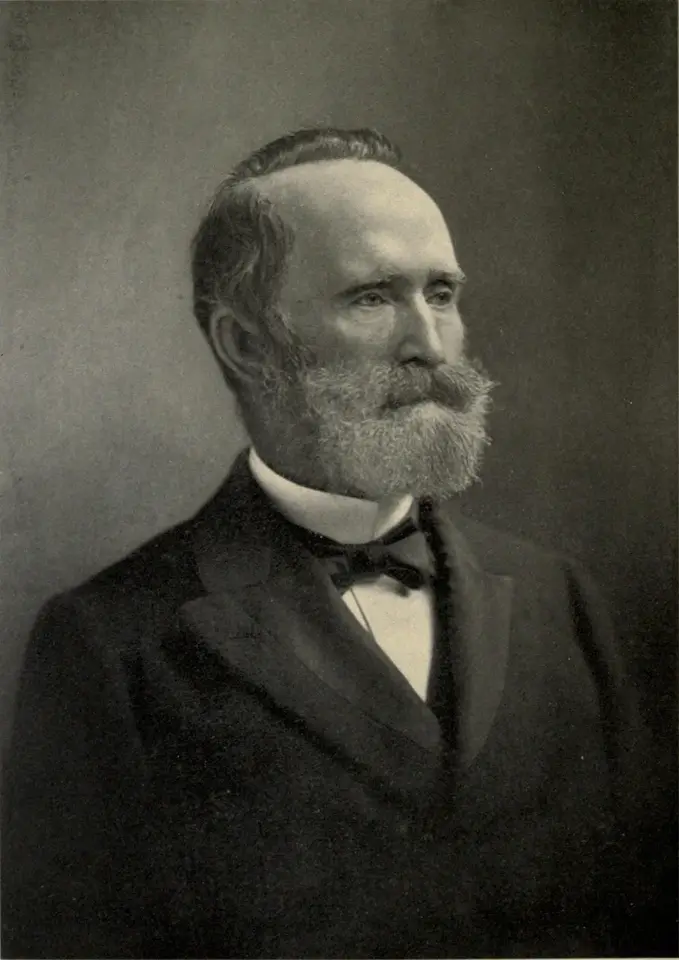
Life
Transoceanic Journey and Early Missionary Work
William Alexander Parsons Martin was born on April 10, 1827 CE, in Livonia, Indiana, into the family of a Presbyterian minister. Displaying early intellectual precocity, he received a rigorous classical and humanistic education at Indiana University, followed by theological studies at the New Albany Theological Seminary in Indiana, where he was ordained. Inspired by the nineteenth-century foreign missionary movement, Martin resolved to dedicate his life to Christian mission and cultural engagement in ancient China.
In November 1849, the newly married Martin embarked with his wife aboard an ocean sailing vessel bound for China under the auspices of the American Presbyterian Mission. Navigating through the Atlantic and Indian Oceans for four and a half months and crossing every major climate zone except polar regions, they landed at the treaty port of Ningbo in Zhejiang Province in April 1850. During his decade in Ningbo, Martin displayed an extraordinary gift for linguistics. He quickly achieved fluency in both the local Ningbo dialect and standard mandarin, founded the Chongxin Academy, and compiled phonetic romanized textbooks. Concurrently, he immersed himself in the Confucian classics and imperial histories, acquiring a profound sinological erudition rare among contemporary Westerners.
During the Second Opium War, Martin's bilingual mastery and grasp of Chinese political psychology led to his engagement in 1858 as official interpreter to American Minister William B. Reed. He participated directly in the drafting and diplomatic negotiations surrounding the Treaty of Tianjin, subsequently travelling to Beijing for the exchange of treaty ratifications. This historic experience convinced Martin that the Qing imperial bureaucracy was dangerously ignorant of Western international law, and that traditional tributary concepts left China helpless in foreign relations, inspiring his resolve to translate Western jurisprudence into Chinese.
Leadership at the Tongwen Guan and Translating the Law of Nations
In 1862, following a furlough in America, Martin relocated to Beijing, where he established the Presbyterian Truth Hall Academy (precursor of Beijing No. 21 High School). Coinciding with the rise of the Self-Strengthening Movement under Prince Gong (Yixin) and Wenxiang, the Qing court established the Zongli Yamen (foreign office) and the Tongwen Guan, seeking modern administrative personnel. With the assistance of Chinese scholars, Martin undertook the monumental task of translating American jurist Henry Wheaton's classic Elements of International Law.
In 1864, Prince Gong memorialized the throne, praising Martin's translation as methodical and indispensable for international negotiation. The Qing government allocated five hundred taels of silver from the imperial treasury to carve printing blocks, officially publishing the text under the title Wanguo Gongfa and distributing copies to provincial governors and maritime customs intendants. The publication established Martin's reputation throughout the capital.
In 1869, breaking historical precedent, the Zongli Yamen appointed Martin as Head Faculty Member (Zongjiaoxi) of the Tongwen Guan. Across twenty-five years of leadership, Martin expanded the language academy into a modern collegiate institution incorporating mathematics, physics, chemistry, astronomy, international law, medicine, and world history. He recruited foreign instructors, designed examination standards, and supervised chemical and physical laboratories. For his exemplary services, the Qing court conferred upon him the Third Rank button in 1885 and subsequently the Second Rank button in 1898, an exceptional honor for a foreign resident.
Inaugural President of the Imperial University of Peking
In the summer of 1898 (twenty-fourth year of Guangxu), the Guangxu Emperor launched the Hundred Days of Reform, decreeing the establishment of China's first national comprehensive university—the Imperial University of Peking. On the recommendation of Grand Secretary Sun Jianai, the emperor personally appointed Martin as the inaugural President (Zongjiaoxi), charging him with drafting the university's academic statutes and designing its Western curriculum alongside Chinese chancellor Xu Jingcheng.
Following the suppression of the reform movement in the autumn of 1898, the Imperial University of Peking survived as the sole institutional achievement of the Hundred Days. Martin remained in his post, organizing departments in natural sciences, law, engineering, and agriculture. However, in the summer of 1900, the Boxer Uprising engulfed northern China. Martin and hundreds of foreign diplomats, missionaries, and Chinese converts were besieged within Beijing's Legation Quarter for nearly two months under continuous artillery fire. Following the arrival of the Eight-Nation Alliance, the university was looted and damaged, and Martin vacated his administrative post. He subsequently authored The Siege in Peking, offering a dramatic eyewitness account of the ordeal.
Senior Years and Cross-Cultural Authorship
Following the Boxer crisis, Martin briefly returned to the United States. In 1901, prominent Self-Strengthening leader and Huguang Governor-General Zhang Zhidong invited Martin to Wuchang to assist in organizing collegiate academies in Hubei. Martin served in Wuchang for three years, mentoring a new generation of scholars across central China.
In 1905, Martin returned to Beijing, spending his final years in scholarly retirement at the Presbyterian mission near Chongwenmen. Approaching eighty years of age, he continued producing influential studies on Chinese philosophy, society, and history, publishing The Awakening of China and Hanlin Papers. He championed the moral nobility of Confucian ethics, striving to counter Western racial chauvinism and foster equitable international respect. On December 17, 1916, Martin passed away peacefully in Beijing at eighty-nine. High officials from the Chinese Ministry of Foreign Affairs, Ministry of the Interior, and faculty from Peking University gathered to mourn him, interring him in the Presbyterian cemetery outside Xizhimen.
Major Contributions
Translating the Elements of International Law and Pioneering Chinese Jurisprudence
Martin's foremost historical achievement was his translation of Henry Wheaton's Elements of International Law (Wanguo Gongfa), which systematically introduced modern public international law to China. Prior to 1864, the Qing court remained trapped within an anachronistic tributary ideology, rendering its officials incapable of asserting sovereign rights through treaty mechanisms.
Working in close collaboration with Chinese literati, Martin translated Wheaton's intricate legal terminology into dignified classical Chinese prose. The four-volume Wanguo Gongfa defined essential modern doctrines including state sovereignty, territorial jurisdiction, diplomatic immunity, declarations of war, and neutral rights. The book became the indispensable manual for the Zongli Yamen and maritime commissioners. During crises such as the Franco-Danish War incident and the Ryukyu territorial disputes with Japan, the Qing government successfully cited provisions from Martin's translation to safeguard national interests. Martin subsequently translated Woolsey's Introduction to the Study of International Law (Gongfa Bianlan) and Bluntschli's Das moderne Völkerrecht (Gongfa Huitong), establishing the permanent foundations of modern Chinese international jurisprudence.
Presiding Over the Tongwen Guan and Cultivating Modern Diplomats
Appointed Head Faculty Member in 1869, Martin directed the Tongwen Guan for a quarter of a century. Overcoming entrenched bureaucratic xenophobia and public suspicion, he transformed a rudimentary translation school into China's earliest modern polytechnic academy.
Martin instituted an eight-year progressive curriculum, making natural sciences, mathematics, physics, and world geography mandatory alongside English, French, Russian, and German. He constructed China's earliest modern chemical and physical laboratories and supervised the translation of cutting-edge scientific texts, including his own textbook Gewu Rumen (Introduction to Natural Philosophy). Under his direction, the Tongwen Guan trained dozens of China's earliest professional diplomats and scholars, including Yang Shu, Wang Fengzao, and Lianfang, providing the institutional template for higher foreign language education in China.
Structuring Modern Curriculum at the Imperial University of Peking
As the inaugural foreign president of the Imperial University of Peking in 1898, Martin formulated the operational statutes and pedagogical structure of modern Chinese higher education. Rejecting traditional rote memorization of imperial examination essays, he integrated Western university structures with Chinese classical learning.
Martin recruited distinguished foreign professors in physics, mathematics, chemistry, and international law, establishing dedicated departmental facilities and a modern research library. His organizational framework dismantled two millennia of imperial academy (Taixue) traditions, implanting modern university governance in the capital and laying the direct structural foundation for the growth of modern Peking University.
Bridging Sino-Western Cultural Understanding
Unlike many contemporary Western figures who viewed non-Western civilizations with disdain, Martin maintained profound admiration for traditional Chinese ethical philosophy and statecraft. Throughout his six decades in China, he functioned simultaneously as an apostle of Western science to China and a premier interpreter of Chinese civilization to the West.
Martin mastered classical Chinese literature and published extensively in Western academic journals, compiling his celebrated essays into Hanlin Papers and his memoirs into A Cycle of Cathay. He lauded Confucian moral governance, analyzed the historical influence of China's imperial examinations on the modern Western civil service system, and translated Chinese poetry and the San Zi Jing into English. Through his lifelong endeavors, he forged an enduring cross-cultural bridge that fostered mutual respect between China and the Western world.