Birth in Jiangning
Born in the official mansion of the Jiangning Textile Commissioner in Nanjing; his biological father Cao Yong had died early, and he was adopted and raised by his uncle Cao Fu.
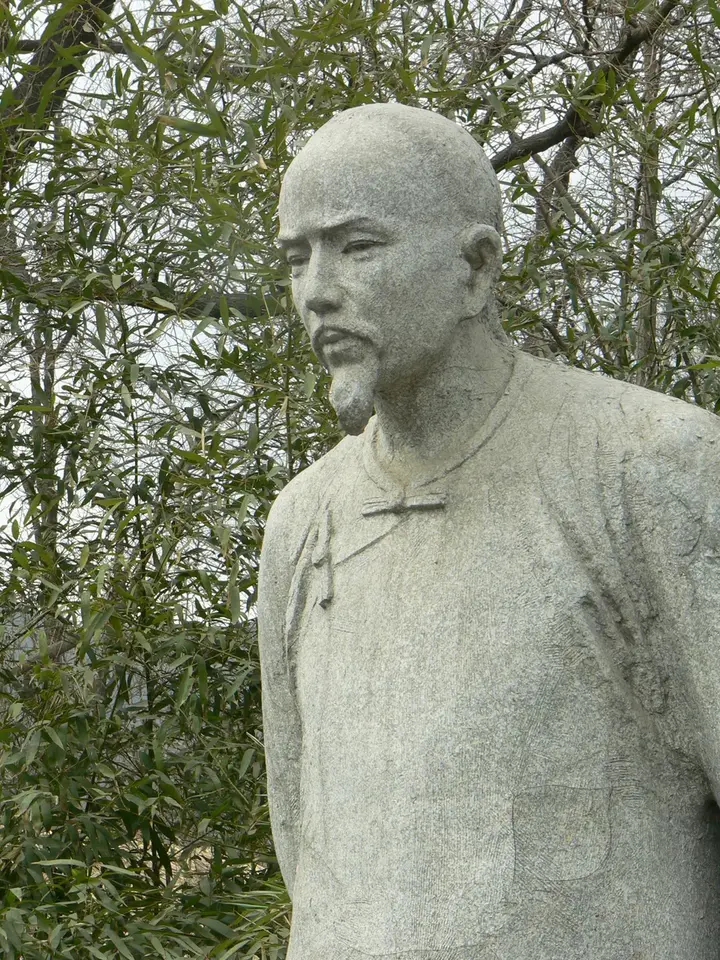
曹雪芹
Cao Xueqin (曹雪芹, c. 1715–c. 1763), personal name Cao Zhan (曹霑), courtesy name Mengruan (梦阮), pseudonyms Xueqin (雪芹), Qinpu (芹圃), and Qinxi Jushi (芹溪居士), was a preeminent Qing Dynasty novelist, poet, and artist whose ancestral home was in Fengrun, Zhili, and who was born in Jiangning (modern Nanjing, Jiangsu). He stands as the crowning summit in the artistic development of Chinese classical fiction and a monumental figure in…
Cao Xueqin (曹雪芹, c. 1715–c. 1763), personal name Cao Zhan (曹霑), courtesy name Mengruan (梦阮), pseudonyms Xueqin (雪芹), Qinpu (芹圃), and Qinxi Jushi (芹溪居士), was a preeminent Qing Dynasty novelist, poet, and artist whose ancestral home was in Fengrun, Zhili, and who was born in Jiangning (modern Nanjing, Jiangsu). He stands as the crowning summit in the artistic development of Chinese classical fiction and a monumental figure in world literature. Born into a prominent hereditary Plain White Banner bondservant family within the Imperial Household Department, his great-grandfather Cao Xi, grandfather Cao Yin, uncle Cao Yong, and adoptive father Cao Fu successively held the prestigious post of Jiangning Textile Commissioner for fifty-eight years, concurrently serving as salt distribution surveillance censors for the Lianghuai region. During the Kangxi Emperor's six southern inspection tours, Cao Yin hosted the imperial entourage four times, making the family one of the wealthiest and most prestigious grand clans in southern China. In late 1727 (the fifth year of the Yongzheng reign), the Cao family fell victim to political factional struggles and official deficits. The Yongzheng Emperor ordered their ancestral estate confiscated and titles stripped; Cao Fu was cast into prison, and the century-old noble house collapsed overnight. At age thirteen, Cao Xueqin moved with his impoverished surviving family back to Beijing, experiencing severe hardship, poverty, and the cold indifference of society. During the early Qianlong reign, he briefly served as a minor clerk in the Right Wing School of the Imperial Clan, where he befriended Manchu noble literary figures including the brothers Dunmin and Duncheng. In his later years, he relocated to the impoverished outskirts of the Western Hills near Xiangshan, living in a leaking thatch cottage and surviving on thin porridge while persevering for a decade through five comprehensive revisions to compose his immortal eighty-chapter masterpiece, Dream of the Red Chamber (originally The Story of the Stone). Dream of the Red Chamber is set against the dramatic rise and fall of the four grand aristocratic families of Jia, Shi, Wang, and Xue, with the tragic romance between Jia Baoyu, Lin Daiyu, and Xue Baochai serving as its central emotional core. It profoundly reveals the inevitable historical collapse and structural decay of late imperial Chinese feudal society. Featuring hundreds of fully fleshed-out characters, masterful realistic psychological insight, and extensive integration of poetry, opera, gardens, medicine, culinary arts, and folk customs, the work represents the highest peak of ancient Chinese vernacular prose art. Additionally, Cao authored Feiyizhai Jigao (Drafts from the Waste Arts Studio), recording folk handicrafts to help disabled veterans and the poor achieve self-sufficiency. On Lunar New Year's Eve in roughly 1763, heartbroken following the untimely death of his young son and worn down by poverty and illness, Cao passed away in his Western Hills cottage. His legacy birthed the dedicated field of "Redology" and stands as an enduring monument in world literature.
Born in the official mansion of the Jiangning Textile Commissioner in Nanjing; his biological father Cao Yong had died early, and he was adopted and raised by his uncle Cao Fu.
Grew up in the opulent West Garden of the Jiangning Textile Bureau, enjoying aristocratic culture, classical literature, painting, and music.
The Yongzheng Emperor ordered the total confiscation of the Cao family estate; Cao Fu was dismissed in chains, and the family relocated north to Beijing.
Endured severe impoverishment after multiple confiscations, residing in modest quarters near Suanshikou outside Chongwenmen in Beijing.
Obtained a minor administrative post in the Right Wing School of the Imperial Clan, forming deep friendships with Dunmin and Duncheng.
Left urban official circles and relocated his family to Zhengbaiqi Village near Xiangshan in Beijing's western suburbs, living in frugal rustic seclusion.
After a decade of work and five revisions, completed the eighty-chapter manuscript of The Story of the Stone, annotated by Zhiyanzhai.
Completed eight volumes of Feiyizhai Jigao, teaching kite-making, weaving, and textile crafts to help disabled and impoverished citizens earn a living.
His beloved young son succumbed to epidemic illness; shattered by grief, Cao collapsed into chronic illness and bedridden exhaustion.
Died on Lunar New Year's Eve in his Western Hills cottage; his literary friends Duncheng, Dunmin, and Zhang Yiquan raised funds for his burial and wrote elegiac verses.
In the spring of 1715 (the fifty-fourth year of the Kangxi reign), Cao Xueqin was born in the grand Jiangning Textile Commissioner mansion in Jiangning (modern Nanjing, Jiangsu). The Cao family was a prominent hereditary bondservant clan belonging to the Plain White Banner of the Imperial Household Department, having originally resided in Liaoyang during the late Ming dynasty. In the early Shunzhi era, Cao's ancestor Cao Zhenyan entered the central plains with the Qing banners and attained administrative office; his great-grandmother Lady Sun was chosen to serve as the wet nurse to the young Kangxi Emperor, fostering an exceptionally intimate bond with the throne. His great-grandfather Cao Xi won deep trust through diligence and was appointed Jiangning Textile Commissioner in 1663, inaugurating the family's fifty-eight-year tenure in the crucial southern textile bureau. His grandfather Cao Yin was a renowned scholar-official who served as imperial reader-in-waiting and imperial bodyguard before succeeding to the textile commissioner post and concurrently serving as salt surveillance commissioner of Lianghuai for two decades, during which he oversaw the compilation and carving of the monumental Complete Tang Poetry. During Kangxi's six inspection tours of the south, Cao Yin hosted the emperor four times at the mansion's West Garden, elevating the family to the pinnacle of wealth, prestige, and cultural renown in the lower Yangtze region.
In the first lunar month of 1715, Cao Yin's son, then Jiangning Textile Commissioner Cao Yong, fell abruptly ill and died while on official duty in Beijing. The Kangxi Emperor granted special permission for Cao Fu, son of Cao Yin's brother Cao Yi, to be adopted as Cao Yin's heir and take over the commissioner post. On the seventh day of the third month, Cao Fu submitted a memorial noting that his widowed sister-in-law Lady Ma was seven months pregnant; the posthumous child she carried was Cao Xueqin. Born on the twenty-sixth day of the fourth lunar month (May 28, 1715), the child was given the personal name Zhan, derived from an imperial memorial recording abundant rains moistening the soil, rooted in the Classic of Poetry. He took the courtesy name Mengruan and later the pseudonym Xueqin, inspired by Su Shi's verse regarding celery shoots rooted in winter snow.
During his childhood, which coincided with the peak of the High Qing era under Kangxi and Yongzheng, Cao Xueqin grew up surrounded by luxury and refined elegance in the West Garden of the textile bureau. Naturally brilliant and gentle-hearted, he harbored a distaste for rigid examination-style eight-legged essays and conventional moralistic texts, immersing himself instead in poetry, calligraphy, painting, folk drama, landscape architecture, and craft techniques. Living alongside female cousins and maids within the sprawling inner chambers, he observed both the exquisite etiquette of an aristocratic dynasty and the tender, vulnerable inner lives of aristocratic women. This dreamlike youth in Nanjing left an indelible mark on his soul, providing the authentic emotional bedrock and sensory memories for the garden world of the Daguan Garden in his later masterpiece.
Beneath the outward splendor of the Cao estate lay severe political and financial vulnerabilities. For decades under the Kangxi Emperor, the family had absorbed colossal public expenditures to host imperial southern visits, purchase rare court luxuries, and conduct secret surveillance of southern scholar circles, accumulating hundreds of thousands of silver taels in official treasury deficits. Protected by the elderly Kangxi Emperor, the family had managed to defer retribution. However, upon the emperor's death in 1722, the Yongzheng Emperor took the throne amid intense factional rivalry among the imperial brothers. Yongzheng moved swiftly and sternly to rectify imperial finances and eradicate political rivals, focusing his wrath on officials associated with rival princes.
In the twelfth month of 1727, Yongzheng issued a decree condemning Cao Fu for gross financial mismanagement, public waste, and improper conduct, ordering the confiscation of all family property in Jiangning and the arrest of Cao Fu in wooden cangues. In early 1728, incoming commissioner Sui Hede sealed the family estates. Cao Xueqin's grandmother, mother Lady Ma, and scores of relatives and servants were evicted, leaving only seventeen modest rooms in Suanshikou outside Chongwenmen in Beijing and three servant couples for their basic survival. At thirteen, Cao witnessed his family plunge from wealth into ruin overnight, accompanying his mother and surviving relatives northward on horse carts to Beijing.
Upon arriving in the capital, former aristocratic allies turned their backs on the ruined family. Burdened by a large household and destitute finances, the family survived by pawning heirlooms and receiving irregular assistance from relatives. During these impoverished adolescent years, Cao Xueqin stepped out of the cloistered aristocratic bubble into the bustling, gritty streets of inner and outer Beijing. He witnessed firsthand the bitter internal disputes among relatives over meager property, the grim realities of banner livelihoods, and the callousness of society. These hardships dissolved any aristocratic vanity, granting him profound insight into the moral decay and hypocrisy of the ruling class.
In 1736, the Qianlong Emperor ascended the throne, ushering in an initial period of political clemency. Many families punished under the Yongzheng reign were pardoned; Cao Fu was released from detention, and the family enjoyed a brief period of domestic stability. Due to longstanding ancestral connections between the Cao family and the Manchu imperial nobility, the talented Cao Xueqin was recommended to a minor clerical or teaching post at the Right Wing School of the Imperial Clan near Ganshi Bridge in Xidan, Beijing.
The school was an elite institution established to educate unranked Manchu imperial clan youths. During his service there, Cao met the two lifelong friends who would become his most loyal literary companions: Dunmin and Duncheng, twelve-generation descendants of Nurhaci. Despite their imperial lineage, both brothers possessed untrammeled spirits, detested rigid civil examination training, and were passionately devoted to poetry and literature. Recognizing Cao's extraordinary intellect, noble independence, and brilliant eloquence, they formed a deep bond of intellectual fellowship with him.
For several years, Cao gathered regularly with the Dun brothers and fellow poet Zhang Yiquan in Beijing wine shops and private libraries. Cao's poetic brilliance astonished his peers. In his verse dedicated to Cao, Duncheng praised his untamable creative pride despite destitution, writing of drinking together in snowy winds and admiring his defiant spirit. Dunmin similarly wrote verses commemorating their bohemian singing and intellectual fervor against the backdrop of winter cold in the Western Hills. These literary gatherings allowed Cao to express his profound melancholy over his fallen house and further deepened his artistic insight into the rot of the Qing aristocratic elite.
Around 1750 (the fifteenth year of the Qianlong reign), when relatives were implicated in political reverberations surrounding the Hongxi conspiracy, the Cao family suffered another wave of decline. Cao Xueqin resolved to abandon his minor clerical post and leave behind the oppressive politics and superficial society of inner Beijing. He gathered his wife and children and moved westward to settle in Zhengbaiqi Village near Xiangshan in the Western Hills outside Beijing.
Nestled beneath wooded ridges and clear streams, the Western Hills provided natural beauty but harsh living conditions. In his later years, Cao lived in a modest thatched cottage exposed to wind and rain, frequently subsisting on plain porridge and buying wine on credit. To provide for his family, he sold occasional paintings and calligraphy and accepted modest gifts from Duncheng and Dunmin. Yet material destitution failed to quench his creative drive. In this humble rural refuge, illuminated by solitary oil lamps, Cao channeled the memories of his aristocratic youth, the tragedy of his family's fall, and his philosophical reflections on society into a monumental realistic novel.
With extraordinary artistic perseverance, Cao devoted a decade of labor to the manuscript. As recorded in the opening chapter of the novel, he undertook five major revisions in his Mourning Red Studio, organizing chapters and crafting verses that lamented the author's bittersweet tears. His work was accompanied by close intellectual confidants and relatives, most notably the annotators known as Zhiyanzhai and Jihusou, who provided commentary, preserved manuscripts, and discussed artistic nuances. Circulating among literary circles in handwritten copies, these eighty chapters—known collectively as the Zhiyanzhai versions—won immediate acclaim, with copies fetching high prices and bringing readers to tears.
Alongside his literary genius, Cao demonstrated a profound humanitarian commitment to the welfare of the poor and disabled. Between 1755 and 1758, seeing wounded banner soldiers, disabled individuals, and impoverished locals struggling to survive without livelihoods, he compiled eight volumes of practical craft instructions entitled Feiyizhai Jigao (Drafts from the Waste Arts Studio). The work covered kite fabrication, seal carving, fur garment restoration, intricate knot weaving, dyeing techniques, clay sculpting, and culinary arts. Cao not only designed intricate diagrams for his renowned "Cao Family Kites" but personally instructed blind and crippled individuals in kite-crafting, enabling them to earn an independent living and exemplifying his compassionate spirit.
In the late autumn of 1762, an epidemic broke out in the Western Hills, taking the life of Cao's beloved young son. The tragic loss shattered Cao's already fragile health and spirit. Plunging into deep despair, his chronic pulmonary illness flared up, leaving him bedridden for months without money for medical treatment.
On Lunar New Year's Eve in roughly 1763 (or early 1764), with heavy snow blanketing the Western Hills, Cao Xueqin passed away in his desolate cottage at the age of forty-eight. His family was so impoverished that they could not afford a coffin; his burial beneath the Jinji Ridge in the Western Hills was financed through donations from his devoted friends Dunmin, Duncheng, and Zhang Yiquan. In his elegy for Cao, Zhang Yiquan mourned the genius who died in squalor, surviving on porridge while leaving behind peerless artistic treasure. Though Cao died in penury, Dream of the Red Chamber remains an immortal masterpiece of global literature.
Cao Xueqin's crowning historical contribution was the creation of the peak masterpiece of Chinese classical realistic vernacular fiction, Dream of the Red Chamber (the first eighty chapters titled The Story of the Stone). Standing alongside the greatest works of world literature, such as Dante's Divine Comedy, Shakespeare's dramas, Cervantes' Don Quixote, and Tolstoy's War and Peace, the novel surpasses its predecessors in philosophical depth and social scope. By abandoning simple linear storytelling and mythological tropes in favor of an intricate multidimensional web structure, Cao fused unvarnished realistic observation with poetic romanticism, bringing Chinese vernacular prose fiction to its highest maturity.
Through his incisive realistic portrayal, Cao dissected the inner mechanics of China's late imperial autocracy. By illustrating the interdependent alliances among the four grand houses of Jia, Shi, Wang, and Xue, he tore away the veneer of patriarchal warmth to expose official corruption, judicial bribery, and the exploitation of commoners. Through the unyielding logic of character development and plot, Cao demonstrated the historical inevitability of the parasitic aristocracy's moral collapse and eventual extinction, producing an unvarnished mirror of an entire historical era in decline.
Cao achieved unmatched psychological depth in character development. Across the novel, over seven hundred distinct characters appear, with more than four hundred possessing vivid, individual personalities. Cao discarded conventional dramatic stereotypes of absolute virtue and unmitigated villainy, portraying human nature within intricate social contexts. Whether through the nonconformist rebellions of Jia Baoyu and Lin Daiyu, the dignified accommodation of Xue Baochai, the ruthlessness of Wang Xifeng, or the rich emotional lives of female figures such as Shi Xiangyun, Tanchun, Qingwen, and Xiren, Cao constructed an enduring humanist gallery that elevated the dignity of individual human emotion.
In an era deeply entrenched in patriarchal subjugation, Cao articulated a revolutionary defense of women's humanity. Through Jia Baoyu's declaration that women were made of pure water while men were formed from muddy clay, the novel challenged centuries of feudal misogyny that treated women as moral burdens or domestic possessions. Cao portrayed the intellectual brilliance, emotional depth, and autonomous agency of the women of the Twelve Beauties of Jinling, mourning their tragic destruction by rigid patriarchal norms and sounding the earliest dawn of female emancipation and individual liberty in modern Chinese cultural history.
Beyond literature, Cao demonstrated practical compassion by recording artisanal crafts to alleviate poverty. Living in the Western Hills, he authored the eight-volume Feiyizhai Jigao to provide disabled soldiers and destitute locals with marketable trades. Systematizing techniques for kite-making, stone seal carving, leather repair, textile weaving, dyeing, clay sculpting, and culinary arts, he invented durable kite designs and distributed instructional verses and diagrams, exemplifying the Confucian ideal of practical scholarship dedicated to relieving human suffering.
FIGURES ASSOCIATED WITH THIS DYNASTY