Birth in Taicang
Born on August 30 in Liuhe, Taicang Department; entered the prefectural school at age thirteen
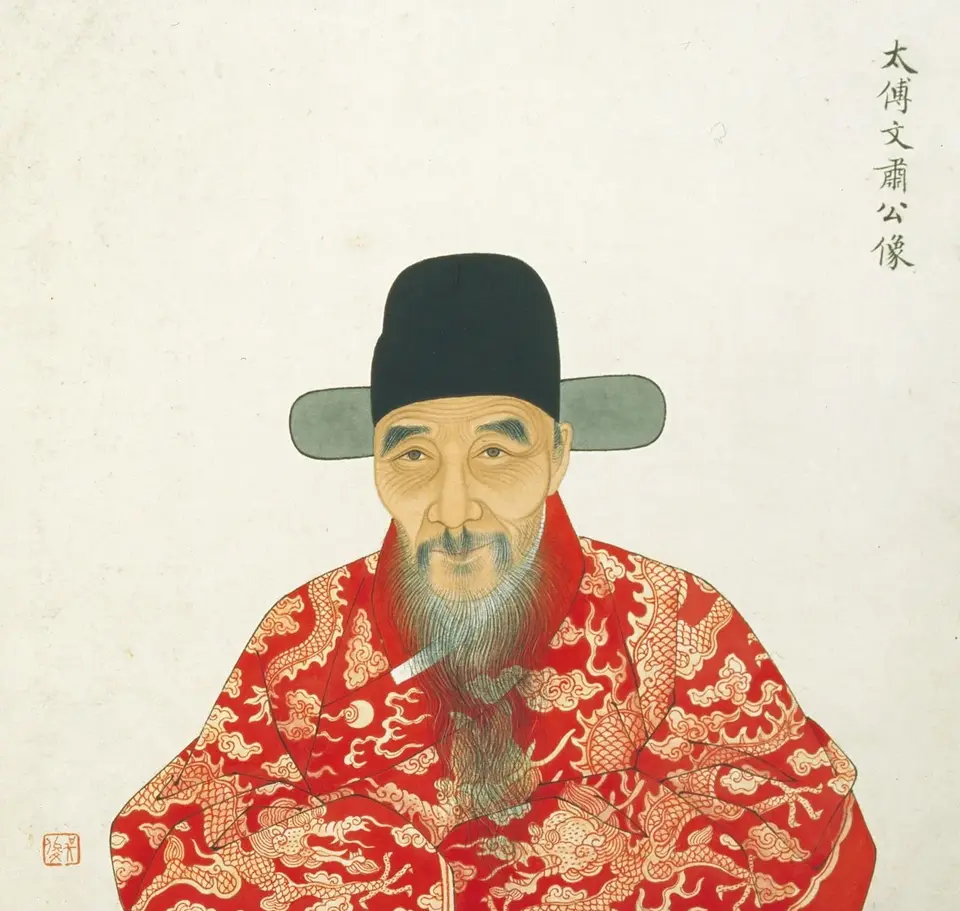
王锡爵
Wang Xijue (王锡爵, August 30, 1534 – February 11, 1611), courtesy name Yuanyu, art name Jingshi, a native of Taicang Department in Suzhou Prefecture (modern Taicang, Jiangsu), was a major statesman, scholar, and Senior Grand Secretary of the late Ming dynasty. Placing first in the 1562 metropolitan examination (huiyuan) and second in the palace examination (bangyan) behind his fellow Suzhou scholar Shen Shixing, he entered…
Wang Xijue (王锡爵, August 30, 1534 – February 11, 1611), courtesy name Yuanyu, art name Jingshi, a native of Taicang Department in Suzhou Prefecture (modern Taicang, Jiangsu), was a major statesman, scholar, and Senior Grand Secretary of the late Ming dynasty. Placing first in the 1562 metropolitan examination (huiyuan) and second in the palace examination (bangyan) behind his fellow Suzhou scholar Shen Shixing, he entered the Hanlin Academy, served as Chancellor of the Imperial University and Right Vice Minister of Rites, and co-compiled the Veritable Records of the Jiajing and Longqing reigns. In 1577, he broke with Senior Grand Secretary Zhang Juzheng over Zhang's refusal to retire for mourning (duoqing) and comforted the flogged remonstrators Wu Zhongxing and Zhao Yongxian, retiring home in 1578; yet when Zhang Juzheng was posthumously disgraced in 1584, Wang Xijue spoke out to defend Zhang's administrative achievements. Entering the Grand Secretariat in late 1584 alongside Shen Shixing, he protected Supervising Secretary Li Yi from the rod and engineered the dismissal of the powerful East Depot eunuch Zhang Jing. Serving as Senior Grand Secretary in 1593–1594, he prioritized the Ming military intervention in Korea against Toyotomi Hideyoshi over the Ningxia mutiny, directed massive famine relief across Henan that saved millions of lives, and—after withdrawing the controversial "Simultaneous Investiture of Three Princes" (Sanwang Bingfeng) edict—persuaded the Wanli Emperor in 1594 to inaugurate formal palace schooling for the Emperor's eldest son Zhu Changluo. Retiring in 1594 and declining a second appointment as Senior Grand Secretary in 1607, he died at home on February 11, 1611, at the age of seventy-seven, was posthumously promoted to Grand Guardian, and received the posthumous name Wensu.
Born on August 30 in Liuhe, Taicang Department; entered the prefectural school at age thirteen
Placed fourth in the Yingtian provincial examination specializing in the Spring and Autumn Annals
Placed first (huiyuan) in the metropolitan examination and second (bangyan) in the palace examination, becoming a Hanlin Compiler
Opposed Senior Grand Secretary Gao Gong over relocating the historiography office and was transferred to head the Nanjing Hanlin Academy
Promoted to Chancellor of the Imperial University after completing the Veritable Records of Emperor Muzong, and rose to Supervisor of the Household of the Heir Apparent (1576) and Right Vice Minister of Rites (1577) after completing the Veritable Records of Emperor Shizong
Interceded for officials flogged for opposing Zhang Juzheng's retention in office during mourning, and took leave in 1578 to care for his parents in Taicang
Defended Zhang Juzheng's reform achievements during the posthumous purge of Zhang's family, and was recalled in the twelfth month as Minister of Rites and Grand Secretary of the Wenyuan Pavilion
Saved Supervising Secretary Li Yi and helped oust East Depot eunuch Zhang Jing; defended his son Wang Heng after Wang Heng placed first in the Shuntian provincial examination
Assumed office as Senior Grand Secretary in the first month; directed Ming strategy in the Imjin War in Korea, organized Henan flood relief, withdrew the "Simultaneous Investiture of Three Princes" edict after court protests, and urged the Emperor in a private audience to educate his eldest son
Secured the formal commencement of palace schooling for Zhu Changluo in the second month, and retired in the fifth month as Grand Secretary of the Jianji Hall
Named Junior Guardian and recalled to head the Grand Secretariat, but firmly declined to leave Taicang
Died at home on February 11, 1611, at age seventy-seven; posthumously promoted to Grand Guardian and canonized as Wensu
Wang Xijue was born on August 30, 1534, in Taicang Department, Suzhou Prefecture, into a prosperous gentry family descended from the Northern Song chief councilor Wang Dan. Renowned from childhood for his incorruptibility—at age six he threw a silver ingot into a river when a relative tried to bribe his father through him—he placed fourth in the 1558 Yingtian provincial examination. In 1562, he won first place (huiyuan) in the metropolitan examination and finished second (bangyan) in the palace examination behind his fellow Suzhou native Shen Shixing, receiving appointment as a Hanlin Compiler.
After clashing with Senior Grand Secretary Gao Gong in 1571 and serving briefly in Nanjing, Wang Xijue was recalled in 1572 as Vice Director of the Veritable Records of Emperor Muzong. Promoted in 1574 to Chancellor of the Imperial University, he revived the early Ming credit-point system (jifenfa), required young nobles to attend ritual and archery instruction, and subsidized impoverished students from his own salary. Following the completion of the Veritable Records of Emperor Shizong in 1576, he rose to Supervisor of the Household of the Heir Apparent and Right Vice Minister of Rites in charge of the Hanlin Academy.
Although admired by Senior Grand Secretary Zhang Juzheng, Wang Xijue broke with Zhang in the ninth month of 1577 when Zhang refused to leave office to mourn his father (duoqing). When Hanlin scholars Wu Zhongxing and Zhao Yongxian were brutally flogged at court for remonstrating against Zhang, Wang Xijue confronted Zhang in person to plead for them and defied secret-police surveillance to host a farewell banquet for the banished scholars. In 1578, refusing to sign a joint petition urging Zhang Juzheng to return from his father's burial, Wang Xijue took leave to care for his aging parents in Taicang for six years.
When Zhang Juzheng's family was confiscated in 1584 and opportunistic courtiers competed to denounce all of Zhang's policies, Wang Xijue wrote to court leaders urging fairness: "Jiangling's (Zhang Juzheng's) achievements as chief minister were substantial; the court should preserve some measure of protection for the sake of national dignity." Recalled in the twelfth month of 1584 as Minister of Rites and Grand Secretary of the Wenyuan Pavilion, Wang Xijue served alongside Senior Grand Secretary Shen Shixing. In 1588, he intervened to save Supervising Secretary Li Yi from execution after Li impeached the corrupt East Depot eunuch Zhang Jing, and subsequently helped persuade the Wanli Emperor to dismiss Zhang Jing. That same autumn, when his son Wang Heng won first place in the Shuntian provincial examination and was challenged by Ministry officials Gao Gui and Rao Shen, a strict re-examination confirmed Wang Heng's first-place standing, though Wang Xijue's fiery memorials in his son's defense drew criticism from younger censors.
Returning to Beijing in the first month of 1593 as Senior Grand Secretary after the retirements of Shen Shixing, Xu Guo, and Wang Jiaping, Wang Xijue worked at an extraordinary pace. He persuaded the Wanli Emperor to halt imperial textile quotas in Jiangnan and porcelain quotas in Jiangxi, reduce gold tribute from Yunnan, and release inner-treasury silver to relieve catastrophic floods across Henan, northern Jiangsu, and southern Shandong.
In the ongoing succession controversy (Guoben Zhi Zheng) over the Wanli Emperor's delay in naming his eldest son Zhu Changluo as Crown Prince, the Emperor issued a rescript in early 1593 proposing to invest his first, third, and fifth sons simultaneously as princes (Sanwang Bingfeng) while leaving the position of Crown Prince vacant pending a possible son by the Empress. Hoping to resolve the impasse quietly, Wang Xijue drafted the edict, triggering an immediate storm of protest from Donglin and ministry officials led by Gu Xiancheng, Luo Wanhua, andYue Yuansheng. Recognizing the depth of court opposition, Wang Xijue promptly took responsibility and persuaded the Emperor to withdraw the three-prince edict. In the autumn of 1593, during a private audience in the Warm Pavilion, Wang Xijue pressed the Emperor to educate Zhu Changluo, pointing out that the prince was already twelve years old and no imperial son in history had ever been left without schooling at thirteen. Moved by his argument, the Wanli Emperor decreed in the second month of 1594 that Zhu Changluo formally begin palace lectures with the full ritual honors of an heir apparent.
In the fifth month of 1594, worn down by controversy over the 1593 metropolitan evaluation (Jingshi) in which Bureau Director Zhao Nanxing was cashiered, and anxious to care for his eighty-year-old mother, Wang Xijue submitted eight resignation memorials and retired to Taicang as Minister of Personnel and Grand Secretary of the Jianji Hall. When the Emperor recalled him in 1607 with the rank of Junior Guardian to resume the post of Senior Grand Secretary, Wang Xijue firmly declined. He died at home in Taicang on February 11, 1611, at the age of seventy-seven, was posthumously promoted to Grand Guardian, and received the posthumous name Wensu.
When Wang Xijue was summoned to become Senior Grand Secretary in 1592, the Ming court faced simultaneous crises: the mutiny of Pubei in Ningxia and Toyotomi Hideyoshi's invasion of Joseon Korea. While en route to Beijing, Wang Xijue wrote to the Emperor arguing that the Ningxia mutiny was a localized revolt that would soon be contained, whereas the Japanese invasion of Korea posed a mortal strategic threat to Liaodong and Beijing, requiring the commitment of the empire's finest troops. Throughout 1593–1594, he corresponded constantly with Supreme Commander Song Yingchang and General Li Rusong, guiding the victorious campaigns that recaptured Pyongyang and Seoul. Simultaneously, when devastating floods struck Henan in 1593, Wang Xijue secured inner-treasury funds, tax exemptions, and official salary donations, dispatching Commissioner Zhong Huamin to oversee relief efforts that saved millions of famine victims.
After withdrawing the controversial "Simultaneous Investiture of Three Princes" proposal in 1593 in response to public opinion, Wang Xijue used his unmatched personal rapport with the Wanli Emperor during a private Warm Pavilion audience to dismantle the Emperor's excuses for delaying the succession. By persuading the Emperor to inaugurate formal palace schooling (chuge jiangxue) for Zhu Changluo in the spring of 1594 with full Crown Prince ceremonial, Wang Xijue established the institutional foundation for Zhu Changluo's eventual investiture as Crown Prince in 1601.
In a series of major statecraft memorials submitted in 1593–1594—including his Memorial on Stabilizing the State and Unifying the Body Politic—Wang Xijue warned that the combination of imperial seclusion, shelved memorials (liuzhong), and bitter factional warfare among censorial and ministry officials threatened to paralyze the Ming state. Drawing on the administrative legacy of Zhang Juzheng, he advocated strengthening the coordinating authority of the Grand Secretariat and restoring regular audiences between the sovereign and his ministers to prevent palace eunuchs and consort clans from usurping state power.
Throughout his career and retirement, Wang Xijue repeatedly petitioned the throne to lighten fiscal burdens on commoners, reminding the Wanli Emperor that "for every fraction of tribute demanded above, the people expend threefold below." Whenever catastrophic floods struck the Yangtze Delta—as in 1588, 1593, and 1608—he wrote urgent memorials and letters to the Grand Secretariat and Ministry of Revenue pleading for full exemptions of current grain taxes across Suzhou, Taicang, and Songjiang, arguing that the court must not rely solely on overtaxed Jiangnan to fund the state. A prolific writer and accomplished calligrapher steeped in Tang stele inscriptions, he left the fifty-five-volume Collected Works of Duke Wang Wensu (Wang Wensu Gong Wenji) and won high praise from Dong Qichang for his vigorous small-standard script.
FIGURES ASSOCIATED WITH THIS DYNASTY