Birth in Jiangxia
Born into a scholar-gentry lineage in Wuchang Prefecture, Huguang.
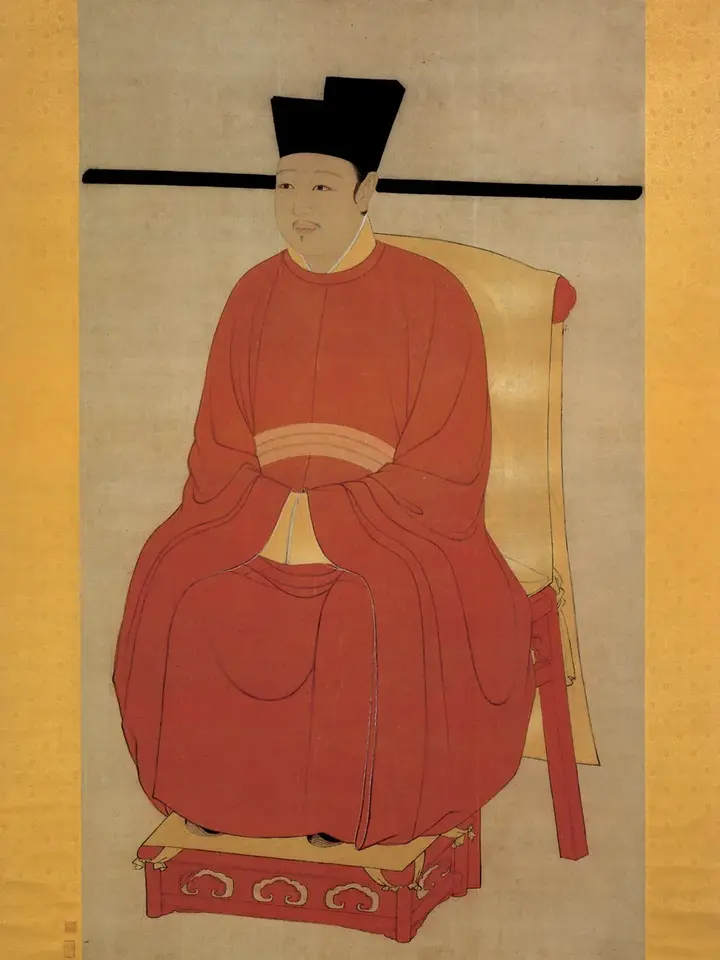
吴伟
Wu Wei (吴伟, 1459–1508), courtesy name Ciweng (次翁), also styled Shiying (士英) and Lufu (鲁夫), art name Xiaoxian (小仙), was a native of Jiangxia County, Wuchang Prefecture, Huguang (present-day Jiangxia District, Wuhan, Hubei). He was an outstanding master painter of the mid-Ming dynasty and the founding patriarch of the influential Jiangxia School, which formed the energetic core of the later Zhe School (Zhe Pai) tradition.…
Wu Wei (吴伟, 1459–1508), courtesy name Ciweng (次翁), also styled Shiying (士英) and Lufu (鲁夫), art name Xiaoxian (小仙), was a native of Jiangxia County, Wuchang Prefecture, Huguang (present-day Jiangxia District, Wuhan, Hubei). He was an outstanding master painter of the mid-Ming dynasty and the founding patriarch of the influential Jiangxia School, which formed the energetic core of the later Zhe School (Zhe Pai) tradition. Originating from a scholar-official family that fell into poverty following his father's obsessive pursuit of Daoist alchemy, the orphaned Wu was taken in by Qian Xin, former Left Administration Commissioner of Huguang, who recognized his artistic genius and sponsored his training in classical painting. Moving to Nanjing as a young adult, his dynamic brushwork captivated metropolitan elites; Grand Preceptor Zhu Yi, Duke of Chengguo, acclaimed his unearthly talent and bestowed upon him the moniker "Xiaoxian" (Little Immortal). During the Chenghua era, the Chenghua Emperor summoned him to the imperial court, commissioning him as Painter-in-Attendance at the Renzhi Hall and investing him as a pacification officer in the Embroidered Uniform Guard. Fiercely independent and disdainful of sycophancy, Wu alienated powerful court eunuchs and soon resigned to live as an unconstrained professional artist along the Qinhuai River. Under the Hongzhi Emperor, Wu was recalled to court and elevated to company commander, receiving the unprecedented imperial honor of an official jade seal designating him the "Number One Painter" (Hua Zhuangyuan). Incapable of enduring the stifling etiquette of the palace, he returned to Nanjing within two years, dedicating his mature career to teaching and painting. Demonstrating mastery in both landscape and figure painting, Wu expanded the vigorous brushwork of Dai Jin, Ma Yuan, and Xia Gui, incorporating the rapid, spontaneous reduction techniques of Liang Kai to pioneer an expressive, calligraphic style celebrated for explosive ink-splashing (pomo). In 1508, the Zhengde Emperor summoned him to Beijing for a third tour of service; before he could depart, Wu died suddenly from alcohol-induced apoplexy at the age of fifty. Among his celebrated surviving masterworks are Gathering Lingzhi, Immortals with Crane, Ten Thousand Li of the Yangtze River, Fisherman on a Mountain Stream, and Beauty with a Pipa.
Born into a scholar-gentry lineage in Wuchang Prefecture, Huguang.
Orphaned following his father's alchemy-related ruin; adopted by Qian Xin in Changshu, where he immersed himself in painting.
Traveled to Nanjing; gained the patronage of Zhu Yi, Duke of Chengguo, who granted him the title "Xiaoxian."
Summoned by the Chenghua Emperor; appointed Painter-in-Attendance at the Renzhi Hall and Pacification Officer in the Embroidered Uniform Guard.
Disgusted by the corruption of court eunuchs, resigned his commission to sell paintings along the Qinhuai River in Nanjing.
Re-summoned by the Hongzhi Emperor; elevated to Company Commander and presented with the imperial seal of "Number One Painter."
Chafed under court restrictions; cited illness to return permanently to Nanjing, consolidating the Jiangxia School.
Issued a third imperial summons by the Zhengde Emperor; collapsed and died from excessive drinking on the eve of his departure.
Wu Wei was born in 1459 in Jiangxia County, Wuchang Prefecture, Huguang. His family had long enjoyed scholarly prestige: his grandfather Wu Yonglian had served as a prefectural magistrate, and his father was a provincial scholar (juren) renowned for his classical prose. However, in his later years, his father succumbed to an obsessive infatuation with Daoist longevity alchemy, exhausting his family assets on cinnabar furnaces and secret elixirs. Following his father's premature death from alchemical poisoning, the estate collapsed entirely, leaving the young Wu destitute and homeless. Wandering eastward across the Yangtze delta, he eventually reached Haiyu (modern Changshu, Jiangsu).
Fortunately, Qian Xin, the retired Left Administration Commissioner of Huguang, encountered the destitute youth. Perceiving intelligence in the boy's countenance and refined cadence in his speech, Qian took him into his household as a companion and reading partner for his own son. In his leisure hours, Wu secretly collected scrap paper, charcoal, and discarded brushes, sketching trees, rivers, and wandering beggars with uncanny vitality. Stumbling upon these drawings, Qian Xin was astounded, exclaiming: "This child possesses divine genius; will he truly become a master painter of the age?" Instead of discouraging him, Qian purchased rolls of fine silk and classical pigment blocks, hiring local masters to instruct Wu in classical brushwork and composition. Immersed in the study of ancestral masterworks, Wu's artistic mastery matured with astonishing rapidity.
Around 1478, having attained his majority, Wu bade farewell to the Qian family and traveled to Nanjing, the cultural capital of the south. In this cosmopolitan center of literati culture, Wu's bold, uninhibited style immediately set him apart from conventional court academic painters. His brushstrokes possessed kinetic energy and rugged strength, capturing the wild vitality of nature. Metropolitan grandees competed to obtain his works. Grand Preceptor Zhu Yi, the Duke of Chengguo, was so struck by Wu's transcendent brushwork that he exclaimed: "This youth's art transcends the mortal realm; is he not an immortal who has descended to earth?" Zhu welcomed Wu into his palace as an honored guest and bestowed upon him the studio name "Xiaoxian" (Little Immortal), an epithet Wu proudly inscribed upon his paintings throughout his life.
Around 1483, news of Wu's extraordinary talent reached the Chenghua Emperor (Zhu Jianshen). An avid connoisseur of painting, the emperor issued an imperial decree summoning the twenty-four-year-old artist to Beijing. Granted an audience in the imperial palace, Wu demonstrated his skill before the throne, executing sweeping landscape vistas with breathtaking confidence. Delighted, the monarch appointed him Painter-in-Attendance at the Renzhi Hall and conferred upon him the concurrent military title of Pacification Officer (zhenfu) in the Embroidered Uniform Guard.
However, the Renzhi Hall was an environment dominated by bureaucratic protocol and the arbitrary oversight of powerful palace eunuchs. Wu was constitutionally proud, fiercely independent, and utterly incapable of servility. He treated corrupt eunuchs with open contempt, regarding them as domestic servants; when imperious officials demanded paintings with arrogant condescension, Wu would shatter his inkstone on the floor and storm out of the room. When powerful eunuchs such as Wang Zhi and Liang Fang sought to discipline him, Wu grew thoroughly alienated from court life. Realizing that bureaucratic subservience stifled his artistic freedom, he pleaded chronic illness in 1485, surrendered his commission, and returned to Nanjing to live as an unconstrained painter along the banks of the Qinhuai River.
In 1488, following the accession of the Hongzhi Emperor (Zhu Youtang), the court ushered in a golden era of cultural refinement. Highly valuing Wu's peerless genius, the young sovereign issued a special imperial dispatch summoning the painter back to the Forbidden City. Entering the palace for a second tour of duty, Wu was treated with unprecedented imperial indulgence. The Hongzhi Emperor promoted him to Company Commander (baihu) in the Embroidered Uniform Guard and commissioned the palace workshop to carve an exclusive jade seal bearing the inscription "Number One Painter" (Hua Zhuangyuan), an honor never before accorded to a court artist in the Ming dynasty.
Numerous anecdotes illustrate Wu's legendary eccentricities during this imperial tenure. Deeply addicted to alcohol, Wu believed that true inspiration could only be unlocked through complete inebriation. On one occasion, the Hongzhi Emperor summoned Wu for an immediate command performance while the artist was dead drunk in a metropolitan tavern. Palace eunuchs frantically carried the disheveled, stumbling painter into the imperial presence with hair tangled and robes askew. As courtiers trembled in horror at the breach of court etiquette, the emperor laughed indulgently, commanding attendants to bathe Wu's face with cold well water and prepare massive rolls of silk. Leaping forward in a drunken frenzy, Wu seized a saturated brush, splashing ink across the silk like torrential rain before scrubbing with coarse hemp. Within minutes, a magnificent panorama of gale-swept pines emerging from mist-shrouded peaks—the celebrated Pine Wind (Songfeng Tu)—materialized before the court. The emperor sighed in amazement: "This is truly the brushwork of an immortal!"
Yet despite royal patronage, Wu found palace life intolerable. After two years of service, he once again cited recurring physical infirmities to petition for his release. Recognizing that the wild artist could never be domesticated by court ritual, the emperor reluctantly granted his discharge.
Returning to Nanjing, Wu established his residence by the misty waters of the Qinhuai River. Free from institutional constraints, he surrendered himself to a life of unfettered artistic creation and bohemian revelry. Clad in coarse commoner's tunics, he drank daily with fishermen, woodcutters, and courtesans, welcoming poets, monks, and literati to his studio. Whenever his funds were exhausted, he produced spontaneous sketches to sell for wine, sharing his earnings with impoverished neighbors. Renowned literati figures such as Shen Zhou, Du Jin, and Guo Yi maintained intimate friendships with him, admiring both his extraordinary talent and his disdain for wealth and rank. On one occasion at a friend's banquet, when asked for an impromptu painting, Wu seized a fresh lotus seedpod from the table, dipped it into an inkwell, and stamped it dozens of times across the paper; picking up his brush, he connected the splatters with swift strokes, transforming the chaotic blotches into a vibrant, crawling composition entitled Catching Crabs (Buxie Tu).
The decade spent along the Qinhuai River represented the absolute zenith of Wu's artistic influence. Merging the classical architectural discipline of the Southern Song Academy with the spontaneous calligraphic liberation of literati ink painting, he founded the Jiangxia School, attracting scores of disciples including Zhang Lu, Jiang Song, and Wang Zhao.
In 1508, the youthful and martial Zhengde Emperor ascended the throne. Fascinated by tales of Wu's artistic legend, the monarch issued an urgent imperial decree summoning the master to Beijing for a third term of palace service. When imperial couriers arrived in Nanjing, local literati and friends organized lavish celebratory banquets to bid him farewell. On the eve of his departure, Wu engaged in an evening of unrestrained drinking, consuming massive quantities of wine. Later that night, he collapsed from sudden cerebral apoplexy induced by alcohol poisoning, passing away at the age of fifty. News of his death plunged the artistic communities of Nanjing and Beijing into profound mourning.
FIGURES ASSOCIATED WITH THIS DYNASTY