Birth in Jinan
Born in Licheng under Jin occupation; trained in martial arts and military treatises by his grandfather Xin Zan.
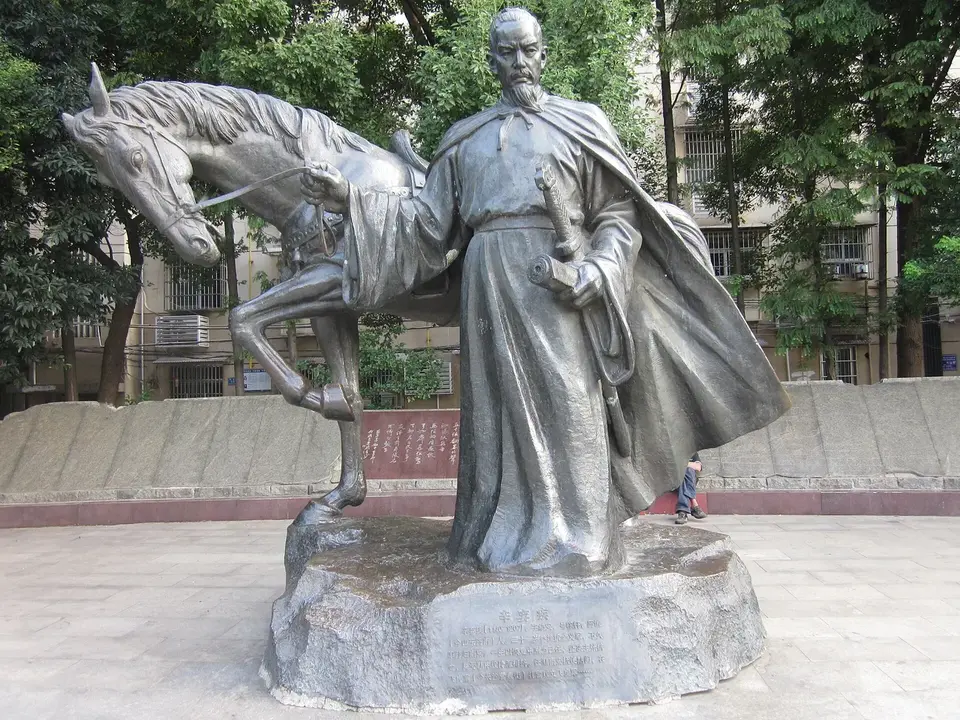
辛弃疾
Xin Qiji (辛弃疾) (1140 – 1207 AD), styled You'an (幼安), sobriquet Jiaxuan (稼轩), posthumously titled Zhongmin (忠敏), was a native of Licheng County in Jinan Superior Prefecture (modern Licheng District, Jinan, Shandong Province). He was an outstanding heroic lyricist, patriotic commander, and military strategist of the Southern Song dynasty, celebrated alongside Su Shi as Su-Xin and revered throughout Chinese literary history as…
Xin Qiji (辛弃疾) (1140 – 1207 AD), styled You'an (幼安), sobriquet Jiaxuan (稼轩), posthumously titled Zhongmin (忠敏), was a native of Licheng County in Jinan Superior Prefecture (modern Licheng District, Jinan, Shandong Province). He was an outstanding heroic lyricist, patriotic commander, and military strategist of the Southern Song dynasty, celebrated alongside Su Shi as Su-Xin and revered throughout Chinese literary history as the Dragon Among Lyricists. Born in northern China under Jurchen Jin occupation, he witnessed the suffering and humiliation of Han Chinese subjects under steppe rule from childhood. Under the guidance of his grandfather Xin Zan, he pledged his life to the sacred mission of recovering lost northern territories and avenging the national humiliation. In 1161 AD, when Jin ruler Wanyan Liang launched a massive invasion southward, twenty-two-year-old Xin gathered two thousand volunteers in his hometown to take up arms, subsequently joining the grand peasant army led by Geng Jing as chief secretary. In 1162 AD, when traitor Zhang Anguo assassinated Geng Jing and surrendered to the Jin, Xin led a daring raid of fifty elite horsemen into a Jin camp of fifty thousand soldiers, capturing Zhang Anguo alive and escorting him across enemy lines to Lin'an. This legendary feat astounded the imperial court, and Emperor Gaozong acclaimed his extraordinary courage, appointing him Assistant Magistrate of Jiangyin. Following his return south, Xin dedicated himself to national defense, submitting renowned strategic treatises such as Ten Discussions on Humble Proposals and Nine Deliberations, which provided acute analyses of enemy vulnerabilities and operational plans for northern reconquest. However, the appeasement factions dominant at court preferred peace, marginalizing Xin's strategic vision. He was dispatched to provincial administrative posts across Chuzhou, Jiangling, Tanzhou, and Zhedong. In Hunan, he established the formidable Flying Tiger Army, which remained a bulwark of regional defense for decades; across his jurisdictions, he suppressed famine, curbed grain speculation, and restrained corrupt local magnates. Due to his uncompromising stance on northern liberation, he was repeatedly impeached by factional opponents, spending over twenty years in forced retirement at his Dai Lake estate in Shangrao and Piaoquan in Yanshan. Recalled late in life by Han Tuozhou on the eve of the Kaixi Northern Expedition, he was assigned as Prefect of Zhenjiang, where he composed his immortal lyric Joy of Eternal Union: Meditations on the Past at Beigu Pavilion in Jingkou. In 1207 AD, he was summoned as Chief of Staff of the Bureau of Military Affairs, but succumbed to critical illness before assuming office at age sixty-eight, crying out on his deathbed: "Kill the thieves! Kill the thieves!" He was posthumously awarded Junior Preceptor and canonized as Zhongmin. Combining heroic martial spirit with consummate poetic craftsmanship, Xin Qiji brought the heroic school of classical song lyric (ci) to its absolute historical pinnacle.
Born in Licheng under Jin occupation; trained in martial arts and military treatises by his grandfather Xin Zan.
Gathered two thousand volunteers in Licheng upon Wanyan Liang's invasion; joined Geng Jing's army as chief secretary.
Led fifty horsemen into a fifty-thousand-strong enemy camp to capture traitor Zhang Anguo alive, escorting him to Lin'an.
Submitted the comprehensive ten-thousand-word military strategy Ten Discussions on Humble Proposals to Emperor Xiaozong.
Appointed Prefect of Chuzhou; restored war-torn farmlands, eased taxes, and built the Fanxiong Hall and Dianzhen Pavilion.
Appointed Prefect of Tanzhou and Hunan Pacification Commissioner; founded the elite Flying Tiger Army to pacify banditry.
Impeached by censors and dismissed; built his estate at Dai Lake in Shangrao, devoting himself to lyrics under the style Jiaxuan.
Conferred with patriotic scholar Chen Liang for ten days at Goose Lake, debating northern reconquest strategies.
Recalled by Han Tuozhou to govern Zhenjiang; ascended Beigu Pavilion to compose the historic lyric Joy of Eternal Union.
Appointed Chief of Staff of the Bureau of Military Affairs; passed away at Piaoquan shouting defiance, posthumously awarded Junior Preceptor and titled Zhongmin.
Xin Qiji was born in Sifengzha Village of Licheng County in Jinan Superior Prefecture on the eleventh day of the fifth lunar month in the tenth year of the Shaoxing era of Emperor Gaozong of Song (May 28, 1140 AD). Thirteen years had elapsed since the Jingkang Incident, and the heartland of northern China lay entirely under Jurchen military rule. Xin's grandfather, Xin Zan, had been unable to evacuate south with the fleeing imperial house due to his extensive family clan, compelling him to accept civilian appointments under the Jin regime, including magistrate of Hao County. However, Xin Zan remained unswervingly loyal to the Song dynasty in his heart, dreaming constantly of northern liberation.
Recognizing exceptional gifts in his young grandson, Xin Zan instilled within Xin Qiji an unyielding resolve to avenge national disgrace and liberate his homeland. He frequently guided the boy to mountaintop vistas, pointing out captured mountain ranges and rivers while narrating the tragic humiliation inflicted upon Han populations by foreign conquerors. To observe Jin vulnerabilities firsthand, Xin Zan twice dispatched Xin Qiji to the Jin capital of Yanjing (modern Beijing) under the pretext of taking the civil examinations, allowing him to inspect frontier topography, fortress garrisons, and popular morale. Throughout his adolescence, Xin mastered classical statecraft, military treatises, and equestrian archery, cultivating the fearless, chivalrous spirit of northern warriors.
In 1161 AD (the thirty-first year of the Shaoxing era), Jin ruler Wanyan Liang mobilized a vast army of six hundred thousand troops to invade southern China, intending to extinguish the Southern Song dynasty. Severe tax extortions and forced conscription in the northern territories sparked widespread uprisings among Chinese peasants. Twenty-two-year-old Xin Qiji seized this historic moment, raising two thousand armed volunteers in his native Licheng. Assessing regional dynamics, he incorporated his forces into the grand volunteer host of Geng Jing, serving as chief secretary of the Tianping Commandery to manage intelligence, proclamations, and military communications.
In early 1162 AD, Wanyan Liang's invasion was shattered at the Battle of Caishi, and the Jin emperor was assassinated during an army mutiny. Exploiting this opportunity, Geng Jing sent Xin Qiji as an imperial envoy to Jiankang (modern Nanjing) to submit a formal petition of allegiance to Emperor Gaozong, seeking military supplies and coordinating a joint offensive. Emperor Gaozong received Xin warmly in his temporary palace, officially appointing Geng Jing Military Commissioner and naming Xin an imperial officer.
However, as Xin journeyed north bearing the imperial commissions, disaster struck the volunteer camp: traitorous subordinate Zhang Anguo had assassinated Geng Jing and surrendered several tens of thousands of troops to the Jin army. Consumed by grief and outrage, Xin selected fifty fearless cavalrymen, galloping through blinding storms directly toward the Jin army encampment at Jizhou, which held fifty thousand troops. In a lightning night assault, Xin penetrated the central compound, overpowered the guards, seized Zhang Anguo, and bound him securely to a warhorse. Driving through encirclement before the stunned enemy could rally, Xin galloped south across the Huai River and the Yangtze, escorting the traitor alive to Lin'an for public execution. This legendary stroke of tactical genius astonished the southern court, prompting Emperor Gaozong to extol his superhuman courage and reassign him as Assistant Magistrate of Jiangyin.
Having returned south, twenty-five-year-old Xin was eager to organize an immediate northern expedition. In 1165 AD, he presented his monumental military memorial, Ten Discussions on Humble Proposals, to the newly enthroned Emperor Xiaozong. Comprising ten thousand words, the first three chapters presented a cold, penetrating analysis of internal fractures within the Jurchen ruling class, demonstrating that the Jin empire appeared formidable but was hollow within, dispelling the defeatism pervasive across southern ruling circles. The remaining seven chapters detailed a comprehensive operational roadmap: overhauling imperial taxation, reorganizing field armies, preparing logistical depots, and executing a coordinated pincer advance across Shandong and Henan. In 1170 AD, he submitted Nine Deliberations to Chancellor Yu Yunwen, arguing that reliance on the Yangtze for passive defense was an illusion that guaranteed eventual conquest.
However, the conservative appeasement faction held absolute dominance at court. Terrified by the failure of the Longxing Northern Expedition, Emperor Xiaozong harbored deep distrust toward refugees from the north (guizhengren). Xin's brilliant operational plans were shelved, and he was relegated to regional administrative posts. In 1172 AD, Xin was appointed Prefect of Chuzhou. Devastated by border warfare, Chuzhou's urban defenses were collapsed and farmlands lay abandoned. Undaunted, Xin restructured local administration: settling refugees on vacant plots, waiving illegal surcharges, and reviving commercial trade. Within six months, Chuzhou flourished; Xin erected the Fanxiong Hall and Dianzhen Pavilion to celebrate civic recovery, proving himself an administrator of rare practical genius.
In 1179 AD (the sixth year of the Chunxi era), Xin was reassigned as Prefect of Tanzhou concurrent with Hunan Pacification Commissioner. Hunan had long been plagued by bandit insurrections and unrest along mountainous ethnic borders, which existing regional garrisons were too demoralized to control. Convinced that strong military institutions were indispensable for regional order and national defense, Xin petitioned the throne to create an elite standing provincial corps of two thousand five hundred men, named the Flying Tiger Army. Confronted with obstruction from conservative bureaucrats who accused him of excessive expenditures, Xin exhibited unbending resolve: executing corrupt contractor foremen, enforcing strict discipline, and completing fortified garrison cantonments in record time.
Xin trained the Flying Tiger Army according to the rigorous standards of frontier combat legions, furnishing every trooper with fine armor and mounts. Within months of its formation, the corps crushed entrenched bandit networks across the province, pacifying Hunan entirely. Over the ensuing three decades, the Flying Tiger Army served as one of the most reliable combat units of the Southern Song, standing firm against both Jin incursions and later Mongol thrusts, earning the dread of enemy troops who called them the Tiger Battalion. In 1181 AD, Xin was promoted for his achievements to Court Gentleman for Consultation and Prefect of Longxing concurrent with Jiangxi Pacification Commissioner. However, jealous courtiers led by censor Wang Youzhi fabricated slanders, accusing him of squandering treasury funds and exercising arbitrary severity, prompting Emperor Xiaozong to strip him of office.
In the winter of 1181 AD, forty-two-year-old Xin was dismissed from office at the height of his administrative powers. Anticipating that his offensive doctrines would not be tolerated by an appeasing regime, he had constructed an estate along Dai Lake in Shangrao (modern Jiangxi Province), adopting the title Retired Scholar Jiaxuan from the maxim that human life thrives through diligent cultivation. In this lakeside retreat, he spent over a decade in enforced rural obscurity, plowing fields, fishing, and writing poetry.
During these years of exile, his thwarted patriotism found expression in peerless literary creation. In the winter of 1188 AD, Chen Liang, an equally fervent champion of northern reconquest, traveled a thousand li to visit Xin. The two heroes met at Goose Lake Temple, conferring for ten days on grand geopolitical strategy and the liberation of northern territories. Deeply moved by their shared vision, Xin composed his immortal masterpiece Poem to the Tune of Breaking through the Battle Array: A Heroic Song for Chen Tongfu: "Drunk, I trim the lamp-wick to gaze upon my sword; dreaming, I return to bugle calls echoing through connected camps. Eight hundred li of pasture roasted for the legions; fifty strings playing melodies of the northern frontier, an autumn muster on the sands... Alas, white hair now invades my brow!" These verses captured the tragic anguish of a warrior denied the battlefield, standing as a summit of Chinese patriotic verse.
In 1194 AD, while serving as Fujian Pacification Commissioner, Xin was impeached once more and retired to Piaoquan in Yanshan County. In 1203 AD, Chancellor Han Tuozhou, seeking military glory to consolidate his autocratic power, began preparations for the Kaixi Northern Expedition. Seeking the prestige of venerable patriots, Han recalled sixty-four-year-old Xin, appointing him Prefect of Shaoxing concurrent with Zhedong Pacification Commissioner, and subsequently Prefect of Zhenjiang.
Zhenjiang stood as the northern gateway overlooking the Yangtze front. Arriving at his post, Xin worked tirelessly despite advancing age and infirmity, mobilizing volunteer militias, manufacturing eighty thousand sets of armor, and dispatching reconnaissance scouts deep into Jin territory. However, his investigations revealed that Han Tuozhou's preparations were dangerously inadequate: the imperial treasuries were depleted, frontier commanders were incompetent, and troops were untrained. Ascending Beigu Pavilion in Zhenjiang, Xin gazed across the great river toward the lost northern plain and composed his crowning masterpiece Joy of Eternal Union: Meditations on the Past at Beigu Pavilion in Jingkou: "Across ten thousand ages of hills and streams, no trace remains of heroic Sun Zhongmou... Hasty triumphs in the Yuanjia era yielded only panic upon looking north. Forty-three years have fled, yet my eyes still recall the beacon fires on the Yangzhou road. Who will ask: Though Lian Po has grown old, can he still consume his ration?"
His prudent counsel infuriated Han Tuozhou, who dismissed him from frontier defense. In 1206 AD, Song forces launched their premature offensive, suffering catastrophic routs on every front just as Xin had predicted. In the autumn of 1207 AD, with the dynasty reeling in panic, the court recalled Xin as Chief of Staff of the Bureau of Military Affairs to coordinate imperial defense. However, the summons arrived too late: sixty-eight-year-old Xin was bedridden with fatal illness. On the tenth day of the ninth lunar month of 1207 AD, he passed away at his Piaoquan estate. In his final delirium, he raised clenched fists toward the ceiling, shouting repeatedly: "Kill the thieves! Kill the thieves!" He was posthumously honored as Junior Preceptor and canonized as Zhongmin. The Dragon Among Lyricists had departed, his unfulfilled dream etched forever into the soul of Chinese literature.
Xin Qiji represents an insurmountable peak in the history of classical Chinese poetry. Expanding upon the foundations laid by Su Shi, he demolished the restrictive convention that song lyrics (ci) were merely delicate trifles fit for banquets. Treating lyric meters with the expansive freedom of prose and the solemn power of ancient verse, he integrated political ideals, frontier combat, tactical maneuvers, and philosophical contemplations into his poetry. His verses possess sweeping grandeur, dramatic vigor, and rich textural variety, encompassing both tempestuous martial fury and serene, subtle pastoral observation. With over six hundred surviving works—the largest corpus of any Song lyricist—he is universally honored alongside Su Shi as the twin titan of the heroic style and revered as the Dragon Among Lyricists.
In 1162 AD, confronting the crisis of Zhang Anguo's assassination of Geng Jing, twenty-two-year-old Xin executed one of the most astonishing tactical exploits in Chinese military history. With only fifty elite horsemen, he infiltrated a hostile army of fifty thousand troops under cover of darkness, seized the traitor in the heart of the enemy headquarters, and broke out through surrounding legions to ride thousands of li back to the capital. This legendary display of audacity and tactical precision remains a classic archetype of heroic valor in world military chronicles.
Xin Qiji was an exceptional grand strategist whose geopolitical acumen was rarely equaled in the Southern Song era. In Ten Discussions on Humble Proposals and Nine Deliberations, he employed rigorous empirical analysis to examine the economic stability, ethnic contradictions, and troop deployments of both the Song and Jin empires. He formulated core doctrines of strategic opportunism, assessing terrain and popular morale to construct operational blueprints for northern reconquest. His strategic treatises represent the highest intellectual achievement of Southern Song military thought.
During his administration as Hunan Pacification Commissioner, Xin overcame bureaucratic resistance to forge the Flying Tiger Army, an elite corps of two thousand five hundred shock troops. Enforcing iron discipline and equipping the force with advanced armor and chargers, he rapidly pacified deep-rooted regional rebellions across central and southern China. Over the following three decades, the Flying Tiger Army stood as an indispensable elite reserve of the imperial army, demonstrating Xin's exceptional talents in military administration and combat training.
FIGURES ASSOCIATED WITH THIS DYNASTY