Birth on the Huai
Born aboard a boat on the Huai River; fled south with his family as an infant during Jurchen invasions, settling in Shanyin.
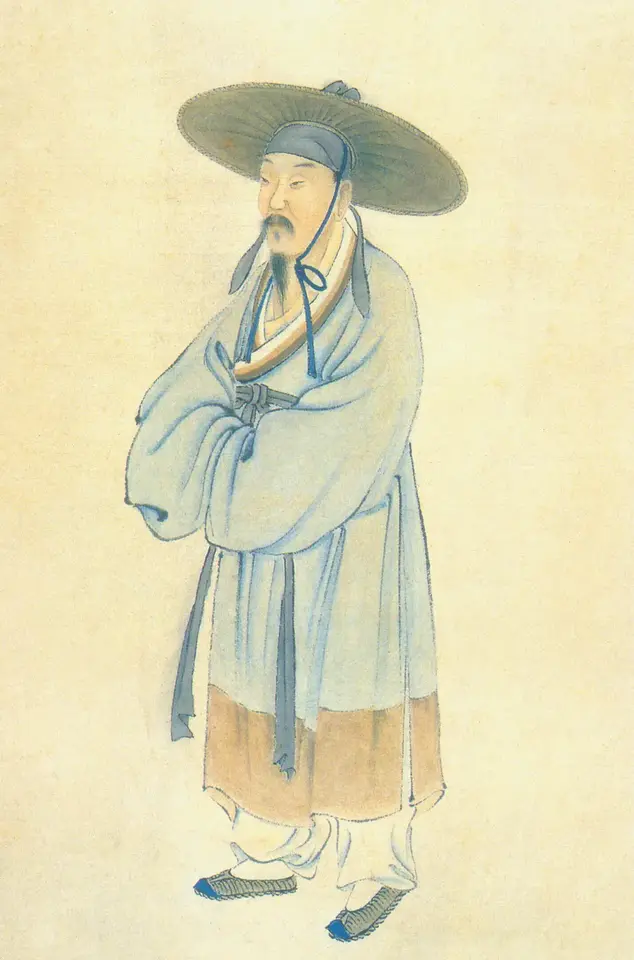
陆游
Lu You (陆游) (1125 – 1210 AD), styled Wuguan (务观), sobriquet Fangweng (放翁), was a native of Shanyin in Yue Prefecture (modern Shaoxing, Zhejiang Province), born aboard a boat on the Huai River. He was an outstanding patriotic poet, essayist, and historian of the Southern Song dynasty, universally recognized as the leader of the Four Great Poets of Mid-Song Restoration (alongside Yang Wanli, Fan Chengda, and You Mao), and…
Lu You (陆游) (1125 – 1210 AD), styled Wuguan (务观), sobriquet Fangweng (放翁), was a native of Shanyin in Yue Prefecture (modern Shaoxing, Zhejiang Province), born aboard a boat on the Huai River. He was an outstanding patriotic poet, essayist, and historian of the Southern Song dynasty, universally recognized as the leader of the Four Great Poets of Mid-Song Restoration (alongside Yang Wanli, Fan Chengda, and You Mao), and celebrated as the most prolific poetic master in Chinese literary history. Born into an illustrious Jiangnan lineage of bibliophiles, his grandfather Lu Dian studied under Wang Anshi and rose to Vice Grand Councilor, while his father Lu Zai was an upright official of the late Northern Song. Born on the eve of the Jingkang Incident, Lu was carried south as an infant amidst wartime flight, absorbing from early childhood a fervent commitment to national reconquest. In 1153 AD, Lu ranked first in the metropolitan preliminary examination, but was stripped of his credentials by the despotic chief minister Qin Hui, whose grandson Qin Xun had been outshone by Lu's papers. Following Qin Hui's death, Emperor Xiaozong ascended the throne, granted Lu the jinshi degree, and appointed him Compiler of the Bureau of Military Affairs. Vigorously advocating northern recovery and the punishment of traitors, he was repeatedly sidelined by the appeasement faction. In 1170 AD, he traveled up the Yangtze to assume office as Controller-General of Kuizhou, authoring the celebrated travelogue Account of Entering Shu. In 1172 AD, General Wang Yan recruited Lu into his expeditionary headquarters in Nanzheng. Stationed along the frontier at Dasanguan Pass, Lu wore armor, patrolled snowbound borders, and killed a marauding tiger with his own hands, experiencing the most exhilarating military months of his life. Following the dissolution of the Nanzheng headquarters, Lu served in administrative posts across Sichuan and Zhejiang, eventually supervising the compilation of the imperial veritable records of Emperors Xiaozong and Guangzong, attaining the rank of Edict Attendant of the Hall for Treasuring the Heritage. Denounced repeatedly by conservative censors for his hawkish memorials, he spent his twilight decades in rural retirement at his Sanshan Thatched Cottage in Shanyin. On the twenty-ninth day of the twelfth lunar month in 1209 AD (January 26, 1210 AD), eighty-five-year-old Lu You succumbed to illness, leaving behind his immortal farewell poem Showing to My Sons, lamenting that he had not lived to see the empire unified and instructing his sons to inform his spirit during ancestral sacrifices whenever the imperial armies recovered the central plains. Posthumously canonized as Wenxiu, Lu left over 9,300 poems and over a hundred song lyrics, his sweeping verses elevating patriotic devotion to the pinnacle of classical Chinese literature.
Born aboard a boat on the Huai River; fled south with his family as an infant during Jurchen invasions, settling in Shanyin.
Married his cousin Tang Wan at age twenty; deeply devoted, they were forced into divorce by his mother, inspiring the tragic lyric at Shenyuan.
Placed first in the ministerial examination; purged by Qin Hui for outranking his grandson Qin Xun, remaining barred from office until Qin's death.
Granted the jinshi degree by Emperor Xiaozong and appointed Compiler in the Bureau of Military Affairs, submitting plans for northern reconquest.
Appointed Controller-General of Kuizhou; journeyed upstream along the Yangtze for six months, composing Account of Entering Shu.
Joined Wang Yan's forward expeditionary staff in Hanzhong; patrolled Dasanguan Pass in armor and engaged in frontier defense.
Stationed in Chengdu following the headquarters closure; exchanged verses with Fan Chengda and adopted the sobriquet Fangweng.
Appointed Prefect of Yanzhou, promoting agriculture and flood control; composed Great Wind and Rain on the Fourth Day of the Eleventh Month.
Commissioned to edit the imperial veritable records of two reigns; awarded Edict Attendant of the Hall for Treasuring the Heritage upon retirement.
Authored his deathbed poem Showing to My Sons at age eighty-five, posthumously awarded the canonical title Wenxiu.
Lu You was born on the seventeenth day of the tenth lunar month in the seventh year of the Xuanhe era of Emperor Huizong of Song (November 13, 1125 AD). His father, Lu Zai, was traveling north by boat along the Huai River to present himself at the imperial court in Bianjing, accompanied by his wife Lady Tang. Amidst heavy gale storms and torrential rain, a third son was born aboard the anchored vessel, prompting his father to name him You, denoting wandering on waters. The Lu clan was an eminent gentry house of Jiangnan: his great-great-grandfather Lu Zhen had passed the examinations under Emperor Zhenzong, rising to Bureau Director in the Ministry of Personnel; his grandfather Lu Dian had studied under Wang Anshi and served as Vice Grand Councilor, authoring standard commentaries on the Spring and Autumn Annals and Erya; his father Lu Zai had served as Vice Fiscal Commissioner of Jingxi, assembling a vast family library of over thirteen thousand volumes.
However, Lu was born on the eve of imperial catastrophe. In the winter of 1125 AD, Jurchen armies swept across northern China; in 1127 AD, Bianjing fell in the Jingkang Incident, and Northern Song rule collapsed. Lu Zai evacuated his family southward amidst chaotic refugee columns, settling in Dongyang and Shanyin. In 1129 AD, Jurchen armies crossed the Yangtze, forcing the family into hazardous wandering across Zhejiang hills. The traumatic experiences of childhood flight left an indelible imprint upon young Lu's consciousness. His father frequently hosted patriotic scholars at their Shanyin home, weeping openly over the lost northern territories. Listening in silence, young Lu formed a lifelong determination to take up arms on horseback and write military declarations for imperial recovery.
Possessing brilliant intellect, Lu immersed himself in classical literature throughout his youth. In 1144 AD (the fourteenth year of the Shaoxing era), twenty-year-old Lu married his maternal cousin, Tang Wan. Cultured, sensitive, and versed in classical poetry, Tang Wan shared an intimate intellectual bond with Lu. However, Lu's mother Lady Tang grew intensely hostile to the marriage, believing that her son's devotion to his wife was distracting him from civil examinations, while being resentful that Tang Wan had borne no children. Under severe maternal pressure, Lu was forced to divorce his beloved wife, secretly renting a private villa to shelter her before being discovered and permanently separated. Years later, Lu visited Shenyuan in southern Shanyin, where he unexpectedly encountered Tang Wan, who had remarried local gentry Zhao Shicheng. With her husband's consent, Tang Wan sent wine and delicacies to Lu's table. Overwhelmed with sorrow, Lu inscribed his immortal lyric Phoenix Hairpin upon the garden wall, to which Tang Wan later matched a heartbreaking reply before succumbing to grief shortly thereafter.
In his administrative examinations, Lu suffered equally cruel injustice. In 1153 AD, twenty-nine-year-old Lu sat for the imperial ministerial examination in Lin'an. His brilliant essays on statecraft earned unanimous praise from chief examiner Chen Zimao, who ranked him first on the roster. However, Qin Xun, the favored grandson of despotic chancellor Qin Hui, sat for the same examination and placed below Lu. Infuriated that a common candidate had eclipsed his grandson, Qin Hui demoted the examiners. The following spring at the metropolitan examinations, Qin Hui personally instructed examiners to award Qin Xun the top rank and ordered Lu You summarily purged from the rosters. Refusing to bend to the chancellor's household, Lu returned home to study in seclusion.
In 1155 AD, Qin Hui died, breaking the political blockade. In 1158 AD, thirty-four-year-old Lu entered official life as an assistant magistrate in Ningde, Fujian. In 1162 AD, Emperor Gaozong abdicated and Emperor Xiaozong ascended the throne. Anxious to recover northern territory, Emperor Xiaozong granted Lu an audience in Yanhe Hall, commending his strategic vision, conferring upon him the jinshi degree, and appointing him Compiler in the Bureau of Military Affairs.
At court, Lu acted with unyielding courage. On the eve of the Longxing Northern Expedition, he submitted numerous memorials urging military discipline, the appointment of proven field commanders, and agrarian relief for northern refugees, while warning against overreliance on reckless favorites. Following the setback at Fulian, when appeasement ministers led by Tang Situi agitated for surrendering four border prefectures to the Jurchen, Lu fiercely opposed capitulation, denouncing appeasement as national suicide. His forthright speeches enraged the dominant peace clique, who slandered him as a reckless warmonger and had him dismissed from the capital.
In late 1169 AD, following years of rural seclusion, Lu was appointed Controller-General of Kuizhou (modern Fengjie, Chongqing). In the intercalary fifth lunar month of 1170 AD, forty-six-year-old Lu departed Shanyin with his family, traveling via canals into the Yangtze and sailing upstream through the Three Gorges. The arduous five-month journey covered thousands of li. Lu kept a daily journal recording landscape topographies, local customs, historical monuments, and border defenses, culminating in Account of Entering Shu, the first mature diary-style travelogue in Chinese literature. In Kuizhou, visiting Zhuge Liang's Eight Formations site and Baidi City, his patriotic resolve deepened.
In the spring of 1172 AD, Lu experienced the defining martial adventure of his career. General Wang Yan, Pacificator of Sichuan, established his military headquarters in Hanzhong, planning an offensive to recover Chang'an and the Guanzhong plain. Recognizing Lu's strategic insight, Wang appointed him as an executive staff officer. Forty-eight-year-old Lu abandoned his civil robes, donned iron armor, and galloped to the frontlines of Nanzheng.
Stationed at Dasanguan Pass, Lu patrolled outer watchtowers, formulated battle tactics, and killed a fierce tiger with his bow on the snowy plains of Hanzhong. At night, he listened to border winds and cavalry hooves, composing magnificent martial poetry. This brief eight-month deployment represented his sole firsthand experience of frontier warfare. Tragically, political resolve wavered in Lin'an: Emperor Xiaozong recalled Wang Yan and disbanded the headquarters, forcing Lu to surrender his armor and transfer to civil administrative posts in Chengdu.
From 1174 AD onward, Lu held prefectural appointments in Shuzhou and Jiazhou, before becoming staff advisor to the Chengdu Pacificator. With the northern frontier sealed by diplomatic appeasement, administrative life in Sichuan was characterized by shallow bureaucratic indulgence. Lu experienced bitter despair, finding solace in the company of poet Fan Chengda, then Governor of Sichuan.
Disdaining corrupt conventions, Lu mocked administrative trivialities, spending his days drinking wine and composing uninhibited verse. Conservative censors impeached him for eccentric conduct and disorderly revelry. Laughing at their narrowness, Lu formally adopted the sobriquet Fangweng (The Uninhibited Old Man), inscribing Fangweng's Lodging above his study. In 1178 AD, Emperor Xiaozong recalled him to the capital, concluding his nine transformative years in Sichuan. The frontier experience had stripped his poetry of pedantic ornament, instilling the epic vigor that came to characterize his collection Jiannan Shigao.
Returning to eastern China, Lu served as Prefect of Yanzhou, managing hydraulic repairs and easing tax burdens. In 1188 AD, during a palace audience, Lu urged Emperor Xiaozong to train crack divisions and accumulate grain for northern recovery, but the emperor remained noncommittal. Following Emperor Guangzong's accession, Lu was impeached again for outspoken opinions and dismissed, returning permanently to his Sanshan Thatched Cottage beside Mirror Lake in Shanyin.
For twenty years, between ages sixty-five and eighty-five, Lu lived as an uncomplaining rural farmer, interrupted only in 1202 AD when he was summoned to Kaifeng to compile the imperial veritable records of three reigns, earning the rank of Edict Attendant of the Hall for Treasuring the Heritage upon retirement. In his village, he labored alongside peasants. On a stormy winter night in 1186 AD, listening to howling gales outside his window, sixty-two-year-old Lu penned Great Wind and Rain on the Fourth Day of the Eleventh Month: "Lying stiff in a solitary village, I mourn not for myself; still I think of guarding the frontier at Luntai. Lying awake listening to wind and rain late at night, iron steeds crossing frozen rivers charge into my dreams!"
In 1206 AD, Han Tuozhou launched the ill-fated Kaixi Northern Expedition; eighty-one-year-old Lu rejoiced from his sickbed, composing verses to inspire the troops. However, the campaign collapsed swiftly. On the twenty-ninth day of the twelfth lunar month of 1209 AD (January 26, 1210 AD), eighty-five-year-old Lu lay dying in his humble cottage. Surrounded by his descendants, the dying poet took up his brush with trembling fingers to compose his celebrated farewell poem Showing to My Sons: "In death I know full well all things turn to void, yet I grieve that I have not seen the nine provinces unified. On the day the royal hosts march north to pacify the central plains, forget not to inform your father in the family ancestral rites!" With those final words, he passed away, leaving an immortal monument of patriotic virtue in the soul of the Chinese nation.
Lu You stands as the most prolific master in the history of classical Chinese poetry. Leaving behind over 9,300 poems and over a hundred song lyrics, his writings capture the turbulent transitions of the Southern Song dynasty. Breaking away from the formalist constraints of the Jiangxi Poetry School, his frontier service at Dasanguan Pass endowed his verse with grand architecture and martial vigor. Integrating unyielding devotion to northern reconquest, battlefield heroism, and deep empathy for agrarian life, he was hailed as the foremost of the Four Great Poets of Mid-Song Restoration, elevating realistic and romantic verse to its peak.
Lu You was one of the exceedingly rare classical poets who experienced combat command on the frontlines. In 1172 AD, at forty-eight years of age, he joined General Wang Yan's forward staff at Nanzheng, patrolling frontier passes, shooting tigers, and designing offensive operations to liberate the central plains. This frontier experience provided an enduring spiritual reservoir for his writing, infusing classical Song poetry with unprecedented martial vigor and heroic authenticity.
Lu You made pioneering contributions to classical Chinese travel literature. His six-volume Account of Entering Shu, documenting his journey from Shanyin to Kuizhou in 1170 AD, represents the first complete and mature diary-style travelogue in Chinese history. Meticulously recording Yangtze geography, regional customs, historical fortifications, and military posts, his refined prose combined literary beauty with irreplaceable historical documentation, inaugurating the travelogue tradition of the Ming and Qing eras.
Beyond literature, Lu was a master of official dynastic historiography. In 1202 AD, at seventy-eight years of age, he was summoned as Co-compiler of the Institute of Veritable Records, directing the compilation of the imperial veritable records of Emperors Xiaozong and Guangzong. Employing the rigorous standards of classical historiography, he recorded the military confrontations, administrative debates, and political achievements of the twelfth century, preserving vital primary archives for later historians.
FIGURES ASSOCIATED WITH THIS DYNASTY