Life and Career
Impoverished Youth and Military Studies
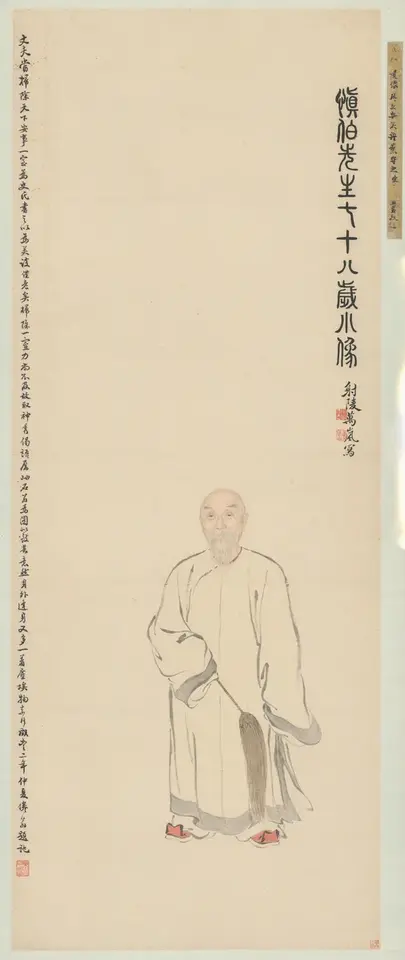
Bao Shichen was born in 1775 in Anwu Town, Jingxian County, Anhui. Although descended from an educated lineage, his family was impoverished by the time of his youth. Resolute and observant from childhood, Bao read classical histories and mathematics under his father's instruction. During the late Qianlong reign, the White Lotus Rebellion destabilized central China, exposing the corruption of imperial Green Standard forces. Witnessing civilian suffering, Bao recognized that civil examination compositions could not defend the state, prompting him to study military strategy, horsemanship, archery, and firearms alongside classical studies.
Bao criticized contemporary scholars who spent their lives collating classical minutiae while remaining ignorant of agriculture and governance. In his twenties, he traveled extensively across the Yangtze and Huai river valleys, observing dykes, salt works, and flood-damaged districts while interviewing farmers, boatmen, and salt workers. In 1808, at thirty-four, he passed the Jiangnan provincial examination as a Juren. However, his outspoken critiques of bureaucratic corruption and logistical inefficiency alienated conservative examiners in Beijing, leading to repeated failures in the metropolitan examinations.
Serving as Secretarial Advisor and Planning Maritime Transport
Rather than lamenting his examination setbacks, Bao entered the private secretarial networks (mufu) that shaped late Qing administration. Over thirty years from 1810, he served as a strategic counselor to influential statesmen including Tao Shu, Li Zhaoluo, Yuqian, Yang Fang, and Lin Zexu. Among late imperial secretarial advisors, Bao became celebrated for his mastery of canal transport, salt administration, flood prevention, currency stabilization, and coastal defense.
In 1826, catastrophic floods breached the Grand Canal in Shandong and Jiangsu, stranding millions of bushels of tribute grain destined for Beijing. Grain shortages threatened the capital with famine. Serving as chief advisor to Liangjiang Viceroy Tao Shu, Bao championed a departure from canal reliance by proposing the transport of tribute grain by sea. Conducting field investigations in Shanghai, Taicang, and Chongming, Bao drafted the comprehensive Maritime Transport Plan, charting coastal tides, sandbars, and shipping routes while hiring merchant sand-junks (shachuan) and arranging naval escorts. Over one million bushels of grain were successfully transported to Tianjin without loss, saving over one million taels of silver compared to canal transport and inaugurating modern coastal shipping in China.
Magistrate of Xinyu and Early Retirement
In 1839, at sixty-five, Bao passed the Ministry of Personnel evaluation in the first class, receiving an appointment as Magistrate of Xinyu County in Jiangxi. Approaching his post with reformist commitment, he abolished predatory fees collected by regional bailiffs, lowered arbitrary surcharges, and personally reviewed backlogged legal disputes, overturning dozens of wrongful convictions. Confronting the regional custom of female infanticide, he strictly prohibited the practice and established foundling homes.
However, Bao's unyielding rectitude alienated regional gentry and corrupt superiors who demanded customary kickbacks. Facing administrative obstruction, Bao resigned on grounds of illness after barely a year in office, concluding his direct bureaucratic service. When he departed Xinyu, thousands of local residents gathered along the roads to bid him farewell, commemorating his brief tenure as a model of benevolent governance.
Late Years in Seclusion and Passing in Haizhou
Following his retirement, Bao resided in Zhenjiang and Yangzhou, supporting his family through teaching and writing. He dedicated his final years to compiling his extensive statecraft memorials and calligraphic treatises. In the early 1850s, as the Taiping armies captured Nanjing and disrupted the lower Yangtze region, Bao relocated his household to Haizhou in northern Jiangsu.
Throughout his final years in Haizhou, though advanced in age, Bao continued monitoring coastal defense and military affairs, composing policy treatises for provincial commanders. In 1855, Bao passed away peacefully in Haizhou at the age of eighty-one. His coffin was escorted back to Jingxian for burial, with scholars and disciples honoring him with the private posthumous title Master Wenzhong.
Major Achievements
Championing Practical Statecraft and Compiling Anwu Sizhong
Bao Shichen was a seminal thinker who challenged the academic isolation of late Qing scholarship, leading the nineteenth-century revival of practical statecraft (jingshi zhiyong). Recognizing that evidential philology failed to address social decay while Neo-Confucian metaphysics offered no administrative solutions, Bao argued that scholarship must directly serve governance.
He compiled his life's reformist treatises into the encyclopedic collection Anwu Sizhong, comprising four core works: Zhongqu Yishao, analyzing Grand Canal conservancy and coastal shipping; Yizhou Shuangji, articulating literary style and stele calligraphic theory; Guanhan Ji, gathering his official memorials on administrative and military reform; and Qimin Sishu, a comprehensive treatise on agriculture, sericulture, cotton cultivation, and irrigation that pioneered the transition from imperial agronomy to modern agricultural economics. Bao's thought directly inspired Wei Yuan's compilation of the Huangchao Jingshi Wenbian and shaped the statecraft initiatives of Lin Zexu, Zeng Guofan, and Li Hongzhang.
Leading the Stele Movement and Structuring Yizhou Shuangji
In art history, Bao was a transformative figure who propelled Chinese calligraphy from the model-book tradition to the Stele School. Throughout the early and mid-Qing, the imperial court's promotion of Dong Qichang and Zhao Mengfu had produced smooth, formulaic handwriting lacking structural strength. Building upon Ruan Yuan's theoretical essays, Bao drew on two decades of studio practice to author Yizhou Shuangji, creating a systematic curriculum for stele calligraphy.
Bao championed Northern Dynasties stone tablets (including the Zheng Wengong Stele, Zhang Menglong Stele, and Yiheming) alongside Han clerical inscriptions for their rugged grandeur. He articulated precise physical guidelines based on centered tip control (zhongfeng), deliberate resistance (sejin), and horizontal balance. He maintained that calligraphers must channel concentrated focus to impart a dense, bronze-like resonance to every stroke. Yizhou Shuangji became an essential manual for nineteenth-century calligraphers, transforming late imperial calligraphic aesthetics and inspiring masters including He Shaoji, Zhao Zhiqian, and Kang Youwei.
Denouncing Opium and Pioneering Monetary Reforms
Bao demonstrated notable insight into monetary economics and anti-opium defense. During the Daoguang reign, British merchants through the East India Company smuggled vast quantities of opium into China, causing severe health crises and massive silver outflows. Because the Qing operated on a bimetallic silver-copper system, silver scarcity caused the price of silver to spike relative to copper cash, doubling peasant tax burdens and destabilizing state revenues.
Bao was among the earliest scholars to identify the structural macroeconomic dangers of this crisis. He submitted detailed proposals to Tao Shu and Lin Zexu urging the suppression of opium smuggling and severe penalties for corrupt officials. In monetary policy, he proposed issuing state-backed paper notes (yinbiao and qianbiao) and establishing government mints to stabilize currency exchange rates and prevent foreign economic extraction. His proposals provided theoretical backing for Lin Zexu's anti-opium campaigns and anticipated later nineteenth-century monetary reforms.