Appointed Zuoshuzhang | Appointed Zuoshuzhang; led an attack on Han and captured Xincheng
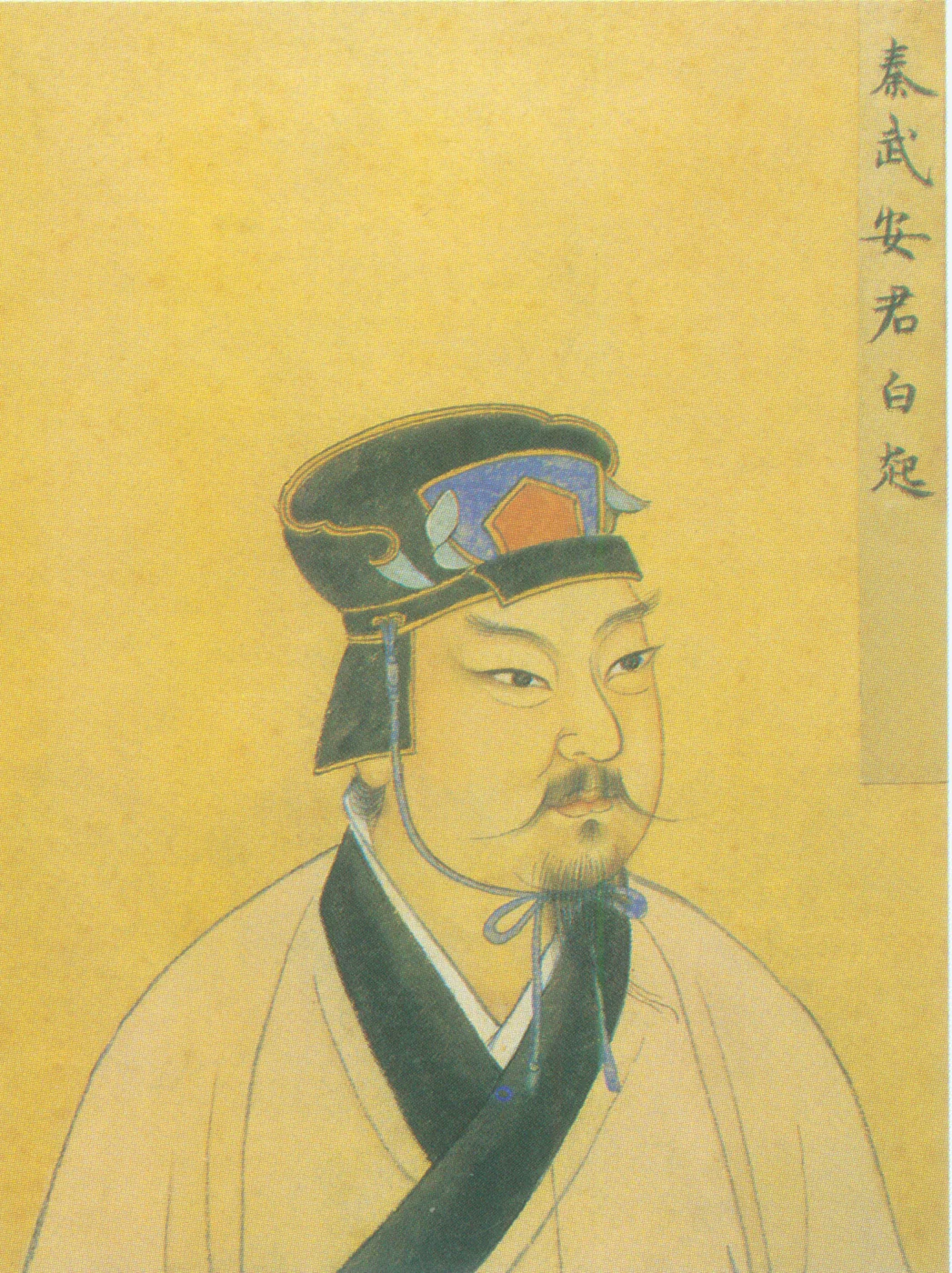
?–257 BCE
General
Bai Qi
白起
Bai Qi (d. 257 BCE), also known as Gongsun Qi, was from Mei, in present-day Mei County, Shaanxi. He was a renowned Qin general of the Warring States period, an outstanding military commander, and a representative figure in the military tradition. Bai Qi was well versed in warfare, skilled in command, and close to Wei Ran, Marquis of Rang. He served King Zhaoxiang of Qin and repeatedly won major victories. Over more than…
?–257 BCEQin Dynasty
PROFILE
Bai Qi (d. 257 BCE), also known as Gongsun Qi, was from Mei, in present-day Mei County, Shaanxi. He was a renowned Qin general of the Warring States period, an outstanding military commander, and a representative figure in the military tradition. Bai Qi was well versed in warfare, skilled in command, and close to Wei Ran, Marquis of Rang. He served King Zhaoxiang of Qin and repeatedly won major victories. Over more than thirty years as a principal commander of Qin forces, he captured more than seventy cities and became famous throughout the six states for assessing enemies accurately and using unexpected tactics. He was enfeoffed as Lord of Wu'an. Later, after conflicts with King Zhaoxiang and Chancellor Fan Ju, Marquis Ying, he was reduced to the status of a common soldier and ordered to commit suicide at Duyou.
- Other Names
- Lord of Wu'an; Gongsun Qi
- Period
- Qin
- Date of Birth
- Not recorded in historical sources
- Date of Death
- 257 BCE
- Dynasty/Polity
- Qin
- Identity
- General
- Ethnicity/Ethnic Affiliation
- Not recorded in historical sources
- Native Place
- Mei (present-day Baijiacun, Changxing Town, Mei County, Shaanxi)
- Place of Birth
- Not recorded in historical sources
- Major Achievements
- One of the foremost generals of the Warring States period; decisively defeated Zhao at the Battle of Changping; was enfeoffed as Lord of Wu'an and later ordered to commit suicide by King Zhaoxiang of Qin
LIFE TIMELINE
Promoted to Zuogeng | Promoted to Zuogeng; crushed the allied Wei and Han armies at the Battle of Yique, killing 240,000 according to the source, and was promoted to Guowei
Promoted to Daliangzao | Promoted to Daliangzao; attacked Wei and captured sixty-one cities
Attacked Zhao and captured Guanglang City in the Dai region | Attacked Zhao and captured Guanglang City in the Dai region
Led an invasion of Chu and captured Yan | Led an invasion of Chu and captured Yan
Captured the Chu capital Ying | Captured the Chu capital Ying, burned the tombs of former Chu kings, and was enfeoffed as Lord of Wu'an
With Zhang Ruo captured Wu Commandery and regions south of the Yangtze and established Qia | With Zhang Ruo captured Wu Commandery and regions south of the Yangtze and established Qianzhong Commandery
At the Battle of Huayang | At the Battle of Huayang, decisively defeated the allied Zhao and Wei forces, killing 130,000 according to the source
Attacked Xingcheng in Han territory | Attacked Xingcheng in Han territory, captured five cities, and killed 50,000 according to the source
At the Battle of Changping | At the Battle of Changping, decisively defeated the Zhao army and had 400,000 surrendered Zhao soldiers killed according to the source
After refusing to attack Handan | After refusing to attack Handan, was reduced to commoner status
Ordered to commit suicide at Duyou | Ordered to commit suicide at Duyou
BIOGRAPHY
Biography
Family Background and Early Years
Bai Qi was also called Gongsun Qi and came from Mei, present-day Baijiacun in Changxing Town, Mei County, Shaanxi. According to the Tang poet Bai Juyi, who claimed to be Bai Qi’s descendant, Bai Qi was a direct descendant of Crown Prince Jian, son of King Ping of Chu. In that account, the Bai lineage belonged to the Mi clan of the Chu royal house: Crown Prince Jian fled to Zheng; Jian’s son Sheng lived in the Wu–Chu region and was known as Lord Bai, from whom the family name Bai derived. After Lord Bai was killed in Chu, his son fled to Qin, and later generations produced famous generals. Bai Qi, a later descendant, rendered great service to Qin and received the title Lord of Wu'an. The account further states that after the First Emperor remembered Bai Qi’s achievements, he enfeoffed Bai Qi’s son Bai Zhong at Taiyuan, where the descendants settled. The source notes, however, that this genealogy remains to be verified. The New Book of Tang: Genealogical Tables of the Chancellors gives a different ancestry, naming the Qin general Bai Yibing as Bai Qi’s ancestor.
The period in which Bai Qi was born was one of growing Qin power. In 295 BCE, the twelfth year of King Zhaoxiang, Qin established a strategy of advancing eastward, defeating the Three Jin states, and seeking supremacy over the realm; capable generals were therefore urgently needed. King Zhaoxiang was ambitious and continued the policies of Shang Yang’s reforms, fully implementing the military merit system and promoting men of ability from non-aristocratic backgrounds. Against this background, Bai Qi became known for his skill in warfare and, with the recommendation of the newly appointed chancellor Wei Ran, gradually entered King Zhaoxiang’s service.
Rise to Prominence: The Battle of Yique and Eastward Expansion
In 294 BCE, the thirteenth year of King Zhaoxiang, Qin began an offensive against Han. Xiang Shou was first sent to lead the attack, but Bai Qi, then holding the rank Zuoshuzhang, replaced him and attacked Han’s Xincheng, west of present-day Yichuan County, Henan.
In 293 BCE, forces of Han, Wei, and Eastern Zhou held the Xiaoshan–Hangu corridor to block Qin’s eastward advance. Bai Qi, by then promoted to Zuogeng, first defeated Eastern Zhou troops and then fought the allied Han and Wei armies at Yique near present-day Longmen south of Luoyang. He exploited the allies’ mutual hesitation and their unwillingness to attack first. He placed a diversionary force opposite the stronger Han army and used a smaller contingent to pin it down, while concentrating his main force against the weaker Wei troops. The Wei army was unprepared and quickly collapsed; the Han army, shaken and exposed on its flank, was then attacked from multiple directions and broke without effective resistance. Bai Qi pursued the retreating troops. The source states that, with fewer than half the men of the Han–Wei alliance, he annihilated 240,000 enemy soldiers, captured Yique, took the Wei commander Xi Wu, identified as Gongsun Xi, and seized five cities. The victory made Bai Qi famous and earned him promotion to Guowei. Han and Wei, having lost much of their elite manpower, were forced to cede territory for peace. Bai Qi then crossed the Yellow River and seized Han lands from Anyi, northwest of present-day Xia County in Shanxi, eastward to the Qian River near present-day Yuanqu.
After Yique, the approaches to Han and Wei were exposed. In 292 BCE, Bai Qi, now Daliangzao, attacked Wei and captured sixty-one cities, laying a foundation for Qin expansion east beyond the mountain passes. In 291 BCE he joined Guest Minister Sima Cuo in capturing Yuan in present-day Yuanqu, Shanxi, which was later returned to Wei. He then advanced against Wan, a Han handicraft center in present-day Nanyang, Henan. In 289 BCE, Wei Ran and Bai Qi attacked Wei territory in the Henei region north of the Yellow River and captured another sixty-one cities. Han and Wei were further weakened and became increasingly unable to resist Qin attacks. In 286 BCE, Bai Qi attacked Zhao, killed 30,000 troops according to one account and 20,000 according to another, and captured Guanglang City in the Dai region, in present-day Gaoping, Shanxi.
Southern Campaigns against Chu: The Yan–Ying Campaign
After Yique, Qin shifted its attention southward to further weaken Chu. In 280 BCE, Sima Cuo led Qin troops from Longxi down the Fu River through Ba, replenished provisions and ships in Ba and Shu, and captured Chu’s Qianzhong Commandery, in the region of western Hunan and northeastern Guizhou. Chu was forced to cede Shangyong and the territory north of the Han River to Qin.
In 279 BCE, Qin again invaded Chu. Bai Qi led tens of thousands of soldiers through the Wuguan route deep into Chu. The source describes King Qingxiang of Chu as relying on the size of his state while neglecting government, leaving the realm divided and its defenses weak. Bai Qi committed to a decisive campaign, quickly captured Deng north of present-day Xiangyang, and approached Yan, a strategic secondary capital of Chu and gateway to Ying. King Qingxiang reinforced Yan with the main Chu forces. Bai Qi used a water attack: he built a dam west of the city and diverted water from the western mountain valleys into a long channel, later known as the Bai Qi Canal, flooding the city from west to east. The source states that hundreds of thousands of soldiers and civilians drowned, inflicting heavy losses on Chu’s main army and leading to Yan’s fall. Bai Qi then turned southwest and captured Xiling, also called Yiling, south of present-day Yichang, cutting communications between Ying and Wu Commandery.
In 278 BCE Qin forces penetrated behind the Chu army, inflicted another major defeat, and captured Ying. Bai Qi ordered the ancestral tombs of former Chu kings at Xiling burned to damage Chu morale. Qin then advanced east to Jingling and Anlu and south toward Dongting Lake and areas beyond it. Chu forces disintegrated and retreated successively toward Chengyang and Chen. Qin established Nanjun around Ying and enfeoffed Bai Qi as Lord of Wu'an. The Chinese source explains the title as reflecting his ability to sustain his soldiers, win battles, and bring the population to stability. His reputation spread across the realm.
In 277 BCE, Bai Qi and Zhang Ruo, governor of Shu, captured Wu Commandery and areas south of the Yangtze and established Qianzhong Commandery there.
The Battle of Huayang and the Campaign against Xingcheng
In 276 BCE Bai Qi attacked Wei and captured two cities.
In 273 BCE, Zhao and Wei jointly attacked Huayang, a strategic Han position north of present-day Xinzheng, Henan. Han appealed to Qin for aid, and King Zhaoxiang sent Bai Qi, Wei Ran, and Guest Minister Hu Yang. Qin forces made a rapid long-distance march, averaging one hundred li per day according to the source, and appeared unexpectedly at Huayang. The allied Zhao and Wei forces were taken by surprise and decisively defeated. Qin captured generals and, according to the source, killed 130,000 soldiers; the Wei commander Mang Mao fled. Bai Qi then fought reinforcements under Zhao general Jia Yan and caused 20,000 Zhao soldiers to drown. Wei was ultimately forced to cede Nanyang to Qin in exchange for peace.
In 264 BCE, Bai Qi attacked Xingcheng on the Fen River, northeast of present-day Quwo, Shanxi, captured five cities according to one account and nine according to another, and killed 50,000 troops according to the source. In 263 BCE he occupied Han’s Nanyang region south of the Taihang Mountains, aiming to sever Shangdang Commandery from the southern portion of Han and seize the territory.
The Peak of His Career: The Battle of Changping
In 262 BCE, Bai Qi captured Yewang in Han territory, present-day Qinyang, Henan, cutting the route between Shangdang and the Han capital. King Huanhui of Han ordered Feng Ting, governor of Shangdang, to surrender the commandery to Qin in hopes of ending the war. Feng Ting refused and instead offered Shangdang to Zhao. King Xiaocheng of Zhao, following the advice of Lord Pingyuan Zhao Sheng and others, made Feng Ting Lord of Huayang, sent Lord Pingyuan to accept the territory, and dispatched general Lian Po to Changping, northwest of present-day Gaoping, Shanxi, to prepare for a Qin attack.
In 260 BCE Qin sent Wang He, then Zuoshuzhang, to take Shangdang. Its inhabitants fled toward Zhao, where Zhao forces received them at Changping. In the fourth month, Wang He attacked Lian Po’s army. The two sides skirmished repeatedly. In the sixth month, Qin forces broke a Zhao position, captured two fortifications, and took four officers. In the seventh month the Zhao army built defensive walls and refused battle. Qin attacked, seized western camps, and captured two more officers. Lian Po held his fortified positions, waiting for Qin supplies to run low, and did not respond to repeated challenges. King Xiaocheng nevertheless repeatedly criticized him for avoiding a pitched battle. Qin chancellor Fan Ju sent agents to Zhao to spread the claim that Lian Po was easy to deal with and that Qin truly feared Zhao Kuo, son of the general Zhao She. Already angry with Lian Po, King Xiaocheng believed the deception and replaced him with Zhao Kuo.
When King Zhaoxiang learned that Zhao Kuo had taken command, he secretly replaced Wang He with Bai Qi as Qin commander. Bai Qi became supreme commander while Wang He served as his deputy, and the army was strictly ordered not to leak the change, on pain of death. Zhao Kuo abandoned Lian Po’s defensive strategy and attacked. Qin pretended to retreat. Zhao forces pursued as far as the Qin camp but could not break its strong defenses. Bai Qi sent 25,000 troops around to sever the Zhao line of retreat and another 5,000 cavalry between the Zhao main force and its camp, splitting the Zhao army into two isolated groups and cutting its supply route. He repeatedly sent light troops to attack. The Zhao army, after suffering reverses, built field fortifications and awaited relief. When King Zhaoxiang learned that the Zhao main army had been cut off from supplies, he personally went to Henei Commandery, granted one additional rank of noble status to local men, and mobilized all able-bodied males aged fifteen and above to the Changping front to block Zhao reinforcements.
By the ninth month, the Zhao main force had reportedly been without food for forty-six days, and the source states that soldiers killed one another for food. Zhao Kuo divided the remaining troops into four groups and launched repeated breakout attempts, but none succeeded. He finally led picked troops in person and was killed by Qin arrows. Two hundred thousand Zhao soldiers then surrendered to Bai Qi. Bai Qi and his commanders discussed the danger that the surrendered men might rebel again, citing the earlier flight of Shangdang’s inhabitants to Zhao rather than Qin. Bai Qi then used deception and ordered the surrendered soldiers killed, sparing only 240 younger men to return to Zhao with the news. The source gives a total of 450,000 Zhao soldiers killed before and after the Battle of Changping. It adds that the scale of the killing shocked Zhao and that heads collected from the battlefield were piled into a mound called the “Bai Qi Terrace.”
Fall from Power and Ordered Suicide
After the Battle of Changping, Zhao’s principal army had been destroyed, and the state was plunged into mourning.
In 259 BCE Qin again occupied Shangdang and divided its forces into three columns. Wang He captured Wu'an and Pilao; Sima Geng attacked Taiyuan Commandery; according to the Chinese source, Bai Qi personally led the main army against Handan, the Zhao capital, with the intention of destroying Zhao. Han and Zhao were terrified. King Huanhui of Han decided to cede land for peace, while King Xiaocheng of Zhao personally went to Qin to meet King Zhaoxiang and agreed with his minister Zhao Hao to cede six cities. Han and Zhao also sent envoys carrying large sums of money to lobby the Qin chancellor Fan Ju. Concerned that Bai Qi’s growing prestige might threaten his own position, Fan Ju advised King Zhaoxiang to accept peace on the grounds that Qin’s exhausted troops needed rest. King Zhaoxiang accepted, on the condition that Han cede Yuanyong and Zhao six cities. Hostilities ceased in the first month, and Bai Qi’s relationship with Fan Ju deteriorated.
Qin later renewed the attack on Handan and failed to capture it. King Zhaoxiang wanted Bai Qi to command, but Bai claimed illness and refused. Wang He replaced him and Qin suffered a major defeat. Bai Qi remarked, “Qin would not listen to my plan; how has it turned out now?” King Zhaoxiang became furious and ordered him to take command. Bai again pleaded illness. The king stripped him of his noble rank, reduced him to commoner status, and ordered him to move to Yinmi. When Bai Qi reached Duyou, King Zhaoxiang consulted Fan Ju and concluded that Bai had delayed obeying orders and harbored resentment. The king therefore sent an envoy with a sword and ordered Bai Qi to take his own life. Before killing himself, Bai Qi said in substance that he deserved to die because at Changping he had deceived and killed hundreds of thousands of surrendered Zhao soldiers. He then committed suicide.
Bai Qi's forebears came of the ducal house of Chu: the Chu heir Jian fled to Zheng, and Jian's son Sheng, who lived between Wu and Chu, was called the duke of Bai and took the name as his clan name; when Chu killed him, his son fled to Qin, and the family served as generals thereafter. Bai Qi won great merit for Qin and was enfeoffed as Lord Wu'an; afterward, though guilty of no crime, he was given to die at Duyou, and the men of Qin, pitying him, raised a shrine to him at Xianyang; and when the First Emperor remembered his merit he enfeoffed his son Bai Zhong in Taiyuan, where the descendants settled. The genealogy appears in the family record drawn up under the Bai family of the Tang, and is the chief basis for later accounts of his ancestry.
In the thirteenth year of King Zhao of Qin (294 BC) Bai Qi was made leader of the left and led troops against Xincheng in Han. The next year, as leader of the left with higher rank, he attacked the Han and Wei armies at Yique, took two hundred and forty thousand heads, captured the Wei general Gongsun Xi, took five cities, crossed the river and seized the Han lands from Anyi east to the Qian river. At Yique he avoided the strong and struck the weak first: taking advantage of the two armies' watching each other and neither wishing to move first, he set out decoys against the Han to pin down the stronger force with a few troops, then massed his best men against the weaker Wei; caught unprepared, the Wei collapsed at once, and the Han, shaken and exposed on the flank, were caught between the two and broke without a fight. He was afterward made grand commandant, took sixty-one cities from Wei, stormed Yuancheng with a guest minister, and later took Guanglang from Zhao.
A passage quoted from Bai Qi in the Intrigues of the Warring States shows his sense of opportunity. He said that the king of Chu trusted in the size of his state and neglected its government, that his ministers envied one another's merit and flatterers held office, that good men were kept at a distance, the people estranged and the walls unrepaired; and so he could lead his troops deep, burning his bridges to hold the army to one purpose and plundering the countryside for food. At Yique, Han stood alone and waited for Wei, while Wei relied on Han's edge and wished to push it to the front, and each held back; he could therefore set decoys against Han and hurl his whole strength on Wei by surprise, and pursuing the beaten enemy won his name. All this, he said, was a matter of weighing advantage and circumstance, the natural order of things, and nothing divine.
In 279 BC Bai Qi attacked Chu and took Yan and Deng. Yan was the gate to the capital Ying, and King Qingxiang of Chu reinforced it to hold at all costs; Bai Qi therefore dammed the Changgu water of the western hills, built a dyke west of the city and turned the water from the west to the east of it, so that many tens of thousands of Chu soldiers and people were drowned and the city fell. The canal has been known since as Bai Qi's canal and long served for irrigation. The next year he took Ying, which Qin made the commandery of Nan; the king of Chu fled east and moved his capital to Chen, and Bai Qi burned the tombs of the former kings of Chu at Yiling, being advanced for it to Lord Wu'an. He went on to take the commanderies of Wu and Qianzhong, and Chu's power in the Jiang and Han country was much reduced.
In 273 BC, when the armies of Zhao and Wei attacked Huayang in Han, and Han appealed to Qin, the Qin troops marched a hundred li a day and appeared suddenly on the field, catching the allies unprepared and breaking them; Bai Qi took Huayang, drove off Mang Mao, captured the generals of the three Jin and took a hundred and thirty thousand heads, and in a battle with the Zhao general Jia Yan drowned twenty thousand Zhao soldiers in the river. In 264 BC he attacked Xingcheng in Han, took five cities and fifty thousand heads; the next year he seized the Taihang road through Nanyang and cut Han's communications north and south.
In 262 BC Bai Qi attacked Yewang in Han; Yewang surrendered to Qin and the road to Shangdang was cut. Feng Ting, holding Shangdang, took counsel with the people, saying that with the road to Zheng closed Han could not keep the district, and that it were better to give it to Zhao, for if Zhao took it Qin would be enraged and attack Zhao, and Zhao, attacked, would draw close to Han, and the two together could stand against Qin. King Xiaocheng of Zhao consulted the prince of Pingyang and the prince of Pingyuan; the first held it better not to accept, the second that a commandery gained without cost should be taken, and Zhao accepted Shangdang and enfeoffed Feng Ting as lord of Huayang. The act brought on the battle of Changping.
At Changping (262-260 BC) Zhao at first held on under Lian Po, laying three lines of defence: the Kongcangling line, the Dan river line and a hundred-li stone wall. The first clash came in the valley west of the first line, where in confused fighting the Qin killed the Zhao van, broke through Kongcangling and took the front-line town of Guanglang, and Zhao's first line fell. The two armies then faced each other for long; Zhao replaced Lian Po with Zhao Kuo, and Qin secretly appointed Bai Qi commanding general. Bai Qi drew the enemy deep and cut him into pieces: feigning defeat to bring the Zhao out, he sent surprise forces to cut their retreat and their supply, and penned the Zhao army at Changping. After more than forty days without food, unable to break out, Zhao Kuo was killed by an arrow and the rest surrendered; Bai Qi, on the ground that the Zhao troops were unreliable, buried more than four hundred thousand of them alive and sent back only two hundred and forty of the youngest to Zhao. The battle all but destroyed the young manhood of Zhao and removed the chief military obstacle to Qin's unification.
Bai Qi then urged an immediate attack on Handan, but the Qin chancellor Fan Ju, worked on by Zhao, advised accepting the cession of land and peace, and King Zhao called off the campaign, so that Bai Qi and Fan Ju fell out. In 259 BC Qin attacked Handan again without success; Bai Qi pleaded illness and would not take the field, and when the Qin armies met one reverse after another under the pressure of the relief forces of the other states, the king in a rage degraded him to the ranks and then sent him a sword to take his own life at Duyou. Before he died Bai Qi said that he had done nothing to deserve it, and then that he had indeed deserved death, for at Changping, when several hundred thousand Zhao troops surrendered, he had by a trick buried them all; and he killed himself. The men of Qin pitied him, and every district raised a shrine to him.
Later judgment of Bai Qi turns on two things: his skill in war, adapting to the enemy and excelling at the long raid and the envelopment, beating many with few; and the burying alive of the surrendered at Changping, taken as proof of cruelty in war and making his figure a complicated one.
Major Activities
Military Contributions
Bai Qi served as a Qin general for more than thirty years, captured more than seventy cities, destroyed large enemy forces, and was enfeoffed as Lord of Wu'an. He commanded numerous major campaigns, including the battles of Yique, Yan–Ying, Huayang, Xingcheng, and Changping, helping lay a military foundation for Qin’s later unification of the six states.
He was skilled at assessing the balance between his own army and the enemy and choosing appropriate strategy and tactics. At Yique he exploited the hesitation between the Han and Wei allies, avoided strength and struck weakness, attacked the weaker enemy first, and used an inferior force to destroy an army of 240,000 according to the source. In the Yan–Ying campaign he used water to flood Yan and then captured Ying. At Huayang he used rapid long-distance marching to achieve surprise and defeat Zhao and Wei. At Changping he encircled and divided the Zhao army and cut its food supply, destroying its main force.
Political Activities
Bai Qi was closely associated with Qin chancellor Wei Ran, who was one of his principal political supporters. Wei Ran, an uncle of King Zhaoxiang, wielded great power in Qin, and his recommendation was important to Bai Qi’s rise. Later, Fan Ju entered Qin, advocated the strategy of befriending distant states while attacking nearby ones, and gradually displaced Wei Ran. Bai Qi’s relationship with Fan Ju became hostile and, according to the source, contributed to Bai Qi’s tragic end.
Travels and Campaign Areas
Bai Qi spent much of his life campaigning across areas corresponding to present-day Shaanxi, Henan, Shanxi, Hubei, Hunan, and other regions. He led armies that captured Xincheng, Anyi, and Xingcheng from Han; Yuan and Henei from Wei; Guanglang City from Zhao; and Yan, Ying, Jingling, Wu Commandery, and Qianzhong Commandery from Chu. His campaigns greatly expanded Qin territory.
Contemporary Associates
Bai Qi served King Zhaoxiang of Qin for more than thirty years and repeatedly won victories for him. He was close to Wei Ran, who was his political ally. He came into conflict with Fan Ju, whose accusations and political maneuvering are described by the source as contributing to the order for Bai Qi’s suicide. On the battlefield Bai faced Zhao generals Lian Po and Zhao Kuo and defeated Zhao Kuo’s army at Changping.
Personal Relations
- Bai Yibing: according to the New Book of Tang: Genealogical Tables of the Chancellors, an ancestor of Bai Qi and a general under Duke Mu of Qin
- Bai Zhong: son of Bai Qi; said in the source to have been enfeoffed at Taiyuan by the First Emperor of Qin
- Bai Juyi: Tang poet who claimed descent from Bai Qi
- Wei Ran: Qin chancellor, Bai Qi’s recommender and political ally
- King Zhaoxiang of Qin: ruler of Qin and Bai Qi’s sovereign
- Fan Ju: Qin chancellor who came into conflict with Bai Qi
- Zhao Kuo: Zhao general defeated by Bai Qi at Changping
- Lian Po: Zhao general who confronted Qin during the earlier phase of the Changping campaign
- Mang Mao: Wei general defeated at Huayang
- Jia Yan: Zhao general defeated at Huayang
Historical Assessment
Warring States / Contemporary Period
- King Zhaoxiang of Qin praised Bai Qi’s victories in Chu and at Yique, saying in substance that Bai led only tens of thousands into Chu, captured Yan and Ying, burned ancestral temples, advanced east to Jingling, and terrified Chu, while at Yique he defeated forces of Han and Wei larger than his own and killed 240,000; his achievements were known throughout the realm. (Strategies of the Warring States)
- Su Li compared Bai Qi’s skill in warfare to the legendary archer Yang Youji, who could strike the target a hundred times in a hundred shots. (Strategies of the Warring States)
- A Chu speaker described Bai Qi contemptuously as a “mere boy,” yet acknowledged that with only tens of thousands of troops he captured Yan and Ying in one campaign, burned Yiling in another, and humiliated the ancestors of the Chu king. (Records of the Grand Historian, “Biographies of Lord Pingyuan and Yu Qing”)
Qin and Han Periods
- Sima Qian wrote that Bai Qi adapted to enemy changes, used endlessly inventive tactics, and shook the realm with his reputation, but could not save himself from the danger posed by Marquis Ying. (Records of the Grand Historian, “Biographies of Bai Qi and Wang Jian”)
- Sima Qian also lamented that Bai Qi, despite his strength, could be controlled by a single word from Marquis Ying and described his fate as tragic. (Records of the Grand Historian, “Biographies of Bai Qi and Wang Jian”)
- Yang Xiong wrote that Bai Qi of Qin was inhumane and killed many people and that his crimes deserved death. (Fayan)
Tang and Song Periods
- Bai Juyi wrote that Bai Qi rendered great service to Qin, was enfeoffed as Lord of Wu'an, and was later ordered to die at Duyou through no crime of his own; the people of Qin pitied him and built shrines to him in Xianyang. (Account of the Late Magistrate Bai of Gong County)
- Sima Guang wrote that Bai Qi deceived and buried alive 400,000 surrendered Zhao troops and that his lack of humanity was extreme. (Comprehensive Mirror in Aid of Governance)
- Su Shi wrote that Bai Qi excelled at attacking and taking territory but was poor at preserving himself. (Dongpo Zhilin)
Modern Period
- Mao Zedong is quoted in the source as calling Bai Qi the foremost general of the Warring States period and saying that the killing of 400,000 Zhao soldiers at Changping laid a foundation for Qin unification, but that killing surrendered troops was excessive and ultimately brought retribution. (Mao Zedong’s Comments on the Twenty-Four Histories)
- Ray Huang is quoted as regarding Bai Qi as an outstanding military commander whose killing of surrendered soldiers at Changping left him with a reputation for brutality. (China: A Macro History / the Chinese work cited in the source as Hexiong Hepan Tan Zhongguo Lishi)
- Modern historians generally regard Bai Qi as an outstanding ancient Chinese commander whose strategic ideas and methods influenced later warfare, while widely criticizing the killing of surrendered soldiers.
FIGURES ASSOCIATED WITH THIS DYNASTY
Bibliography
- Sima Qian, Records of the Grand Historian, “Biographies of Bai Qi and Wang Jian”
- Essentials of Historical Geography for Reading History