Birth in Le Mans
Born in Le Mans, France; entered the Society of Jesus and specialized in astronomy, higher mathematics, and physics.
白晋
Joachim Bouvet (白晋, 1656–1730), courtesy name Mingyuan, was a native of Le Mans, France. He was an eminent French Jesuit missionary, mathematician, cartographer, and astronomer at the court of the Kangxi Emperor, and an academician of the French Academy of Sciences. In 1685, Bouvet was selected by King Louis XIV as one of the six "Mathematicians to the King," inaugurating formal, state-level scientific and cultural relations…
Joachim Bouvet (白晋, 1656–1730), courtesy name Mingyuan, was a native of Le Mans, France. He was an eminent French Jesuit missionary, mathematician, cartographer, and astronomer at the court of the Kangxi Emperor, and an academician of the French Academy of Sciences. In 1685, Bouvet was selected by King Louis XIV as one of the six "Mathematicians to the King," inaugurating formal, state-level scientific and cultural relations between France and China. Arriving in China in 1687, Bouvet and Jean-François Gerbillon were summoned to the Forbidden City by the Kangxi Emperor in 1688. Serving as the emperor's personal tutors in Western sciences for a decade, they delivered daily lectures in Manchu and Chinese on Euclidean geometry, practical algebra, spherical trigonometry, and human anatomy, participating in the bilingual translation of Pardies' Elements of Geometry and an imperial anatomical atlas. In 1693, having cured the Kangxi Emperor of severe malaria using cinchona bark (quinine), Bouvet was appointed special imperial envoy to France to recruit additional scientific personnel for the court. During his stay in Paris in 1697, he published Portrait historique de l'Empereur de la Chine and L'Estat present de la Chine, introducing European audiences to Kangxi's enlightened governance and igniting the eighteenth-century European fascination with China (Chinoiserie). In 1708, under imperial decree, Bouvet organized and led the unprecedented nationwide geodetic triangulation survey that culminated in the 1718 publication of the Huangyu Quanlan Tu (Complete Map of the Imperial Empire), China's earliest national map surveyed using modern scientific methods. Furthermore, Bouvet pioneered Figurism in sinology through his deep studies of the Yijing (Book of Changes). His transatlantic correspondence with German philosopher and mathematician Gottfried Wilhelm Leibniz concerning the correlation between the sixty-four hexagrams and binary arithmetic exerted an enduring influence on the history of modern mathematical logic. Bouvet passed away in Beijing in 1730 and was interred at the Zhengfusi cemetery with imperial honors.
Born in Le Mans, France; entered the Society of Jesus and specialized in astronomy, higher mathematics, and physics.
Selected by King Louis XIV as a "Mathematician to the King" and admitted to the French Academy of Sciences before departing for China.
Reached Ningbo, Zhejiang after a perilous voyage; summoned to Beijing by imperial decree the following year.
Entered the Forbidden City with Gerbillon to instruct the Kangxi Emperor daily in geometry, algebra, and observational astronomy.
Administered quinine to cure Kangxi's malaria; commissioned as Qing imperial envoy to France to recruit European scientists.
Published Portrait historique de l'Empereur de la Chine in Paris, sparking widespread admiration for Chinese civilization across Enlightenment Europe.
Returned to Beijing aboard the Amphitrite accompanied by ten French scientists, including Dominique Parrenin, and scientific instruments.
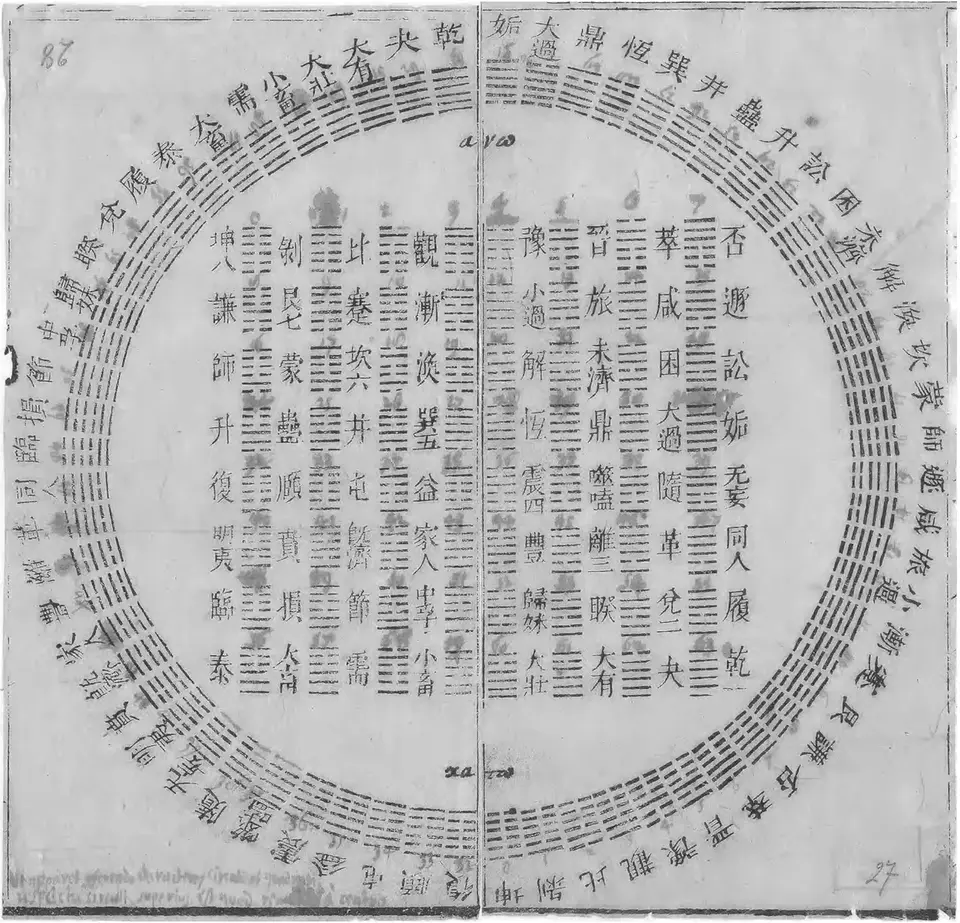
Corresponded with German philosopher Leibniz, transmitting Shao Yong's hexagram arrangement that confirmed Leibniz's binary arithmetic.
Commissioned by Kangxi to supervise the geodetic survey of the Great Wall and northern provinces for the national atlas.
Completed the Huangyu Quanlan Tu, the earliest comprehensive geodetic map of the Chinese empire using modern spherical triangulation.
Died in Beijing at the age of seventy-four; granted imperial funeral funds by the Yongzheng Emperor and buried at the Zhengfusi cemetery.
Joachim Bouvet was born into a cultured Catholic family in Le Mans, France. Educated in Jesuit colleges, he exhibited extraordinary gifts in mathematics, optics, cartography, and mechanics, joining the Society of Jesus at age twenty-two.
In the late seventeenth century, King Louis XIV and his chief minister Colbert sought to establish direct French diplomatic and scientific relations with the Qing Empire, challenging the Portuguese maritime trade monopoly in East Asia. Louis XIV resolved to dispatch an elite contingent of scholars trained in the Royal Academy of Sciences.
In 1685, the twenty-nine-year-old Bouvet was selected alongside Jean de Fontaney, Jean-François Gerbillon, Louis Le Comte, and Guy Tachard as "Mathematicians to the King" (Mathématiciens du Roi). Granted membership in the French Academy of Sciences, they were equipped with high-precision quadrant instruments, telescopes, marine chronometers, and meteorological barometers. Departing aboard the French naval vessel L'Oiseau, they survived severe tempests, tropical fevers, and political upheavals in Siam, finally landing at Xiangshan Port near Ningbo, Zhejiang, in July 1687.
Informed of the arrival of French mathematicians, the science-minded Kangxi Emperor dispatched high officials to escort Bouvet and Gerbillon to Beijing. In March 1688, Kangxi granted them an audience in the Hall of Heavenly Purity. Impressed by Bouvet's refined bearing and deep mathematical command, the emperor appointed both men as resident palace tutors and scientific advisors.
For nearly a decade, Bouvet entered the inner palace every morning to instruct the emperor in the Hall of Mental Cultivation and the Western Warm Chamber. Translating European scientific treatises into Manchu and Chinese, Bouvet taught Euclidean geometry, practical algebra, spherical trigonometry, and sun-dial calculation. Kangxi studied with immense diligence, solving mathematical problems alongside Bouvet for hours. With Bouvet's assistance, Kangxi ordered the imperial translation and publication of Ignace-Gaston Pardies' Elements of Geometry.
Bouvet also introduced modern anatomy to the court, collaborating with Gerbillon to translate a comprehensive anatomical treatise into Manchu, illustrated with detailed plates of skeletal, muscular, and circulatory systems. In May 1693, when Kangxi was stricken with life-threatening malaria and imperial physicians were helpless, Bouvet and Jean de Fontaney administered cinchona bark (quinine). The emperor rapidly recovered. In profound gratitude, Kangxi conferred upon Bouvet fourth-rank official honors and gifted the French Jesuits a vast estate inside the Xi'an Gate, establishing the historic North Church (Canjikou Church).
To expand scientific cooperation and reinforce the Imperial Astronomical Bureau, the Kangxi Emperor took the unprecedented step in July 1693 of appointing Bouvet as his personal imperial envoy to King Louis XIV. Entrusted with Kangxi's personal credentials and state gifts consisting of silks, porcelains, and imperial lacquerware, Bouvet returned to Europe to recruit additional scientists.
In 1697, Bouvet arrived at the Palace of Versailles clad in Chinese imperial robes, presenting Kangxi's gifts to Louis XIV in an opulent ceremony that captivated the French court.
During his residence in Paris, Bouvet published two landmark works: Portrait historique de l'Empereur de la Chine (Historic Portrait of the Emperor of China) and L'Estat present de la Chine (The Present State of China). Bouvet depicted Kangxi as an enlightened, tireless, and benevolent philosopher-king who governed a prosperous civilization through Confucian moral philosophy and meritocratic civil examinations. Translated into English, German, and Italian, Bouvet's writings ignited widespread intellectual admiration for China across Europe, profoundly influencing Enlightenment philosophers such as Voltaire, Leibniz, and Quesnay, who cited China as a model of rational governance.
In 1699, Bouvet returned to China aboard the Amphitrite—the first ship to establish a direct commercial sea route between France and Guangzhou—accompanied by a distinguished cohort of ten French scientists, including Dominique Parrenin and Jean-Baptiste Régis, alongside astronomical clocks, telescopes, and royal engravings gifted by Louis XIV.
Upon returning to Beijing, Bouvet was entrusted with one of the most ambitious scientific endeavors in imperial Chinese history. Having pacified internal rebellions and consolidated borderlands, the Kangxi Emperor recognized that traditional Chinese grid-maps were inadequate for military defense and hydraulic administration.
In 1708, Kangxi launched a comprehensive geodetic survey of the empire, appointing Bouvet, Jean-Baptiste Régis, and Pierre Jartoux to direct the project. Leading survey teams equipped with European quadrants, theodolites, and leveling chains, Bouvet personally surveyed the Great Wall and the northern provinces under extreme climatic conditions. Utilizing spherical triangulation, meridian arc calculations, and trapezoidal projections, the teams systematically surveyed thirty-two provinces and border regions over ten years, culminating in the 1718 completion of the Huangyu Quanlan Tu. The atlas represented the most accurate, extensive geodetic map produced anywhere in the early eighteenth-century world.
Concurrently, Bouvet devoted decades to the study of the ancient Chinese classic Yijing (Book of Changes). Founding the Figurist school, he argued that the sixty-four hexagrams contained ancient metaphysical and numerical truths rather than mere superstitious divination. Between 1701 and 1703, Bouvet conducted extensive correspondence with German philosopher and mathematician Gottfried Wilhelm Leibniz. Bouvet sent Leibniz a copy of Shao Yong's arrangement of the sixty-four hexagrams, pointing out the mathematical patterns of broken and unbroken lines. Leibniz was astounded to discover that the hexagram sequence corresponded perfectly to his newly invented binary arithmetic (representing unbroken lines as 1 and broken lines as 0), prompting Leibniz to publish his historic 1703 paper establishing the universal validity of binary mathematics.
Bouvet was celebrated throughout his life for his modest demeanor, integrity, and deep respect for Chinese ancestral customs, consistently defending the compatibility of Confucian civic rites with Christian doctrine during the Chinese Rites Controversy.
When the Yongzheng Emperor ascended the throne, he maintained profound personal respect for Bouvet, ensuring that the elderly French scholar was protected and provided for in Beijing. In his final years, though weakened by age, Bouvet continued his scholarly research, compiling Latin-Chinese-Manchu lexicons and philosophical commentaries in his study.
On June 28, 1730, Bouvet passed away peacefully in Beijing at the age of seventy-four. The Yongzheng Emperor expressed deep sorrow, issuing an imperial decree granting royal funds for his funeral. Accompanied by Qing officials and European missionaries, Bouvet was buried at the French Jesuit cemetery at Zhengfusi in western Beijing, leaving an indelible legacy as a bridge between European and Chinese civilizations.
Bouvet's paramount diplomatic and scientific achievement was serving as the bridgehead for direct, state-level intellectual exchange between France and the Qing Empire.
Selected by Louis XIV in 1685 as one of the "Mathematicians to the King," Bouvet transformed Western missions in China from regional commercial ventures into an official royal scientific delegation. He introduced the cutting-edge mathematical, astronomical, and geodetic methodologies of the French Royal Academy of Sciences directly to the Qing court.
His exemplary scholarship and integrity earned the lifelong trust of the Kangxi Emperor, cementing a century of French scientific preeminence in Beijing and demonstrating a model of reciprocal, enlightened civilizational dialogue in the early modern era.
During his decade of service as resident palace tutor, Bouvet profoundly shaped the Kangxi Emperor's scientific education and helped institutionalize modern mathematics within the imperial palace.
Conducting daily tutorials in the Inner Court, Bouvet translated European geometric and algebraic treatises into Manchu and Chinese, instructing the emperor in practical surveying, logarithms, and celestial coordinate calculations.
Under imperial sponsorship, Bouvet and Gerbillon compiled the bilingual Manchu-Chinese edition of Ignace-Gaston Pardies' Elements of Geometry (Jihe Yuanben). This work provided a rigorous foundation for mathematical pedagogy in the Qing court and furnished core mathematical frameworks later incorporated into the monumental imperial compendium Shuli Jingyun.
Bouvet was the primary European author responsible for introducing the political philosophy and culture of the Qing Empire to early Enlightenment Europe.
His 1697 publications, Portrait historique de l'Empereur de la Chine and L'Estat present de la Chine, provided European intellectuals with their first authoritative, eyewitness portrait of the Kangxi Emperor. Bouvet portrayed an emperor dedicated to empirical inquiry, public welfare, and classical ethics, managing a sprawling empire through an open, merit-based civil service.
Bouvet's writings circulated across Europe, deeply influencing philosophers such as Leibniz and Voltaire. By demonstrating that a highly refined, virtuous civilization could flourish based on rational ethics and meritocracy, Bouvet's work provided vital ideological momentum to the European Enlightenment and ignited the widespread cultural phenomenon of Chinoiserie.
Bouvet achieved a landmark breakthrough in global cartography as the primary organizer and director of the Kangxi Emperor's national cartographic survey.
Prior to Bouvet's project, Chinese cartographers relied on rectangular grid systems that could not account for the curvature of the earth. In 1708, Bouvet and his colleagues mobilized international and Chinese survey teams to carry out extensive field measurements across northern China and the Great Wall.
By employing spherical triangulation, meridian arc calculations, and trapezoidal projections, Bouvet established a unified geodetic coordinate network. The resulting Huangyu Quanlan Tu covered thirty-two imperial regions, standing as the most extensive and geographically precise national survey of the eighteenth-century world. The map was subsequently engraved in Europe by Jean-Baptiste Bourguignon d'Anville, defining Western geographical knowledge of East Asia for over a century.
Bouvet holds a unique position in intellectual history for connecting ancient Chinese cosmological diagrams with the foundations of modern computing logic.
Rejecting Eurocentric dismissals of the Yijing as primitive superstition, Bouvet founded the Figurist school, asserting that the hexagrams represented an advanced numerical system of cosmological relations. In 1701, Bouvet transmitted Shao Yong's circular and square arrangements of the sixty-four hexagrams to Gottfried Wilhelm Leibniz in Germany.
Upon analyzing the diagram, Leibniz realized that the systematic arrangement of broken and unbroken lines corresponded precisely to the binary system of arithmetic (0 and 1) that he had conceived. This breakthrough prompted Leibniz to publish his seminal 1703 memoir on binary arithmetic, creating an enduring bridge between ancient Chinese philosophy and early modern Western mathematics.
FIGURES ASSOCIATED WITH THIS DYNASTY