Birth in Anyang
Born on May 14 in Anyang County, Zhangde Prefecture, Henan
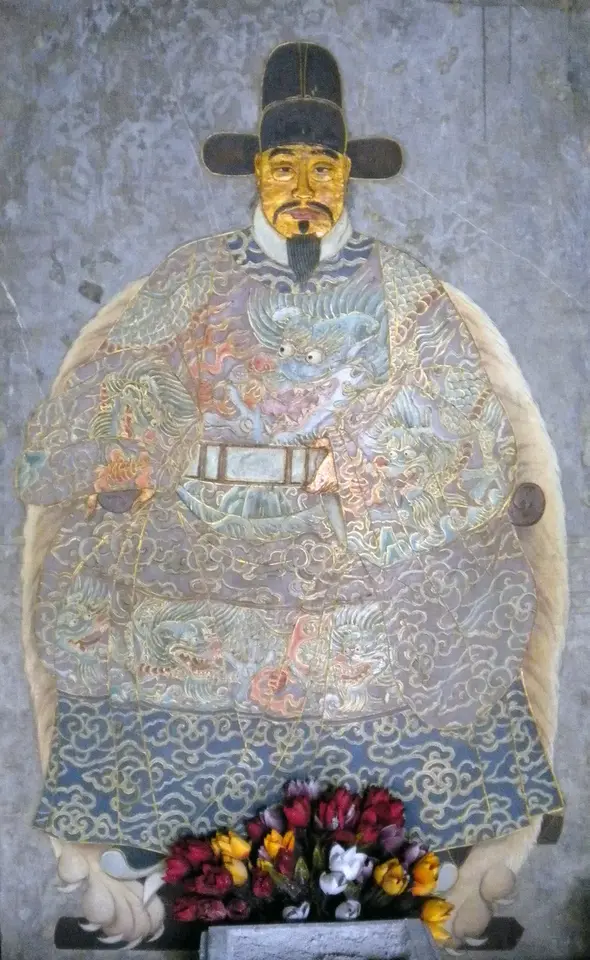
郭朴
Guo Pu (郭朴, May 14, 1511 – June 17, 1593), courtesy name Zhifu, art name Dongye, known in his hometown as "Grand Secretary Guo," was a native of Anyang County, Zhangde Prefecture, Henan, and a Grand Secretary of the mid-Ming dynasty. Passing the palace examination as a jinshi in 1535, he was selected as a Hanlin Bachelor, rose to Right Vice Minister of Rites serving in the Western Park to compose Daoist prayers (qingci),…
Guo Pu (郭朴, May 14, 1511 – June 17, 1593), courtesy name Zhifu, art name Dongye, known in his hometown as "Grand Secretary Guo," was a native of Anyang County, Zhangde Prefecture, Henan, and a Grand Secretary of the mid-Ming dynasty. Passing the palace examination as a jinshi in 1535, he was selected as a Hanlin Bachelor, rose to Right Vice Minister of Rites serving in the Western Park to compose Daoist prayers (qingci), and advanced to Minister of Rites. In the winter of 1561 he succeeded Ouyang Bijin as Minister of Personnel, returning home in 1563 to mourn his father's death before being recalled in 1565 on the recommendation of Senior Grand Secretary Xu Jie. In the third lunar month of 1566, he was appointed Grand Secretary of the Hall of Martial Valor alongside his fellow Henan native Gao Gong, and tactfully persuaded the Jiajing Emperor to spare the life of the imprisoned remonstrator Hai Rui. After the Jiajing Emperor died in the twelfth lunar month of 1566, Xu Jie drafted the imperial valedictory edict without consulting Gao Gong or Guo Pu, causing a rift among the Grand Secretaries. Following Gao Gong's departure in the fifth lunar month of 1567, Guo Pu retired in the ninth lunar month and lived quietly in Anyang for more than twenty years until his death in 1593 at age eighty-three, receiving the posthumous title Grand Preceptor and the posthumous name "Wenjian."
Born on May 14 in Anyang County, Zhangde Prefecture, Henan
Placed fourth in the Second Class of the palace examination as a jinshi, entering the Hanlin Academy as a Bachelor and Compiler
Serving in the Western Park, promoted to Junior Guardian of the Heir Apparent and Minister of Rites managing the Household of the Heir Apparent
Succeeded Ouyang Bijin as Minister of Personnel in winter, winning renown for incorruptibility
Left office in the third month to mourn his father's death, succeeded by Yan Na
Recalled before completing mourning on Xu Jie's recommendation to block Dong Fen, resuming office as Minister of Personnel
Appointed Grand Secretary of the Hall of Martial Valor alongside Gao Gong in the third month; interceded with the Jiajing Emperor to spare Hai Rui
Advanced to Junior Preceptor; retired in the ninth month after three requests amid censorial attacks by Pang Shangpeng and Ling Ru
Died at home on the eighteenth day of the fifth lunar month at age eighty-three; posthumously named "Wenjian" and buried south of Mount Hanling
On May 14, 1511, Guo Pu was born in Anyang County, Zhangde Prefecture, Henan (with ancestral roots in Linzhang County). In 1535, he passed the palace examination as the fourth jinshi of the Second Class, was selected as a Hanlin Bachelor (shujishi), and was appointed a Hanlin Compiler (bianxiu). Over the following decades he served twice as chief examiner for provincial examinations and once for the metropolitan examination, rising to Right Vice Minister of Rites, entering the Western Park (Xiyuan) to compose Daoist prayers, and serving as Right and Left Vice Minister of Personnel and Companion to the Heir Apparent.
When the post of Nanjing Minister of Rites fell vacant, the Jiajing Emperor pitied Guo Pu's long seniority and promoted him with the title Junior Guardian of the Heir Apparent. When Guo Pu petitioned to remain near the throne to participate in literary drafting rather than leaving the capital, the delighted Emperor appointed him Minister of Rites managing the Household of the Heir Apparent while continuing his Western Park duties (leading contemporaries to group him with Li Chunfang, Yan Na, and Yuan Wei as the "Blue-Verse Grand Secretaries"). In the winter of 1561, when Minister of Personnel Ouyang Bijin was dismissed, Guo Pu was appointed Minister of Personnel. In the third lunar month of 1563, he returned home to mourn his father's death and was succeeded by Yan Na.
In the fourth lunar month of 1565, when Yan Na entered the Grand Secretariat, Senior Grand Secretary Xu Jie feared that the favored but corrupt Minister of Works Dong Fen would replace Yan, and urgently recommended recalling Guo Pu. Although Guo Pu pleaded to complete his three-year mourning period, the Jiajing Emperor refused his request on account of his integrity, and Guo Pu returned to head the Ministry of Personnel, soon receiving the title Grand Guardian of the Heir Apparent. Across his two terms in charge of civil appointments, Guo Pu prized practical competence over empty rhetoric, promoted officials according to moral character and ability rather than factional rumor, and valued broad integrity over minor faults.
In the third lunar month of 1566, Guo Pu was appointed concurrent Grand Secretary of the Hall of Martial Valor (Wuyingdian daxueshi), entering the Grand Secretariat on the same day as his fellow Henan native Gao Gong. Earlier, in the winter of 1565, Ministry of Revenue secretary Hai Rui had purchased a coffin, bade farewell to his family, and submitted his scathing Memorial on Peace and Order (Zhi'an Shu) criticizing the Jiajing Emperor's obsession with Daoist rituals and neglect of court audiences. Enraged, the Emperor had Hai Rui cast into the Imperial Prison, though he hesitated to execute him after eunuch Huang Jin reported Hai Rui's readiness to die.
In the spring of 1566, the ailing sixty-year-old Jiajing Emperor summoned the newly appointed Guo Pu to ask how to handle Hai Rui, complaining bitterly that illness had prevented him from holding court and that Hai Rui deserved death for his insults. Determined to save the upright remonstrator, Guo Pu first urged the Emperor to rest and care for his health, and then tactfully replied: "What Hai Rui did was indeed foolish and blunt, as he has been known for stubborn simplicity since his days as a county magistrate; yet his heart was motivated by loyal concern for Your Majesty, which is excusable. Your old minister begs Your Majesty to show mercy and spare Hai Rui, who will surely repay the state with his life." Sighing that he too did not wish to kill remonstrators, the Emperor set aside the Ministry of Justice's death warrant without signing it when it was presented after Guo Pu withdrew, thus preserving Hai Rui's life.
At that time, Senior Grand Secretary Xu Jie wielded immense authority, and Grand Secretaries Li Chunfang and Yan Na treated him with deferential submission. Guo Pu, however, was close to his fellow Henan native Gao Gong, and both men treated Xu Jie with greater independence. When the Jiajing Emperor died in the twelfth lunar month of 1566, Xu Jie drafted the imperial valedictory edict reversing Jiajing-era policies in consultation with Zhang Juzheng without informing Gao Gong or Guo Pu, provoking a bitter rift.
In 1567, censors impeaching Gao Gong also targeted Guo Pu. After Gao Gong resigned in the fifth lunar month, Guo Pu—by then promoted to Junior Preceptor (shaofu) and Grand Preceptor of the Heir Apparent—repeatedly requested retirement in the face of attacks by Censors Pang Shangpeng and Ling Ru, receiving permission to return home in the ninth lunar month.
Living in retirement in the eastern suburbs of Anyang for more than twenty years, Guo Pu led the simple life of a commoner, writing in a poem: "Three thatched rooms shade the sun, a hibiscus fence blocks the wind; on the desk a manual of farming, on the wall a few pictures of plowing." During his retirement, Guo Pu authored the Compact on Learning (Xueyue), Four Admonitions on Reflection (Sisi Zhen), Four Admonitions on Reverence (Siwei Zhen), Continuation of the Gazetteer of Ye (Xu Yecheng), and the 1581 Gazetteer of Zhangde Prefecture (Zhangde Fuzhi). He died on June 17, 1593, at age eighty-three, was posthumously named Grand Preceptor and canonized as "Wenjian," and was buried south of Mount Hanling.
Throughout his career in the Ministry of Personnel and the Grand Secretariat, Guo Pu was celebrated for his impartiality and refusal to abuse imperial favor. In his hometown of Anyang, he was equally remembered for his humility toward commoners. In early autumn 1566, while walking incognito over Phoenix Ridge south of Anyang during a home visit, he heard a middle-aged peddler struggling to push a wheelbarrow loaded with wooden mallets up the slope call out, "Elder brother, please help me push this cart!" Delighted by the plain greeting after years of court flattery, Guo Pu stepped forward to help push the cart to the top, swore brotherhood with the poor peddler, and asked him to deliver a cartload of mallets on the Mid-Autumn Festival, which was also Guo's birthday.
On the Mid-Autumn Festival, when officials and gentry filled his residence to celebrate his birthday, Guo Pu kept the banquet waiting past noon until his friend arrived. When servants tried to turn the mallet peddler away at the gate, Guo Pu personally welcomed him inside, seated him beside himself in the main hall, distributed pairs of wooden mallets to the guests as birthday tokens, and presented the peddler with ten taels of silver to help him care for his eighty-year-old mother. Moved by the Grand Secretary's example, the assembled officials and gentry contributed hundreds of taels of silver and jewelry, enabling the peddler to purchase farmland and support his family.
FIGURES ASSOCIATED WITH THIS DYNASTY