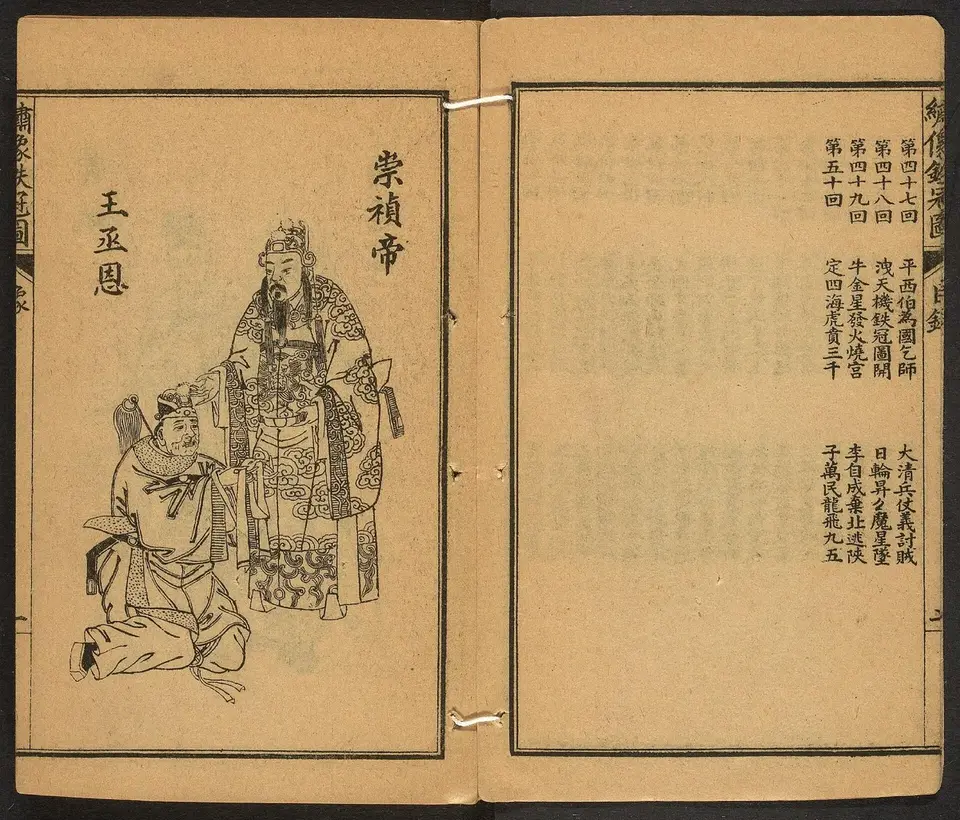
王承恩
Historical portrait of Wang Chengen
Image creditsSongzishanren, creator Shanghai shu ju 松滋山人 上海書局 · Public domainImage source

Senior court eunuch of the late Ming Dynasty who accompanied the Chongzhen Emperor in suicidal martyrdom on Jingshan (明末司礼监秉笔太监、崇祯帝自缢殉国伴驾近臣)

Wang Chengen (王承恩)

王承恩

Wang Chengen (王承恩, died April 25, 1644) was a native of Bai'ankou Village in Xingtai County, Shunde Prefecture, Beizhili (present-day Xingtai City, Hebei Province). He was an influential senior palace eunuch of the late Ming Dynasty who served as Brush-Holding Eunuch Director of the Directorate of Ceremonial and Superintendent of the Capital Guard Divisions. Entering inner palace service during the Tianqi era under the…

Ming Dynasty (明朝)

PROFILE

Wang Chengen (王承恩, died April 25, 1644) was a native of Bai'ankou Village in Xingtai County, Shunde Prefecture, Beizhili (present-day Xingtai City, Hebei Province). He was an influential senior palace eunuch of the late Ming Dynasty who served as Brush-Holding Eunuch Director of the Directorate of Ceremonial and Superintendent of the Capital Guard Divisions. Entering inner palace service during the Tianqi era under the patronage of eunuch director Cao Huachun, he served in the personal princely household of Zhu Youjian (later the Chongzhen Emperor), winning lifelong imperial trust through his unswerving loyalty, modest demeanor, and administrative discretion. Amidst the structural collapse of the late Ming administration, Wang Chengen was entrusted with supreme command over the capital metropolitan garrisons. In April 1644 (the seventeenth year of the Chongzhen era), when Li Zicheng's rebel forces laid siege to Beijing, Wang personally manned the artillery emplacements on the city battlements to repulse insurgent vanguards. On the dawn of April 25, 1644, as rebel troops breached the inner gates, the Chongzhen Emperor ascended Jingshan (Coal Hill) north of the Forbidden City and hanged himself from a crooked sophora tree. While thousands of imperial officials and palace eunuchs surrendered to the invaders, Wang Chengen remained faithfully at his sovereign's side, hanging himself from an adjacent crabapple tree to complete his martyrdom. The Southern Ming Hongguang Emperor conferred upon him the posthumous title Zhongmin, while the Qing Shunzhi Emperor erected an imperial monument and tomb for him beside the Chongzhen Emperor's Siling Mausoleum, venerating him as an eternal exemplar of dynastic loyalty.

Posthumous Name
Zhongmin (忠愍, posthumously conferred by the Hongguang Emperor)
Dynasty
Ming Dynasty (明朝)
Date of Death
April 25, 1644 (Chongzhen 17, 3rd Month, 19th Day)
Native Place
Bai'ankou, Xingtai County, Shunde Prefecture, Beizhili (北直隶顺德府邢台县)
Highest Post & Noble Titles
Brush-Holding Eunuch Director of the Directorate of Ceremonial (司礼监秉笔太监), Superintendent of the Capital Guard Divisions (提督京营太监)
Major Offices
Brush-Holding Eunuch Director of the Directorate of Ceremonial, Superintendent of the Capital Guard Divisions
Identity
Senior court eunuch of the late Ming Dynasty who accompanied the Chongzhen Emperor in suicidal martyrdom on Jingshan (明末司礼监秉笔太监、崇祯帝自缢殉国伴驾近臣)

LIFE TIMELINE

Relationship graph

BIOGRAPHY

Life and Career

Early Palace Entry and Service in the Princely Mansion

Wang Chengen was born into an impoverished peasant family in the mountainous village of Bai'ankou, located in Xingtai County, Shunde Prefecture. Castrated in his youth due to familial destitution, he entered palace service and was placed under the household supervision of Director of the Directorate of Ceremonial Cao Huachun (also recorded as Liu Kejing in the Ming palace memoir Zhuozhong Zhi). Unassuming, scrupulous, and naturally temperate, Wang Chengen avoided the factional corruption and ostentatious bribery that characterized contemporary eunuch circles.

During the Tianqi era, the eunuch dictator Wei Zhongxian established despotic control over the imperial court, purging upright scholar-officials. Living in constant apprehension, Prince of Xin Zhu Youjian (the younger brother of the Tianqi Emperor) lived in strict seclusion in his princely residence. Wang Chengen was assigned to manage the prince's daily household affairs. He guarded the prince with meticulous devotion through the perilous palace intrigues of the late Tianqi reign, forging an unbreakable bond of mutual trust. In October 1627, following the Tianqi Emperor's death, the Prince of Xin ascended the imperial throne as the Chongzhen Emperor.

Advancement to the Directorate of Ceremonial and Capital Defense

Upon ascending the throne, the Chongzhen Emperor swiftly executed the ringleaders of the Wei Zhongxian faction and instituted harsh purges across the inner palace bureaucracy. However, mindful of Wang Chengen's unblemished fidelity in his princely days, the emperor elevated him to positions of immense responsibility. Wang was appointed Brush-Holding Eunuch Director of the Directorate of Ceremonial (Silijian Bingbi Taijian), the supreme administrative bureau within the Twelve Directorates, responsible for reading, summarizing, and transmitting imperial rescripts on memorials submitted by outer court ministries.

As peasant insurrections led by Li Zicheng and Zhang Xianzhong swept across northern and central China, while Later Jin (Qing) armies repeatedly breached the Great Wall, the suspicious Chongzhen Emperor increasingly lost faith in civil ministers and regional generals. In his final years, the emperor consolidated metropolitan defense into inner palace hands, appointing Wang Chengen as Superintendent of the Capital Guard Divisions (Tidu Jingying). In this capacity, Wang held joint military oversight over the three central training divisions guarding the imperial capital. He curbed eunuch abuses, inspected munitions, and attempted to restore defensive readiness amidst severe treasury shortages and epidemic sickness.

The Siege of Beijing and Artillery Defense

In early 1644, Li Zicheng's Shun army advanced through Shanxi with irresistible momentum, overrunning Datong, Xuanfu, and Juyong Pass within weeks. On April 21 (the fifteenth day of the third lunar month), the rebel vanguard arrived outside the walls of Beijing; by the following day, the capital was placed under a total siege.

The imperial capital stood defenseless: years of arrears in soldier pay and the devastating devastation of a virulent plague had reduced metropolitan garrisons to skeletal numbers, extinguishing military morale. Under the emperor's urgent orders, Wang Chengen personally inspected the outer fortifications. On April 23, rebel forces erected high scaling towers to mount fierce assaults against Xizhimen, Fuchengmen, and Deshengmen. Seeing rebel sappers burrowing into the brick foundations to plant explosives, Wang Chengen personally directed the artillery batteries on the ramparts, firing cannons that killed several rebel vanguards. However, the outer defense was hopelessly compromised, as numerous demoralized eunuchs and garrison commanders were already secretly negotiating surrender.

Suicidal Martyrdom on Jingshan

On the night of April 24, rebel forces were admitted through Guang'anmen by surrendering eunuchs, swiftly occupying the outer city and storming the inner gates. In the Qianqing Palace, the frantic Chongzhen Emperor summoned Wang Chengen to muster surviving eunuchs for a desperate final counterattack, but the palace guards had already fled in panic. Realizing that the dynasty was lost, the emperor commanded his consorts to take their own lives and sent his three young sons into hiding.

At the fifth watch before daybreak on April 25, 1644, amid roaring gunfire and burning gates across Beijing, the Chongzhen Emperor, disheveled and wearing a single boot, walked out of the Xuanwumen accompanied solely by Wang Chengen. Scaling the northern slope of Jingshan (Coal Hill), they reached the Shouhuang Pavilion. Beneath a crooked scholar tree, the Chongzhen Emperor bit his finger to write a final blood decree on his robe, pleading with the rebels not to harm a single civilian, before hanging himself at the age of thirty-four. Looking upon his dead sovereign, Wang Chengen bowed reverently in total grief. Refusing to survive the collapse of the Ming Empire, he unfastened his imperial sash and hanged himself from an adjacent crabapple tree, completing his supreme act of martyrdom.

Imperial Enfeoffment and Burial at Siling

On April 27, rebel patrols discovered the bodies of the Chongzhen Emperor and Wang Chengen on the hillside of Jingshan. While countless imperial officials and eunuchs prostrated themselves before Li Zicheng to seek appointments in the new regime, Wang Chengen's absolute loyalty evoked profound veneration across the realm. Following the establishment of the Southern Ming court in Nanjing, the Hongguang Emperor issued an imperial decree honoring Wang Chengen with the posthumous title Zhongmin.

When the Qing court established its capital in Beijing, Regent Dorgon and the Shunzhi Emperor sought to legitimize their rule by burying the Chongzhen Emperor with imperial honors at Siling Mausoleum in Changping. In 1645 (the second year of the Shunzhi era), moved by Wang Chengen's devotion, the Shunzhi Emperor allocated sixty mu of land to construct a private mausoleum for Wang directly outside the gates of Siling, allowing him to eternally guard his master. In 1660 (the seventeenth year of the Shunzhi era), the Shunzhi Emperor personally authored an eight-hundred-word imperial monument praising Wang Chengen as a paragon of loyalty, establishing a rare historical precedent of an imperial dynasty constructing an official shrine for a predecessor eunuch.

Major Achievements

Command and Resistance of the Metropolitan Guard

During the final disintegration of the Ming central government, Wang Chengen assumed the perilous mantle of Superintendent of the Capital Guard Divisions. Despite facing mutinous garrisons, depleted armories, and catastrophic plague, he personally patrolled the nine city gates. When rebel assault forces attacked Deshengmen and Xizhimen, he manned the battlements under heavy fire, organizing defensive cannon barrages until the inner defenses collapsed, exhibiting remarkable military valor rare among late Ming palace officials.

Ultimate Demonstration of Dynastic Loyalty

The fall of Beijing in 1644 exposed pervasive moral cowardice among the Ming elite, with thousands of civil ministers and palace eunuchs competing to open gates and offer flattery to the conquering rebels. Standing in stark contrast, Wang Chengen, holding the highest rank of Brush-Holding Director, rejected escape, capitulation, or self-preservation. Accompanying his sovereign to the peak of Jingshan, he chose suicidal hanging, elevating his memory into an immortal symbol of uncompromised personal integrity and feudal loyalty.

Universal Posthumous Canonization by Two Dynasties

Wang Chengen's supreme act of sacrifice earned extraordinary veneration across dynastic boundaries. He was granted the formal posthumous title Zhongmin by the Southern Ming dynasty and received unique honors from the Qing conquerors. The Shunzhi Emperor personally composed two imperial stone inscriptions and commanded that Wang be buried beside Siling Mausoleum, making him the only palace eunuch in Chinese history to receive an imperial shrine and burial within the sacred precincts of the Ming Tombs.

Chronology

  • ca. 1600 (Wanli Era, Ming Shenzong) | Birth | Born into a poor peasant family in Xingtai County, Shunde Prefecture, entering palace service in childhood.
  • ca. 1622 (Tianqi Era, Ming Xizong) | Service to the Prince of Xin | Assigned under Cao Huachun to serve Prince of Xin Zhu Youjian, establishing profound mutual trust.
  • 1627 (Tianqi 7, Ming Xizong) | Accession of Chongzhen | The Prince of Xin ascended the throne as the Chongzhen Emperor; Wang accompanied him into the Forbidden City.
  • ca. 1635 (Chongzhen Era, Ming Sizong) | Brush-Holding Director | Promoted to Brush-Holding Eunuch Director of the Directorate of Ceremonial, assisting in imperial memorials.
  • 1642 (Chongzhen 15, Ming Sizong) | Metropolitan Superintendent | Appointed Superintendent of the Capital Guard Divisions, assuming joint military command over capital garrisons.
  • 1644 (Chongzhen 17, 3rd Month, 1st Day) | Emergency Garrison Command | With Li Zicheng's rebel armies approaching the capital, the Chongzhen Emperor commissioned Wang to direct all inner and outer capital defenses.
  • 1644 (Chongzhen 17, 3rd Month) | Battlements Defense | Li Zicheng besieged Beijing; Wang personally manned artillery on Deshengmen to repel rebel sappers.
  • 1644 (Chongzhen 17, April 25) | Martyrdom on Jingshan | Beijing fell; accompanied the Chongzhen Emperor to Jingshan and hanged himself beside his master, receiving the posthumous title Zhongmin from the Southern Ming and a tomb stele beside Siling Mausoleum from the Shunzhi Emperor.

Personal Relationships

  • Sovereign: Chongzhen Emperor (Zhu Youjian), tragic final ruler of the Ming Dynasty who reposed absolute trust in Wang Chengen and hanged himself alongside him.
  • Palace Patron: Cao Huachun, Director of the Directorate of Ceremonial under whose household supervision Wang Chengen was trained.
  • Rebel Adversary: Li Zicheng, founder of the Shun regime whose siege of Beijing drove the Chongzhen Emperor and Wang Chengen to suicide.
  • Southern Ming Sovereign: Hongguang Emperor (Zhu Yousong), first ruler of the Southern Ming who honored Wang's martyrdom with the posthumous title Zhongmin.
  • Qing Imperial Patron: Shunzhi Emperor (Fulin), first Qing emperor to rule China proper, who composed royal inscriptions honoring Wang Chengen and built his tomb beside Siling Mausoleum.

Historical Evaluation

  • History of Ming (Ming Shi, Biographies of Eunuchs II): "The inner city fell. As dawn approached, the emperor passed away at the Shouhuang Pavilion; Wang Chengen immediately hanged himself beneath the pavilion. During the reign of the Prince of Fu, he was granted the posthumous title Zhongmin. Our current dynasty granted sixty mu of land, erecting a shrine and stele to honor his loyalty, burying him beside his former sovereign's tomb." (Recording his martyrdom and the rare honor of his imperial burial).
  • Shunzhi Emperor (Imperial Stele Honoring Loyalty): "I have heard that when a loyal subject serves his lord, he surrenders his very life; though amidst ruin and upheaval, his devotion does not waver, a virtue rarely witnessed across antiquity and the present... You, Wang Chengen, pursued solitary loyalty without peer, sacrificing your mortal life to follow your sovereign; your righteous spirit endures, forever illuminating the historical annals!" (Expressing imperial admiration for Wang Chengen's transcendent loyalty).
  • Meng Sen (Lectures on Ming History): "During the Cataclysm of 1644, gentry officials who surrendered were as numerous as ants, and palace eunuchs who capitulated numbered in the thousands; only a single eunuch, Wang Chengen, died a martyr beside his emperor; looking upon him, the court full of turncoat grandees ought to die of shame!" (Contrasting Wang Chengen's steadfast martyrdom with the pervasive cowardice of contemporary scholar-bureaucrats).

Related Entries

  • Chongzhen Emperor
  • Li Zicheng
  • Cao Huachun
  • Cataclysm of 1644
  • Jingshan Park
  • Ming Shi

FIGURES ASSOCIATED WITH THIS DYNASTY

Bibliography

  • Ming Shi (History of Ming), Volume 304, Biography 193: Eunuchs II: Biography of Wang Chengen
  • Ming Shi (History of Ming), Volume 24, Basic Annals 24: Basic Annals of Emperor Zhuanglie II
  • Mingji Beilüe (Northern Records of the Late Ming), Volume 20: Events of the 19th Day of the Third Month (by Ji Liuqi)
  • Jiashen Chuanxin Lu (Faithful Records of the Year Jiashen, edited by Qian Qianyi)