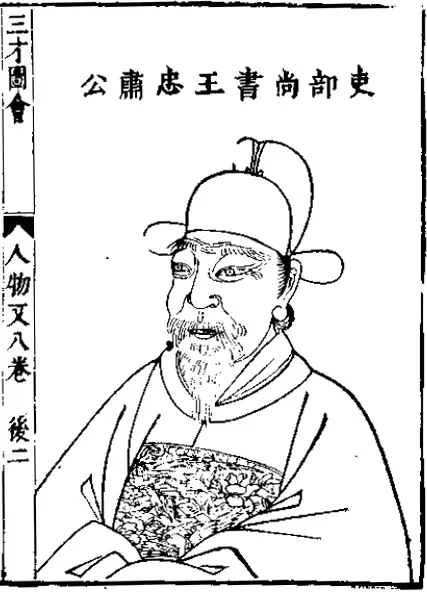
Life and Career
Early Career and Legislative Rectitude
Wang Ao was born into a scholarly farming family in Yanshan, Hejian Prefecture (modern Yanshan County, Hebei Province). In 1412 (the tenth year of Yongle), he became a county student. In 1415, the imperial court held its metropolitan examination in Beijing for the first time. Emperor Chengzu (Zhu Di), who was planning the permanent transfer of the capital north to Beijing, was eager to recruit northern talent. Wang Ao excelled in both the metropolitan and palace examinations. Delighted by his learning, Chengzu summoned him to a private banquet, conferred imperial foods upon him, and appointed him a Shujishi in the Hanlin Academy.
In 1419, having completed his academy studies, Wang Ao was assigned as Senior Director of the Left in the Court of Judicature and Revision, where he handled capital judicial appeals with impartiality. In 1421, following his father's demise, he observed three years of filial mourning in his hometown. In 1425 (the first year of Hongxi under Emperor Renzong), he returned to court and was reassigned as a messenger in the Messenger Office, traveling across the provinces on imperial missions with untarnished integrity.
In 1426 (Xuande 1), Emperor Xuanzong ascended the throne. Grand Secretary Yang Shiqi recognized Wang Ao's unbending uprightness and recommended him for promotion to investigating censor. Under existing statutes, officials guilty of administrative misconduct were permitted to pay fines or transport building bricks to clear their records and resume their duties. Wang Ao submitted a trenchant memorial asserting that officials who accepted bribes and embezzled public funds must never be permitted to return to office, even after paying fines. Emperor Xuanzong immediately ratified the memorial into dynastic law, delivering a major blow to bureaucratic venality.
Inspecting the Frontier and Pacifying Sichuan
In 1430 (the fifth year of Xuande), Wang Ao was assigned as Regional Inspector of Sichuan. At the time, tribal rebellions were spreading through Songpan, while Chief Military Commissioner Chen Huai remained stationed eight hundred li away in Chengdu, unable to respond effectively. Wang Ao investigated the mountain front and submitted his renowned Five Practical Measures Memorial: first, ordering Chen Huai to relocate his headquarters directly to Songpan; second, coordinating military convoys to transport military grain during the agricultural off-season, preventing burdens on ordinary civilians; third, compelling corrupt regional clerks to surrender voluntarily; fourth, establishing community schools throughout tribal regions to promote Confucian education; and fifth, permitting minor offenders in remote silver mines to redeem penalties by providing grain directly to the frontier garrisons. Emperor Xuanzong endorsed all measures, restoring peace to the region.
In 1435, upon the accession of Emperor Yingzong, the court dispatched trusted officials to govern the provinces. Wang Ao was promoted to Right Assistant Censor-in-Chief to co-govern Jiangxi alongside Commander Wu Xing. In Jiangxi, he curbed rampant corruption and protected commoners. In 1439, when outlaws from Chuzhou ravaged Guangxin, Wang Ao took the field and rounded up the insurgents.
In late 1439, the Songpan Regional Commander Zhao Liang kidnapped the Tibetan State Preceptor Shangba, seized his wealth, and falsely accused him of sedition. Shangba's younger brother assembled an army in fury, raiding Ming outposts. Yingzong ordered Wang Ao and Commander Li An to march with twenty thousand soldiers. Learning from local censors that Shangba had been framed, Yingzong gave Wang Ao full discretionary command. Arriving in Songpan, Wang Ao released Shangba from prison, pacified his brother's troops, impeached and executed Zhao Liang, and restored Shangba's titles. The entire border was tranquilized without further bloodshed. In 1441, Wang Ao took over the defense of Shaanxi, auditing and forgiving insurmountable debts owed by impoverished frontier soldiers.
Decade of Defense in Liaodong
In the winter of 1442 (Zhengtong 7), escalating tensions with northern Mongol confederations prompted Emperor Yingzong to appoint Wang Ao as Superintendent of Liaodong Military Affairs. Arriving in Liaodong, Wang Ao discovered that military readiness had deteriorated drastically. When the commanders arrived for inspection, Wang Ao furiously rebuked their negligence and ordered the guards to drag several slack officers out to be executed. The terrified commanders prostrated themselves, pleading for a chance to redeem their lives in combat. Wang Ao granted clemency, instantly restoring firm discipline.
Braving the subzero northern winters, Wang Ao inspected more than a thousand li of borders from Shanhaiguan to Kaiyuan. He ordered the extensive repair of ancient city walls, deepened moats, built forts every five li, and erected relay stations every ten li, linking the entire front with continuous beacon towers. Knowing that border guards endured severe isolation, he arranged honorable marriages for widowed soldiers. To solve the persistent shortfall of grain shipments from the south, Wang Ao instituted a policy allowing offenders to clear legal penalties through agricultural reclamation, stone quarrying, or delivering grain and livestock. Over ten years, this policy accumulated hundreds of thousands of bushels of grain and vast herds of sheep and cattle, making Liaodong fully self-sufficient.
In 1447, Wang Ao and Regional Commander Cao Yi patrolled beyond the frontier, colliding with the main force of the Uriankhai Mongols. Wang Ao coordinated a crushing cavalry strike, decapitating thirty-two enemy warriors, capturing over seventy, and seizing forty-six hundred horses and livestock. For this victory, he was elevated to Right Censor-in-Chief. In 1449, after further border victories, he became Left Censor-in-Chief. When Esen Taishi and Toghtoa Bukha launched the devastating invasion that culminated in the Tumu Crisis, Mongol cavalry besieged Guangning. With the defensive garrison wavering, officers urged retreat. Wang Ao drew his sword, declaring that anyone advocating retreat would be summarily beheaded. Under his resolute defiance, the fortress held firm until the invaders withdrew.
Inaugural Viceroy of Liangguang
In 1452 (the third year of Jingtai), Wang Ao returned to Beijing to supervise the Censorate and was granted the honorary title of Grand Guardian of the Heir Apparent. Meanwhile, violent uprisings among the Yao and Zhuang populations in Xunzhou and Wuzhou had overwhelmed imperial defenses in southern China. The existing commanders, Dong Xing and Wu Yi, engaged in petty bickering and avoided combat. Minister of War Yu Qian memorialized that the complex geography of the south required a supreme civilian dignitary to unify civil and military command, proposing the establishment of a single supreme commander over Guangdong and Guangxi.
Emperor Daizong adopted Yu Qian's advice and appointed Wang Ao as the empire's very first Viceroy of Liangguang. Stationed in Wuzhou, Wang Ao's imposing moral stature immediately commanded respect among local officers. Recognizing that ethnic unrest had been fueled by rapacious local clerks, Wang Ao combined military vigilance with administrative mercy. He deployed garrisons to secure mountain passes while sending respected intermediaries into the highlands to announce imperial pardons, abolish illegal levies, and punish extortionate officials. Deeply moved, tribal leaders led their followers to submit peacefully. Through Wang Ao's leadership, the institutional office of the Viceroy of Liangguang was firmly established as an enduring pillar of provincial administration.
Custodian of Personnel and Imperial Restoration
In 1453 (Jingtai 4), Vice Minister of Personnel He Wenyuan was dismissed for nepotism, and the eighty-year-old Minister Wang Zhi struggled to manage personnel appointments alone. Emperor Daizong urgently recalled Wang Ao to Beijing, appointing him Minister of Personnel to co-direct bureaucratic evaluations. Wang Ao strictly upheld dynastic statutes, ensuring that selections were made purely upon demonstrated competence.
In January 1457 (Jingtai 8), General Shi Heng, Xu Youzhen, and the eunuch Cao Jixiang carried out the Incident at the Southern Gate, restoring Emperor Yingzong to the throne. Yu Qian was executed, Wang Zhi retired, and veteran ministers were widely purged. Shi Heng despised Wang Ao for his incorruptible independence and attempted to oust him. Wang Ao requested retirement, which Yingzong initially granted. However, Grand Secretary Li Xian passionately argued before the throne that Wang Ao's unblemished rectitude was vital to the stability of the realm, prompting Yingzong to retain Wang Ao as sole head of the Ministry of Personnel. When Shi Heng subsequently slandered Li Xian, Wang Ao likewise defended Li's loyalty, persuading the emperor to recall him. Together, Wang Ao in the ministry and Li Xian in the Grand Secretariat formed the core bulwark of administrative governance during the Tianshun era.
Emperor Yingzong revered Wang Ao, frequently consulting him in the private apartments and addressing him affectionately as "Teacher" or "Old Wang." During Cao Qin's violent military rebellion in July 1461, mutineers stormed the Ministry of Personnel and took Li Xian hostage, demanding that Wang Ao and Li draft a memorial demanding imperial forgiveness. Facing drawn blades, Wang Ao remained composed, stalling the rebels throughout the night until regular imperial troops surrounded and eliminated them.
Exemplary Character and Peaceful Passing
Throughout his fifteen years as Minister of Personnel, Wang Ao lived in ascetic simplicity, residing almost continuously in his office and declining all private callers. Whenever appointments were made, he scrutinized dossiers late into the night, refusing to leave decisions to subordinates. He never revealed his personal recommendations to the beneficiaries, remarking that the Ministry of Personnel belonged to the public realm and was no place to cultivate private debts of gratitude.
In 1465, Emperor Xianzong ascended the throne and granted Wang Ao the rare privilege of being excused from morning court audiences during rain and snow. Although Wang Ao repeatedly petitioned for retirement due to extreme old age, Xianzong consistently retained him with affectionate edicts and imperial physicians. In the winter of 1467, as Wang Ao fell terminally ill, the emperor finally granted his retirement. Within days of receiving the decree, Wang Ao passed away peacefully in Beijing on December 2, 1467, at the age of eighty-four.
Emperor Xianzong expressed profound grief, suspended court audiences, and posthumously elevated Wang Ao to Grand Guardian with the posthumous name Zhongsu. Across his service under seven reigns, his uncompromising integrity became the golden standard of Ming official rectitude.