Biography
Early Life and Palace Education
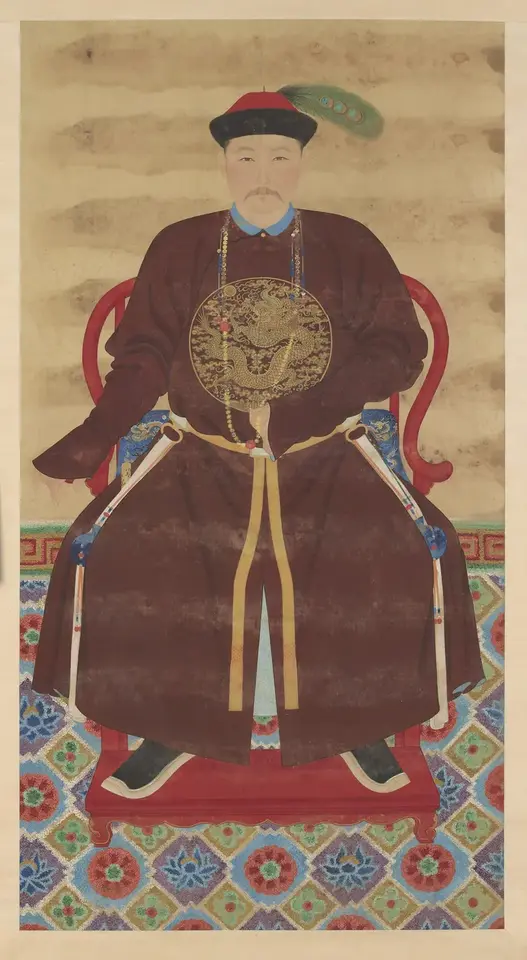
Aisin Gioro Yinsi was born on March 29, 1681, in the Forbidden City in Beijing. His biological mother, Lady Wei, was the daughter of Abunai, an internal supervisor of the Plain Yellow Banner, originating from the Sina boo (booi aha) bondservant division of the Imperial Household Department; she was later promoted to Consort Liang. Within the rank-conscious Qing court, her background was viewed as humble. In accordance with palace regulations, Yinsi was entrusted in early childhood to Consort Hui of the Nara clan, the biological mother of the eldest prince Yinzhi. Yinsi consequently established an enduring familial affection with Consort Hui and her son, laying the groundwork for Yinzhi's later support in succession disputes.
Yinsi displayed sharp intelligence and emotional maturity from an early age, cultivating a gentle, approachable, and prudent demeanor. Entering the Palace School at the age of six, he pursued rigorous studies in Manchu, Mongolian, and Chinese classics. In June 1687, the Kangxi Emperor examined the scholastic progress of his elder sons; the six-year-old Yinsi recited classical prose with fluid composure and clear pronunciation, drawing high paternal praise. Observing that his Chinese calligraphy required improvement, the Kangxi Emperor selected the distinguished classicist and calligrapher He Zhuo to serve as his daily instructor, requiring Yinsi to submit ten calligraphic sheets daily for imperial inspection. Yinsi treated He Zhuo with profound respect, forging a lifelong bond and establishing intellectual connections with prominent Jiangnan literati.
Beyond literary learning, Yinsi excelled in equestrian archery. The Kangxi Emperor prized physical resilience and martial prowess among his sons. In July 1692, the eleven-year-old Yinsi accompanied his father and elder brothers on a grand hunt beyond the Great Wall, enduring intense heat and wind on horseback. The Jesuit missionary Jean-Francois Gerbillon noted in his journal that these young princes displayed extraordinary agility with composite bows at full gallop. At age thirteen, Yinsi was tasked by the emperor to test tribute horses, assessing their temperament and endurance. During the second campaign against Galdan, the Kangxi Emperor noted with satisfaction in letters to the Crown Prince that Yinsi had bagged as many wild hares as his adult brothers.
Enfeoffment and Rising Administrative Renown
In March 1698, following the final pacification of the Dzungar khanate, the Kangxi Emperor conducted the first formal creation of princely ranks for his adult sons. At seventeen, Yinsi was created a Doroi Beile alongside Yinzhen (the fourth prince), Yinzhi (the fifth prince), and Yinyou (the seventh prince), being the youngest recipient. Upon establishing his independent princely household, Yinsi was entrusted with important administrative responsibilities. Whenever the Kangxi Emperor embarked on northern hunting tours or southern inspection circuits, Yinsi was repeatedly assigned to remain in Beijing alongside Yinzhi (the third prince) to manage central palace and bureaucratic affairs.
In administrative service, Yinsi displayed remarkable organizational skill and interpersonal tact. He was assigned to assist his uncle Fuquan, Prince Yu, in managing the Guangshan Treasury, which oversaw imperial clan loans and emergency relief disbursements. Yinsi verified dockets meticulously, eliminated fraudulent claims, and earned Fuquan's deep admiration. Before his death in 1703, Fuquan commended the Eighth Prince before the throne as a reliable pillar of the dynastic house. In 1700, the Kangxi Emperor appointed Yinsi to oversee the Imperial Household Department. This vast bureau managed imperial estates, palace workshops, and crown expenditures, historically plagued by embezzlement and servant abuses. Yinsi instituted rigorous accounting standards while maintaining humane discipline, earning universal respect among banner personnel, court eunuchs, and the Imperial Clan Court.
Equally consequential was Yinsi's unparalleled popularity across the civil bureaucracy. Unlike the arrogant eldest prince Yinzhi or the austere and demanding fourth prince Yinzhen, Yinsi treated everyone with warmth and dignity. Regardless of aristocratic status or humble birth, he received scholar-officials with genuine respect. When his tutor He Zhuo returned to Jiangnan to observe mourning for his father, he entrusted his young daughter to the care of Yinsi's primary consort, Lady Gorbolo. Across the capital, scholars and officials acclaimed him as the "Eighth Virtuous Prince." Over the years, Yintang, Yiner, and Yinti rallied devotedly around him, while influential ministers such as Grand Minister of the Imperial Guard Tong Guowei, Grand Secretary Maci, Alingga, Censor-in-Chief Kuaixu, and Minister Wang Hongxu quietly coalesced into his formidable political camp.
The Deposition of Yinreng and the Zhang Mingde Conspiracy
In August 1708, while traveling through Inner Mongolia, the Kangxi Emperor was devastated by the grave illness of his young son Yinxie. While the sovereign was distraught, Crown Prince Yinreng demonstrated callous indifference. Subsequently, Yinreng, panicked over his insecure status, engaged in suspicious nocturnal espionage outside the imperial yurt. Fearing a coup d'etat, the Kangxi Emperor summoned his retinue at Burhastai on September 18, tearfully denouncing the Crown Prince for tyranny and treason, ordering him arrested and confined in the Xian'an Palace in Beijing.
The sudden vacancy of the crown prince title triggered acute rivalry among the elder princes. The eldest prince Yinzhi, recognizing that his own aggressive overtures had provoked imperial disgust, sought to block other competitors by aggressively promoting Yinsi. Yinzhi reported that the itinerant physiognomist Zhang Mingde had examined Yinsi's facial features and predicted that he would attain supreme imperial majesty, foolishly offering to execute Yinreng on his father's behalf. The Kangxi Emperor was horrified, concluding that Zhang Mingde was a dangerous charlatan inciting regicide, and suspected that Yinsi had harbored treasonous ambitions by concealing the physiognomist's remarks.
The following day, the Kangxi Emperor convened the princes and ministers in the Qianqing Palace, angrily condemning Yinsi for insidious deceit, treasonous ambition, and factional scheming against Yinreng, ordering him immediately chained and remanded for trial by the Council of Princes and High Officials. Yintang and Yinti, bearing poison in their robes, boldly rushed into the presence to plead for Yinsi. Yinti argued vehemently, infuriating the emperor to the point that Kangxi unsheathed his ceremonial sword to strike him down. Prince Yinzhi (the fifth prince) lunged forward to embrace his father's waist, while the other princes knelt weeping and kowtowing. The emperor relented, sentencing Yinti to twenty lashes and expelling him from the palace. Following the inquest, Zhang Mingde was executed by slow slicing, and Yinsi was stripped of his rank of Beile and reduced to a commoner imperial clansman.
Shortly thereafter, the third prince Yinzhi disclosed that the eldest prince Yinzhi had employed a Mongolian lama named Bahan Gelong to cast witchcraft curses upon Yinreng. A thorough investigation confirmed the sorcery and revealed that the eldest prince had actually hired Zhang Mingde to assassinate Yinreng, whereas Yinsi had previously driven the physiognomist away. Realizing Yinsi's relative innocence regarding the murder plot, the Kangxi Emperor's fury abated, yet the discovery of Yinsi's extensive factional support left an indelible mark of deep suspicion in the sovereign's mind.
The Collective Nomination and Imperial Backlash
In late November 1708, the Kangxi Emperor fell ill from emotional distress. Seeking to calm princely strife and restore governmental equilibrium, he summoned all high civil and military ministers to the Changchun Garden, formally issuing an imperial mandate: "Deliberate together among yourselves regarding which prince should be established as the new Crown Prince; Whomever you recommend unanimously, We shall appoint." The emperor covertly anticipated that the court would intuit his underlying paternal attachment and recommend the reinstatement of Yinreng.
However, the response of the bureaucracy completely contradicted the emperor's design. Guided by Tong Guowei and championed by Grand Secretary Maci, high officials including Alingga, Orunde, Kuaixu, and Wang Hongxu organized a unified consensus. When the deliberation convened, the ministers submitted a joint memorial overwhelmingly nominating the Eighth Prince Yinsi. This unexpected result struck the Kangxi Emperor like a thunderbolt. In his eyes, such monolithic solidarity demonstrated an illicit coalition of civil and military officials attempting to dictate the imperial succession and hold imperial prerogative hostage.
Confronted by this factional challenge, the Kangxi Emperor instantly reneged on his imperial pledge. He castigated the assembly: "Yinsi is immature and has committed offenses; furthermore, his mother is of humble origin from the Sina boo; he cannot possibly be appointed! Deliberate anew!" The emperor subsequently claimed that he had been visited in dreams by Empress Xiaozhuang and Empress Xiaocheng, declaring that Yinreng's earlier erratic behavior had been caused by sorcery from which he was now cured. In February 1709, Kangxi launched an investigation into the leaders of the nomination movement. Tong Guowei was denounced and forced into retirement, while Maci was stripped of office and placed under arrest. In April, Yinreng was formally reinstated as Crown Prince, and Yinsi was restored to the rank of Beile to maintain stability. Nevertheless, the Kangxi Emperor henceforth regarded Yinsi as his most dangerous political rival.
The Dead Falcon Incident and Severance of Paternal Ties
In October 1712, Yinreng was permanently deposed for persistent factional intrigue, leaving the succession unresolved. Having experienced the bitter consequences of overt candidacy, Yinsi withdrew from public competition, redirecting his influence to support his ally Yinti, who was later dispatched to the northwest as General-in-Chief Pacifying the Distant Frontiers.
Yet the Kangxi Emperor's hostility toward Yinsi never softened. In November 1714, the emperor journeyed toward Rehe, resting at the Miyun Lodge. The date coincided with the second anniversary of the death of Yinsi's mother, Consort Liang. Unable to join the imperial entourage due to memorial sacrifices at her tomb, Yinsi subsequently selected two magnificent hunting gyrfalcons, dispatching the eunuch Yaqibu to deliver them to Miyun as an imperial tribute. Due to poor handling during rapid transit, the two falcons arrived at the lodge exhausted, near death, and barely able to breathe.
The ailing and suspicious emperor took this as an intentional insult, interpreting the dying birds as a malicious curse upon his own longevity. Kangxi summoned his sons and retinue, launching an unprecedented tirade that released years of accumulated resentment. He denounced Yinsi as treacherous since childhood, born of a wretched bondservant woman, and declared: "From this moment forth, all paternal ties between father and son are severed!" The emperor ordered the total suspension of all stipends and allowances for Yinsi and his princely retinue. The incident shattered Yinsi's political standing; devastated by paternal condemnation, he fell dangerously ill and permanently abandoned all aspirations for the throne during his father's lifetime.
The Accession of Yongzheng and Illusory Princely Elevation
On December 20, 1722, the Kangxi Emperor passed away at the Changchun Garden. Aided by General Commandant of the Gendarmerie Longkodo and General Nian Gengyao, the fourth prince Yinzhen secured control of the capital and ascended the throne as the Yongzheng Emperor. Because the succession was fraught with controversy, Yinti commanded vast armies in the northwest, and the Eighth Prince retained extensive prestige among the banners, the political situation in Beijing was precarious.
To neutralize potential armed resistance, the Yongzheng Emperor deployed an appeasement strategy. On the day after his accession, he named Yinsi, Prince Yi (Yunxiang), Grand Secretary Maci, and Longkodo as the four Grand Ministers of the newly created Council of State. Soon afterward, Yongzheng elevated Yinsi to Heshuo Prince Lian, assigned him to superintend the Ministry of Revenue, and placed him in charge of the Ministry of Works, while requiring all imperial brothers to replace the character "Yin" with "Yun" to honor the taboo on the emperor's personal name. Yinsi harbored no illusions regarding his brother's motives. Returning to his residence as Prince Lian, he appeared sorrowful; his primary consort, Lady Gorbolo, remarked sardonically to well-wishers: "What is there to congratulate? Who knows when our heads will fall!"
During his three years as Grand Minister, Yunsi carried out his duties with meticulous caution. He oversaw the construction of Kangxi's Jingling mausoleum, audited provincial treasury deficits, and coordinated military supply lines for the northwest. However, his preference for administrative conciliation and moderate fiscal recovery clashed sharply with Yongzheng's aggressive, uncompromising enforcement of financial accountability, deepening the emperor's determination to crush him.
Degradation, Renaming, and Tragic Death
Between 1723 and 1725, having solidified his authority, the Yongzheng Emperor recalled Yinti from the frontier to confinement, exiled Yintang to Xining under military surveillance, stripped Yiner of his titles, and swiftly purged Nian Gengyao and Longkodo, systematically neutralizing Yunsi's external support network.
In late 1725, Yongzheng launched a total assault on Yunsi. The emperor issued dozens of edicts charging Yunsi with hypocrisy, clandestine opposition to royal policy, and factional disruption. On January 28, 1726, Yongzheng stripped Yunsi of his title of Heshuo Prince Lian, reducing him to an unranked clansman. The emperor ordered him to forcibly divorce his consort Lady Gorbolo, compelling her to commit suicide and having her ashes scattered. In March, Yunsi was formally expelled from the imperial clan, his name struck from the imperial genealogy, and he was remanded to solitary confinement in the Imperial Clan Court.
To thoroughly obliterate his dignity, the emperor required him to adopt a humiliating name. Yunsi was forced to assume the Manchu name "Akina," meaning "frozen fish on a chopping board" or "wretched dog," while Yintang was renamed "Seshe" ("pest"). In the Imperial Clan Court, Yunsi was subjected to heavy iron fetters in a sealed chamber under armed guard, receiving coarse rations and foul water. Broken by unremitting psychological abuse and severe gastrointestinal illness, Yunsi died in confinement on October 5, 1726, at the age of forty-five.
Posthumous Rehabilitation by the Qianlong Emperor
Following Yunsi's death, his only son Hongwang was stripped of imperial clan status and exiled to Rehe under strict surveillance. More than five decades later, on February 9, 1778, the Qianlong Emperor formally issued an imperial decree re-evaluating the bitter succession conflict of the late Kangxi era.
The Qianlong Emperor observed that while Yunsi and Yintang had formed factions in pursuit of the throne, such ambitions were shared by many princes of that era, and neither had committed actual acts of regicide or violent treason. He characterized their degradation and punitive renaming under the Yongzheng reign as excessively severe punishments necessitated by past political exigencies. Qianlong ordered their total rehabilitation, abolishing the names "Akina" and "Seshe," restoring their original names Aisin Gioro Yinsi and Yintang, reinstating their lineage within the imperial genealogical records, and granting their descendants red-girdle clan privileges. This decree brought an official historical and legal resolution to the succession struggles that defined early Qing dynastic politics.