Biography
Hereditary Privilege and Rise Through Regional Administration
Qishan was born into the hereditary aristocracy of the Manchu Plain Yellow Banner. His distant ancestor, Geder'er of the Mongol Borjigit clan, had led his followers to swear fealty to Nurhaci during the early Qing, receiving a hereditary first-class marquisate and registration in the Manchu banner system. His father, Chengde, served as Lieutenant-General of Jehol. In 1806 (Jiaqing 11), the twenty-year-old Qishan was appointed Vice Director in the Ministry of Justice by virtue of hereditary Yin privilege. Aware that young banner nobles without examination credentials were often looked down upon by veteran Han clerks, Qishan paid substantial private retainers to hire a seasoned ministry scribe as his tutor, immersing himself in Qing administrative jurisprudence and penal precedents for three years until he achieved exceptional mastery of legal administration.
In the second month of 1814 (Jiaqing 19), Qishan was promoted to Vice Director of the Transmission Office, and in October was dispatched as Judicial Commissioner of Henan. During his tenure, he directed rigorous intelligence sweeps across Runing and Guangzhou, capturing over seven hundred adherents of the White Lotus sect, which earned him royal commendation and the peacock feather. In 1821 (Daoguang 1), Qishan transferred to Financial Commissioner and Governor of Shandong. Upon his father's death in 1823, the Daoguang Emperor ordered him to remain at his post without entering formal mourning (Duoqing) due to his administrative efficiency, while permitting him to inherit the first-class marquisate. In Shandong, he suppressed anti-Qing rebellions in Linqing and mobilized eight hundred thousand taels to reinforce the Gaojiayan dyke in Jiangnan. In 1825 (Daoguang 5), at the age of thirty-nine, he was elevated to Governor-General of Liangjiang concurrent Director-General of Water Transport. In Liangjiang, he supported the experimental maritime tribute transport initiative championed by Tao Shu and Lin Zexu. However, eager for quick renown in hydraulic affairs, Qishan overruled the objections of Southern River Director Zhang Jing and forced the opening of the Wangjiaying overflow dam to dredge the Yellow River channel. The project squandered six million taels of treasury funds without providing flood relief, triggering widespread outrage and official impeachments that resulted in his demotion in 1827.
Viceregal Governance in Zhili and Sea Coast Opium Control
In 1829 (Daoguang 9), Qishan was reassigned as Lieutenant-General of Jehol. In the second month of 1831 (Daoguang 11), the Daoguang Emperor appointed him Governor-General of Zhili, the premier regional viceroyalty, and subsequently elevated him to Associate Grand Secretary and Grand Secretary of the Wenyuan Hall. In the capital region, Qishan forged a close political alliance with the influential grand councillor Mujangga, establishing a powerful conservative aristocratic coalition at court. Governing Zhili for nearly a decade, Qishan was aloof, intellectually sharp, and administratively demanding, handling finances and judicial sentencing with unremitting personal scrutiny.
When the imperial debate over opium prohibition erupted in 1838 following Huang Juezue's memorial, Qishan was initially hesitant, emphasizing the immense difficulties of patrolling expansive northern coastlines. However, when the Daoguang Emperor issued severe reprimands, Qishan executed imperial orders with characteristic thoroughness. He surveyed the maritime terrain between Dagu and the Hai River, formulating the comprehensive Tianjin Maritime Opium Prohibition Regulations in the eleventh month of 1838. He deployed undercover informants across Dagu, Beitang, and Hangu, established mutual responsibility guarantees for transport lighters, and audited commercial shipping manifests. Within months, his constables confiscated over thirteen thousand taels of contraband opium and arrested over one hundred dealers, drawing high imperial praise. Yet this operational success did not instill in Qishan a determination to confront Western aggression; observing the devastating firepower of armed foreign opium cutters, he developed an overwhelming dread of British military superiority.
Diplomatic Negotiations at Dagu and Southern Appointment
Following Lin Zexu's decisive opium confiscation at Humen in 1839, the British government launched the First Opium War in the summer of 1840 to defend the illicit trade and enforce colonial demands. Admiral George Elliot led an expeditionary fleet to blockade the Pearl River, seized Tinghai on Zhoushan Island, and sailed north unchecked, anchoring off Dagu at the mouth of the Baihe River on August 11, 1840. The arrival of British gunboats outside the maritime gateway to Beijing caused intense alarm at the imperial court.
Stationed in Baoding, Qishan was commissioned as Imperial Plenipotentiary to conduct negotiations. Meeting British representatives off the Baihe River, Qishan concluded that the dilapidated coastal forts were incapable of resisting modern gunboats. Adopting an appeasement strategy, he treated the invaders with deferential courtesy, sending twenty bullocks, two hundred sheep, and abundant provisions to the warships as gestures of imperial benevolence. In his memorials to the throne, Qishan deliberately laid all blame for the crisis upon Lin Zexu, accusing him of excessive zeal and provincial misrule. He assured Captain Charles Elliot that if the fleet withdrew south, the Qing court would dismiss Lin Zexu and fairly adjudicate all British complaints. Convinced that their military demonstration had secured diplomatic leverage and constrained by the onset of autumn gales, the British agreed to withdraw. Delighted by what he perceived as a masterstroke of bloodless pacification, the Daoguang Emperor praised Qishan for single-handedly repelling the foe, cashiered Lin Zexu in September 1840, and appointed Qishan as Imperial Commissioner and Governor-General of Liangguang to negotiate final terms in the south.
Capitulation at Canton and the Convention of Chuenpi
Qishan arrived in Canton on November 29, 1840. Prior to his formal entry, he dispatched trusted adjutants Zhang Dianyuan and Bai Hanzhang alongside the traitorous comprador linguist Bao Peng to initiate covert backchannel talks with Charles Elliot. Clinging to the illusion that minor fiscal concessions would satisfy the invaders, Qishan pursued a disastrous policy of unilateral de-escalation. To demonstrate good faith, he disbanded thousands of local militia and naval volunteers recruited by Lin Zexu and suspended fort reinforcements to cut military spending.
British negotiators, however, escalated their ultimatums, demanding six million silver dollars, the opening of Amoy and Fuzhou to foreign trade, and territorial concessions. On January 21, 1841, the Daoguang Emperor, finally realizing that British terms were intolerable, issued an urgent edict commanding Qishan to reject all territorial and trading demands and prepare for total war. Before this decree could be implemented, the British launched an assault on the outer defenses on January 7, capturing the Shajiao and Dajiao forts, where General Chen Liansheng perished in combat. Terrified by the loss of the forts, Qishan ignored the emperor's battle orders. On January 27, 1841, he attended a secret personal conference with Elliot at Lotus City on the Shiziyang channel. Under British intimidation, Qishan verbally consented to the draft Convention of Chuenpi, conceding the cession of Hong Kong Island and six million dollars in compensation, falsely reporting to the throne that Hong Kong was merely being granted as a temporary anchorage.
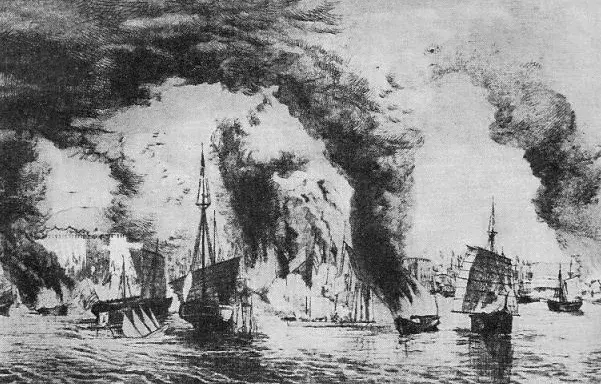
British troops landed and hoisted the Union Flag on Hong Kong Island on January 26. Recognizing the extreme peril, Guangdong Naval Commander Guan Tianpei repeatedly petitioned Qishan for reinforcements and artillery to secure the Humen bottleneck. Qishan adamantly refused, barring the city gates and withholding all troop deployments. On February 26, British warships bombarded the Jingyuan fort; Guan Tianpei and his four hundred surviving marines fought to the last breath before being overwhelmed. As the Humen defenses fell, Qishan attempted to feign mortal illness to evade responsibility. When reports of Hong Kong's seizure and Guan Tianpei's martyrdom reached Beijing, the Daoguang Emperor erupted in fury, denouncing Qishan for betraying the dynasty. Qishan was immediately stripped of all offices, transported in chains to Beijing, had his colossal personal fortune confiscated by imperial inspectors, and was sentenced by the Board of Punishments to decapitation with stay of execution.
Rehabilitation and Administration in Tibet
Following the signing of the Treaty of Nanking in 1842, Qishan was released from prison through the political patronage of Grand Councillor Mujangga and permitted to redeem himself as an unranked volunteer in the Zhejiang theater. In December 1842, the emperor restored him to a fourth-class imperial bodyguard and commissioned him as Assistant Resident in Yarkand, followed by appointment as Lieutenant-General of Jehol in 1843. Despite bitter denunciations from censors like Chen Qingyong, the emperor's favor remained undiminished. In 1844, Qishan was appointed Imperial Resident in Tibet (Amban) with the rank of Deputy Lieutenant-General.
At the time, political order in Tibet was severely destabilized by the Second Tsemonling Regent (Ngawang Jampel Tsultrim Gyatso), who had dominated administrative affairs for twenty-six years through corruption, autocracy, and seditious resistance to imperial authority. Arriving in Lhasa, Qishan acted with decisive severity, allying with the Seventh Panchen Lama to arrest the Tsemonling Regent, strip him of his titles, and exile him to Heilongjiang, peacefully resolving a grave regional crisis. In November 1844, Qishan co-authored the Twenty-Eight Article Regulations for Eradicating Malpractices of the Shangshang, instituting sweeping administrative reforms that curtailed the fiscal autonomy of the Tibetan regency, regularized corvée labor, and reinforced the supervisory supremacy of the Imperial Resident. In 1846, when French Catholic missionaries Évariste Huc and Joseph Gabet penetrated Lhasa in disguise, Qishan personally interrogated them with dignified statecraft, providing an armed escort to conduct them peacefully back to the interior, thereby checking early Western missionary infiltration into Tibet.
Frontier Governance and Death at the Jiangbei Great Camp
In 1849 (Daoguang 29), Qishan was elevated to Governor-General of Shaan-Gan in recognition of his service in Tibet, and transferred to Governor-General of Sichuan in 1850. In 1852 (Xianfeng 2), the Taiping Rebellion erupted from Guangxi, capturing Yuezhou, Hanyang, and Wuchang, and sweeping down the Yangtze River. The Xianfeng Emperor recalled the veteran viceroy, granting him third-rank insignia to act as Governor of Henan and shortly thereafter appointing him Imperial Commissioner in supreme command of government armies along the Henan-Hubei frontier.
In March 1853, the Taiping forces took Nanjing and established their capital as Tianjing. Qishan led over ten thousand cavalry and infantry from northern banners and Green Standard garrisons to establish the Jiangbei Great Camp outside Yangzhou. Stationed at Zhuanqiao and Leitang, the Jiangbei Great Camp formed a coordinated containment line with Xiang Rong's Jiangnan Great Camp, severing Taiping grain transports north of the Yangtze. However, the regular imperial garrisons were plagued by poor discipline and morale, and Qishan's assaults were repeatedly repulsed by Taiping commanders Luo Dagang and Lin Fengxiang. The relentless operational strain and intense friction among provincial commanders broke the elderly viceroy's failing health. On the tenth day of the intercalary seventh month of 1854 (Xianfeng 4), Qishan died of acute heatstroke and dysentery in the Yangzhou encampment at the age of sixty-nine. The Xianfeng Emperor issued an imperial edict mourning his demise, granting full viceregal honors, posthumously promoting him to Associate Grand Secretary, bestowing the posthumous title Wenqin, and authorizing the construction of memorial shrines in his honor.
Major Achievements
The Dagu Placation Policy and Initial British Negotiations
During the critical opening months of the First Opium War in 1840, Qishan's diplomatic maneuvering at Dagu represented a decisive turning point in late Qing foreign relations. Confronting advanced British steamships outside the imperial capital, Qishan correctly perceived the utter obsolescence of Qing coastal defenses, but chose appeasement over energetic fortification. Through lavish gift distributions and diplomatic concessions, he induced the British fleet to depart northern waters, temporarily lifting the direct military threat to Beijing. However, this superficial tactical success deceived the imperial court into a false sense of security, directly leading to the catastrophic dismissal of Lin Zexu and the dismantling of southern maritime defenses.
Secret Negotiations at Canton and the Calamity of Chuenpi
As Imperial Commissioner and Governor-General of Liangguang, Qishan presided over one of the most disgraceful chapters in modern Chinese diplomatic history. Placing blind faith in negotiations with Captain Charles Elliot through disreputable interpreters, he neglected garrison readiness, refused to reinforce General Guan Tianpei during the Battle of Humen, and unilaterally consented to the draft Convention of Chuenpi. By offering to cede Hong Kong Island and pay millions in silver without imperial authorization, he established an alarming precedent of territorial and fiscal capitulation that severely damaged national sovereignty.
Tibetan Administrative Reforms and Expulsion of Foreign Missionaries
During his tenure as Imperial Resident in Tibet, Qishan demonstrated exceptional executive competence in frontier governance. He swiftly neutralized the sedition of the Second Tsemonling Regent, reinforcing Qing central authority over the frontier region. The resulting Twenty-Eight Article Regulations for Eradicating Malpractices of the Shangshang instituted enduring reforms in taxation, official ranks, and judicial oversight. Furthermore, his lawful detention and deportation of French missionaries Évariste Huc and Joseph Gabet successfully shielded the Tibetan borderlands from early European religious and political penetration.
Establishing the Jiangbei Great Camp Against the Taiping Rebellion
Following the fall of Nanjing to the Taiping Heavenly Kingdom, Qishan mobilized northern military formations to construct the Jiangbei Great Camp outside Yangzhou. By fortifying strategic positions along the northern banks of the Yangtze, his forces interdicted Taiping supply networks across northern Jiangsu and Anhui, providing a crucial strategic barrier that contained rebel expansion and secured vital time for the Qing dynasty to organize regional armies such as the Xiang Army.