Birth in Fengxin
Born into an official-gentry family in Pailou Village, Fengxin County, Jiangxi; great-grandson of Ming Minister of Works Song Jing.
宋应星
Song Yingxing (宋应星, 1587–c. 1666), courtesy name Zhanggeng (长庚), was a native of Fengxin County in Nanchang Prefecture, Jiangxi (modern Songbu Town, Fengxin County, Jiangxi Province). He was an illustrious scientist, technological historian, and philosopher of the late Ming and early Qing dynasties, as well as a great-grandson of Song Jing, who served as Minister of Works during the Ming Dynasty. Endowed with prodigal…
Song Yingxing (宋应星, 1587–c. 1666), courtesy name Zhanggeng (长庚), was a native of Fengxin County in Nanchang Prefecture, Jiangxi (modern Songbu Town, Fengxin County, Jiangxi Province). He was an illustrious scientist, technological historian, and philosopher of the late Ming and early Qing dynasties, as well as a great-grandson of Song Jing, who served as Minister of Works during the Ming Dynasty. Endowed with prodigal intellect and photographic memory, Song Yingxing immersed himself from childhood in the Confucian classics, historical chronicles, astronomical calendars, agricultural treatises, and artisanal mechanics. In 1615, he and his elder brother Song Yingsheng passed the provincial examination together, winning wide acclaim across the region as the Two Songs of Fengxin. However, during the following sixteen years, the brothers sat for the metropolitan examinations in Beijing five times, suffering repeated failure. The disillusionment of the civil examination halls prompted Song Yingxing to break away completely from abstract eight-legged essay writing and dedicate his energies to the empirical mechanics of agricultural and craft production vital to public livelihood. In 1634, Song Yingxing was appointed Instructor of the County School in Fenyi, Yuanzhou Prefecture, Jiangxi. During four years of austere teaching at Fenyi, he visited rural workshops and farmland furrows, conducting field investigations into traditional agrarian and artisanal methods. With the generous financial patronage of his scholar friend Tu Shaokui, he published his monumental work The Exploitation of the Works of Nature in 1637, a masterwork that occupies a glorious place in world scientific history. Song Yingxing subsequently served as Judge of Tingzhou Prefecture in Fujian and Prefect of Bozhou in Southern Zhili. Following the fall of the Ming Dynasty, the Southern Ming regime repeatedly summoned him to serve in military surveillance posts, but he declined all appointments. When Qing armies swept southward across the Yangtze, his elder brother Song Yingsheng chose death by poison to preserve dynastic fidelity, while his close friends Tu Shaokui and Jiang Riguang perished in the turmoil. Deeply mourning the dynastic collapse, Song Yingxing steadfastly refused all invitations to serve the Qing court, returning to his native soil to live in austere seclusion as a farming recluse until his quiet demise. Comprising three volumes and eighteen chapters, Song Yingxing's masterpiece The Exploitation of the Works of Nature systematically organized the comprehensive spectrum of ancient Chinese agricultural cultivation and handicraft technology developed over millennia. Covering cereal cultivation, textile weaving and dyeing, ceramics, brickmaking, metallurgical casting, papermaking, shipbuilding, vehicle construction, salt and sugar manufacturing, weaponry, and gunpowder, it stands as the world's first comprehensive encyclopedia of agricultural and industrial technology. The work pioneered the documentation of smelting pure metallic zinc directly into brass, introduced rigorous quantitative measurements, and articulated dialectical materialist natural philosophy. Through his empirical scientific methodology and boundless humanitarian concern for human welfare, Song Yingxing remains celebrated as a towering giant of global scientific history.
Born into an official-gentry family in Pailou Village, Fengxin County, Jiangxi; great-grandson of Ming Minister of Works Song Jing.
Sat for the provincial examination in Nanchang alongside his elder brother Song Yingsheng, ranking third in Jiangxi; celebrated as the Two Songs of Fengxin.
Journeyed to Beijing for the metropolitan examination but failed; subsequently entered the Bailudong Academy to study Guan School natural philosophy.
Having failed the metropolitan examinations five times under Wanli, Tianqi, and Chongzhen, he formally abandoned civil examination ambitions.
Appointed Instructor of the County School in Fenyi, dedicating his free hours to firsthand empirical investigation of agricultural and artisanal techniques.
With the financial backing of his friend Tu Shaokui, his magnum opus The Exploitation of the Works of Nature was engraved and published in Nanchang.
Promoted to Judge of Tingzhou Prefecture in Fujian, where he reformed judicial administration, cleared backlog cases, and won high civic renown.
Promoted to Prefect of Bozhou in Southern Zhili; relieved refugees, repaired civic defenses, and rebuilt classical academies amid wartime devastation.
With the fall of Beijing to peasant insurgent forces and the Qing entrance, he resigned his prefecture and returned to Jiangxi, vowing never to serve Qing.
His elder brother Song Yingsheng committed suicide to preserve dynastic loyalty; Song Yingxing retreated to deep agrarian seclusion in Fengxin until death.
In the fifteenth year of the Wanli reign (1587), Song Yingxing was born in Pailou Village, Fengxin County, Nanchang Prefecture, Jiangxi (modern Songbu Town, Fengxin County). The Song clan was a prestigious lineage in Fengxin; his great-grandfather, Song Jing, had served under the Jiajing Emperor as Minister of Works, Minister of War, and Left Censor-in-Chief of the Censorate, receiving the posthumous title Grand Preceptor of the Crown Prince, Minister of Personnel, and the posthumous name Zhuangjing. However, following the early passing of his grandfather Song Chengqing in his twenties and the prolonged stagnation of his father Song Guolin as a local licentiate, the family fortune waned into modest scholarly circumstances. Song Yingxing entered the family tutorial school founded by his grand-uncle Song Heqing alongside his elder brother Song Yingsheng, before studying under his clan uncle Song Guozuo and later under Deng Liangzhi, a provincial graduate from Xinjian.
Endowed with exceptional intellect and retentive memory, Song Yingxing began composing poetry at a tender age and demonstrated an innate curiosity regarding the underlying principles of the material universe. Admitted to the Fengxin County School as a stipendiary student, he immersed himself in the Confucian classics while perceiving the arid triviality of late Neo-Confucian metaphysics. Among northern and southern Song masters including Cheng Hao, Cheng Yi, Zhou Dunyi, Zhu Xi, and Zhang Zai, he uniquely championed the Guan School doctrines of northern Song philosopher Zhang Zai, embracing the materialist monism that regarded the universe as composed of physical pneumatic vital energy. Beyond his formal curriculum, he read extensively in astronomy, acoustics, hydraulic engineering, agronomy, metallurgy, and medicine, analyzing Li Shizhen's Bencao Gangmu with exhaustive precision.
During his youth, Song Yingxing demonstrated a broad-minded character infused with deep civic concern. He frequently toured local mountains and streams with his brother and schoolmates, challenging one another with poetic verses and holding vibrant debates regarding current affairs, state defense, and practical economics. This steadfast devotion to real-world observation and natural phenomena provided the robust intellectual foundation for his future empirical research.
In the autumn of 1615, the twenty-nine-year-old Song Yingxing and his thirty-eight-year-old brother Song Yingsheng traveled to the provincial capital of Nanchang to participate in the provincial examinations. Competing against more than ten thousand elite candidates from across Jiangxi, Song Yingxing achieved brilliant success by securing the third rank in the province, while his brother claimed the sixth rank. In that examination cycle, they were the only two candidates from Fengxin County to attain provincial graduate status, earning them widespread acclaim as the Two Songs of Fengxin. This triumph ignited high hopes for their official careers, and late that autumn they rode north toward the imperial capital of Beijing to prepare for the metropolitan examination of 1616.
However, the hurdles of the metropolitan examinations proved far more daunting than anticipated. In the spring of 1616, both brothers failed to make the honors list. Undeterred, they took up residence at the historic Bailudong Academy nestled beneath Mount Lu in Jiujiang, Jiangxi. The academy was then directed by the renowned scholar Shu Yuejing, under whose guidance Song Yingxing deepened his grasp of practical statecraft. In 1619, during the final metropolitan examination conducted under the Wanli Emperor, the brothers journeyed to Beijing a second time, yet once again met with bitter disappointment.
Over the next twelve years across the Tianqi and Chongzhen eras, the brothers embarked on three additional arduous overland treks to Beijing, but each attempt concluded in failure. Throughout this nearly twenty-year period of pursuit, Song Yingxing traversed the empire between Fengxin and Beijing five or six times, accumulating tens of thousands of miles of travel. He witnessed the rampant corruption of palace eunuchs, peasant displacement, and decaying frontier garrisons, while directly observing Grand Canal transport systems, Yellow River flood control dikes, dryland farming in the north, paddies in the south, porcelain kilns in Jingdezhen, and ironworks along the Yangtze River. These travels dissolved all illusions regarding the sterile civil examination system. In 1631, at forty-five, Song Yingxing formally abandoned his quest for civil degree advancement, resolving to dedicate his life to practical science for human benefit.
In 1631, Song Yingsheng obtained an official appointment as Magistrate of Tongxiang in Zhejiang through civil selection, while Song Yingxing returned home to attend to their elderly mother. In 1634, Song Yingxing was appointed Instructor of the County School in Fenyi, Yuanzhou Prefecture, Jiangxi. Tasked with overseeing the studies and conduct of county licentiates, this low-ranking academic post carried meager stipends, yet it offered him the intellectual tranquility required for comprehensive writing and research.
During his four-year tenure at Fenyi from 1634 to 1638, Song Yingxing led an austere existence. In his leisure hours and holidays, he ventured into rural workshops, smelting furnaces, weaving huts, and pottery kilns across Fenyi and neighboring counties. He consulted veteran farmers, silkworm rearers, smiths, potters, and brine workers, recording trade oral formulas, tool dimensions, material proportions, and consumption rates. In this creative burst, he authored seminal philosophical treatises such as Yeyi, Lunqi, and Tantian, alongside his literary collection Huajiadang Ji.
In 1636, Song Yingxing completed the draft of his crowning masterpiece, The Exploitation of the Works of Nature. As an impoverished local instructor, he lacked the substantial funds required to carve printing blocks for this heavily illustrated treatise. Learning of his predicament, his close friend and fellow provincial scholar Tu Shaokui, former Prefect of Changzhou, read the manuscript with profound admiration and volunteered to bear the entire cost of publication. In 1637, the work was published in Nanchang. In his famous preface, Song Yingxing wrote that ambitious career scholars should cast this book aside, for it had nothing to do with passing examinations or winning high honors, boldly challenging contemporary elite vanity and affirming his commitment to productive craftsmanship.
In 1638, Song Yingxing concluded his four-year term as school instructor in Fenyi. Having earned high ratings in the triennial official evaluation, he was promoted to Judge of Tingzhou Prefecture in Fujian. Responsible for handling municipal criminal litigation, the post of prefecture judge was vital for local peace. Tingzhou was situated in the rugged mountainous frontier of western Fujian, where bandit activity was frequent and official backlogs of unresolved cases were severe.
Upon arrival, Song Yingxing struck hard at extortion by entrenched underlings and overhauled the judicial machinery. Acting with rectitude and compassion, he personally reviewed complex judicial dockets, overturning numerous wrongful convictions. In settling civil disputes and clan conflicts, he emphasized moral guidance, formulated community compacts, and fostered reconciliation. During his three years in Tingzhou, his incorruptibility and judicial discernment earned him wide admiration. In 1640, following the death of his mother, he resigned his commission in accordance with filial statutes and escorted her remains home for mourning.
In 1643, upon concluding his mourning period, Song Yingxing was promoted to Prefect of Bozhou in Southern Zhili. By this time, the Ming Dynasty stood on the brink of total collapse, torn by relentless warfare and refugee waves. Bozhou was a strategic transportation hub connecting northern and southern plains, subjected to repeated clashes between peasant rebels and imperial forces. The urban ramparts were battered, government buildings lay in ashes, and the countryside was deserted. Confronted with this wasteland, Song Yingxing erected thatched pavilions among the rubble to conduct administrative affairs. He organized refugees to reclaim fallow lands, repaired ramparts, expended his personal savings to assist the starving and war orphans, and rebuilt classical academies. Amid extreme peril, he provided a fragile shield of protection for the surviving residents of Bozhou.
Early in 1644, recognizing that the imperial crisis was beyond remedy, Song Yingxing resigned his prefecture and returned to Jiangxi. In the third month, Li Zicheng captured Beijing and the Chongzhen Emperor perished. In the fourth month, Qing armies marched through Shanhaiguan, establishing their capital at Beijing, while in the fifth month the Prince of Fu established the Southern Ming regime in Nanjing. Seeking men of practical ability, the Southern Ming court issued edicts appointing Song Yingxing to high surveillance commissioner posts, but he declined, seeing through the corrupt power struggles of court factions led by Ma Shiying and Ruan Dacheng. His brother Song Yingsheng likewise resigned as Prefect of Guangzhou.
In the summer of 1645, Qing forces advanced southward into Jiangxi. Song Yingxing's patron Tu Shaokui fled with his family, but their vessel sank during a storm on Junshan Lake, drowning his entire household. Another intimate companion, Grand Secretary Jiang Riguang, committed suicide by leaping into a pool after failing to defend Nanchang. In 1646, witnessing the fall of his homeland, Song Yingsheng took poison to preserve his moral loyalty to the fallen dynasty. These tragic losses shattered Song Yingxing's world.
Under the harsh rule of the early Qing, Song Yingxing maintained unyielding dynastic integrity. He retreated with his sons Song Shihui and Song Shiyi to humble thatched huts in Yaxi and Huibu in rural Fengxin, closing his doors to all visitors and laboring in the fields. Though regional Qing officials repeatedly visited his home with promises of lucrative appointments, he sternly refused them all and instructed his descendants never to sit for Qing examinations. Living in poverty and obscurity, he passed away peacefully around 1666 at the age of approximately eighty.
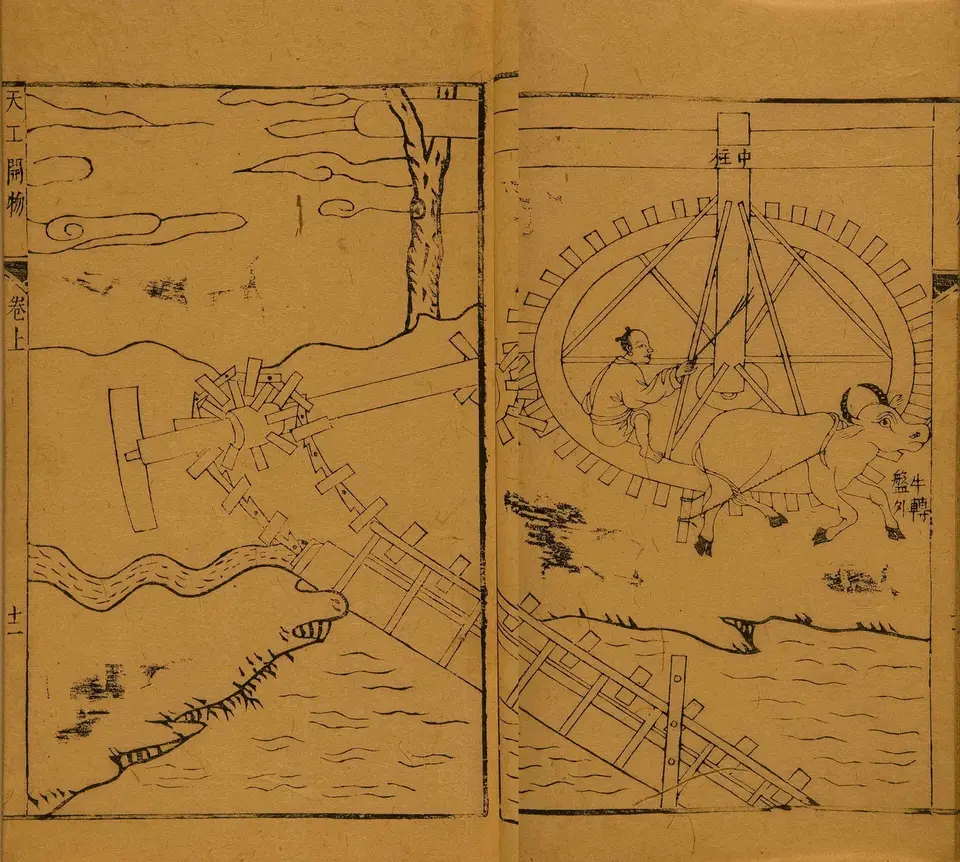
Published in 1637, The Exploitation of the Works of Nature represents the pinnacle of Song Yingxing's scientific legacy. Spanning eighteen chapters across three volumes, it constructed a comprehensive panorama of traditional Chinese agriculture and handicraft production. The first volume systematically analyzed cereal cultivation, sericulture, cotton spinning, plant dyeing, grain milling, salt refining, and sugar manufacture. The second volume documented pottery, brick kilns, bronze and iron casting, boat and wagon construction, metal forging, lime calcination, oil pressing, and papermaking. The third volume detailed the mining and smelting of precious and base metals, firearms, chemical pigments, fermentation yeasts, and precious stone cutting. Accompanied by 123 meticulous technological illustrations, it serves as an incomparable seventeenth-century encyclopedia of practical engineering.
Song Yingxing made groundbreaking contributions to global metallurgy and early experimental chemistry. He was the first scholar in world history to provide a scientifically precise account of the properties and distillation of metallic zinc. In the metals section of his work, he recorded how calamine ore (zinc carbonate) and charcoal were placed within sealed earthen crucibles and subjected to high-temperature firing, causing zinc vapor to condense into solid metal ingots. Prior to this, civilizations obtained brass solely by smelting mixed copper and zinc ores, unable to isolate pure elemental zinc. Song Yingxing explicitly identified zinc as an independent metal, recording the advanced method of producing high-grade brass by fusing pure copper with pure metallic zinc. This invention rendered China the sole state capable of mass-producing pure zinc for centuries, preceding European metallurgical isolation by more than 150 years.
Song Yingxing also exhibited early conceptualizations of the conservation of mass in chemical reactions. In discussing the cupellation of gold and silver, he detailed the precise technique of employing lead in porous crucibles to absorb silver while releasing pure gold. When describing the sublimation of cinnabar (mercuric sulfide) from mercury and sulfur, he noted that one pound of mercury yielded fourteen ounces of primary vermilion and three ounces five drams of secondary vermilion, observing that the increase in weight was derived from the incorporation of sulfur. This recognition of mass relationships among reacting components represented a brilliant precursor to quantitative chemistry.
Song Yingxing provided an unprecedentedly thorough summary and theoretical generalization of Chinese agricultural production. In crop cultivation, he documented the entire cycle of soaking seeds, sprouting, nursing seedlings, transplanting, and weeding, while applying quantitative analysis to evaluate operational ratios. In analyzing rice cultivation, he stated that the seedlings grown from one mou of nursery sufficed to transplant twenty-five mou of main paddies, establishing a one-to-twenty-five ratio that remains followed in southern agriculture today.
In the processing of agrarian products, Song Yingxing compiled precise statistical measures of oil extraction from diverse oilseeds, recording that one picul of sesame, castor, or camphor seeds yielded forty catties of oil, radish seeds twenty-seven catties, and rapeseed thirty catties, converting folk crafts into quantitative science. Furthermore, his work illustrated and analyzed complex agricultural mechanisms such as vertical-axis windmills, rotating sugar mills, and ox-driven rope wheels for brine extraction, assembling a comprehensive account of seventeenth-century Chinese mechanical engineering.
In agricultural biology, Song Yingxing exhibited insights that anticipated modern science. In his surveys of southern paddy fields, he investigated how rice and barley mutated under varied soil conditions, water availability, and local climates, advancing the scientific dictum that soils alter across eras, while varieties adapt according to water and terrain. In sericulture, he documented how silkworm rearers crossed early and late silkworm varieties to produce robust, high-yielding hybrids, and mated white male moths with yellow female moths to yield superior dual-tone cocoons. Charles Darwin cited Song Yingxing's observations on artificial selection and ecological variation in his foundational treatise The Variation of Animals and Plants under Domestication, utilizing them as crucial empirical proof for evolutionary theory.
Beyond practical engineering, Song Yingxing stood out as a profound philosopher of nature. In his philosophical treatises Lunqi and Tantian, he championed Zhang Zai's Guan School doctrines, firmly refuting idealist notions of metaphysical precedence and supernatural superstitions. He argued that physical pneumatic vital energy (qi) was the sole material substance constituting the universe, framing an early concept that all things arise through the transformations of material energy. In acoustics, he posited in Qisheng that sound is formed by vibrating airwaves moving through atmospheric space, uncovering the wave-like propagation of acoustic waves through air. In observational optics and astronomy, he insisted on empirical observation and firsthand testing, embodying the essence of scientific inquiry.
FIGURES ASSOCIATED WITH THIS DYNASTY