Lineage Birth
Born in Chaisang of Xunyang; great-grandfather was the celebrated military commander Tao Kan, and maternal grandfather was Meng Jia.
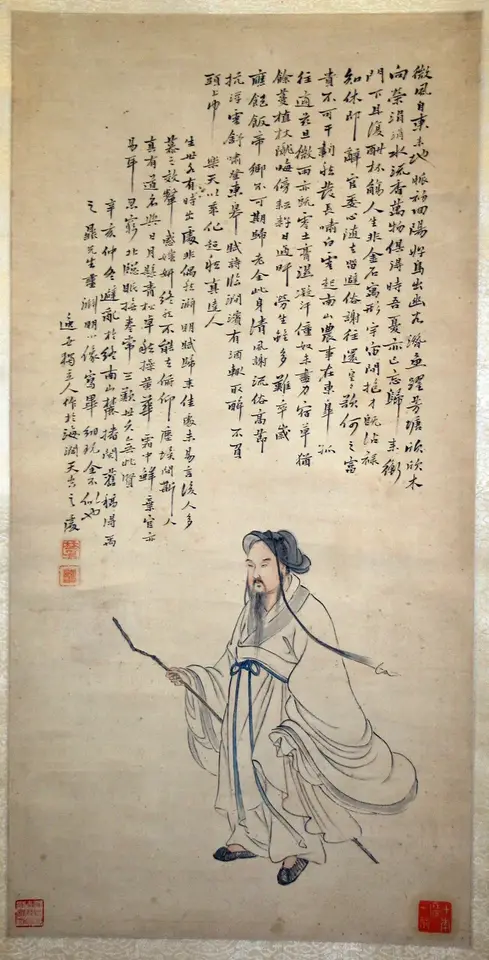
陶渊明
Tao Yuanming (陶渊明) (365 – 427 AD), named Tao Qian (陶潜), styled Yuanliang (元亮), sobriquet Master of the Five Willows (五柳先生), and privately posthumously titled Jingjie, was a native of Chaisang County in Xunyang Commandery (southwest of modern Jiujiang City, Jiangxi Province). He was a great writer, poet, rhapsodist, and essayist of the late Eastern Jin to early Liu Song period, universally recognized in Chinese literary…
Tao Yuanming (陶渊明) (365 – 427 AD), named Tao Qian (陶潜), styled Yuanliang (元亮), sobriquet Master of the Five Willows (五柳先生), and privately posthumously titled Jingjie, was a native of Chaisang County in Xunyang Commandery (southwest of modern Jiujiang City, Jiangxi Province). He was a great writer, poet, rhapsodist, and essayist of the late Eastern Jin to early Liu Song period, universally recognized in Chinese literary history as the pioneer of the pastoral school of poetry and the foremost patriarch of hermit literature. Born into an eminent official clan of Jiangzhou, his great-grandfather was Tao Kan, the prominent general and Grand Marshal of the Eastern Jin dynasty, and his maternal grandfather was the renowned scholar Meng Jia. By the time of Tao Yuanming's youth, however, his family fortunes had severely declined, and he grew up imbued with both Confucian aspirations to serve the realm and Daoist veneration for the natural world. At the age of twenty-nine, driven by the necessity of securing family subsistence and realizing his ideals, Tao Yuanming entered imperial administration, serving in local posts including Libationer of Jiangzhou. As the late Eastern Jin court deteriorated amid elite factional warfare and warlord strife, Tao served on the personal staffs of warlords Huan Xuan, Liu Yu, and Liu Jingxuan. Bearing witness to relentless bloodshed, usurpation, and moral bankruptcy in contemporary politics, he experienced profound disillusionment. In 405 AD, he assumed office as Magistrate of Pengze County, remaining in the post for merely eighty-odd days. Unwilling to bow down and flatter corrupt supervisory inspectors, he declared that he could not bend his waist for five pecks of grain, immediately surrendered his official seal, and composed his immortal rhapsody Return Home! to affirm his spiritual liberation. Following his withdrawal from worldly office, Tao Yuanming engaged in direct farming beneath the southern hills, finding contentment in poverty and simple virtue. Despite enduring the loss of his home to fire, the early death of family members, and the humiliation of begging for food in his declining years, he steadfastly guarded his spiritual independence, refusing multiple summons to return to imperial service under the Liu Song regime. His prose and poetry, characterized by plain elegance, profound tranquility, and unadorned authenticity, produced lasting masterpieces such as The Peach Blossom Spring, Return Home!, Biography of Master of the Five Willows, Drinking Wine, and Returning to the Countryside to Live. Tao Yuanming not only forged a new pastoral aesthetic in Chinese classical literature, but also established an enduring spiritual monument for scholars seeking inner freedom and moral autonomy.
Born in Chaisang of Xunyang; great-grandfather was the celebrated military commander Tao Kan, and maternal grandfather was Meng Jia.
Lost his father at age eight; family circumstances steadily deteriorated while he diligently studied classical texts and Daoist philosophy.
Appointed Libationer under Wang Ningzhi, Governor of Jiangzhou; resigned shortly thereafter due to distaste for administrative servitude.
Traveled to Jiangling to serve on the staff of Huan Xuan; resigned upon discerning Huan Xuan's treasonous ambitions using maternal mourning as a reason.
Joined Liu Yu's expeditionary staff against Huan Xuan; subsequently reassigned to serve on the staff of Liu Jingxuan.
Served as Magistrate of Pengze for eighty days; surrendered office rather than submit to inspectors, composing Return Home!.
Old residence in Chaisang destroyed by fire; resided temporarily on a boat before relocating to South Village in Xunyang.
Penned The Peach Blossom Spring on the eve of major political shifts, envisioning an agrarian utopia beyond tyrannical strife.
Liu Yu usurped the Jin throne; Tao changed his name to Qian, strictly dating all correspondence using sexagenary cycles or Jin eras.
Passed away peacefully amid sickness and poverty at age sixty-three; his friend Yan Yanzhi composed his dirge, giving him the posthumous title Jingjie.
Tao Yuanming was born in Chaisang County of Xunyang Commandery in the third year of the Xingning era of Emperor Ai of Jin (365 AD). The Tao clan had been a prominent aristocratic house during the founding decades of the Eastern Jin dynasty. His great-grandfather Tao Kan had risen from humble origins through distinguished military achievements to become Grand Marshal, Governor of Jingzhou and Jiangzhou, commander-in-chief of military operations across eight provinces, and Duke of Changsha Commandery, serving as one of the preeminent military pillars of the empire. His maternal grandfather, Meng Jia, was an eminent cultured scholar who served as adjutant to Grand Marshal Huan Wen, immortalized in literati tradition for his unruffled demeanor when his hat was blown away by the wind on Dragon Mountain. By the generation of Tao Yuanming's grandfather and father, however, the clan had drifted away from the center of power, and household fortunes had severely contracted.
At the tender age of eight, Tao Yuanming lost his father, precipitating a steep decline in the family's economic status. At age twelve, his foster mother also passed away, leaving young Tao Yuanming, his mother, and his younger sister to face hardship together. In his later commemorative essay Elegy for Sister Cheng, he reflected mournfully: "My caring mother passed away early when we were still helpless infants; I was only twelve, and you were barely nine." In spite of material deprivation, Tao was extraordinarily perceptive and devoted to intellectual inquiry. He mastered Confucian canonical texts—including the Odes, Documents, Rites, and Changes—instilling within himself the lofty ambition to exert his wings and soar across the realm to rectify the empire. Simultaneously, he was deeply influenced by Laozi and Zhuangzi, nurturing an innate fondness for serene nature and seclusion from early youth. This twin disposition—possessing both reforming vigor to govern the realm and unyielding desire to preserve spiritual purity—guided the course of his entire existence.
As years advanced, family finances deteriorated, compelling the young scholar to venture beyond his study to seek an administrative career for the maintenance of his kin. In 393 AD (the eighteenth year of the Taiyuan era), twenty-nine-year-old Tao Yuanming accepted a summons from Wang Ningzhi, Governor of Jiangzhou and second son of the legendary calligrapher Wang Xizhi, to serve as Libationer of Jiangzhou. This post marked his first step into bureaucratic life. However, Wang Ningzhi was fanatically devoted to the Way of the Five Pecks of Rice and detached from realistic governance, while provincial administrative circles were dominated by haughty aristocrats and burdensome protocol. Direct, candid, and naturally upright, Tao found it impossible to endure the venality and vulgarity of the court, resigning shortly after on the pretext of ill health to return to Chaisang.
Not long after his return, the provincial administration summoned him again to serve as a Chief Clerk, but Tao declined the summons. Remaining in his rural dwelling, he divided his days between literature, musical performance on the zither, and manual labor in the fields. During this period, he composed his autobiographical prose masterpiece, Biography of Master of the Five Willows, employing simple, direct prose to depict an eccentric recluse who did not seek wealth or fame, took immense pleasure in reading without pedantic nitpicking, drank heartily to his content, and took serene delight in nature, projecting his unbending refusal to conform to mainstream hypocrisy.
In 399 AD (the third year of the Long'an era), the peasant uprising led by Sun En and Lu Xun swept through southern China, throwing the court into turmoil and sharpening noble rivalries. Huan Xuan, Governor of Jingzhou based in Jiangling, maintained substantial military forces and controlled the middle and upper Yangtze. To relieve his family's destitution and harboring lingering hopes of stabilizing the collapsing regime, Tao traveled to Jiangling to serve on Huan Xuan's staff. However, he soon observed that Huan Xuan was consumed by personal ambition and plotting to usurp the Jin imperial house. Unwilling to become a pawn of a usurper, Tao took advantage of a diplomatic mission to the capital Jiankang in 401 AD to excuse himself on the grounds of his mother's death, departing from the encampment to observe mourning rites in his ancestral home.
In the spring of 404 AD, Huan Xuan formally usurped the throne, proclaiming the Chu dynasty. Liu Yu, commander of the Northern Garrison Army, rose in righteous rebellion at Jingkou to defeat the usurper. Seeking to assist in the restoration of the Jin dynasty, Tao Yuanming joined Liu Yu's headquarters as a Consulting Adjutant to the General Pacifying the Military. Yet during the bloody suppression of rivals, Liu Yu revealed himself to be an equally tyrannical military autocrat whose political ambitions were no less perilous than Huan Xuan's. Foreseeing another catastrophic dynastic usurpation, Tao felt deeply despondent. In the spring of 405 AD, he transferred to serve as Consulting Adjutant to Liu Jingxuan, General Establishing Awe and Governor of Jiangzhou. When Liu Jingxuan resigned following intricate bureaucratic intrigues, Tao likewise surrendered his post, closing his turbulent career within warlord camps.
In the autumn of 405 AD, recommended by his uncle Tao Kui and seeking sufficient income to keep his family fed and clothed, Tao accepted appointment as Magistrate of Pengze County. Pengze was situated near his ancestral hometown of Chaisang, and the modest salary could sustain his dependents. Tao directed local subordinates to plant glutinous rice across government fields for brewing wine, dividing half the acreage for non-glutinous grain only after gentle admonition from his wife. However, his scrupulous honesty and aversion to official sycophancy quickly proved incompatible with provincial norms. After merely eighty-odd days in office, a commandery supervisory inspector arrived at Pengze on an official tour. Subordinate clerks hurried to advise Tao that he must fasten his sash, don ceremonial robes, and present lavish gifts to pay obsequious court to the visiting official.
Aware of the predatory corruption common among such traveling commissioners, Tao sighed deeply and remarked: "How can I bend my waist and fawn upon a petty village scoundrel for the sake of five measly pecks of grain?" Without hesitation, he untied his official seal, surrendered his office, and abandoned administrative service forever. This historic moment marked his final, decisive break with bureaucratic servitude. Sitting aboard his homeward boat as crisp breezes swept over the river, Tao gave voice to his profound awakening in Return Home!, one of the most radiant masterpieces in Chinese lyrical prose. He rejoiced at the fluttering robes and the buoyant craft gliding over the current, condemned the false entrapment of public life, and celebrated his joyful return to soil and sky.
Having cast off worldly rank, Tao Yuanming settled permanently in his ancestral home in Chaisang, embarking on over two decades of uncompromising agrarian seclusion. He labored in the fields with his own hands, rising at dawn to weed his crops and returning beneath the moonlight with a hoe upon his shoulder, mingling freely with neighboring farmers over cups of homemade wine to discuss harvests and mulberry crops. Nonetheless, rural labor was grueling and natural calamities were frequent, rendering life precarious. In the summer of 408 AD, a sudden fire consumed his dwelling and meager savings, forcing his entire family to seek shelter on a rickety boat on the river. Following this catastrophe, Tao relocated his household to South Village in Xunyang, where poverty deepened substantially.
Life at South Village proved exceptionally difficult, inspiring poignant poems such as Moving House and Begging for Food. During seasons of acute drought and crop failure, he had to swallow his pride and knock on neighbors' doors to beg for basic sustenance, recording his shame and deep gratitude in verse: "Deep in my heart I know not how to express my thanks, hoping in the next world to repay this kindness." Even when bowls were empty and his coarse garments were patched with rags, he never voiced regret or made compromises. When Tan Daoji, the renowned general and Governor of Jiangzhou, paid a personal visit to his humble hut and found him bedridden with hunger, offering gifts of fine meat and grain while urging him to accept imperial office, Tao politely but firmly declined all gifts; only with Governor Wang Hong, who revered his integrity and supplied wine and rice without patronizing expectations, did Tao maintain warm companionship alongside fellow literati Yan Yanzhi.
In 420 AD (the second year of the Yuanxi era), Liu Yu formally forced the abdication of Emperor Gong of Jin (Sima Dewen) and proclaimed himself founding emperor of the Liu Song dynasty, officially terminating the Jin empire. As the descendant of an illustrious Jin patriot, Tao Yuanming harbored unwavering loyalty toward the fallen realm. Grieved and outraged by Liu Yu's usurpation, he deemed it dishonorable to serve the new masters, formally altering his personal name from Tao Yuanming to Tao Qian, and taking the style Yuanliang to signify his intent to live in perpetual obscurity. From that juncture onward, in all his surviving compositions and letters, he completely refused to employ the official reign titles of the Song court, dating his writings strictly with cyclical stems and branches or previous Jin eras.
Following the accession of Emperor Wen of Song in 424 AD, the imperial court issued multiple decrees appointing Tao Qian to prestigious posts such as Editorial Director in the Palace Library, yet he pleaded illness and firmly declined, preferring humble destitution over court favors. In 427 AD, at sixty-three years of age, Tao Yuanming's physical strength ebbed away. Aware that his end was near, his mind remained remarkably serene and composed. In his final weeks, he authored his renowned Three Dirges for Myself and the farewell prose Funeral Oration for Myself, facing death with calm philosophy and proclaiming that to pass away was merely to return his physical frame to the embrace of the mountains. In the eleventh month of that year, he passed away in South Village and was laid to rest beneath the Southern Mountain. His close friend Yan Yanzhi penned a sorrowful funeral tribute, and his community conferred upon him the private posthumous title of Gentleman Jingjie.
Tao Yuanming stands as a monumental landmark in the evolution of Chinese poetry. Prior to his work, the Wei-Jin poetic world was dominated by the arid philosophical treatises of Mystery-Discourse Verse and the ornate, artificial embellishments of the Taikang school, divorcing literary creation from everyday realities. Tao broke through these conventions by adopting rural landscapes, agricultural labor, and village life as central subjects, creatively inaugurating the pastoral school of classical Chinese poetry. Utilizing natural, conversational diction, he composed vivid tableaus—such as faint village smoke in the distance, dogs barking in deep alleys, and roosters crowing atop mulberry branches—bestowing fresh vitality, subject matter, and aesthetic ideals upon classical verse, earning universal reverence as the founding master of the pastoral genre.
Tao Yuanming's The Peach Blossom Spring represents one of the finest utopian achievements in global literature. Confronted with widespread devastation, punitive taxation, and relentless warlord warfare in the late Eastern Jin era, Tao utilized compassionate humanism and brilliant artistic imagination to conceive a hidden sanctuary where peach blossoms carpeted the earth, fertile lands and clear ponds were shaded by bamboo groves, and inhabitants lived in communal peace. In this envisioned society, there were neither imperial tax collectors nor compulsory military levies, and all members lived in mutual amity, laboring happily and growing old with dignity. This classic archetype not only embodied the eternal yearning of ordinary Chinese people for peace, but also became a permanent spiritual sanctuary for countless generations of intellectuals seeking solace in a troubled world.
Tao Yuanming's momentous declaration that he would not bend his waist for five pecks of grain, accompanied by his unhesitating surrender of his magistrate seal, was far more than a personal retirement; it represented a decisive moral rebellion against autocratic feudal institutions and corrupt aristocratic privilege. Choosing rural privation over compromised dignity, he refused to trade his independent spirit for administrative prestige. Through a lifetime of steadfast virtue, he erected an immortal ethical standard for Chinese scholars, demonstrating the courage to preserve integrity in the face of political coercion and material temptation.
Tao Yuanming's literary legacy and moral philosophy exerted an immeasurable influence on subsequent Chinese civilization. As Su Shi observed, his verse was plain on the surface yet lavish within, lean in form yet rich in spiritual resonance, embodying the supreme artistic attainment where consummate artistry appears artless. Tang dynasty masters such as Wang Wei, Meng Haoran, Wei Yingwu, and Liu Zongyuan developed and deepened his pastoral and landscape traditions; Li Bai and Du Fu held his unblemished character in the highest esteem; and Song giant Su Shi regarded Tao as his ultimate spiritual mentor, composing over a hundred matching poems and remarking that among all poets, his heart belonged solely to Yuanming. The harmonious unity with nature, unadorned authenticity, and contemplative peace exemplified by Tao Yuanming remain bedrock elements of traditional Chinese aesthetic philosophy.
FIGURES ASSOCIATED WITH THIS DYNASTY