布拉呢敦
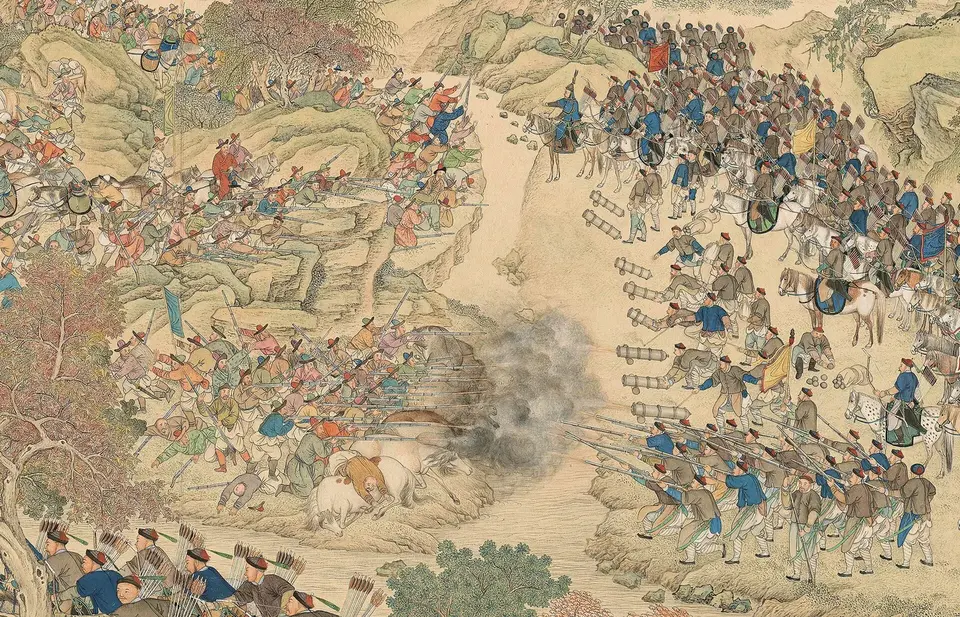
Historical narrative painting (Burhān ud-Dīn)
Image credits"Qing troops battling moslem insurgents" · Public domainImage source

Eighteenth-century leader of the White Mountain Khojas in Xinjiangco-instigator of the Revolt of the Altishahr Khojas

Burhan al-Din (布拉呢敦)

布拉呢敦

Burhan al-Din (布拉呢敦) (d. 1759), also rendered as Boranidu (波罗尼都) or Bunadun, commonly known as the "Elder Khoja," was the hereditary religious and political leader of the Afaqi (White Mountain) branch of the Naqshbandi Sufi order in southern Xinjiang during the Qianlong era of the Qing Dynasty. He was the eldest son of Mahmut and the elder brother of Hojijan (the Younger Khoja). In his early life, the brothers were held…

Qing Dynasty (清朝)

PROFILE

Burhan al-Din (布拉呢敦) (d. 1759), also rendered as Boranidu (波罗尼都) or Bunadun, commonly known as the "Elder Khoja," was the hereditary religious and political leader of the Afaqi (White Mountain) branch of the Naqshbandi Sufi order in southern Xinjiang during the Qianlong era of the Qing Dynasty. He was the eldest son of Mahmut and the elder brother of Hojijan (the Younger Khoja). In his early life, the brothers were held hostage in Ili by the Dzungar Khanate to secure the subordination of the Tarim Basin oases. In 1755, following the Qing conquest of the Dzungars, the Qianlong Emperor liberated the brothers and commissioned Burhan al-Din to return to Yarkand and Kashgar to pacify the local populations and oversee administrative affairs in Altishahr under imperial suzerainty. Following the outbreak of the rebellion led by Amursana in the north, Hojijan fled back to Yarkand and incited Burhan al-Din to renounce Qing allegiance. In 1757, the brothers ambushed and massacred imperial envoy Amin Dao and his escort of one hundred soldiers, declaring an open insurrection across southern Xinjiang, an event known in dynastic history as the "Revolt of the Altishahr Khojas." Between 1758 and 1759, the Qing court deployed imperial forces under General Zhao Hui and Vice General Fu De, which shattered the rebel forces in the Battle of Kuqa, the Siege of Black Water Camp, and the Battle of Qurman. Abandoning their cities, the brothers fled across the Pamir Mountains to Badakhshan (in modern northeastern Afghanistan), where they were captured and executed by Sultan Shah. The suppression of their revolt led the Qing dynasty to establish the office of the Kashgar Councilor and integrate the Tarim Basin into the direct imperial administrative framework.

Aliases
Boranidu (波罗尼都), Elder Khoja (大和卓), Bunadun (布那敦)
Dynasty
Qing Dynasty (清朝)
Date of Death
1759 (24th year of the Qianlong era, Qing Dynasty)
Ancestral Home
Altishahr, South of the Tianshan Mountains (Kashgar, Xinjiang)
Highest Office and Title
Supreme Leader of the Afaqi (White Mountain) Khojas, Ruler of Yarkand
Primary Offices
Hereditary Spiritual Leader of the White Mountain Khojas, Qing Appointed Administrator of Altishahr
Identity
Eighteenth-century leader of the White Mountain Khojas in Xinjiang, co-instigator of the Revolt of the Altishahr Khojas

LIFE TIMELINE

Relationship graph

BIOGRAPHY

Chronology

  • 1730 (8th year of the Yongzheng era) | Upbringing in Southern Xinjiang | Born into the Afaqi Sufi nobility in the Tarim Basin as the eldest son of Mahmut.
  • 1750 (15th year of the Qianlong era) | Confinement in Ili | Detained alongside his brother Hojijan as hostages in Ili following the Dzungar subjugation of Altishahr.
  • 1755 (20th year of the Qianlong era) | Imperial Liberation | Released by victorious Qing armies in Ili; commissioned by the Qianlong Emperor to govern Muslim populations in Yarkand and Kashgar.
  • 1756 (21st year of the Qianlong era) | Restoring Afaqi Authority | Defeated the rival Ishaqi (Black Mountain) faction with Qing assistance and established control over Yarkand.
  • 1757 (22nd year of the Qianlong era) | Outbreak of Insurrection | Incited by Hojijan to rebel, ambushing and murdering imperial envoy Amin Dao.
  • 1758 (23rd year of the Qianlong era) | The Qing Offensive | Qing forces captured Kuqa; General Zhao Hui advanced to Yarkand and became besieged at the Black Water Camp, while Burhan al-Din held Kashgar.
  • 1759 (24th year of the Qianlong era) | Collapse and Flight | Following the relief of Black Water Camp and the Qurman victory, Qing armies seized Yarkand and Kashgar; the Khojas fled westward toward Badakhshan.
  • 1759 (24th year of the Qianlong era) | Execution in Badakhshan | Apprehended and executed by Sultan Shah of Badakhshan, who forwarded their severed heads to Qing vanguard commanders.

Biography

Lineage and Hostage Confinement under the Dzungars

Burhan al-Din was born into the prestigious Afaqi (White Mountain) lineage of the Naqshbandi Sufi order, claiming patrilineal descent from the Islamic prophet. He was the great-grandson of the influential saint Afaq Khoja and the eldest son of Mahmut. Within eighteenth-century southern Xinjiang society, the Khoja families exercised immense spiritual influence, controlling extensive inalienable religious endowments (waqf) and commanding the veneration of vast peasant populations across the Tarim Basin.

During the late seventeenth and early eighteenth centuries, Galdan of the Dzungar Khanate invaded southern Xinjiang, exploiting bitter rivalries between the White Mountain (Afaqi) and Black Mountain (Ishaqi) factions. Following Galdan's downfall, regional leadership was briefly restored to Mahmut. However, as the Dzungar leaders Tsewang Arabtan and Galdan Tseren reconquered the Tarim Basin, the Dzungars enforced strict subjugation over the Muslim oasis cities. To preempt local insurrections, the Dzungars deported Mahmut and his young sons, Burhan al-Din and Hojijan, to the northern capital at Ili, holding them as political hostages for decades. During this confinement, Burhan al-Din endured humiliating subjection while closely observing the inner mechanisms of Dzungar nomadic governance.

Liberation by the Qing and Return to Altishahr

In the spring of 1755, the Qianlong Emperor dispatched an imperial expeditionary army into the Ili River valley, capturing Dawachi and dismantling the Dzungar Khanate. Arriving in Ili, Qing commanders liberated captive elites, including the Khoja brothers.

Recognizing the necessity of respected local spiritual figures to stabilize the vast Tarim Basin, the Qianlong Emperor issued an imperial decree pardoning the brothers and investing Burhan al-Din with authority to administer southern Xinjiang on behalf of the Qing state. Accompanied by Imperial Bodyguard Tuoluntai and Vice Commander Amin Dao, Burhan al-Din was dispatched south with imperial escort. Meanwhile, Hojijan remained in Ili to oversee northern Muslim affairs. In the autumn of 1755, Burhan al-Din arrived in Aksu and Uqturpan, where Afaqi adherents received him with religious fervor. The rival Black Mountain leader Yusuf mobilized forces to block his entry, but Burhan al-Din, reinforced by Qing artillery, routed Black Mountain troops and occupied the regional palace at Yarkand, re-establishing White Mountain hegemony and sending formal tribute missions to Beijing.

Incitement by Hojijan and Murder of the Imperial Envoy

In 1756, the Dzungar prince Amursana staged an anti-Qing rebellion in northern Xinjiang, plunging the Ili region into violent anarchy. Abandoning his assigned duties, Hojijan mobilized partisans and fled Ili, arriving in Yarkand in early 1757.

Arrogant and ambitious, Hojijan exerted relentless pressure on Burhan al-Din to sever ties with the Qing Empire and declare an independent khanate. Burhan al-Din initially hesitated, recognizing the magnanimity of the Qianlong Emperor and the military might of the empire; however, under persistent pressure from Hojijan and radical Sufi partisans, he agreed to revolt. The brothers assumed princely titles, conscripted thousands of oasis peasants, and launched purges against pro-Qing beks and Black Mountain adherents.

In the summer of 1757, alarmed by reports from the frontier, the Qianlong Emperor dispatched Vice Commander Amin Dao with a retinue of one hundred imperial guards to Yarkand to counsel the brothers. Concealing their hostile intentions, Burhan al-Din and Hojijan ambushed the delegation outside Yarkand, slaughtering Amin Dao and his entire escort. They publicly tore up the imperial seals and proclamations, inaugurating the Revolt of the Altishahr Khojas.

General Zhao Hui's Campaign and the Black Water Siege

Infuriated by the slaughter of his imperial envoys, the Qianlong Emperor directed imperial mobilization to crush the insurrection. In 1758, Ya'erdashi advanced on Kuqa, followed by the appointment of General Zhao Hui as supreme commander.

The insurgents fortified Kuqa, but Qing forces breached the walls with heavy cannon fire, forcing Hojijan to flee southward. As imperial forces advanced, the beks of Aksu and Uqturpan, resentful of the Khojas' heavy extractions, surrendered their towns to the Qing. Burhan al-Din and Hojijan withdrew to their strongholds of Kashgar and Yarkand, respectively, attempting to support each other defensively. Burhan al-Din commanded ten thousand fighters in Kashgar, while Hojijan held Yarkand.

In October 1758, General Zhao Hui advanced upon Yarkand with a forward cavalry detachment of over a thousand men, becoming encircled at Black Water Camp (Karasu) by Hojijan's numerically superior forces. For three months, Zhao Hui's garrison held defensive entrenchments against continuous assaults. Burhan al-Din dispatched reinforcements from Kashgar to reinforce the siege; however, an imperial relief column led by Vice General Fu De shattered the rebel cordon in the Battle of Qurman in early 1759, breaking the siege of Black Water Camp and routing the Khoja army.

Flight to the Pamirs and Extinction in Badakhshan

In the summer of 1759, the combined Qing armies launched a coordinated offensive against Kashgar and Yarkand. Having alienated the oasis population through extortionate grain requisitions, the brothers faced internal collapse, as local residents actively guided Qing columns.

On July 23, 1759, Qing vanguards approached Kashgar. Realizing military resistance was futile, Burhan al-Din abandoned the city under cover of night, seizing palace treasures and fleeing west into the Pamir Mountains. Hojijan similarly fled Yarkand. Uniting their remaining forces of several thousand mounted partisans, the brothers crossed the high passes into Badakhshan (in modern northeastern Afghanistan). General Zhao Hui pursued relentlessly, catching the rebel rear guard at Lake Yeshil-Kul and capturing thousands of fighters.

Burhan al-Din and Hojijan sought asylum with Sultan Shah, the ruler of Badakhshan. Aware that Qing forces had reached his borders and that harboring the fugitives would invite conquest, Sultan Shah feigned hospitality while preparing an ambush. Sultan Shah's troops arrested both brothers and executed them, dispatching their severed heads to Vice General Fu De. The two-year revolt of the Altishahr Khojas was thereby completely extinguished.
Major Achievements

Instigating Regional Conflict and Theocratic Fragmentation

Upon returning to the Tarim Basin, Burhan al-Din had the opportunity to foster civil reconstruction and economic revival under Qing imperial suzerainty. Instead, he prioritized sectarian vengeance, imposing theocratic rule that purged secular beks and rival Black Mountain Muslims. By orchestrating the ambush of imperial envoy Amin Dao and launching an armed revolt, he dragged the Tarim Basin into devastation, disrupting the regional oasis economy and inflicting severe hardship upon the local populations.

Catalyzing Direct Qing Administration in Southern Xinjiang

The rebellion instigated by Burhan al-Din and Hojijan represented a crucial turning point in Qing frontier governance. Following the elimination of the Khojas, the Qing court dismantled the hereditary theocratic hegemony of Sufi families in southern Xinjiang. The court instituted the office of the Kashgar Councilor, supported by local assistant ministers in key oases under the jurisdiction of the Military Governor of Ili. Combining the military banner apparatus with reformed secular bek administration, this administrative system consolidated imperial sovereignty over the Tarim Basin and established the territorial foundations of modern Xinjiang.

Personal Relationships

  • Family: Mahmut (father, spiritual head of the Afaqi Khojas), Hojijan (younger brother and co-leader of the revolt), Sarimsaq (son, who fled to Central Asia, father of Jahangir Khoja).
  • Qing Imperial Commanders: The Qianlong Emperor (who liberated him, then ordered the punitive campaign), Amin Dao (imperial envoy ambushed by the brothers), Zhao Hui (General of Pacifying the Frontiers, supreme commander), Fu De (Vice General who relieved Black Water Camp and pursued the rebels).
  • Rival Factional Figures: Yusuf (leader of the Black Mountain Ishaqi faction, defeated by Burhan al-Din), Emin Khoja (Prince of Turpan, Uyghur leader who assisted the Qing campaign).
  • Foreign Executioner: Sultan Shah (Ruler of Badakhshan, who executed Burhan al-Din and delivered his head to Qing forces).

Historical Evaluation

  • The Qianlong Emperor: "The brothers Boranidu and Hojijan received imperial clemency yet harbored no gratitude, instigating rebellion and slaughtering innocents. Zhao Hui and his officers endured fierce campaigns to annihilate these traitors, securing perpetual pacification for our western frontier." (Veritable Records of Gaozong)
  • Draft History of Qing: "Boranidu and Hojijan repaid imperial favor with rebellion. Zhao Hui, fighting with an isolated force, ultimately pacified the Muslim regions, securing the western territories for the empire." (Qingshi Gao, Biography of Zhao Hui)
  • Modern Historical Assessment: Burhan al-Din was a theocratic aristocrat whose political ambitions were bound to sectarian hegemony. In defying dynastic authority, he subjected the peoples of southern Xinjiang to devastating warfare. The Qing suppression of the Khoja rebellion was a crucial operation that upheld imperial territorial integrity and ended feudal theocratic monopolies, laying an enduring foundation for regional security and national integration in northwestern China.

Related Entries

  • Revolt of the Altishahr Khojas
  • Zhao Hui
  • Hojijan
  • Qianlong Emperor
  • Kashgar Councilor

FIGURES ASSOCIATED WITH THIS DYNASTY

Bibliography

  • Qing Shilu (Veritable Records of the Qing), Veritable Records of Emperor Gaozong
  • Qingshi Gao (Draft History of Qing), Volume 313, Biography 100, Biography of Zhao Hui
  • Qingshi Gao (Draft History of Qing), Volume 525, Biography 312, Outer Tributaries VIII, Muslim Regions of Xinjiang