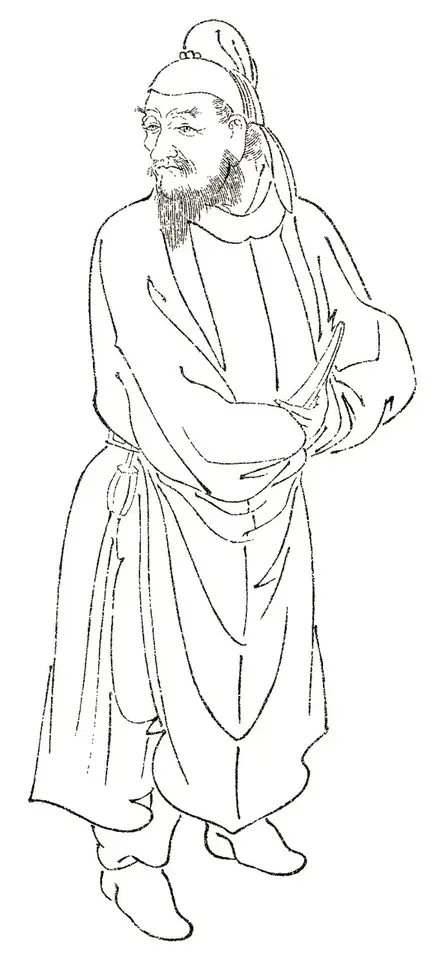
Biography
Youth in Japan and Selection for the Mission
Abe no Nakamaro was born in 698 in Yamato Province, Japan. He came from the prominent Abe clan, an influential court noble lineage. From an early age, he showed exceptional aptitude for classical Chinese learning, memorizing historical treatises and mastering poetic composition. During the Nara period, Japan actively sought to absorb advanced Chinese political, legal, and cultural systems by dispatching large-scale embassies to the Tang Empire.
In the second year of Reiki (716, Kaiyuan 4 of Tang), Empress Gensho organized the eighth Kentoshi embassy, comprising 557 members led by Tajihi no Agatamori. Nineteen-year-old Nakamaro was selected as an official student, alongside fellow scholar Kibi no Makibi and the Buddhist monk Genbo, embarking on a historic intellectual voyage across the dangerous East China Sea.
In the third month of 717, the fleet set sail from Naniwatsu (modern Osaka). Surviving treacherous storms, they arrived at the Tang eastern capital of Luoyang in the autumn. Emperor Xuanzong granted the delegation an audience at Yingtiangate of the Ziwei Palace. Deeply impressed by Nakamaro's erudition and refined demeanor, Xuanzong issued an imperial decree permitting him to matriculate at the Imperial Academy (Guozijian) in Chang'an. Nakamaro immersed himself in the Confucian classics, including the Book of Rites, the Rites of Zhou, and the Zuo Zhuan, adopting the Chinese courtesy name Chao Heng and style Juqing.
Academic Distinction and Imperial Service
Following years of intensive study at the Imperial Academy, Nakamaro took the imperial civil service examinations. During the Kaiyuan era, the Jinshi examination was notoriously demanding, requiring masterly command of poetry, rhapsodies, classical commentaries, and policy essays. Nakamaro passed with honors, setting an illustrious precedent as one of the first foreign students to obtain the Jinshi degree in imperial China.
In 725 (Kaiyuan 13), Emperor Xuanzong appointed Nakamaro Collator in the Secretariat of the Heir Apparent (Left Spring Bureau, rank 9b). The office was responsible for collating and editing classical texts for the crown prince's studies. The poet Chu Guangxi composed verses praising his remarkable talent and graceful bearing. In 731, he was promoted to Left Reminder (Zuo Buque, rank 7b) in the Chancellery, granting him daily access to the imperial presence to offer counsel on administrative matters.
In 733, when the ninth Kentoshi mission arrived under Tajihi no Hironari, Nakamaro submitted a memorial requesting permission to return home to attend to his elderly parents. Xuanzong, unwilling to part with such an accomplished advisor, issued a decree warmly asking him to stay. Honored by the emperor's profound trust, Nakamaro resolved to remain in Chang'an. Over the subsequent two decades, he served successively as Companion to Prince Yi, Vice Director of the Court of Imperial Insignia, and ultimately Director of the Palace Library (Bishujian, rank 3b). Holding supreme authority over the empire's imperial archives, astronomical charts, and dynastic histories, his appointment reflected the cosmopolitan openness of the High Tang Empire.
Friendship with Tang Literary Masters
Nakamaro was not only a dedicated administrator but also a gifted classical poet. He entered the innermost circles of High Tang literary society, establishing profound friendships with Li Bai, Wang Wei, Chu Guangxi, Bao Ji, and Zhao Hua. They met frequently at Qujiang Pool, the Zhongnan Mountains, and Leyou Plateau to compose verses and converse. Nakamaro once gifted Li Bai a fine Japanese woven fur robe, forging a bond of deep mutual affection.
In late 752 (Tianbao 11), the eleventh Kentoshi embassy arrived in Chang'an, led by Fujiwara no Kiyokawa, with Nakamaro's former classmate Kibi no Makibi serving as vice ambassador. Reunited with his old friend, the fifty-six-year-old Nakamaro felt an overpowering yearning for his homeland and petitioned Emperor Xuanzong for permission to retire and visit Japan. Recognizing his nearly four decades of meritorious service, Xuanzong granted his request and appointed Nakamaro as Tang imperial envoy to Japan.
The news of Nakamaro's impending departure prompted prominent court officials and poets to host elaborate farewell banquets. Wang Wei composed the renowned poem Seeing Off Palace Library Director Chao on His Return to Japan, extolling him as an extraordinary talent from the eastern seas and an ornament of China. Deeply moved, Nakamaro responded with his celebrated verse Written on Returning to My Native Land on Imperial Command: "My heart clings to the enlightened sovereign in China, while across the seas I long for my beloved mother. Looking westward I remember royal grace; turning eastward I feel the bond of kinship. This treasured sword of my lifetime I leave behind to my dearest friend." This poem was later incorporated into the Song dynasty imperial anthology Wenyuan Yinghua, the only work by a foreign author preserved in that monumental collection.
Shipwreck and Misfortune in Annam
In the sixth month of 753 (Tianbao 12), Nakamaro traveled with the embassy to Yangzhou, where he visited Master Jianzhen at Yanguang Temple, warmly entreating the eminent monk to sail to Japan to transmit the Buddhist Vinaya. On the fifteenth day of the tenth month, Nakamaro and Jianzhen boarded separate vessels of a four-ship fleet at Huangsipu in Suzhou and set sail. Gazing at the nocturnal horizon, Nakamaro composed his immortal waka: "Looking up at the vast sky, my mind flies to the hills of Kasuga in Nara; on Mount Mikasa, surely the brilliant moon has risen." He translated the poem into five-character classical Chinese verse for his companions.
However, a furious typhoon shattered the fleet in the open sea. While three vessels survived, the flagship carrying Nakamaro and Kiyokawa was dismantled by massive waves, drifting thousands of leagues southward before running aground on the coast of Huanzhou in Annam (modern central Vietnam). Upon landing, the surviving crew of over 170 people was ambushed by local tribesmen. Most perished, and only Nakamaro, Kiyokawa, and roughly ten survivors managed to escape into the dense jungle.
When reports of the disaster reached Chang'an, contemporaries assumed Nakamaro had drowned. Devastated by the news, his close friend Li Bai penned the timeless mourning quatrain Mourning Chao Heng: "The Japanese Master Chao departed the imperial capital; a lone sail circumnavigated Penglai. The bright moon returns not, sunk in the jade-green sea; sorrowful white clouds blanket Mount Cangwu." Likening Nakamaro to a pure moon submerged in the ocean, Li Bai's poem stands as one of the most moving monuments of cross-national friendship in world literature.
Devotion Across Three Reigns and Demise in Chang'an
Miraculously surviving the tropical perils of Annam, Nakamaro endured a grueling two-year overland journey through southern wilderness, finally returning to Chang'an in the sixth month of 755 (Tianbao 14). Joyful residents welcomed his rebirth from the dead. Reading Li Bai's grief-stricken elegy, an emotional Nakamaro composed his reply Longing for Home: "For thirty years I have lived in Chang'an, yet failed to return to Penglai. All my thoughts of home have been surrendered to the sea and sky. My soul has returned, touched by your deep grief; yet I weep further for you, unable to remain in Chang'an."
Shortly thereafter, in the eleventh month of 755, the An Lushan Rebellion erupted. The sixty-year-old Nakamaro remained steadfastly loyal to the Tang dynasty, accompanying Emperor Xuanzong through arduous mountain passes into exile in Shu. Following the recovery of Chang'an and Luoyang in 757, he served Emperor Suzong and Emperor Daizong with unflagging loyalty, receiving appointments as Left Standing Attendant (Zuo Sanqi Changshi) and Protector-General of Annam (Zhennan Duhu and Annam Jiedushi).
Stationed in remote Annam, Nakamaro pacified border tribes, improved hydraulic waterways, restored agricultural stability, and strictly disciplined civil administration. In recognition of his distinguished governance, Emperor Daizong promoted him to Grand Master for Splendid Happiness (rank 2b), Vice Censor-in-Chief, and Duke of Beihai Commandery with a fief of 3,000 households. In the first month of 770 (Dali 5), Nakamaro passed away peacefully in Chang'an at the age of seventy-three. Having spent fifty-four years in the Tang capital, he was posthumously conferred the supreme military rank of Grand Area Commander of Luzhou (Luzhou Dadudu) and interred in Chang'an with state honors.
Key Achievements
Imperial Academic Excellence and the Jinshi Degree
In 717, Nakamaro arrived in Tang China as an elite student of the eighth Kentoshi mission. Studying Confucian classics at the Guozijian, he demonstrated extraordinary mastery of classical scholarship and Chinese rhetoric. He sat for the imperial civil service examination and achieved the Jinshi degree, shattering cultural barriers and setting a historic benchmark for foreign scholars seeking public service in the Tang Empire.
Custodianship of Imperial Archives and Cultural Transmission
Throughout his tenure as Collator, Left Reminder, and Director of the Palace Library (Bishujian), Nakamaro supervised the cataloging, restoration, and safeguarding of the Tang imperial collections. Utilizing his high station, he systematically aided visiting Japanese scholars, student monks, and envoys in acquiring core Chinese treatises on astronomy, calendrical calculation, medicine, music, and statecraft, transmitting thousands of vital texts back to Japan to nurture the cultural flourishment of the Nara and Heian periods.
Enduring Literary Heritage and Inscription in Imperial Anthologies
Nakamaro engaged in rich poetic dialogues with the greatest poets of the High Tang, including Li Bai, Wang Wei, and Chu Guangxi. His poem Written on Returning to My Native Land on Imperial Command was anthologized in the Song imperial collection Wenyuan Yinghua, marking the unique inclusion of a foreign writer in that monumental compendium. His waka Looking toward Kasuga and Li Bai's Mourning Chao Heng entered standard educational curricula in both China and Japan as timeless symbols of cultural fraternity.
Dissemination of the Dayan Calendar and Tang Ritual Codes
In the fields of science and state institution building, Nakamaro made enduring contributions. Working closely with his colleague Kibi no Makibi, he helped transmit the Dayan Calendar—formulated by the Tang astronomer-monk Yixing—to the Japanese court. Japan formally adopted the calendar, enacting a historic reform in timekeeping. Furthermore, he assisted in introducing Tang ceremonial protocols (Tangli) into the Japanese court, helping shape the legal and ritual foundation of Japan's ancient Ritsuryo state.
Benevolent Frontier Governance in Annam
In his later years, Nakamaro served as Protector-General of Annam and Military Commissioner. Confronted with ethnic tensions and post-war disruption in the southern frontier, he applied Confucian principles of benevolent governance, repairing irrigation works, stimulating marketplace commerce, and restoring peace along the border. His integrity and administrative fairness won the affection of local populations, earning him the title Duke of Beihai Commandery.
Facilitating Master Jianzhen's Mission to Japan
Prior to his departure in 753, Nakamaro visited Master Jianzhen at Yanguang Temple in Yangzhou, personally urging the venerable master to undertake the arduous voyage to Japan to establish the Vinaya tradition. His diplomatic backing and personal advocacy were decisive in solidifying Jianzhen's resolve, leading to the successful establishment of the Ritsu school and the construction of Toshodai-ji in Nara.