Biography
Youthful Skill and Imperial Service under Liezu
Zhou Wenju was a native of Jurong County in Jiankang Prefecture, a region noted for flourishing literati culture and fine arts. Raised in an environment steeped in visual arts, Zhou demonstrated an innate gift for figurative drawing from an early age, sketching passersby with charcoal. By his early twenties, he possessed formidable realistic skill, capturing the fleeting expressions and postures of subjects ranging from imperial elites to common street peddlers.
During the Five Dynasties and Ten Kingdoms period, southern China enjoyed relative economic peace compared to the war-torn north. In 937 CE, Xu Zhigao established the Southern Tang dynasty in Jiankang, adopting the imperial name Li Bian (Emperor Liezu). Eager to project imperial legitimacy, Liezu established palace ateliers to record auspicious court ceremonies and produce imperial portraiture. Recommended by regional administrators for his lifelike portraits, the youthful Zhou was summoned to court. His dignified portraits of Emperor Liezu and imperial princes earned high imperial favor, securing his position within the palace establishment.
Artistic Flourishing under Emperor Zhongzhu
In 943 CE, Emperor Zhongzhu (Li Jing) ascended the throne. An accomplished poet and patron of the arts, Li Jing reorganized the painting studios into the prestigious Hanlin Academy of Painting, gathering masters such as Gu Hongzhong, Wang Qihan, Zhou Wenju, Zhao Gan, and Dong Yuan, turning the Southern Tang academy into one of the two great artistic centers of tenth-century China.
On New Year's Day in 947 CE, a heavy snowfall blanketed the capital of Jinling. Delighted by the scenery, Li Jing convened an imperial banquet at the Qingshu Pavilion, inviting his royal brothers—the Prince of Qi Li Jingda and Prince of Jiang Li Jingti—alongside high-ranking literati such as Xu Xuan and Gao Yue. To commemorate the gathering, Li Jing commissioned the academy masters to execute a collaborative commemorative scroll. Zhou Wenju was assigned the central task of drafting the composition and executing the principal portraits and robes; Secretariat Drafter Xu Xuan composed the eulogistic poems; Gao Chonggu rendered the architectural pavilions; Dong Yuan painted the snowy rivers and hills; and Xu Ke detailed the court vessels. Zhou's deft portrayal captured Li Jing's dignified bearing, royal fraternal affection, and the festive elegance of the attendants. The resulting masterpiece, the Mysterious Banquet (Xuan Yan Tu), was praised by Li Jing as an peerless triumph of Southern Tang art.
Painter-in-Attendance under the Last Ruler and the Trembling Brush
In 961 CE, the Last Ruler, Li Yu, took the throne. A peerless master of lyric poetry (ci), calligraphy, and aesthetic theory, Li Yu revered Zhou Wenju's talents, elevating him to Painter-in-Attendance. Whenever major court ceremonies, poetry gatherings, or Buddhist rituals were celebrated, Zhou was commanded to paint the scenes.
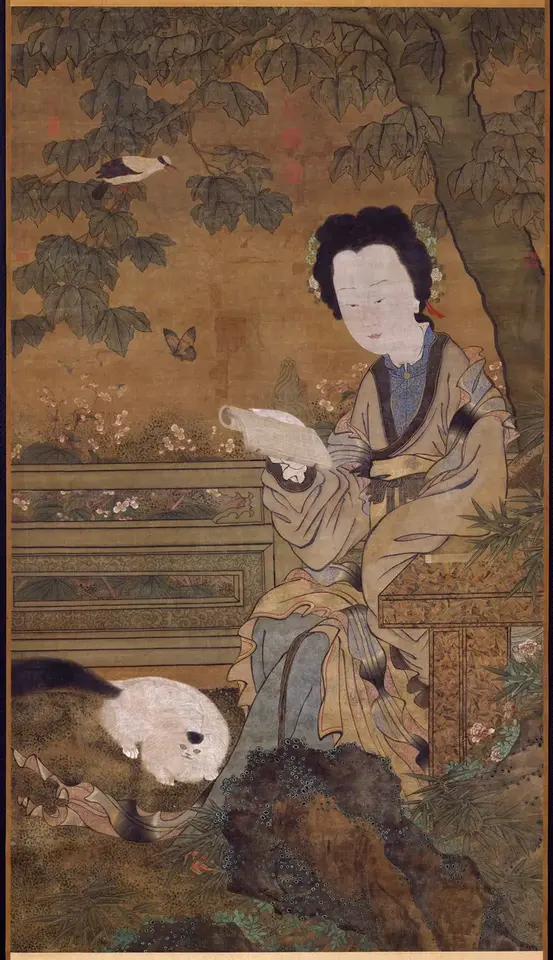
During this reign, Zhou's artistic style reached its peak. Observing the graceful bearing of southern women, he moved beyond the heavy, voluptuous conventions established by late Tang master Zhou Fang, rendering female figures with slender silhouettes, delicate bone structures, and contemplative poise. In brush technique, inspired by the flowing drapery of southern silks, he invented the celebrated "Trembling Brush" (zhanbi miao). Blending cursive calligraphic brushwork with sharp, deliberate pauses, his lines undulated with controlled trembling, conveying the delicate weight and gentle rustle of silk garments.
During this period, Li Yu commissioned Zhou to paint The Double Screen (Chongping Huiqi Tu), portraying Li Jing playing go with his three brothers before a large screen displaying Bai Juyi's poem on afternoon repose, which in turn contained a smaller painted landscape screen. This ingenious design established a multi-layered visual illusion. Simultaneously, Zhou painted The Literary Gathering at Liuli Hall, celebrating Tang poets Wang Changling, Li Bai, and Meng Haoran engaged in poetic composition, capturing their scholarly spirit with lifelike intensity.
Dynastic Fall and Imperial Legacy
In 974 CE, Emperor Taizu of Song dispatched General Cao Bin with a massive combined fleet to invade Southern Tang. In late 975 CE, Jinling fell, and Li Yu surrendered, concluding the Southern Tang dynasty.
Following imperial directives, Song officers inventoried the vast Southern Tang libraries and academy collections, transporting thousands of paintings northward to Kaifeng for inclusion in the Song imperial archives. Shattered by the loss of his nation and the dispersal of his colleagues, the elderly master, nearing seventy years of age, was unable to make the arduous journey to the northern capital, passing away in poverty in Jinling shortly after the conquest.
In the Northern Song period, emperors Taizong and Huizong prized Zhou Wenju's scrolls above all others. By the late Northern Song, the imperial Xuanhe Painting Catalogue recorded seventy-six authenticated masterpieces by Zhou. His trembling brushwork and compositional innovations profoundly influenced Northern Song literati painters, including Li Gonglin and Southern Song master Liang Kai.
Major Achievements
Invention of the Trembling Brush and Linework Innovation
In Tang and early Five Dynasties figure painting, the fluid "water-shield leaf lines" of Wu Daozi and the smooth "lute-string lines" of Zhou Fang constituted standard orthopraxy.
Through decades of court practice, Zhou observed that southern silk robes draped with fine, delicate ripples when subject to gentle movement. He infused the swiftness and rhythmic pauses of cursive calligraphy into linear brushwork, creating the famous "Trembling Brush" (zhanbi miao). Moving the brush with measured hesitations and vibrating pulsations, his lines mimicked rippling water and silk threads, preserving structural strength while bestowing dynamic vitality upon the drapery. Song theorist Guo Ruoxu observed that his "garment lines were slender and intricate, trembling with cursive turns, establishing a distinct school of his own." This technique became a cornerstone of the traditional Eighteen Styles of Line Drawing, leaving an indelible imprint on later figurative traditions.
The Double Screen and Multi-Dimensional Spatial Composition
Zhou Wenju possessed spatial intellect far ahead of his era, epitomized by his masterpiece The Double Screen (Chongping Huiqi Tu, preserved in a Song copy at the Palace Museum in Beijing), depicting Emperor Li Jing playing go with his royal brothers.
The painting is celebrated for its "screen within a screen" composition. Behind the central figures sits a large folding screen painted with a domestic interior illustrating Bai Juyi's poem; within that painted bedroom screen sits yet another painted landscape screen. By layering painted spaces within the flat silk surface, Zhou created a sophisticated multi-dimensional visual illusion. This work not only conveyed subtle political messages regarding fraternal loyalty, but also explored "metapainting" (art reflecting upon itself) centuries before similar concepts developed in European art.
The Epic Scroll In the Palace and Realistic Court Life
Zhou Wenju transformed court lady painting from static icons of aristocratic leisure into psychological studies of female experience. His celebrated narrative scroll In the Palace (Gongzhong Tu, surviving in fragments across the Palace Museum, the Cleveland Museum of Art, and Harvard Art Museums) depicted more than eighty court women engaged in daily activities.
Across sequential narrative vignettes—tuning lutes, arranging coiffures, playing chess, nursing infants, training parrots, washing hands, gazing into mirrors, and playing with puppies—the scroll presents an intimate chronicle of the inner palace. Zhou captured not only the refined elegance of imperial consorts but also the exhaustion of attendants and the innocence of children. His slender, introspective figures reflected the refined aesthetics of the Southern Tang literati, guiding medieval figure painting from religious formalism to humanistic realism.