Biography
Impoverished Youth and Salt Transport (1321–1352)
Zhang Shicheng was born on August 23, 1321, at Baijuchang in Taizhou into an impoverished salt-worker household. Within the hereditary caste structure of the Yuan dynasty, salt workers were tied to coastal salt pans under grueling physical labor. As the eldest brother, originally named Zhang Jiusi, he was soon joined by three younger brothers—Zhang Shiyi, Zhang Shide, and Zhang Shixin. The entire family depended upon perilous water transport of state-monopoly salt on river barges to secure their daily bread.
During the late Yuan period, the central government descended into acute political decadence, fiscal insolvency, and internal factionalism. To compensate for skyrocketing imperial expenditures and military outlays, the Yuan court repeatedly issued unbacked paper currency, Zhizheng Jiaochao, while drastically inflating the prices of official salt permits. This fiscal burden fell crushingly upon the destitute salt workers of the southeast coast. Taizhou, situated along low-lying coastal marshes, suffered continuously from tidal floods and seasonal typhoons that salinized the soil and prevented regular farming, forcing the local populace to toil incessantly in saline pans under extreme weather conditions.
Possessing exceptional physical strength, broad stature, and an innate sense of chivalry, Zhang Shicheng showed deep compassion for his impoverished peers. Despite frequently facing hunger in his own home, he never hesitated to share his meager earnings with distressed boatmen and sick neighbors, earning immense personal prestige among the river workers of Baijuchang. From the age of ten, he hauled oars on salt transport boats. As he grew older, he banded together with daring companions to run illicit private salt, concealing small quantities within official cargo boats to sell to affluent local households in exchange for grain.
However, wealthy local gentry routinely took advantage of their official connections to withhold payment, and they frequently subjected the salt boatmen to insults, beatings, and threats of exposure to magistrates. Furthermore, the local salt police inspector Qiu Yi engaged in relentless bribery and extortion, subjecting salt workers to harsh floggings for minor infractions. In the face of intensifying exploitation and personal degradation, deep-seated resentment smoldered within Zhang Shicheng and his companions, fostering a resolute determination to undertake armed rebellion.
Uprising of the Eighteen Carrying Poles and Conquest of Huaihe (1353)
In January 1353, driven past endurance by Qiu Yi's brutal extortions, Zhang Shicheng resolved to launch an armed insurrection. He secretly assembled his three brothers alongside seventeen close companions, including Li Baisheng, in a secluded room at Baijuchang, where they drank an oath of blood brotherhood. Armed solely with heavy carrying poles and forged iron blades, the eighteen men launched a nighttime raid against the local tax bureau, executing Qiu Yi on the spot and setting fire to the compounds of oppressive wealthy merchants.
Following the seizure of the tax office, Zhang Shicheng refused to pocket any personal plunder. Instead, he threw open the government granaries, distributing grain and stored textiles among hundreds of starving local salt workers. Joyous and desperate to escape their bondage, hundreds of local laborers armed themselves with farming hoes and staves to join the ranks, launching what became celebrated in folklore as the Uprising of the Eighteen Carrying Poles. Zhang Shicheng rapidly advanced along the coast, overrunning neighboring salt-production stations such as Fu'an and Anfeng and swelling his rebel army to more than ten thousand strong within weeks.
In March 1353, Zhang Shicheng directed his forces both by land and canal in a swift assault against the regional administrative center of Taizhou. Despite the robust ramparts and defensive preparations of the Yuan garrison, Zhang Shicheng led his men directly over the scaling ladders, crushing the defending forces and capturing vast stores of military supplies, cavalry horses, and iron armor. The fall of Taizhou severely disrupted the Yuan provincial administration of Huainan, inducing panic and prompting the provincial authorities to dispatch armies alongside peace emissaries offering Zhang Shicheng the official commission of Myriarch.
Weighing his operational readiness, Zhang Shicheng feigned acceptance of the imperial title to gain necessary respite. However, upon intercepting intelligence revealing that the Yuan provincial vice-chancellor Zhao Lian was plotting to poison the rebel leadership and disband his army, Zhang Shicheng struck preemptively, executing Zhao Lian and redistributing the provincial funds among his troops. Re-raising the rebel banner, he reignited the revolutionary storm across the Huaihe plains.
Founding of the Da Zhou and the Great Victory at Gaoyou
In May 1353, observing that the fortified Grand Canal hub of Gaoyou was lightly defended, Zhang Shicheng led his main fleet on a surprise river assault. His forward cavalry charged through the gates, routing the Yuan prefect Li Qi and imperial commanders and securing complete possession of the strategic fortress. Gaoyou commanded the vital Grand Canal grain artery between the southern rice bowl and the imperial capital Dadu. Operating from this strategic stronghold, Zhang Shicheng trained troops, stockpiled provisions, and dispatched contingents to capture neighboring Xinghua and Baoying, severing the grain transport network of the Yuan court.
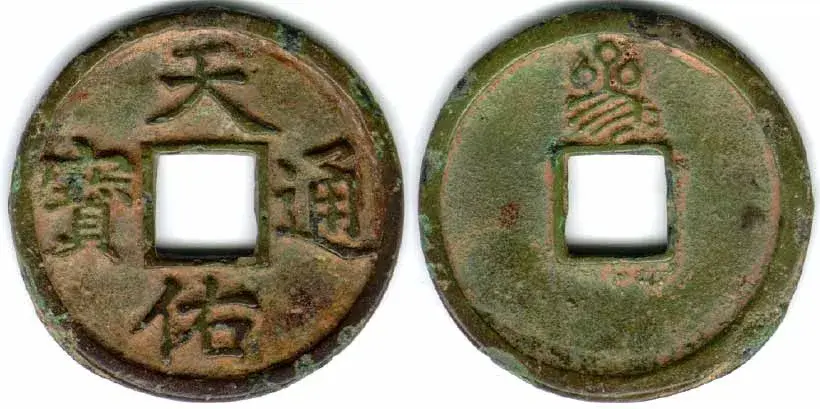
Subsequent Yuan counterattacks led by imperial princes were repeatedly defeated by Zhang Shicheng through disciplined defense behind fortifications and prepared canal ambushes. On the Lunar New Year of 1354, Zhang Shicheng held a formal ceremony in Gaoyou, declaring himself King of Cheng, establishing the Da Zhou dynasty, and inaugurating the Tianyou reign era. He thus became the first rebel leader in the lower Yangtze and Huai regions to institute an independent kingdom during the late Yuan uprisings.
The central government of Da Zhou was structured according to classical imperial institutions, establishing the Secretariat and the Bureau of Military Affairs. Li Xingsu was designated Chancellor, his brother Zhang Shide was appointed Vice-Chancellor, while Jiang Hui, Pan Yuanming, and Shi Chun were assigned senior council posts. Across local territories, he replaced the Yuan route system with commanderies under dedicated prefects, while implementing substantial tax remissions and land reclamation incentives that imparted vibrant initial vitality to the nascent kingdom.
During the early months of the Da Zhou regime, the Yuan court dispatched Huguang vice-chancellor Gou'er along with General Shi Pu to launch an offensive against Gaoyou. Shi Pu captured Baoying and charged the northern gates of Gaoyou, setting fire to the outer gates. Zhang Shicheng remained calm behind the moats, exploiting the jealousy and poor coordination among opposing commanders to draw the enemy into crossfire. Da Zhou warriors ambushed the vanguard, throwing the Mongol cavalry into disarray and killing Shi Pu in combat, thereby preserving Gaoyou as an impregnable operational base.
The emergence of Da Zhou and the severing of the Grand Canal compelled the Yuan court to mount an all-out effort. In the autumn of 1354, Emperor Huizong appointed Grand Chancellor Tuotuo as supreme military commander, mobilizing the combined forces of imperial princes, Central Asian armored horsemen, and Korean auxiliary legions. Numbering hundreds of thousands, the imperial army marched south under the proud banner of reclaiming Jiangnan, representing the largest military mobilization undertaken by the late Yuan state.
In November 1354, Tuotuo's vanguard enveloped Gaoyou in an iron ring of siege camps. Towering trebuchets rained massive boulders upon the city gates daily, while waves of infantry assaulted the ramparts with scaling ladders. Trapped inside with diminishing supplies, Zhang Shicheng organized round-the-clock repair crews using masonry from municipal dwellings and repeatedly led elite shock troops in bloody hand-to-hand combat to repel breaches on the parapets.
The epic siege persisted through the freezing winter, with the Da Zhou defenders refusing to yield despite immense casualties. Just as the defense approached its limits, a political catastrophe erupted in the Yuan court. The envious minister Hama falsely accused Tuotuo of plotting rebellion with his massive army. The gullible emperor abruptly issued an imperial decree stripping Tuotuo of his command and exiling him to the southwest, where he was subsequently executed.
The sudden dismissal of their trusted supreme commander triggered widespread panic and mutiny across the imperial encampments. Recognizing the historic turning point, Zhang Shicheng threw open the city gates and led his rested shock troops in a thunderous counter-offensive. Surrounding regional insurgent bands joined the pursuit, turning the imperial army's retreat into an utter rout across a hundred leagues. Immense piles of abandoned weapons, horses, and wagons fell into rebel hands. The Battle of Gaoyou completely crushed the last elite field army of the Yuan central government, permanently crippling the dynasty's ability to pacify southern China and solidifying the era of multi-faction regional warlordism.
Southward Crossing of the Yangtze and Capital at Pingjiang (1356)
Following the triumph at Gaoyou, severe droughts and famines afflicted the northern Huai plains, creating acute logistical difficulties for the Da Zhou forces. Realizing that the impoverished north could no longer sustain their ambitions, Zhang Shicheng and his brother Zhang Shide formulated a bold strategic pivot to cross the Yangtze River and secure the immensely fertile and commercially vibrant agricultural lands of Jiangnan. In January 1356, Zhang Shide assembled tens of thousands of veteran amphibious troops at Tongzhou to cross the broad expanse of the Yangtze.
Guided by the defecting local commander Zhu Ding, the Da Zhou waterborne assault fleet made landfall, quickly overrunning Changshu and forcing the surrender of Jiangyin. On February 1, 1356, Zhang Shide stormed the historic southern cultural and economic capital of Pingjiang Route (modern Suzhou), slaying the Yuan provincial councilor Tuoyin. In rapid succession, Kunshan, Jiading, and Chongming surrendered their keys, firmly establishing the Da Zhou presence south of the river.
On March 13, 1356, Zhang Shicheng transferred his entire court from Gaoyou to Pingjiang, officially designating it his royal capital under the elevated title of Longping Prefecture. Establishing his palace within the former Chengtian Temple, he strictly forbade looting, restored urban commerce, and melted temple bronzes to mint sound copper currency. Expanding outward, Da Zhou armies swiftly conquered Wuxing (Huzhou), Piling (Changzhou), and Songjiang, thereby securing the most fertile agricultural regions of China and elevating the prestige and wealth of Da Zhou to its zenith.
During the consolidation of the southern commanderies, General Shi Chun and Wang Yujing led an amphibious force across Lake Mao into the Gupu Canal, taking the textile manufacturing capital of Songjiang. Concurrently, Vice-Chancellor Pan Yuanming expelled marauding tribal garrison troops from Huzhou, cementing an integrated logistical network centered on Longping Prefecture.
Nominal Submission to Yuan and Rule in Western Zhejiang
Zhang Shicheng's rapid expansion in Jiangnan brought him into direct confrontation with Zhu Yuanzhang, who had recently conquered Jiqing (Nanjing) and renamed it Yingtian. Situated uncomfortably close to one another, the two rival leaders regarded each other as existential threats. In late 1356, Zhu Yuanzhang dispatched his chief generals Xu Da and Tang He to lay siege to the western gateway of Changzhou. Understanding that Changzhou served as the indispensable western shield of Pingjiang, Zhang Shicheng committed major resources to its defense.
Fierce clashes persisted around Changzhou for nearly a year. In the autumn of 1357, Zhu Yuanzhang's veteran general Zhao Desheng executed an ambush at Yushan Lake Bridge, capturing Da Zhou supreme field commander Zhang Shide after the latter fought valiantly amidst heavy fire. Transported to Nanjing, Zhang Shide rejected all inducements from Zhu Yuanzhang, maintaining a hunger strike until his death. Before dying, he smuggled a secret message to his brother, advising: "It is best to submit nominally to the Yuan to preserve our territory."
The loss of his capable brother struck a devastating blow to Zhang Shicheng's strategic capabilities. Simultaneously, the maritime warlord Fang Guozhen launched an amphibious offensive of fifty thousand men against Longping Prefecture, inflicting severe defeats on the Da Zhou defenses at Kunshan and advancing directly on the capital. Caught between Zhu Yuanzhang's advancing siege armies from the west and Fang Guozhen's coastal assaults from the east, Zhang Shicheng adopted a pragmatic compromise, dispatching envoys to seek terms with the Yuan provincial chancellor Dashitemur.
Incapable of subduing the southern rebellions by force, the Yuan court welcomed the opportunity to deploy Zhang Shicheng as a counterweight against Zhu Yuanzhang. An imperial edict granted him a full pardon, appointed him Grand Defender, and conferred court robes and jade belts while confirming his authority over all occupied territories. In response, Zhang Shicheng nominally dropped his royal Da Zhou title, accepted the Yuan calendar, and committed to sending over one hundred thousand piculs of grain annually to the imperial capital Dadu via coastal shipping.
Following his reconciliation with the court, Zhang Shicheng fortified Taicang as an oceanic outpost to welcome refugees and repel maritime incursions. He also constructed robust field fortifications at Tiger Hill (Huqiu) to protect the western approaches to Pingjiang. While acknowledging imperial suzerainty on paper, he retained absolute autonomy over taxation, civil appointments, and military command, functioning as an independent sovereign in all but name.
The title of Grand Defender provided Zhang Shicheng with an invaluable window of strategic respite. However, an acute threat persisted in Hangzhou, where the Yuan provincial councilor Yang Wanzhe commanded tens of thousands of fierce and undisciplined tribal warriors. Relying on his battlefield prestige, Yang acted with tyrannical lawlessness, plundering local communities and clashing bitterly with imperial authorities. Sensing that Yang Wanzhe posed a grave menace to regional stability, the Yuan chancellor Dashitemur formed a covert pact with Zhang Shicheng to eliminate him.
In August 1358, under the pretext of leading imperial troops against Jiande, Zhang Shicheng dispatched General Shi Chun on a rapid forced march toward Hangzhou. Caught completely off guard, Yang Wanzhe was besieged within his military headquarters and driven to commit suicide alongside his brother Yang Boyan after ten days of fighting. Zhang Shicheng smoothly took possession of Hangzhou, assimilating Yang's elite tribal cavalry and extensive weapons stores into his own army without suffering significant casualties.
Shortly thereafter, Zhang Shicheng ordered Vice-Commissioner Lu Zhen to lead an expedition south into Shaoxing, expelling Fang Guozhen's raiding parties and securing the entire eastern Zhejiang plain. This expansion was facilitated when the local commander Huang Zhong assassinated corrupt imperial censors and delivered Shaoxing to Zhang Shicheng. Consequently, Zhang Shicheng's operational domain extended from the Huaihe River in the north to the Xianxia Ridge in the south, encompassing the richest river basins and coastal waterways of China, supported by an army of hundreds of thousands.
To secure this expanded southern frontier, Zhang Shicheng stationed heavy garrisons along both banks of the Qiantang River, restored former Song fortifications, and positioned trusted veterans across key prefectures, elevating the wealth and military footprint of his regime to unprecedented heights.
During his peak years of prosperity, Zhang Shicheng avoided overextending his forces, choosing instead to strengthen his defensive frontier from Pingjiang to Hangzhou. He constructed defensive camps encircling Lake Tai, designated Huzhou as the crucial inland logistical redoubt under Vice-Chancellor Pan Yuanming, and fortified Tiger Hill and Taicang, maintaining General Lu Zhen with veteran forces on the western perimeter. However, the opulent surroundings of the southern water towns gradually eroded the fighting discipline and administrative vigor of his leadership.
Zhang Shicheng's younger brother Zhang Shixin and son-in-law Pan Yuanshao indulged in lavish domestic architecture, surrounding themselves with concubines, musicians, and extravagant banquets. Military commanders routinely traveled in ornate gilded sedan chairs, and the fighting edge that had characterized the original salt-rebel veterans waned under the influence of luxury. In stark contrast, Zhu Yuanzhang in Nanjing enforced austere discipline, accumulated agricultural reserves, and recruited eminent strategists like Liu Ji and Song Lian, subtly shifting the strategic balance between the two rival courts.
When Zhu Yuanzhang dispatched emissaries proposing peaceful borders and commercial cooperation, Zhang Shicheng responded with condescension, detaining the envoys. In 1360, when the central Yangtze warlord Chen Youliang launched an armada down the river to crush Nanjing, he invited Zhang Shicheng to execute a coordinated pincer attack. Paralyzed by short-sighted complacency, Zhang Shicheng remained completely passive, allowing Zhu Yuanzhang to destroy Chen Youliang's vanguard at Longwan and forfeiting an extraordinary geopolitical opportunity.
Throughout this period, ongoing skirmishes erupted along the western frontier at Changxing, Jiangyin, Yixing, and Changzhou. General Geng Bingwen maintained a resolute defense of Changxing against repeated Da Zhou assaults, while Wu Liang held Jiangyin against riverine probes, effectively preventing Zhang Shicheng's river fleets from advancing up the Yangtze toward Nanjing.
The Storming of Anfeng and Proclamation as King of Wu (1363–1364)
In February 1363, the Red Turban northern expedition suffered catastrophic reverses under the onslaught of Yuan general Chaghan Temur, forcing Red Turban supreme leader Liu Futong and the nominal emperor Han Lin'er to retreat into the isolated stronghold of Anfeng. Recognizing that the fortress was poorly provisioned and lightly guarded, Zhang Shicheng dispatched General Lu Zhen with tens of thousands of elite shock troops on a lightning march to encircle Anfeng.
Lu Zhen attacked relentlessly with scaling towers and artillery, breaching the perimeter after several days of intense fighting. Liu Futong was killed in the final melee, while the young emperor Han Lin'er was captured within his palace. The fall of Anfeng sent shockwaves through Nanjing, as Zhu Yuanzhang recognized that Zhang Shicheng's control of the fortress would expose his northern flank to mortal danger. Overruling the cautious advice of Liu Ji, Zhu Yuanzhang personally led a relief army across the Yangtze to confront Lu Zhen outside the walls.
In the ensuing Battle of Anfeng, Xu Da and Chang Yuchun spearheaded desperate assaults against the Da Zhou forces. Trapped far from friendly lines, Lu Zhen's army was defeated after days of bloody hand-to-hand combat, enabling Zhu Yuanzhang to rescue Han Lin'er and relocate him to Chuzhou. The clash at Anfeng permanently shattered any lingering prospects of accommodation between Zhang Shicheng and Zhu Yuanzhang. Disillusioned with the dying Yuan court, Zhang Shicheng severed his nominal ties with the dynasty in the autumn of 1364, formally ascending the throne as King of Wu in Pingjiang, establishing an imperial-style court, and openly contesting supreme authority over southern China.
Following his coronation, Zhang Shicheng constructed an expansive royal palace in Pingjiang and appointed a full hierarchy of chancellors, ministers, and secretaries. However, Zhu Yuanzhang had also assumed the title of King of Wu in Nanjing, establishing an irreconcilable contest between Eastern Wu (Zhang Shicheng) and Western Wu (Zhu Yuanzhang) that could only terminate in total annihilation.
Collapse of the Huaihe Front and Naval Defeat at Lake Tai (1365–1366)
By 1365, Zhu Yuanzhang had decisively obliterated Chen Youliang's forces at the Battle of Lake Poyang and pacified the middle Yangtze basin, eliminating all threats from the upper reaches. He then mobilized a seasoned army of two hundred thousand veterans for the decisive campaign to crush Zhang Shicheng. Formulating the strategy of "shearing the wings before striking the head," Zhu Yuanzhang directed General Xu Da to commence the campaign against Zhang Shicheng's original heartland across the northern Huai plains.
In the autumn of 1365, Xu Da's cavalry and infantry swept into the Huai region, while Chang Yuchun commanded the naval squadrons along the canals. Facing seasoned adversaries, the Da Zhou garrisons struggled to maintain cohesion. The historic stronghold of Gaoyou fell in April 1366 after a protracted defense, swiftly followed by the surrender of Huai'an, Taizhou, Tongzhou, and Haian. The loss of the northern commanderies stripped Zhang Shicheng of his strategic depth, salt tax revenues, and veteran recruiting grounds, compressing his defensive perimeter to the south of the Yangtze.
In August 1366, Xu Da crossed the river, advancing against the southwestern bulwark of Huzhou. Zhang Shicheng rushed tens of thousands of troops under his nephew Zhang Tianqi and veteran general Li Baisheng to entrench at Jiuguan, supported by the Lake Tai fleet. Chang Yuchun severed the overland supply roads and sprang a tactical naval trap on Lake Tai, routing the Da Zhou forces and capturing commanders Wang Yuangong and thousands of vessels. Cut off and starved within their fortifications, Li Baisheng and Zhang Tianqi surrendered, precipitating the fall of Huzhou and Hangzhou in October and leaving Pingjiang utterly isolated.
Siege of Pingjiang and Heroic Martyrdom
In November 1366, Xu Da and Chang Yuchun led two hundred thousand troops to surround the walls of Pingjiang, constructing siege lines that spanned dozens of leagues. Xu Da erected four-story wooden observation and catapult towers around the perimeter, deploying snipers, firearms, and giant trebuchets to bombard the city with a ceaseless hail of cannonballs and iron bolts. Multiple sections of the stone walls collapsed under the bombardment, yet the defenders held firm.
Faced with impending doom, Zhang Shicheng demonstrated remarkable courage. Wearing heavy armor atop the ramparts day and night, he directed civilian and military work crews to seal breaches, dismantling municipal buildings, temples, and residential houses to supply ammunition for the city's counter-artillery. By the summer of 1367, provisions inside Pingjiang were completely exhausted; soldiers survived on tree bark and rodents, with widespread starvation and disease claiming thousands. Nevertheless, under Zhang Shicheng's inspiring resolve, not a single commander sued for peace, and the garrison executed repeated desperate sorties.
On June 7, Zhang Shicheng personally led his finest household guards in a furious charge out of the Xu Gate, temporarily driving back Chang Yuchun's forward lines. However, his brother Zhang Shixin, watching from the ramparts, panicked and prematurely sounded the retreat, squandering the momentum and allowing Chang Yuchun to rally and force the defenders back inside. On June 24, while dining on the Chang Gate ramparts, Zhang Shixin was struck directly in the face by a catapult boulder and died instantly. Despite the loss of his brother and the absence of external relief, Zhang Shicheng continued to inspect the defensive perimeter, determined to perish with his capital.
Throughout the closing phases of the siege, artillery specialist Xiong Tianrui constructed specialized catapults to counter the enemy towers, creating an intense duel of siege engines over the parapets. Zhang Shicheng personally distributed the remaining royal grain reserves and silks among his wounded warriors, forging a poignant bond of communal loyalty that sustained the defense through ten months of unbroken hardship.
At dawn on October 1, 1367, Xu Da ordered the general assault on Pingjiang. Covered by mobile timber sheds, Ming sappers bridged the moats and forced the outer stockades of the Feng and Chang gates. The outer defenses collapsed as defecting commanders Tang Jie and Pan Yuanshao opened their positions. Zhang Shicheng retreated to the inner palace and rallied his remaining two thousand guards to contest Wanshou Temple Street, fighting until his force was annihilated. Recognizing that all was lost, his primary wife Lady Liu led her concubines and maidservants to the summit of the Qiyun Tower, where they hanged themselves before her adopted son set fire to the structure, perishing in the flames.
Returning to his private quarters, Zhang Shicheng suspended a cord to hang himself, but former comrades broke in and revived him before life had fled. When Xu Da sent captured defectors to urge him to make peace with Zhu Yuanzhang, Zhang Shicheng closed his eyes and maintained complete silence, exhibiting utter contempt for his conquerors. Placed on an old door plank, he was carried out through the Feng Gate while thousands of weeping citizens lined the canals to bid him farewell.
During the journey by water to Yingtian (Nanjing), Zhang Shicheng refused all food and water, lying motionless in the cabin. Upon arrival at the Longjiang provincial offices, Ming chancellor Li Shanchang interrogated him regarding his past defiance. Zhang Shicheng glared at Li, delivering a blistering rebuke against the arrogance of his captors. Late on the night of October 17, 1367, taking advantage of a lapse in the guards' vigilance, Zhang Shicheng hanged himself with his own sash, dying a martyr's death at the age of forty-seven. Impressed by his unbroken integrity and mindful of his benevolent rule over Jiangnan, Zhu Yuanzhang provided a dignified wooden coffin and permitted him to be interred beside Lake Jinji in Suzhou.