Biography
Medical Learning and Erudition in the Inner Courts
Wang Weiyi lived through the zenith of Northern Song cultural and economic prosperity under Emperors Zhenzong and Renzong. Reared in an environment that celebrated scholar-physicians, he immersed himself in Confucian canons, Han-Tang medical commentaries, and the foundational pulse lore of the Yellow Emperor's Inner Canon. He developed consummate expertise in stone-needle lancets, channel energetics, and deep palpation. During the reign of Emperor Zhenzong, when the court placed great emphasis on medical compilation, Wang entered court service as an officer of the Imperial Medical Bureau and Hanlin Medical Academy.
Serving in the inner palace, Wang Weiyi was praised for his meticulous collation of imperial prescriptions and acute surgical acumen. Although Chinese acupuncture possessed a millennium of historical continuity, the devastations of the Five Dynasties had left circulating copies of the Ming Tang Diagrams riddled with textual corruptions. Discrepancies abounded: single points were documented under multiple conflicting names, or identical names were attributed to disparate anatomical locations. Because practitioners relied on secret oral transmissions within private lineages, slight errors in needle insertion often caused severe clinical injury or death. Furthermore, imperial examinations relied entirely on rote memorization of verses rather than practical skill, creating severe bottlenecks in training. Wang Weiyi recognized these institutional failures and repeatedly petitioned the throne to compile a definitive national atlas to standardize acupuncture points.
Imperial Commission and the Illustrated Manual of Acupuncture Points on the Bronze Figure
In the fourth year of the Tiansheng era (1026), Emperor Renzong issued an edict commanding Hanlin Medical Official Wang Weiyi to collate all acupuncture texts and establish national anatomical standards. Gathering all surviving archaic manuscripts from the imperial archives, Wang adopted Huangfu Mi's Systematic Classic of Acupuncture and Moxibustion as his core framework, cross-referencing Suwen, Lingshu, Nanjing, and Tang-era compendia like Wang Tao's Waitai Miyao. Leading a team of court physicians, he reconciled centuries of conflicting records through anatomical cross-examination.
Rather than confining himself to philological glosses, Wang performed rigorous clinical verification using bone-proportional measurements. Within a year, he compiled the three-volume Illustrated Manual of Acupuncture Points on the Bronze Figure (Xin Zhu Tongren Shuxue Zhenjiu Tujing). The text codified the fourteen-meridian system (the twelve primary channels plus the Ren and Du vessels) and standardized 354 distinct acupuncture points across the body (yielding 657 bilateral loci). The upper volume delineated channel itineraries, pathognomonic symptoms, and principal therapeutic indications; the middle and lower volumes surveyed the head, neck, torso, and limbs in anatomical succession, recording relative distances between points, needle insertion depths, needle retention times, moxibustion cone dosages, and clinical contraindications. Supplemented by anatomical drawings, the Illustrated Manual of Acupuncture Points on the Bronze Figure became China's first state-promulgated acupuncture code endowed with legal authority.
The Invention of the Bronze Figures and Standardized Examination
Upon completing the Illustrated Manual of Acupuncture Points on the Bronze Figure, Wang Weiyi understood that two-dimensional parchment illustrations could never fully eliminate perspective errors for students. In 1027, he proposed casting life-sized, three-dimensional bronze anatomical figures modeled precisely after the Illustrated Manual of Acupuncture Points on the Bronze Figure. Emperor Renzong approved the initiative, allocating refined bronze from the imperial treasury and placing Wang in charge of design, measurement, and manufacturing alongside master metallurgists.
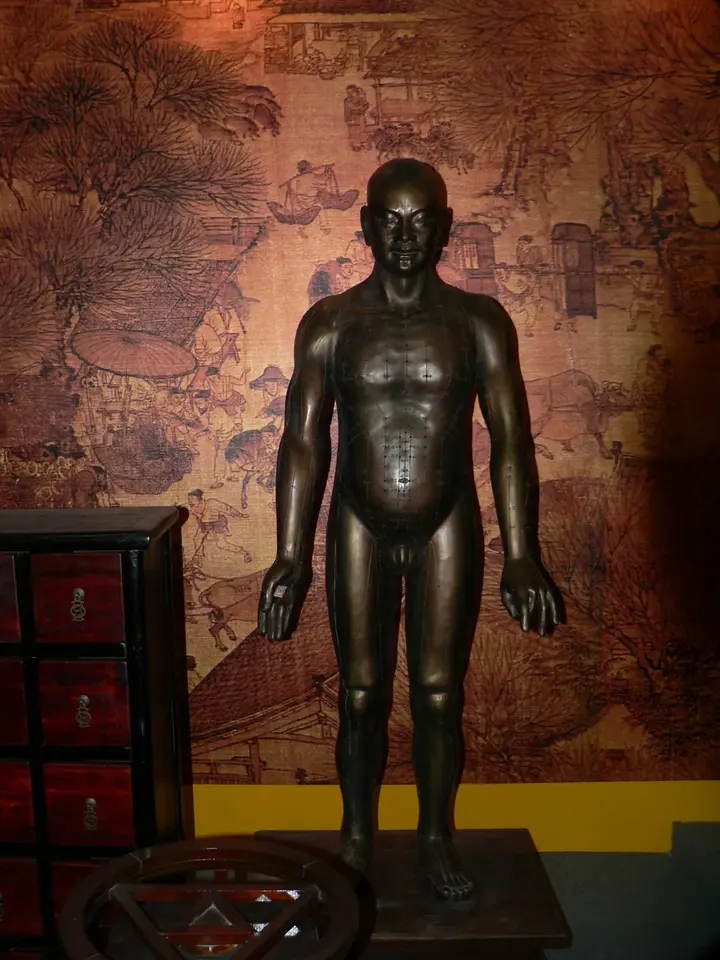
By the winter of 1027, two identical life-sized Acupuncture Bronze Figures were successfully cast. Standing to the height of an average adult, each figure possessed lifelike external features and contained carved, removable wooden internal organs—heart, liver, spleen, lungs, kidneys, stomach, gallbladder, intestines, bladder, triple burner, and pericardium—together with accurate rib cages. On the exterior surface, the fourteen meridians were clearly engraved, and all 354 acupoints were precisely drilled through the metal wall, with point names inlaid in gold alongside each aperture.
Wang Weiyi introduced a revolutionary clinical testing protocol: prior to examination, proctors filled the internal cavities and channels of the Acupuncture Bronze Figure with mercury or warm water, then coated the entire surface with an even layer of yellow beeswax, completely obscuring the holes and inscriptions. Examinees were called forward to locate points blindly based solely on anatomical palpation. When an examinee inserted the needle accurately into the prescribed point, the needle passed cleanly through the wax into the aperture, and mercury welled out upon withdrawal. If the needle missed the mark by even a fraction of an inch, it struck the solid bronze surface and bent, unable to enter. This ingenious method eliminated examiner bias and established the world's earliest recorded objective clinical competency test.
Stone Steles and Lasting Historical Influence
Of the two Acupuncture Bronze Figures, one was kept in the Imperial Palace for imperial inspection, while the other was placed in the Imperial Medical Academy at Xiangguo Temple for public instruction. In 1030, fearing that wooden printing blocks might perish in future wars, Emperor Renzong accepted Wang Weiyi's recommendation to engrave the complete text of the Illustrated Manual of Acupuncture Points on the Bronze Figure onto massive stone tablets. Wang personally supervised the carving of multiple steles, which were erected in the Renji Hall of Xiangguo Temple and the Medical Academy cloisters, permitting doctors and scholars from across the empire to make rubbings freely, thus democratizing royal medical archives.
During the Huangyou era, Wang Weiyi was promoted to Palace Medical Attendant in the Palace Service Directorate and received the title Grand Master for Court Dispersion, standing at the summit of the imperial medical hierarchy. In 1067, having served through three imperial reigns, Wang passed away in Kaifeng at the age of eighty-one. The Acupuncture Bronze Figures and stone tablets were cherished as state treasures across the Song, Jin, and Yuan dynasties. His meridian taxonomy was carried to Korea, Japan, and the Middle East, serving as the foundational ancestor for modern global acupuncture point standards recognized by the World Health Organization.
Key Achievements
Authoring the Definitive State Acupuncture Canon
Under imperial decree, Wang Weiyi collated all historical acupuncture literature, correcting centuries of textual corruption. He formalized the system of fourteen meridians and standardized 354 acupoints with exact anatomical locations, depths, and indications in the official Illustrated Manual of Acupuncture Points on the Bronze Figure.
Casting Life-Sized Bronze Figures and Inventing Objective Clinical Testing
Wang designed and cast two life-sized bronze anatomical models containing modular internal viscera and perforated acupoints. His invention of wax-coated, mercury-filled testing established the earliest objective structured clinical skill examination in global medical history.
Public Stele Engraving and Cultural Dissemination
He supervised the engraving of the complete Illustrated Manual of Acupuncture Points on the Bronze Figure onto monumental stone tablets erected at the Xiangguo Temple, breaking down hereditary guild secrets and facilitating the widespread adoption of standardized acupuncture throughout East Asia.