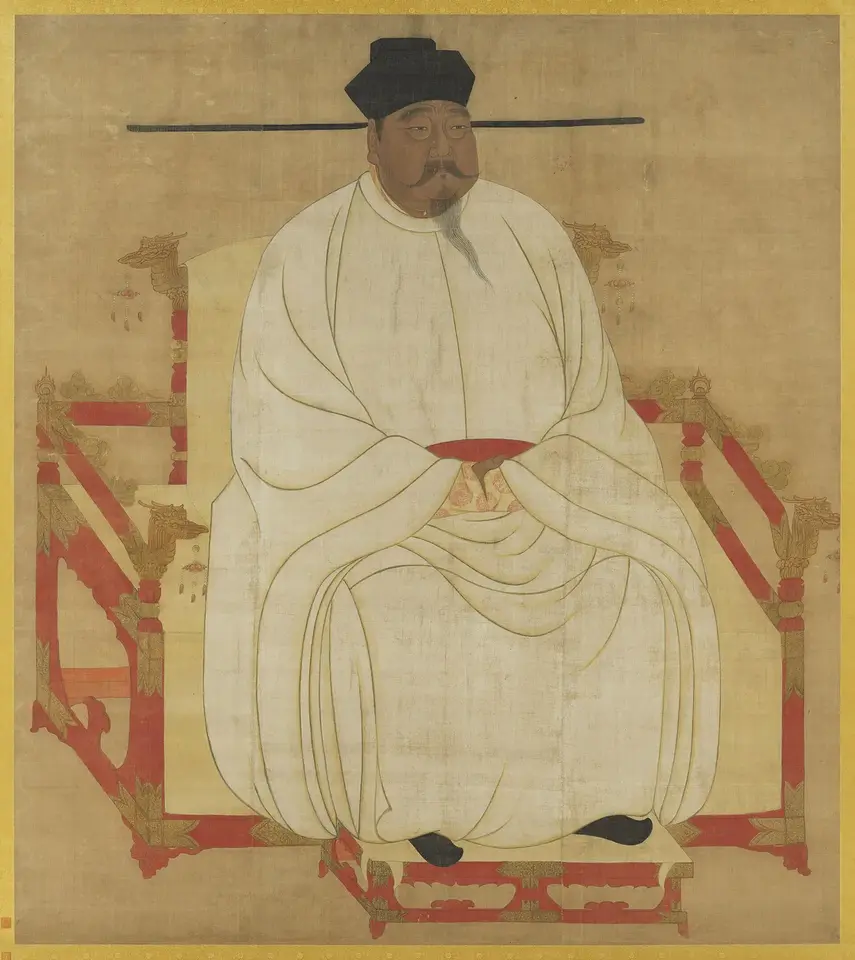
Life and Career
Early Career and Rise in the Military
Wang Renshan was born in Fangcheng, Tangzhou. As a young man, he possessed an audacious, uninhibited character, showing little regard for conventional rural agriculture or mercantile pursuits. Instead, he studied military strategy, administrative logistics, and accounting. During the Later Zhou dynasty, he offered his services to Liu Ci, a respected regional military governor and honorary chancellor. Impressed by Wang's organizational clarity and decisive intellect, Liu Ci appointed him as an officer of the guard (yaxiao), placing him in charge of sensitive administrative affairs.
In 955, as Liu Ci lay dying of illness, he submitted a formal memorial to the Later Zhou court, praising Wang Renshan as a talent capable of commanding armies and governing states. At the time, Zhao Kuangyin held the crucial post of Palace Commander-in-Chief (Dianqian Dujian), exercising direct command over the elite imperial guards. Having long known of Wang Renshan's reputation for practical competence, Zhao Kuangyin personally requested Emperor Shizong (Chai Rong) to transfer Wang to his headquarters, forging an enduring bond between future emperor and minister.
Dynastic Founding and Central Administration
In 960, Zhao Kuangyin seized the imperial throne and founded the Song dynasty. Wang Renshan, as an intimate member of the founder's military staff, was immediately elevated to Commissioner for Military Virtue (Wude Shi) and dispatched to administer the strategic frontier prefecture of Qinzhou. Wang strengthened frontier beacon towers, secured local ethnic garrisons, and demonstrated exemplary administrative vigor. He was subsequently recalled to the capital and appointed Left Commissioner of Imperial Steeds (Zuo Feilong Shi).
In 961, Wang Renshan was promoted to General of the Right Leader Guard (You Lingjunwei Jiangjun) and concurrently appointed Transceiver of the Bureau of Military Affairs (Shumi Chengzhi), an indispensable secretarial post handling confidential military decrees. In the same year, when Gao Jichong, ruler of the regional Jingnan realm, submitted his territory to Song sovereignty, Emperor Taizu appointed Wang Renshan as Patrol Commissioner of Jingnan (Jingnan Xuanjianshi). Wang led troops into the region, disarming potential rebels, monitoring local garrisons, and ensuring the smooth incorporation of the Jianghan plain into the empire. In 963, he became Grand General of the Left Thousand Ox Guard, followed by appointment as Chief of the Court of Reception (Nei Kesheng Shi). In the spring of 964, Emperor Taizu elevated him to Vice Commissioner of Military Affairs (Shumi Fushi), bringing him into the inner circle of imperial defense policy.
The Shu Campaign and Disgrace
In the autumn of 964, Emperor Taizu launched a major military campaign to conquer Later Shu. Wang Renshan was assigned as Forward Army Supervisor of the Fengzhou Circuit, advancing alongside Commander-in-Chief Wang Quanbin and Vice Commander Cui Yanjin with an army of sixty thousand infantry and cavalry. Wang Renshan enforced swift operational momentum, cutting through treacherous mountainous defiles and storming critical fortresses such as Sanquan and Jianmen. In the first month of 965, the Song armies surrounded Chengdu, forcing the Last Ruler of Later Shu, Meng Chang, to surrender unconditionally.
Following the fall of Chengdu, however, the victorious commanders succumbed to indiscipline and greed. Wang Renshan and Wang Quanbin unlawfully opened the palace treasuries of Later Shu, dividing precious jade, silk, and gold among themselves and seizing palace concubines. Worse still, out of suspicion that the surrendered Shu troops might mutiny, Wang Renshan participated in ordering the slaughter of tens of thousands of disarmed Shu soldiers within Chengdu's enclosure walls. This brutal atrocity triggered a massive uprising led by Quan Shixiong, plunging dozens of counties across Sichuan into ferocious warfare that took months and substantial Song resources to suppress. When the army returned to Bianjing in 967, imperial censors impeached the generals. Emperor Taizu severely interrogated Wang Renshan at the palace; out of respect for his founding contributions, the emperor spared his life but stripped him of his chancellery rank, demoting him to General of the Right Guard.
Directorate of State Finance and the Timber Scandal
Following the accession of Emperor Taizong in 976, Wang Renshan was recalled to imperial favor due to his consummate mastery of fiscal administration. Taizong appointed him Minister of Works and Regent of the Eastern Capital, and subsequently entrusted him with the Directorate of the State Finance Commission (Pan Sansi), placing him in sole charge of the three revenue bureaus: Salt and Iron, Expenses, and Population. In 979, during Emperor Taizong's personal campaign against Northern Han at Taiyuan, Wang Renshan was appointed Supreme Commander of the Imperial Palace Guard (Danai Didebushu), managing internal security and logistical dispatching from Bianjing. Following the annexation of Northern Han, Taizong bestowed upon him the honorific title of Grand Tutor with Acting Status (Jianxiao Taifu).
As head of the State Finance Commission, Wang Renshan applied rigorous oversight. In 980, he uncovered a massive embezzlement ring operating across the Qinzhou and Longzhou regions. Imperial relatives, palace eunuchs, and high officials had exploited tax-exempt imperial timber-harvesting permits to traffic lumber into Bianjing, selling it to the government at extortionate rates. Wang Renshan submitted an unvarnished confidential memorial directly to Emperor Taizong. The resulting imperial investigation shook the capital, resulting in disciplinary demotions for Vice Finance Commissioner Fan Min, Revenue Judge Du Zai, Kaifeng Judge Lu Duan, and Imperial Son-in-law Shi Baoji.
Conflict and Final Demotion
Having held supreme fiscal authority for years, Wang Renshan became increasingly autocratic and shielded his own departmental sub-officials from outside auditing. In 982, subordinate auditors Chen Shu and Song Qi uncovered extensive revenue deficits within the various state storehouses, accusing Wang Renshan of condoning multimillion-string embezzlement.
The dispute escalated to the imperial throne room in Chongzheng Hall. During the cross-examination, Wang Renshan argued vehemently against his subordinates, speaking with an abrasive tone that deeply offended Emperor Taizong. Taizong stripped him of his financial directorship, demoting him first to General of the Right Guard, and the following day banishing him to Defense Commissioner of Tangzhou (Tangzhou Fangyushi). Broken in spirit and plagued by illness over his sudden fall, Wang Renshan died at his residence in Bianjing only days later at the age of sixty-six. Emperor Taizong subsequently remarked to Grand Chancellor Zhao Pu that while Wang Renshan possessed exceptional fiscal talents, his fatal indulgence toward corrupt underlings brought about his ultimate disgrace.
Major Achievements
Vanguard Role in the Conquest of Later Shu
As Forward Army Supervisor in 964, Wang Renshan coordinated logistics and vanguard attacks across the formidable Qinling and Bashan mountains. Breaking through the impregnable Jianmen Pass, his rapid offensive secured the surrender of Later Shu in only sixty-six days, eliminating Song's most affluent southwest rival and securing immense strategic depth for the burgeoning empire.
Capital Governance during the Northern Han War
During Emperor Taizong's personal northern expedition against Taiyuan in 979, Wang Renshan was entrusted with supreme domestic security as Supreme Commander of the Imperial Palace Guard and Metropolitan Defense Administrator. His strict curfew patrols, civil administration, and relentless grain and weapons convoys ensured domestic peace, facilitating the final conquest of Northern Han.
Central Financial Organization and Audit Reforms
Overseeing the State Finance Commission (Sansi) during the early Taiping Xingguo era, Wang Renshan unified revenue accounting and transport logistics, reviving national revenue streams following Five Dynasties devastation. His fiscal protocols and balance registries contributed significantly to the centralization of Northern Song public finance.
Investigation of Imperial Timber Speculation
In 980, Wang Renshan demonstrated extraordinary investigative audacity by uncovering and exposing a clandestine timber cartel operated by imperial relatives and high bureaucrats using fraudulent tax-exempt permits. His confidential memorial broke entrenched aristocratic impunity and restored central fiscal regulatory integrity.