Birth | Born at Wuyang in Xuzhou, present-day Wuyang County, Henan.
唐末五代
EmperorFounder of Former Shu;Han
Wang Jian
王建
Wang Jian (February 26, 847 – July 11, 918), courtesy name Guangtu, childhood name Xingge, was a native of Wuyang in Xuzhou (present-day Wuyang County, Luohe, Henan Province). He was the founding emperor of the Former Shu dynasty (reigned 907–918) during the Five Dynasties and Ten Kingdoms period, as well as an outstanding military commander, grand strategist, and benevolent sovereign who brought lasting peace and prosperity…
唐末五代Former Shu
PROFILE
Wang Jian (February 26, 847 – July 11, 918), courtesy name Guangtu, childhood name Xingge, was a native of Wuyang in Xuzhou (present-day Wuyang County, Luohe, Henan Province). He was the founding emperor of the Former Shu dynasty (reigned 907–918) during the Five Dynasties and Ten Kingdoms period, as well as an outstanding military commander, grand strategist, and benevolent sovereign who brought lasting peace and prosperity to the Sichuan basin. Born into humble origins, Wang was reckless and undisciplined in his youth, surviving by slaughtering cattle, stealing donkeys, and trafficking in illicit salt. Because he ranked eighth among his generational kin, local villagers mockingly nicknamed him "Thief Wang the Eighth" (Zei Wang Ba). Later convicted of criminal offenses and sentenced to death, he was covertly released by a compassionate jailer named Meng Yanhui. Fleeing to Wudang Mountain, he encountered an ascetic Buddhist monk named Chu Hong, who read his noble facial physiognomy and urged him to enter military service. Taking this counsel to heart, Wang enlisted as a common soldier in the elite Zhongwu Army, where his daring initiative and martial valor quickly set him apart. During the late Tang dynasty, as the apocalyptic Huang Chao Rebellion ravaged the Central Plains, Wang Jian served under the Zhongwu eunuch army supervisor Yang Fuguang. He, along with Jin Hui, Han Jian, and others, was selected to lead one of the renowned "Zhongwu Eight Battalions" (Zhongwu Badu), campaigning relentlessly across Henan, Huainan, and the Jing-Xiang region. In the fourth year of the Zhonghe era (884), following Yang Fuguang's sudden death, Wang Jian and four fellow battalion commanders broke away from the rogue general Lu Yanhong and marched across the Qinling Mountains to Chengdu to pledge allegiance to the exiled Emperor Xizong of Tang. The powerful court eunuch Tian Lingzi warmly welcomed them, adopting Wang and his four colleagues as foster sons and incorporating their veteran troops into the imperial Shence Army. In the second year of the Guangqi era (886), when Zhu Mei staged an armed coup in the capital, Tian Lingzi abducted Emperor Xizong in a desperate midnight flight toward Xingyuan. Wang Jian spearheaded the escape, cutting through mountain defiles and blazing brushfires while shielding the imperial carriage. Overwhelmed with gratitude and weeping copiously, Emperor Xizong rested his exhausted head upon Wang Jian's knee to sleep, subsequently stripping off his own imperial yellow robe to bestow it upon Wang in recognition of his supreme devotion. Appointed Governor of Lizhou and later pushed out by court rivalries, Wang launched a surprise assault on Langzhou, establishing an independent power base where he recruited displaced refugees, trained thousands of elite troops, and gathered capable advisors. In the second year of the Dashun era (891), allying with Gu Yanlang of Dongchuan, Wang besieged Chengdu for three grueling years, forcing the surrender of warlord Chen Jingxuan and Tian Lingzi to become master of Xichuan. He subsequently annexed Dongchuan from Gu Yanhui in 897, captured Shannan West (Hanzhong) in 902, and was formally enfeoffed as Prince of Shu by Emperor Zhaozong of Tang in 903. In the fourth year of the Tianyou era (907), Zhu Wen usurped the Tang throne to establish the Later Liang dynasty. Refusing to submit to the usurper, Wang Jian declared himself Emperor in Chengdu, adopting the dynastic title Great Shu (known historically as Former Shu) and the era name Tianfu. During his reign, Wang Jian pursued enlightened policies of defending the borders and pacifying the populace, actively recruiting talented scholars fleeing the war-torn north, such as Wei Zhuang, Zhang Ge, and Zhou Xiang. Under Wei Zhuang's guidance, Former Shu faithfully reconstituted the grand institutional rituals, ministerial governance, and civil examination systems of the High Tang. Wang restored the ancient Dujiangyan hydraulic irrigation networks, encouraged sericulture and agriculture, lightened taxes, and maintained unbroken peace in Sichuan while northern China burned. His court fostered a haven of culture and the arts, directly giving rise to the celebrated "Huajian School of Poetry" (Huajian Ji) and exquisite woodblock printing traditions. In his declining years, however, succession crises plagued the imperial court: Crown Prince Wang Yuanying was killed during an armed factional clash with court intimates, and his youngest son, Wang Zongyan, was elevated to the heir apparent through the machinations of Consort Xu and Chancellor Zhang Ge, laying the groundwork for the state's eventual demise. In the first year of the Guangtian era (918), Wang Jian passed away in Chengdu at the age of seventy-two. He was granted the temple name Gaozu and the posthumous name Emperor Shenwu Shengwen Xiaode Minghui, being entombed in the Yongling Mausoleum (the historic Wang Jian Tomb in Chengdu). Rising from an illiterate salt-smuggler to an imperial founder, Wang Jian earned the enduring reverence of both dynastic historians and generations of Sichuan's people for his decisive military prowess and enlightened civil governance.
- Era
- Former Shu
- Identity
- Emperor, Founder of Former Shu;Han
- Date of Birth
- February 26 847
- Date of Death
- July 11, 918 CE(1st year of the Guangtian era, Former Shu, 6th month, 1st day)
- Successor
- Wang Zongyan (Wang Yan), Later Ruler of Former Shu (youngest son)
- Predecessor
- Not applicable (founding emperor of Former Shu)
- Ancestral home
- Wuyang, Xuzhou (present-day Wuyang, Henan);February 26, 847
- Place of birth
- Wuyang, Xuzhou (present-day Wuyang, Henan);July 11, 918 (first day of the sixth lunar month, first year of the Guangtian era of Former Shu)
- Place of death
- Chengdu Temporary Palace (present-day Chengdu, Sichuan);907 (twenty-fifth day of the ninth lunar month)–July 11, 918 (first day of the sixth lunar month, first year of the Guangtian era)
- Era name
- Wucheng, Yongping, Tongzheng, Tianhan, Guangtian;Gaozu
- Posthumous name
- Emperor Shenwu Shengwen Xiaode Minghui;Yongling
- Major achievements
- Rose through military prowess in the late Tang turbulence to conquer Eastern and Western Chuan and establish Former Shu; welcomed fleeing gentry and pacified civilians, maintaining peace, stability, and cultural flourishing in Sichuan during the Five Dynasties.
LIFE TIMELINE
Birth | Wuyang, Xuzhou (present-day Wuyang County, Henan Province)
Youth | Lived as an unruly youth, engaged in cattle slaughter, donkey theft, and illicit salt trafficking; arrested and imprisoned in Xuchang, then released by prison warden Meng Yanhui; fled to Mount Wudang and was persuaded by monk Chuhong to join the army, becoming a squad commander in the Zhongwu Army
Age thirty-four | Huang Chao captured Chang'an; Lu Yanhong led Zhongwu troops under Yang Fuguang to suppress rebels; Wang Jian, Jin Hui, Han Jian, Zhang Zao, and Li Shitai were designated commander heads of the "Eight Battalions of Zhongwu"
Age thirty-eight | Yang Fuguang had died in 883; Lu Yanhong rebelled and sacked Xiangdeng and Xingyuan; Wang Jian and four comrades broke away from Lu and fled to Chengdu to pledge loyalty to Emperor Xizong; powerful eunuch Tian Lingzi adopted them as sons and gave them commands in the Shence Army
Age thirty-nine | Accompanied Emperor Xizong back to Chang'an; when Zhu Mei rebelled, Tian Lingzi fled with Xizong toward Xingyuan; Wang Jian fought through mountain fires and guarded the emperor, who wept and slept resting his head on Wang's knee, conferring an imperial robe; promoted to prefect of Bizhou
Age forty | Yang Fugong replaced Tian Lingzi and demoted Wang Jian to prefect of Lizhou; Wang Jian captured Lizhou, then seized Langzhou, amassing over 10,000 troops
Age forty-two | Emperor Zhaozong ascended the throne; Western Chuan governor Chen Jingxuan and Tian Lingzi grew suspicious of Wang Jian; Wang Jian allied with Gu Yanlang of Eastern Chuan and besieged Chengdu with Chancellor Wei Zhaodu
Age forty-five | After a three-year siege, Wang Jian used intimidation to force Wei Zhaodu to hand over authority and return east; Chen Jingxuan and Tian Lingzi surrendered; Wang Jian entered Chengdu, strictly enforced military discipline, and was appointed military governor of Xichuan
Age forty-six | Suppressed the rebellion of Dong Zhang and received the title of Acting Chancellor (Tong Pingzhangshi)
Age forty-nine | When Li Maozhen threatened the court, Wang Jian executed Chen Jingxuan and Tian Lingzi to eliminate internal threats and launched a campaign against Li Maozhen under the banner of royal defense
Age fifty-one | Following Gu Yanlang's death, Gu Yanhui clashed with Wang Jian; Wang Jian sent Wang Zongdi and Wang Zongkan to conquer Dongchuan; Gu Yanhui committed suicide and Wang Jian unified all of Sichuan
Age fifty-two | Dispatched Wang Zongben to conquer Qiannan (Qianzhou), expanding Shu's territory southward to Bozhou
Age fifty-six | Took advantage of Li Maozhen detaining Emperor Zhaozong in Fengxiang to seize Xingyuan, crushing Qi forces and taking eight prefectures of Shannan West Circuit
Age fifty-seven | Enfeoffed as Prince of Shu; fortified defenses and recruited prominent scholars as Zhu Quanzhong dominated central China
Age sixty-one | Zhu Quanzhong usurped the Tang; on the jihei day of the ninth month, Wang Jian declared himself emperor in Chengdu, establishing the Great Shu dynasty and adopting the era name Tianfu
Age sixty-two | Changed era name to Wucheng; built northern and southern defense walls around Chengdu; allied with Qi Prince Li Maozhen
Age sixty-five | Changed era to Yongping; clashed with Li Maozhen over borders and achieved total victory at the Battle of Qingniling, annexing Jie, Cheng, Wen, Qin, and Feng prefectures
Age sixty-seven | Crown Prince Wang Yuanying violently clashed with minister Tang Wen'yi; Wang Jian suppressed the rebellion and Yuanying was killed; Wang Jian designated his youngest son Wang Zongyan as heir
Age seventy | Adopted era name Tongzheng; commissioned imperial records, gathered historical books, and promoted agriculture with light taxation
July 11, 918 CE(1st year of the Guangtian era, Former Shu, 6th month, 1st day) | Age seventy-one | Changed dynasty name to Han and era to Tianhan; later restored dynasty name to Great Shu and era to Guangtian
BIOGRAPHY
Biography
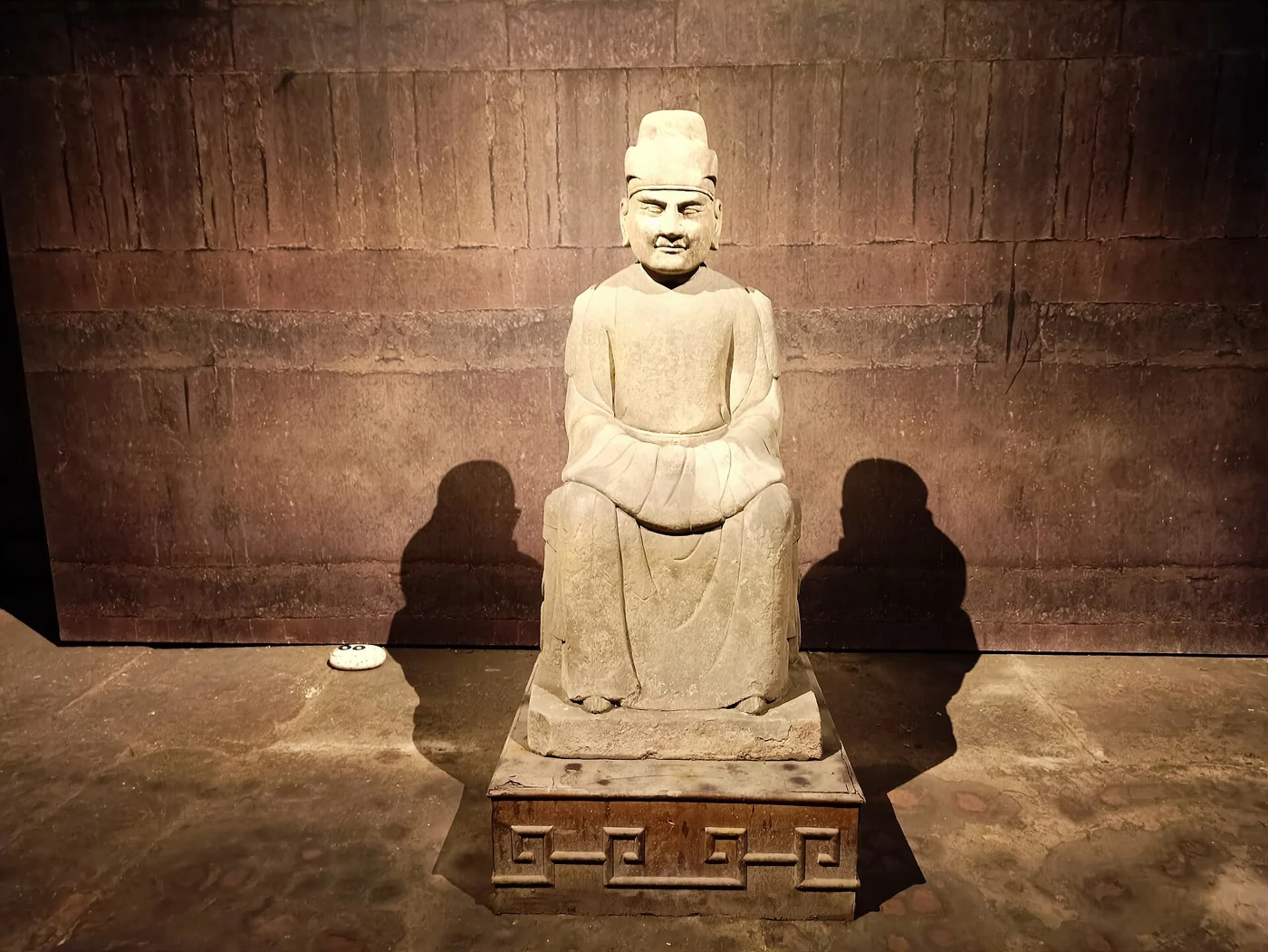
Humble Origins and Rise in the Zhongwu Army Wang Jian, courtesy name Guangtu, childhood name Xingge, was a native of Wuyang in Xuzhou (present-day Wuyang County, Luohe, Henan Province). His dynastic genealogies claimed descent from the prestigious Jingzhao Wang clan, tracing lineage back to General Wang Chang (Marquis of Jiangling) of the Western Han dynasty, whose family relocated to Wuyang during the reigns of Emperors Cheng and Ai. In historical reality, however, Wang Jian emerged from profound destitution, his immediate ancestors operating a humble storefront making and selling baked flatbreads (bingshi). Born on February 26, 847 in the existing Gregorian account(source infobox: eighth day of the second lunar month, Dazhong 1; its correspondence to the Gregorian date has not been independently verified), Wang grew up amidst poverty, developing a reckless, cunning, and aggressive temperament. In his youth, he made a living through illicit activities, including illegally slaughtering cattle, stealing donkeys, and trafficking in contraband salt across the Henan borderlands. Because he was the eighth son among his generation and possessed a ruthless, fearless disposition, local villagers feared and detested him, universally dubbing him "Thief Wang the Eighth" (Zei Wang Ba). Inevitably, Wang was apprehended by imperial magistrates for illegal salt smuggling and robbery, cast into the death row cells of the Xuchang county jail. Facing imminent execution under severe dynastic statutes, his extraordinary stature, piercing gaze, and fearless demeanor captured the sympathy and astonishment of a jailer named Meng Yanhui. Convinced that the prisoner was no ordinary ruffian, Meng covertly unlocked his fetters in the dead of night and facilitated his escape. Wang fled into the dense, misty forests of Wudang Mountain, living in hiding among caves and ravines. While wandering the mountains, he crossed paths with an ascetic Buddhist monk named Chu Hong, a master of physiognomy. Scrutinizing Wang's striking skeletal structure and piercing brow, Chu Hong exclaimed in wonder: "Your skeletal physiognomy is exceedingly noble, far beyond common men. Why do you remain a fugitive in the wilderness instead of joining the army to achieve a leopard-like transformation (baobian)?" Deeply shaken and awakened by the monk's words, Wang abandoned his life as an outlaw, traveled to Xuzhou, and enlisted as a private in the ranks of the Tang dynasty's elite regional garrison—the Zhongwu Army. In combat, his daring ferocity and agile mind propelled him rapidly through the ranks, advancing to squad commander (duijiang). In the first year of the Guangming era (880), the peasant rebel forces of Huang Chao shattered imperial defenses at Tongguan and captured the imperial capital of Chang'an, forcing Emperor Xizong of Tang and his court to flee in disgrace into Shu. In this moment of national crisis, the senior Zhongwu commander Lu Yanhong led eight thousand elite infantry and cavalry to join the imperial pacification commissioner and palace eunuch Yang Fuguang in mounting a counter-offensive against Huang Chao. Observing that the diverse officers were headstrong and difficult to coordinate, Yang Fuguang divided the eight-thousand-man host into the celebrated "Zhongwu Eight Battalions" (Zhongwu Badu), assigning each battalion one thousand men and appointing a trusted commander (dutou). Wang Jian, alongside Lu Yanhong, Jin Hui, Han Jian, Zhang Zao, Li Shitai, and Pang Cong, was selected as a battalion commander. Leading his elite battalion through brutal campaigns across Henan, Huainan, and the middle Yangtze, Wang fought at the vanguard of every engagement, earning a fearsome reputation among rebel and imperial armies alike. ### Escorting the Emperor to Shu and Seizing Regional Independence In the fourth year of the Zhonghe era (884), the eunuch warlord Yang Fuguang died suddenly in Nanyang, removing the sole authority capable of holding the Eight Battalions together. The ambitious and brutal Lu Yanhong immediately seized supreme command, leading his troops on a rampage of looting across Xiangzhou and Dengzhou before turning westward into the Hanzhong valley. Lu stormed Yangzhou and Jinzhou, overran the regional seat of Xingyuan, and drove out Military Governor Niu Xu to carve out his own predatory enclave. Suspicious and cruel, Lu harbored deep jealousy toward the martial talents of younger commanders like Wang Jian and Han Jian, covertly plotting their elimination. Sensing mortal danger, five battalion commanders—Wang Jian, Han Jian, Jin Hui, Zhang Zao, and Li Shitai—convened in secret and resolved to abandon the rogue general. Leading their combined contingents across the rugged, treacherous trails of the Qinling Mountains, they made a desperate forced march to Chengdu to place themselves under the direct command of the exiled Emperor Xizong. At Chengdu, Emperor Xizong found his sovereign authority hollow and his palace guards depleted. The emperor's omnipotent eunuch mentor, Left Shence Army Commander Tian Lingzi, was actively seeking reliable martial forces to buttress his supremacy. Overjoyed by the arrival of five battle-tested commanders with thousands of veteran troops, Tian immediately adopted Wang Jian, Han Jian, Jin Hui, Zhang Zao, and Li Shitai as his foster sons, bestowing generous imperial titles upon them and incorporating their units into the elite Shence Army, with Wang appointed Commander of the Imperial Escort (Hubi Dutou). In the first year of the Guangqi era (885), following the suppression of Huang Chao, Emperor Xizong returned to Chang'an under the escort of the Shence Army. However, imperial peace was fleeting. Tian Lingzi's despotic overreach provoked an armed showdown with Regional Governors Wang Chongrong of Hezhong and Li Keyong of Taiyuan, whose armies converged upon the capital. In December, regional commanders Zhu Mei of Jingnan and Li Changfu of Fengxiang launched a mutiny, occupying Chang'an and proclaiming the imperial prince Xiao Zan as a puppet emperor. Panic-stricken, Tian Lingzi abducted Emperor Xizong under cover of darkness, fleeing toward the Dasan Pass and Baoji with the imperial guard. Zhu Mei dispatched elite cavalry in relentless pursuit, while forest fires raged along the mountain plank roads, filling the narrow defiles with choking smoke and roaring flames. Throughout this harrowing flight, Wang Jian demonstrated monumental courage and unyielding loyalty. Clad in heavy iron lamellar armor and brandishing a long halberd, he rode at the absolute vanguard of the imperial carriage, hacking down mountain brushwood, bridging rushing chasms, and "clearing the road with sword in hand" (qingdao zhanqiao). Repeatedly charging through billowing flames and showers of enemy arrows, he defended the emperor's carriage with one hand while slaying pursuing cavalry with the other, never leaving Xizong's side for an instant. After endless days of mortal peril, Wang successfully escorted Emperor Xizong to the safety of Chenggu. Encamped in a dilapidated wayside shrine, the traumatized young emperor collapsed from sheer exhaustion, resting his head directly upon Wang Jian's knee to fall into a deep, peaceful slumber. Upon waking at dawn, Xizong gazed upon Wang's bloodstained armor, wept uncontrollably, and unfastened his own imperial yellow silk robe to drape it over Wang's shoulders, proclaiming: "Your supreme fidelity and sacrificial toil outshine even the legendary heroes of antiquity!" For this monumental rescue, the court appointed Wang Governor of Bizhou. Yet court politics remained treacherous. In the second year of the Guangqi era (886), universal outrage forced Tian Lingzi to relinquish command of the Shence Army and flee to Chengdu to take refuge with his elder brother, Xichuan Military Governor Chen Jingxuan. The ascendant eunuch rival Yang Fugong, who loathed Tian Lingzi and feared Wang Jian's military prowess, orchestrated Wang's banishment by appointing him Governor of Lizhou (modern Guangyuan, Sichuan). Arriving at Lizhou, Wang found the resident governor, Zhou Xiang, barring the gates. Enraged, Wang stormed the battlements, capturing Zhou Xiang alive. Recognizing Zhou's keen intellect and strategic wisdom, Wang spared his life and appointed him chief advisor. Fearing Wang's growing strength in Lizhou, Yang Fugong issued an imperial summons recalling him to Chang'an. Fully aware that returning to the capital meant execution, Wang defied the decree. Learning that Langzhou (modern Langzhong, Sichuan) possessed immense wealth and formidable mountain barriers, he led his army down the Jialing River, drove out the local magistrate, and seized the city. At Langzhou, Wang recruited thousands of displaced refugees and fierce indigenous mountain warriors, gathering brilliant scholars such as Zhou Xiang and Qi Wu Jian to forge the foundational bedrock of his future empire. ### Sweeping Across the Two Chuans and Unifying Ba-Shu In the third month of the first year of the Wende era (888), Emperor Xizong died and his brother Emperor Zhaozong ascended the throne. At Chengdu, Chen Jingxuan and Tian Lingzi monopolized the immense wealth of Xichuan, casting an apprehensive eye upon Wang Jian's entrenched presence in Langzhou. Tian Lingzi, relying on his former status as Wang's adoptive father, dispatched warm letters inviting Wang to Chengdu to "share in governing the realm." Wang accepted, marching his elite divisions southward. When the vanguard reached the strategic pass of Loutouguan, Chen Jingxuan's general Li Jingzhou warned him: "Wang Jian is a ferocious tiger emerging from the mountains; if he enters Chengdu, he will surely devour his hosts!" Panicking, Chen Jingxuan abruptly sealed the passes and sent armies to intercept him. Infuriated by this duplicity, Wang shattered the Xichuan forces, stormed Hanzhou (modern Guanghan), and advanced directly to the northern suburbs of Chengdu. Confronting the towering walls and deep moats of Chengdu, Wang realized an isolated army could not take the metropolis quickly. He forged a fraternal alliance with Gu Yanlang, Military Governor of Dongchuan, and jointly submitted a blistering memorial to Emperor Zhaozong denouncing Chen Jingxuan and Tian Lingzi for defiance of imperial authority. Desiring to curb warlord autonomy and extract Sichuan's revenues, Zhaozong stripped Chen Jingxuan of his offices and appointed Chancellor Wei Zhaodu as Military Governor of Xichuan and Supreme Commander, sending imperial armies into Sichuan with Wang Jian serving as vanguard assault commander. From 890 to 891, the allied armies besieged Chengdu for three agonizing years. Inside the walls, food reserves vanished, and the starving populace was reduced to horrific cannibalism. Yet Chengdu's fortifications remained impregnable, Chen Jingxuan fought with the desperation of a cornered beast, and imperial supply lines stretching back through the treacherous Qinling Mountains collapsed. In March 891, confronted with mounting crises in northern China and empty treasuries, Emperor Zhaozong ordered the siege lifted, recalling Chancellor Wei Zhaodu and reinstating Chen Jingxuan. Having invested three years of blood and toil, Wang Jian refused to let the grand prize slip through his fingers. He unleashed a masterclass in psychological manipulation and ruthless statecraft. He ordered his cavalry to covertly plunder the imperial supply trains, while his agents staged mock mutinies outside Wei Zhaodu's camp. To deliver the decisive psychological blow, Wang seized and executed Wei Zhaodu's closest confidant, administrative assistant Luo Quanguan, outside the command pavilion, warning the terrified chancellor: "The soldiers have suffered three years of starvation and receive no pay; they are on the verge of open mutiny. We can barely restrain them, but if Your Excellency lingers here, we cannot guarantee your personal survival!" Paralyzed with terror, the scholar-chancellor Wei Zhaodu capitulated entirely. Wang graciously hosted a farewell banquet where, amidst veiled threats, Wei handed over his military seals, imperial commission, and command authority, fleeing in haste back to Chang'an. With the imperial army gone, Wang tightened the encirclement around Chengdu. In August 891, having exhausted all hope of external relief, Chen Jingxuan and Tian Lingzi opened the gates and surrendered. Wang Jian made his triumphant entry into the great metropolis. To prevent the pillaging of Chengdu's immense wealth, Wang implemented iron discipline. During the siege, he had famously motivated his troops by promising: "Chengdu is rich as brocade; once taken, gold, women, and the governorship shall be yours in turns!" Yet on the day of surrender, Wang secretly appointed his sternest officer, Zhang Qing, as Provost Marshal (Mabu Zhanzhuoshi), sending him into the city with an execution squad. He then addressed the assembled troops: "Together we fought a hundred battles over three years to take Chengdu; wealth and honor shall be yours, but any man who loots or kills in the streets shall die. I have dispatched Zhang Qing to patrol the markets; if he arrests you and brings you to me, I might pardon you; but if he executes you on the spot, even I cannot save you!" That very day, Zhang Qing apprehended over one hundred soldiers caught looting and beat them to death with heavy wooden staves in the public square, stacking their corpses in the streets. The army was paralyzed with awe, and not a single soldier dared transgress. When an arrogant junior officer named Han Wu mounted his horse before the government headquarters and shouted, "The Lord promised us we could take turns being Military Governor, why obey these rules?", Wang had him assassinated that night. Order was instantly restored, and civilian life resumed without disruption. In December, the imperial court formally confirmed Wang Jian as Acting Minister of Education, Governor of Chengdu, and Military Governor of Xichuan. Consolidating his control, Wang eliminated potential counter-coups. Between 892 and 895, as Li Maozhen repeatedly coerced the Tang court in Chang'an, Wang seized on the pretext that Chen Jingxuan and Tian Lingzi were covertly conspiring with Li Maozhen, ordering both executed in prison. Wang then turned his attention toward total unification of the Sichuan basin. In 897, Gu Yanlang of Dongchuan died, and his younger brother Gu Yanhui succeeded him, adopting a hostile stance toward Wang. Wang dispatched his supreme field commander Hua Hong (adopted as Wang Zongdi) and Wang Zongkan to invade Dongchuan. In May 897, as Zizhou fell, Gu Yanhui slaughtered his entire family, set his residence ablaze, and slit his own throat. Wang Jian annexed Dongchuan, bringing both western and eastern Sichuan under unified command. Over the ensuing decade, Wang launched sweeping perimeter campaigns: in 898, Wang Zongben conquered Qiannan (modern Guizhou and southeastern Sichuan), extending Shu's frontiers to Bozhou; in 902, exploiting the vicious struggle between Li Maozhen and Zhu Wen, Wang sent Wang Zongdi across the Jianmen Pass to seize Xingyuan, routing Qi forces and annexing the eight prefectures of Shannan West (Hanzhong). In 903, Emperor Zhaozong created Wang Jian Prince of Shu, conferring the highest offices of Defender Minister of Education and Director of the Imperial Secretariat. By 903, the entire Sichuan basin—stretching from the Three Gorges in the east to the Dadu River in the west, and from Qianzhong in the south to the Qinling Mountains in the north—was firmly consolidated under Wang Jian's sovereign rule. ### Proclaiming Empire and Civilian Governance of Shu In April of the fourth year of the Tianyou era (907), Zhu Wen murdered Emperor Ai of Tang and established the Later Liang dynasty in Bianzhou, bringing the three-century-old Tang dynasty to an end. When news of the usurpation reached Chengdu, Wang Jian demonstrated an unyielding dynastic posture. He joined King of Qi Li Maozhen and King of Jin Li Keyong in issuing imperial circulars summoning regional lords to restore the Tang house. When it became clear that regional warlords were calculating their own interests, Wang convened his civil and military officials and declared: "The Son of Heaven has been deposed and murdered; having received immense favors from the Tang house, if I cannot restore the dynastic altars, should I bow my head to the traitor Zhu Wen in Bianzhou?!" On September 25, 907 (the jihai day of the ninth month), Wang Jian erected an imperial altar in Chengdu, formally ascending the throne as Emperor of Great Shu (Former Shu), adopting the era name Tianfu. He established his ancestral temple, created Lady Zhou as Empress, invested his eldest son Wang Zongyi (later Wang Yuanying) as Crown Prince, and established comprehensive imperial ministries. As emperor, Wang Jian displayed brilliant civil administration and strategic clarity, governing across four major dimensions: First, recruiting eminent scholar-officials and restoring classical statecraft. During the cataclysms of the late Tang, large numbers of aristocratic families and scholars fled south into Sichuan. Wang welcomed these refugees with magnanimity, brushing aside regional prejudices. He appointed the preeminent late-Tang literary master Wei Zhuang as Chancellor (Zhongshu Shilang and Tong Pingzhangshi), entrusting him with the restoration of dynastic laws, ceremonial protocols, and court institutions. He placed eminent administrators like Zhang Ge, Xu Ji, and Zhou Xiang in charge of the secretariat and privy council. Under Wei Zhuang's stewardship, Former Shu faithfully resurrected the grand administrative apparatus of the High Tang—the Three Departments and Six Ministries, the Censorate, the Hanlin Academy, and the imperial civil service examinations—transforming Former Shu into the primary sanctuary of classical Chinese civilization amidst the barbarian and military barbarism of the Five Dynasties. Second, promoting agriculture, restoring hydraulic works, and pacifying the realm. Rising from the peasantry, Wang understood that agricultural prosperity was the lifeblood of state power. Upon ascending the throne, he promulgated the Edict on Encouraging Agriculture and Sericulture, forbidding military officers from expropriating farmland and punishing corrupt taxation. He allocated vast state funds to dredge and repair the ancient Dujiangyan hydraulic irrigation networks, reinforcing river dikes across the Min and Tuo river basins to secure reliable irrigation for the Chengdu plain. Throughout his reign of nearly three decades, Sichuan experienced neither foreign invasions nor peasant uprisings; historical chronicles record that "across the two Chuans, war drums were silenced and songs of harvest filled the fields," fostering immense demographic growth and commercial affluence. Third, masterful geopolitical maneuvering against Later Liang and Qi. In foreign policy, Wang maintained unrelenting hostility toward the Later Liang dynasty. When Zhu Wen dispatched an envoy named Lu Pin bearing an imperial dispatch stamped with the seal "Seal of Great Liang Entering Shu" (Daliang Ru Shu zhi Yin), Chancellor Zhang Ge pointed out: "In Tang times, this seal format was used exclusively when sending dispatches to foreign barbarians; Zhu Wen treats our empire as a barbarian tributary!" Enraged, Wang nearly executed Lu Pin, relenting only upon Zhang Ge's counsel. When Zhu Wen was later murdered by his son Zhu Yougui, Wang dispatched envoy Li Hong to offer condolences, intentionally stamping the imperial letter with the counter-seal "Seal of Great Shu Entering Liang" (Dashu Ru Liang zhi Yin), asserting absolute imperial parity. On his northern border, Wang engaged in strategic balancing with Li Maozhen. In 911, border skirmishes culminated in the Battle of Qingniling, where Shu forces crushed the Qi armies, seizing Jie, Cheng, Wen, Qin, and Feng prefectures and securing the Qinling crest as an unbreachable northern rampart. Fourth, patronizing literature and the arts, giving birth to the Huajian School. Wang Jian's personal esteem for scholars turned Chengdu into the cultural capital of early medieval China. When the renowned Buddhist poet-painter Guan Xiu arrived in Sichuan, Wang welcomed him warmly, granting him the title "Master of the Chan Moon" (Chanyue Dashi) and constructing a thatched retreat for his artistic work. Luminaries such as Wei Zhuang, Ouyang Jiong, and Mao Wenxi served in the Shu court, composing lyrical, refined poetry that blended elite court aesthetics with vibrant popular melodies. This unique cultural environment directly culminated in the compilation of the Huajian Ji (Among the Flowers), the earliest anthology of literati ci poetry in Chinese literary history. Concurrently, Wang patronized the pioneering development of woodblock book printing and courtly performing arts, epitomized by the world-famous "Twenty-Four Musicians" stone reliefs of his imperial tomb. ### Succession Crisis and Eternal Rest in Yongling Despite his monumental achievements, Wang Jian succumbed to the tragic dynastic curse of imperial succession crises during his declining years, committing fatal errors in designating his heir. Wang Jian fathered eleven biological sons and adopted dozens of foster sons. His eldest surviving biological son, Wang Zongyi (renamed Wang Yuanying), was arrogant, violent, and suspicious, though possessing martial valor; he was invested as Crown Prince in 907. As Wang Jian grew elderly and frail, Crown Prince Wang Yuanying clashed viciously with a cabal of powerful palace insiders led by the eunuch attendant Tang Wenyi, Chancellor Zhang Ge, and judicial officer Pan Kang. Yuanying repeatedly threatened to purge these favorites from the court. In July of the third year of the Yongping era (913), a violent altercation erupted between the crown prince and imperial guard commanders during an archery banquet at the Eastern Palace. Fearing a preemptive strike, Yuanying launched a palace coup, mobilizing his household troops to storm the Department of State Affairs, killing Pan Kang and besieging the imperial palace to demand Tang Wenyi's execution. Awakened from his sickbed, Wang Jian believed his son had staged a patricidal rebellion. In a fury, he ordered senior generals Wang Zongkan and Wang Zongbi to lead the elite Longwu Imperial Guard to suppress the coup. Following intense combat before the palace gates, the crown prince's forces shattered. Yuanying fled into the city, hiding beneath the Huanhuaxi Bridge, but was murdered the following morning by his own retainers, who brought his severed head to the palace. Learning of his son's bloody death, Wang Jian wept bitterly, mourning him as a victim of bad counsel and demoting him posthumously to commoner status. Following Yuanying's death, Wang's eighth son, Wang Zongjie (Prince of Xin), stood out as the most virtuous, capable, and martial of the princes, bearing an uncanny resemblance to Wang Jian. Wang was inclined to name him crown prince. However, within the imperial harem, two exceptionally beautiful sisters—the Elder Consort Xu and Younger Consort Xu (precursors of the famed "Huarui Furen")—monopolized the emperor's affections. The Elder Consort Xu gave birth to Wang's youngest son, Wang Zongyan, who was effeminate, immature, and dissolute. Seeking to preserve their influence, Tang Wenyi and Chancellor Zhang Ge formed a political alliance with Consort Xu, orchestrating slander against Prince Wang Zongjie. Soon afterward, Wang Zongjie died suddenly and mysteriously in the palace, widely believed to have been poisoned by Consort Xu's cabal. Beguiled by Consort Xu's ceaseless entreaties and Zhang Ge's memorials, the ailing emperor relented and designated the young Wang Zongyan as Crown Prince—a fatal misstep that doomed Former Shu to rapid collapse. In early 918, the seventy-two-year-old emperor became bedridden with severe dysentery. Sensing the end was near, the powerful eunuch Tang Wenyi conspired to conceal the emperor's condition, seal the bedchamber, and execute a coup to monopolize military power. Discovering the plot, senior founding generals Wang Zongbi, Wang Zongyao, and Wang Zongwan forced their way into the imperial apartments, revealing the conspiracy to the dying monarch. Awakening to the danger, Wang Jian used his last reserves of strength to strip Tang Wenyi of command, appointing Wang Zongbi and senior founding statesmen to form a regency council. On July 11, 918 (the first day of the sixth month of the first year of the Guangtian era), the founding sovereign Wang Jian passed away in his palace chamber at Chengdu at the age of seventy-two. Crown Prince Wang Zongyan ascended the throne, and the ministers summarily executed Tang Wenyi in the marketplace. The court conferred upon Wang Jian the temple name Gaozu and the posthumous name Emperor Shenwu Shengwen Xiaode Minghui. In September, he was entombed in the Yongling Mausoleum outside the western gate of Chengdu. The Yongling Mausoleum represents an architectural and archaeological masterpiece. Measuring nearly twenty-four meters in length and constructed of fourteen sets of double stone arches, the subterranean chamber houses a lifelike, seated red-sandstone portrait statue of Wang Jian, alongside the celebrated "Twenty-Four Musicians" stone bas-reliefs depicting twelve instrumentalists, two dancers, and percussionists. Excavated in 1942 by the pioneering Chinese archaeologist Feng Hanji, the tomb yielded jade imperial seals, jade commemorative books, and exquisite silverware, standing as an eternal monument to the cultural and political pinnacle of the Former Shu empire.
Major Activities
Military Annexation and the Unification of Ba-Shu Rising from the common infantry, Wang Jian possessed extraordinary campaign leadership and strategic operational vision. In the chaotic fragmentation of the late Tang, he avoided the meatgrinder of the Central Plains, focusing his ambitions upon the natural redoubt of the Sichuan basin. Over a decade of ceaseless campaigning—from taking Xichuan in 891 and annexing Dongchuan in 897 to capturing Hanzhong in 902—he dismantled centuries of regional fragmentation, uniting Xichuan, Dongchuan, Shannan West, and Qiannan under a single imperial sceptre, forging a grand empire capable of offensive strikes into the north and impregnable defense behind mountain barriers. ### Institutional Governance and Recruiting the Worthy In political construction, Wang Jian transcended the narrow mindset of typical Five Dynasties warlords. Rejecting regional chauvinism, he opened his court to the finest minds of northern China fleeing dynastic collapse. Employing late-Tang literary master Wei Zhuang as Chancellor, alongside statesmen like Zhang Ge, Zhou Xiang, and Xu Ji, he transplanted the Three Departments, Six Ministries, and imperial examination systems of the High Tang to Chengdu. This institutional revival maintained bureaucratic elegance, judicial fairness, and classical statecraft during an era dominated by crude militarism and regicide. ### Promoting Agriculture, Water Conservancy, and Pacifying the People Drawing upon his agrarian origins, Wang established "agriculture as the foundation, peace as the shield" as Former Shu's core grand strategy. He issued repeated edicts on sericulture and agriculture, appointed agrarian overseers, and strictly prohibited military encroachment upon peasant holdings. He financed large-scale hydraulic engineering works to restore the ancient Dujiangyan irrigation network, securing perpetual fertility for the Chengdu plain. Enforcing light taxation and corvée moderation, he insulated Sichuan from major civil strife and foreign invasion for nearly three decades, creating an oasis of agrarian affluence and demographic vitality. ### Preserving Cultural Heritage and the Birthplace of Huajian Poetry Wang Jian maintained profound respect for literati, fostering an exceptionally tolerant and affluent cultural ecosystem. He extended patronage to Chan Moon Master Guan Xiu, welcomed poets, painters, and scholars, and established Chengdu as the cultural jewel of tenth-century China. In this flourishing courtly and urban environment, poets like Wei Zhuang and Ouyang Jiong created elegant, emotive short verses that culminated in the Huajian Ji (Among the Flowers), establishing the stylistic foundation of Song ci poetry. Concurrently, his court pioneered advanced woodblock book printing and magnificent architectural sculpture, ensuring the preservation and transmission of Chinese high civilization across the Five Dynasties rupture.
Personal Relations
- Parents: His father was posthumously honored as Shengzu (Emperor Shengzu Zhidao Renmu Xiaoshun), and his mother as Empress Xiaoshun.
- Empress: Empress Zhou, courtesy name Huiji; Wang's first wife, established as Empress in 907; noted for her frugality and wisdom; posthumously titled Empress Shunde and entombed at Yongling.
- Principal Consorts:
- Consort Zhang: Mother of Crown Prince Wang Yuanying, created Noble Consort in the Tianfu era.
- Elder Consort Xu: Empress Dowager Shunsheng; mother of Wang Zongyan; dominated the palace with her younger sister.
- Younger Consort Xu: Imperial Consort Yisheng; one of the historical inspirations for the legendary "Lady Huarui" (Huarui Furen).
- Consort Xiao, Consort Ma, Consort Yan, Lady of Bright Deportment Wei.
- Sons (11 biological sons, 39 adopted sons):
- Eldest Son (Adopted): Wang Zongji (original surname Gan); distinguished veteran general, Prince of Jin, executed for arrogance and insubordination.
- Second Son (Eldest Biological): Wang Yuanying (original name Wang Zongyi); Crown Prince; killed during an armed clash with court favorites in 913.
- Youngest Son (Eleventh Biological): Wang Zongyan; born to Elder Consort Xu; succeeded as second emperor of Former Shu; surrendered to Later Tang and was executed.
- Eighth Son: Wang Zongjie; Prince of Xin; virtuous and martial, beloved by Wang Jian; died suddenly under suspicious circumstances.
- Other Biological Sons: Wang Zongfan (Prince of Ya), Wang Zongyao (Prince of Lintong), Wang Zongxun (Prince of Qiong), Wang Zongping (Prince of Kai), Wang Zongte (Prince of An).
- Prominent Adopted Sons ("The Zong-Generation Generals"): Wang Zongdi (Hua Hong, supreme general), Wang Zongkan, Wang Zongben, Wang Zongbi, Wang Zongwan, Wang Zongruan. ### Monarch, Ministers, and Strategic Advisors - Tang Emperors:
- Emperor Xizong of Tang (Li Xuan): Rescued by Wang during the flight to Xingyuan, gifted his imperial robe to Wang and appointed him Governor of Bizhou.
- Emperor Zhaozong of Tang (Li Ye): Created Wang Prince of Shu and Defender Minister of Education to balance northern warlords.
- Emperor Ai of Tang (Li Zhu): Last emperor of Tang, deposed by Zhu Wen.
- Former Shu Ministers and Chancellors:
- Wei Zhuang: Preeminent late-Tang literary master; founding Chancellor of Former Shu who designed its dynastic rituals and institutions.
- Zhang Ge: Senior statesman from the Central Plains; Chancellor who managed privy affairs and foreign diplomacy.
- Zhou Xiang: Former governor of Lizhou, Wang's chief strategic counselor, served as Left Executive Assistant.
- Qi Wu Jian: Early counselor who urged Wang to "nurture scholars and cherish the people."
- Xu Ji: Erudite Confucian scholar and Chancellor.
- Tang Wenyi: Powerful eunuch favorite in Wang's twilight years whose plots sparked the crown prince's death, executed following Wang's demise.
- Zhang Qing: Provost Marshal who enforced iron discipline upon entering Chengdu. ### Warlords and Rivals - Huang Chao: Leader of the Huang Chao Rebellion, fought by Wang during his Zhongwu service.
- Lu Yanhong: Rogue Zhongwu general who mutinied; Wang broke away to serve the Tang emperor.
- Tian Lingzi: Powerful late-Tang eunuch; adopted Wang as foster son; later executed by Wang in Chengdu.
- Chen Jingxuan: Tang Military Governor of Xichuan and Tian Lingzi's brother; besieged and forced to surrender by Wang in 891, later executed.
- Gu Yanlang: Military Governor of Dongchuan, early ally of Wang.
- Gu Yanhui: Gu Yanlang's brother and successor; broke with Wang and committed suicide by fire upon defeat.
- Zhu Wen (Zhu Quanzhong): Emperor Taizu of Later Liang; usurper of Tang whom Wang opposed throughout his life.
- Li Maozhen: Prince of Qi; warlord of Fengxiang; fought Wang repeatedly, losing Hanzhong and southern territories, later allied by marriage.
Historical Assessment
Traditional Dynastic Chronicles and Song Dynasty Historians - *Ouyang Xiu (New History of the Five Dynasties, Vol. 63, Hereditary Families of Former Shu 3)*: "Wang Jian was a native of Wuyang in Xuzhou. In his youth, he was reckless, surviving by slaughtering cattle, stealing donkeys, and selling illicit salt, known to villagers as 'Thief Wang the Eighth'... Yet once Jian entered Shu, he was able to nurture his soldiers and recruit eminent men, bringing peace and security to the people of Xichuan. Jian was full of tactical cunning yet treated scholars with consummate respect. Even upon his deathbed, those he entrusted with the regency were the finest talents of the age. Because his appointments were fitting, his state, though small, was fully capable of standing independent."
- *Xue Juzheng (Old History of the Five Dynasties, Vol. 136, Biographies of Usurpers 3)*: "Arising from the base trade of a butcher and the fellowship of thieves, Wang seized the opportunity of dynastic chaos to rise through the military ranks, taking possession of Liang and Shu to establish an independent realm. That he was able to honor scholars, settle displaced refugees, encourage agriculture, and lighten taxes, sparing the people of both Chuans the horrors of war, is worthy of lasting praise. Yet in his declining years, failure to secure a worthy heir sparked civil conflict that doomed his state—how tragic!"
- *Zhang Tangying (Shu Taowu, Vol. 1)*: "At that time, Wang stole among the fields of Xu and Cai alongside Jin Hui, hiding among tombs; his banditry was not even enough to alarm the county magistrates. Yet when condemned to death in fetters, Meng Yanhui set him free—was this not heaven's doing? He subsequently distinguished himself in the ranks, rushed to the imperial carriage, demonstrated brilliant loyalty under the sun, and brandished halberds to shield the emperor through flames—his devotion reached the absolute peak... Observing how he appointed capable officers, utilized wisdom, cherished the soldiers, comforted the commoners, promoted agriculture, and reduced corvée, his deeds matched his intentions. His deathbed entrustment of state affairs was sincere and free of suspicion, bearing no shame even before Liu Bei. Had Zhu Quanzhong not usurped the throne and had Emperor Zhaozong retained power, Wang would never have formed an independent realm; this is why I do not judge him harshly."
- *Hu Yin (Reflections on History from the Zhitang Study): "Wang Jian exploited the turmoil of the Central Plains to establish an independent state; judging by his grand strategies, he was certainly not an adversary that Qi or Bian could easily overcome. As for the monumental decision of imperial succession, he was ensnared by the affection of women and the schemes of base courtiers, acting out of doubt when forced. Alas! Even Han Gaozu and Tang Taizong found the succession question agonizingly difficult; how can one harshly condemn Wang Jian?" ### Ming and Qing Dynasty Historical Commentaries - Wang Fuzhi (Reflections on the Comprehensive Mirror for Aid in Government, Vol. 28): "At that time, every warlord considered himself sovereign, yet the realm had no true emperor. Across thousands of li*, slaughtered corpses carpeted the earth, and the weak and peaceful populace barely retained a breath of life. Yet Wang Chao enforced iron discipline in Fujian, harming not a hair; Wang Jian followed Qi Wu Jian's counsel, nurturing scholars and cherishing the people in western Shu; Zhang Quanyi gathered refugees in Luoyang and personally tilled the land; Yang Xingmi took Yangzhou and transported grain to relieve famine; Cheng Rui sheltered the destitute in Jingnan, encouraging commerce and agriculture. Toward these few men, the gentleman examines the heart of heaven and earth and accommodates the desires of humanity, granting them full praise! Remembering their virtues and overlooking their faults, one must not condemn Wang Jian for assuming imperial titles. Had it not been for Wang Jian, who could have preserved the people of Sichuan?! His merit in sheltering the destitute and preserving surviving civilization was immense."
- *Zhao Yi (Notes on the Twenty-Two Dynastic Histories)*: "Nineteen out of twenty warlords of the Five Dynasties arose from bandits and outlaws. The Shu sovereign Wang Jian began as an illiterate salt smuggler, yet founded an empire and reigned for two decades. The abundance of his talent, the elegance of his ritual institutions, and the rectitude of his administration far exceeded all emperors of the Five Dynasties. Because of the mountain redoubts of Shu, scholars fleeing war gathered in Chengdu, and Wang humbled himself to treat them with honor, never acting with the brutal paranoia of a soldier. Thus was he able to secure a century of peace." ### Modern Scholarly Perspectives - Modern historians emphasize that Wang Jian's career illustrates the dynamic class mobility and geopolitical reconfiguration of the Tang-Song transition. Rising from the lowest urban underclass of "wandering ruffians," his military flexibility and political statecraft allowed him to forge the Former Shu state amidst the collapse of the Tang empire. While northern warlords drowned the Central Plains in blood and barbarism, Wang implemented benevolent policies of agricultural conservation, hydraulic restoration, and light taxation, turning the Sichuan basin into the most prosperous, culturally sophisticated sanctuary of tenth-century China.
- Curators and art historians at the Chengdu Yongling Museum highlight Wang Jian's enduring legacy: the scientific excavation of Yongling not only marked a founding milestone in modern Chinese archaeology, but its lifelike stone portrait and the peerless "Twenty-Four Musicians" reliefs provide an unparalleled, three-dimensional window into courtly music, dance, musical instruments, and dress of the Tang and Five Dynasties, confirming the luminous civilizational zenith achieved under Wang Jian's reign.
FIGURES ASSOCIATED WITH THIS DYNASTY
Bibliography
- Old History of the Five Dynasties (Jiu Wudai Shi*), Volume 136, "Biographies of Usurpers 3"
- New History of the Five Dynasties (Xin Wudai Shi*), Volume 63, "Hereditary Families of Former Shu 3"
- Spring and Autumn Annals of the Ten Kingdoms (Shiguo Chunqiu*), Volume 35, "Former Shu 1: Basic Annals of Gaozu, Part 1"
- Spring and Autumn Annals of the Ten Kingdoms (Shiguo Chunqiu*), Volume 36, "Former Shu 2: Basic Annals of Gaozu, Part 2"
- Shu Taowu*, Volume 1, by Zhang Tangying (Song Dynasty)
- Stories of the Five Kingdoms (Wuguo Gushi*), Volume 1 (Song Dynasty)
- Complete Prose of the Tang Dynasty (Quan Tang Wen*), Volume 891, "Gaozu of Former Shu"
- Reflections on the Comprehensive Mirror for Aid in Government (Du Tongjian Lun*), Volume 28, by Wang Fuzhi (Qing Dynasty)