Birth
Born to Temujin (Genghis Khan) and Borte in the Mongolian grasslands
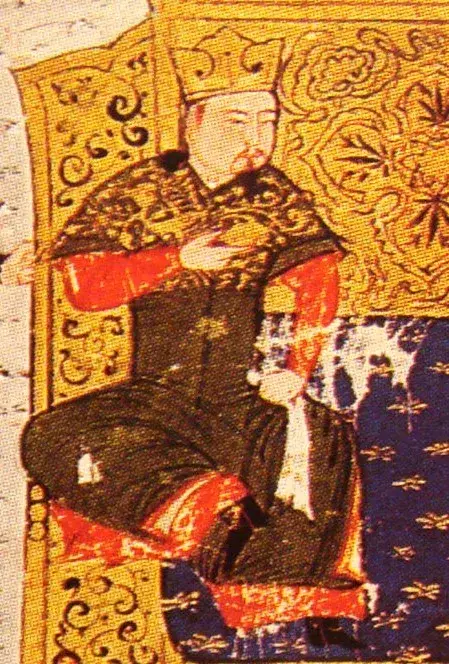
1193 CE–1232 CE
孛儿只斤·拖雷
Borjigin Tolui (孛儿只斤·拖雷, c. 1191–1232), posthumously honored in the Yuan Dynasty as Emperor Ruizong (元睿宗), was the fourth and youngest son of Genghis Khan and Grand Empress Borte, and one of the supreme military strategists of the Mongol Empire. According to nomadic steppe custom, as the youngest son he was designated the Otchigin ("Master of the Hearth"), inheriting his father's personal appanages, ancestral nomadic…
Borjigin Tolui (孛儿只斤·拖雷, c. 1191–1232), posthumously honored in the Yuan Dynasty as Emperor Ruizong (元睿宗), was the fourth and youngest son of Genghis Khan and Grand Empress Borte, and one of the supreme military strategists of the Mongol Empire. According to nomadic steppe custom, as the youngest son he was designated the Otchigin ("Master of the Hearth"), inheriting his father's personal appanages, ancestral nomadic pastures in the Onon and Kerulen river valleys, and the vast preponderance of the imperial army—commanding 101,000 of the 129,000 imperial cavalrymen upon Genghis Khan's passing. Tolui distinguished himself as a peerless cavalry tactician during the First Western Campaign against the Khwarazmian Empire, leading expeditionary forces to capture the major Khurasan bastions of Nishapur, Merv, and Herat. Following Genghis Khan's death in 1227, Tolui governed the unified Mongol Empire as Prince Regent (Yeke Jarguchi) for two years with immaculate legal restraint, subsequently presiding over the grand kurultai of 1229 that enthroned his elder brother Ogedei Khan in accordance with their father's will. During the final war of annihilation against the Jin Dynasty in 1231–1232, Tolui executed an audacious strategic detour through Southern Song territory along the Han River valley. At the climactic Battle of Sanfengshan, he completely encircled and annihilated the 150,000-strong elite field army of the Jin Dynasty, breaking the military spine of the northern empire. Tolui died suddenly in the autumn of 1232 during the return march, famously sacrificing his life in a shamanic ritual to absorb a fatal illness that had afflicted Ogedei Khan. Through his brilliant empress Sorghaghtani Beki, Tolui fathered four sons who transformed the Eurasian world: Möngke Khan (Fourth Great Khan), Kublai Khan (founder of the Yuan Dynasty), Hulagu Khan (founder of the Ilkhanate in Persia), and Ariq Böke.
Born to Temujin (Genghis Khan) and Borte in the Mongolian grasslands
Acknowledged as the Otchigin (Hearth Keeper); allocated hereditary guards
Spearheaded cavalry strikes against the Jin frontier along the Great Wall and accompanied Genghis Khan in tripartite cavalry offensives across Shandong and Hebei in 1213
Commanded the conquest of Bukhara and Samarkand alongside Genghis Khan
Subjugated the major Persian cities of Nishapur, Merv, and Herat
Succeeded to command of the imperial central armies and governed the Mongol Empire as Prince Regent from 1227 to 1229, maintaining peace across Eurasia
Presided over the imperial kurultai, ensuring the smooth succession of Ogedei Khan
Led the southwestern route army through Southern Song lands to bypass Tongguan
Trapped and destroyed Wan-Yan Heda's main Jin army in a blizzard; ingested shamanic curse water in autumn 1232 to spare the ailing Ogedei Khan and died at age forty-one
Tolui grew up during the brutal unification wars of the Mongolian plateau. As the fourth legitimate son of Genghis Khan by his primary wife Borte, Tolui was deeply loved by his father. Steppe nomadic succession traditions dictated that while elder sons received distant appanages on the perimeter of the empire, the youngest son—the Otchigin or "Prince of Fire"—inherited the ancestral hearth, the central pastures, and the royal household retinue.
From his early teens, Tolui rode beside Genghis Khan in battle. He participated in the early assaults on the Jin Dynasty from 1211 to 1215, displaying an instinctive mastery of reconnaissance, tactical feints, and mobile cavalry warfare.
In 1219, Genghis Khan mobilized his full host to destroy the Khwarazmian Empire. After the reduction of Samarkand and Bukhara in 1220, Genghis Khan assigned Tolui an independent army of fifty thousand troops to pacify the rebellious, wealthy province of Khurasan in eastern Iran.
In 1221, Tolui conducted one of the most ruthless sieges in world history. When the city of Nishapur revolted and killed Genghis Khan's son-in-law Toquchar, Tolui brought up siege engines, battered down the ramparts, and reduced the city to rubble. He subsequently captured Merv and Herat, liquidating insurgent garrisons and securing the southern flank of the Mongol advance into the Middle East. Returning to the Indus River, Tolui rejoined Genghis Khan to conclude the first western expedition.
Imperial Regent and the quriltai of 1229
In August 1227, Genghis Khan passed away during the final campaign against Western Xia. In his testamentary distributions, Genghis Khan allocated his four sons their respective military appanages: Jochi's house received 4,000 men; Chagatai received 4,000; Ogedei received 4,000; while Tolui, as the hearth-keeper, inherited the imperial core of 101,000 men, comprising the elite Keshiq bodyguards and the grand mobile columns of the center.
From August 1227 until the autumn of 1229, Tolui served as the supreme ruler and Prince Regent (Yeke Jarguchi) of the Mongol Empire. Although many steppe chieftains and Keshiq commanders urged Tolui to seize the supreme title of Khagan for himself—pointing to his massive military superiority and unparalleled battlefield fame—Tolui steadfastly refused to violate his father's solemn deathbed decree, which had designated the third son, Ogedei, as the imperial heir.
In September 1229, Tolui summoned the imperial princes and nomadic lords to a grand kurultai at Kode'e Island on the Kherlen River. After forty days of ritual feasts and deliberations, Tolui took Ogedei by the right hand while their elder brother Chagatai took him by the left, leading Ogedei to the golden throne and bowing nine times in formal homage as his subject. Tolui's supreme moral restraint preserved the fragile unity of the world empire at its most critical moment.
The Conquest of the Jin and the Triumph of Sanfengshan
In 1230, Ogedei Khan and Tolui mobilized the imperial armies to deliver the deathblow to the Jin Dynasty. The Jin court, having concentrated its remaining 200,000 veteran infantry and cavalry behind the impregnable mountain defiles of Tongguan and the Yellow River, repulsed initial frontal assaults.
Tolui formulated a daring grand strategic concept: rather than exhausting the army in frontal siege warfare against Tongguan, the Mongol army should execute a massive operational envelopment. Ogedei would pin down the Jin front at the Yellow River, while Tolui would lead thirty thousand elite cavalry on an arduous march of over one thousand miles through the rugged Qinling Mountains and Southern Song territory along the Han River, striking the Jin heartland in Henan from the unfortified south.
In late 1231, Tolui forced a passage through Song territory at Wuzhishan, traversed the Han River, and erupted into southern Henan. Alarmed by the sudden appearance of Mongol cavalry in their rear, the Jin Grand Commander Wan-Yan Heda and general Puca Guannu abandoned the Yellow River defenses and rushed south with their elite field army of 150,000 troops to intercept Tolui.
Tolui engaged in a masterclass of mobile warfare: he avoided a direct collision on open plains, instead utilizing light horse archers to harass the strung-out Jin columns day and night, severing their supply wagons and burning all food depots.
In January 1232, the exhausted, freezing Jin army reached the vicinity of Mount Sanfeng (in modern Yuzhou, Henan). At that moment, a ferocious blizzard descended upon the plains. The southern Mongol cavalry were accustomed to Arctic conditions, while the Jin soldiers had gone without hot food for three days and could barely draw their bowstrings.
Tolui surrounded the Jin positions with heavy cavalry and deployed catapult batteries. Employing classical nomadic psychological encirclement, Tolui deliberately opened a corridor toward Junzhou, enticing the desperate Jin troops to break formation. As the Jin infantry fled through the snow, Tolui unleashed his elite cavalry reserves. Wan-Yan Heda's entire 150,000-man army was systematically slaughtered. Wan-Yan Heda fled into Junzhou and was killed; Puca Guannu perished in battle. The Battle of Sanfengshan completely destroyed the last mobile field army of the Jin Empire, ensuring its ultimate capitulation at Kaifeng and Caizhou.
Following the triumph at Sanfengshan, Tolui and Ogedei linked up at the Yellow River to celebrate the victory. In the summer of 1232, as the imperial host was returning north toward the grasslands, Ogedei Khan fell critically ill, losing consciousness and the ability to speak.
The imperial shamans (Bo'e) performed divinations, announcing that the ancestral spirits and river deities of the conquered lands were furious over the slaughter of their people and demanded the soul of an imperial royal family member as an expiatory sacrifice.
Tolui stepped forward into the imperial yurt. In a celebrated speech recorded in The Secret History of the Mongols, Tolui proclaimed to the deities: "My elder brother the Khagan was chosen by our father to rule over all under heaven. His life is indispensable to the realm. I am his younger brother; I have washed away the blood of thousands in battle, and my sins are heavy. Take my soul in place of my brother's!"
Tolui drank the bowl of curse water blessed by the shamans. Within hours, Ogedei Khan recovered consciousness, while Tolui fell violently ill. He passed away on the march in the autumn of 1232 at the age of forty-one. His sacrifice cemented an enduring emotional debt that Ogedei and his successors acknowledged for generations.
In 1251, when Tolui's eldest son Möngke ascended the throne as the Fourth Great Khan, the imperial succession shifted permanently from the House of Ogedei to the House of Tolui. In 1266, his second son, Kublai Khan (founder of the Yuan Dynasty), posthumously conferred upon Tolui the supreme imperial temple name Emperor Ruizong (Ruizong) and the posthumous name Emperor Jingxiang (Jingxiang Huangdi).
FIGURES ASSOCIATED WITH THIS DYNASTY