Birth into Learned Lineage
Born in Quanzhou to Tan Zhu, Director of Studies in the National University; displayed remarkable intellectual agility and literary elegance in youth.
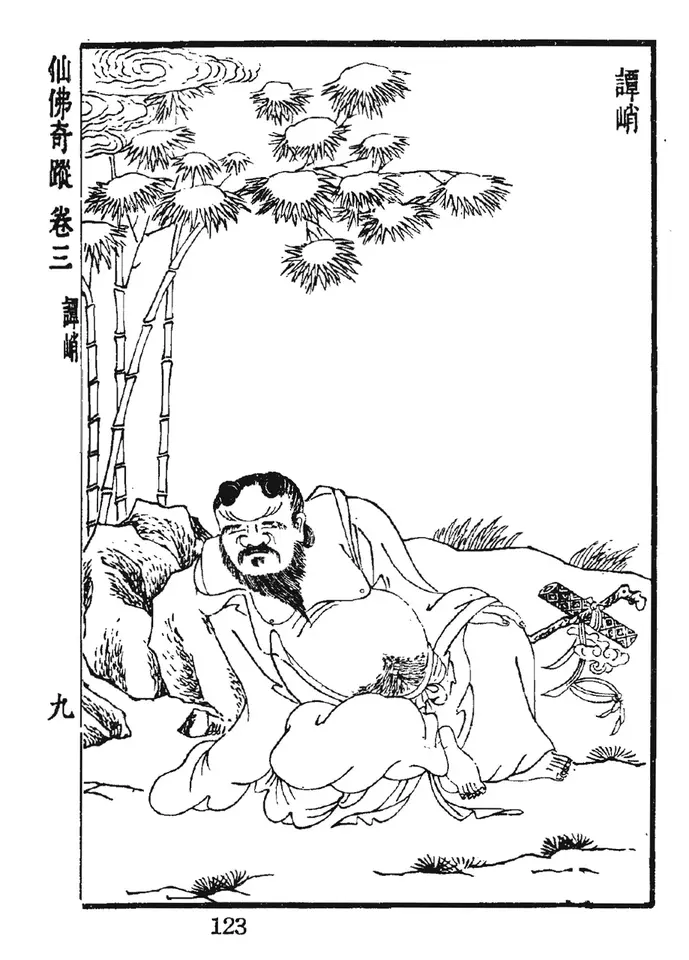
谭峭
Tan Qiao (dates of birth and death unrecorded, active late 9th century to mid-10th century), courtesy name Jingsheng and known in religious traditions as Master Zixiao (紫霄真人) or Tan Zi, was a native of Jinjiang, Quanzhou (present-day Quanzhou, Fujian; alternative sources cite Huating, Xianyou). He was an illustrious Daoist philosopher, natural theorist, and social thinker spanning the late Tang and Five Dynasties and Ten…
Tan Qiao (dates of birth and death unrecorded, active late 9th century to mid-10th century), courtesy name Jingsheng and known in religious traditions as Master Zixiao (紫霄真人) or Tan Zi, was a native of Jinjiang, Quanzhou (present-day Quanzhou, Fujian; alternative sources cite Huating, Xianyou). He was an illustrious Daoist philosopher, natural theorist, and social thinker spanning the late Tang and Five Dynasties and Ten Kingdoms periods. Born into an eminent scholarly family, his father Tan Zhu served as Director of Studies in the National University (Guozijian Siye). Endowed with extraordinary precocity, Tan Qiao mastered the Confucian classics and histories in childhood, yet renounced bureaucratic honors to dedicate his life to Daoist inner cultivation and cosmological inquiry. In his youth, Tan Qiao bade farewell to his family and embarked on an extensive journey across China's sacred peaks, exploring Mount Zhongtiao, Mount Taibai, Mount Taihang, Mount Wangwu, Mount Song, Mount Hua, and Mount Tai. At Mount Song, he studied under a hermit master for over a decade, mastering embryonic breathing, fasting (Bigu), and inner alchemy until he attained total immunity to extreme cold and heat. Eccentric, unconstrained, and deeply fond of wine, he wore heavy winter furs in midsummer and donned thin linen robes in the depth of winter, often sleeping peacefully amidst freezing blizzards, leading contemporaries to regard him as an enlightened eccentric. He secluded himself in Mount Heng and Mount Qingcheng to refine elixirs, receiving the honorific title "Master Zixiao" from the Southern Tang sovereign. In Chinese intellectual history, Tan Qiao achieved enduring renown through his magnum opus, Book of Transformations (Hua Shu, also known as Tanzi Hua Shu). Comprising six volumes and one hundred and ten chapters, the text constructed a revolutionary cosmological ontology grounded in the concept that "all things undergo perpetual transformation" (Wanwu Jiehua), identifying "Supreme Void" (Taixu) as the primordial source of the universe: "The Void transforms into Spirit, Spirit transforms into Qi, Qi transforms into Form, and Form transforms into Life," with all entities eventually returning to the Void. Moving beyond internal cultivation, Tan Qiao mounted trenchant critiques of the feudal exploitation and luxury that ravaged the Five Dynasties, advocating social equality through "equal food distribution" (Junshi), universal frugality (Jianhua), and non-coercive governance (Wuwei). His profound philosophy directly influenced Northern Song Neo-Confucian Zhang Zai's theory of "Supreme Void is Qi" (Taixu Ji Qi), securing Tan Qiao's legacy as a towering intellectual figure of the medieval era.
Born in Quanzhou to Tan Zhu, Director of Studies in the National University; displayed remarkable intellectual agility and literary elegance in youth.
Rejected parental expectations of taking the imperial examinations; obtained leave to visit Mount Zhongnan and commenced lifelong wanderings across sacred mountains.
Studied under an ascetic master at Mount Song for over a decade, mastering fasting, breath circulation, and alchemical cultivation.
Secluded himself at Mount Heng in Hunan to refine elixirs; composed the six-volume philosophical masterpiece Book of Transformations (Hua Shu).
Traveled to Jinling; entrusted his manuscript to Southern Tang Chancellor Song Qiqiu for a preface, who appropriated the text under the title Qiqiu Zi.
Honored by the Southern Tang ruler with the title "Master Zixiao"; retreated into Mount Qingcheng where he attained immortal transcendence.
Tan Qiao was born during the Xiantong reign of Emperor Yizong in Jinjiang County, Quanzhou. His father, Tan Zhu, was an eminent Confucian scholar who attained the prominent court office of Director of Studies in the National University (Guozijian Siye), supervising academic curricula and moral instruction at the empire's supreme educational institution. Raised within an elite scholarly household, Tan Qiao received rigorous classical training from infancy. He displayed extraordinary precocity, committing classical texts and dynastic histories to memory with effortless ease and demonstrating great elegance in essay composition.
Conforming to aristocratic expectations, his father Tan Zhu groomed his talented son to pursue the civil service examinations, hoping he would attain the Jinshi degree and perpetuate the family's bureaucratic prestige. However, living through the catastrophic collapse of the Tang central authority and the predatory violence of regional warlords, Tan Qiao developed a deep aversion to worldly politics. Dismissing bureaucratic honors as hollow vanity, he immersed himself in the foundational texts of Laozi, Zhuangzi, and Liezi, alongside esoteric hagiographies of King Mu of Zhou, Emperor Wu of Han, and the Three Mao Lords.
Determined to break free from secular confinement, Tan Qiao petitioned his father for permission to explore Mount Zhongnan, ostensibly to pursue advanced studies near the capital. Believing Zhongnan was safely proximate to Chang'an, his father consented. Once free in the mountains, however, Tan Qiao cast off worldly ties, abandoning secular pursuits to dedicate his existence entirely to the search for the primordial Dao.
Upon leaving Mount Zhongnan, Tan Qiao took up a simple walking staff and embarked upon an arduous journey across China's greatest mountain ranges. He ascended the freezing precipices of Mount Taibai, crossed the rugged canyons of Mount Taihang, traversed the misty ridges of Mount Wangwu, and paid homage at Mount Hua, Mount Song, and Mount Tai. Wandering through remote forests, he subsisted on wild herbs and spring water, braving wind and snow without regret. Realizing the unyielding nature of his spiritual dedication, his parents ultimately reconciled themselves to his chosen path.
Tan Qiao eventually halted his wanderings at Mount Song, the sacred Central Peak. There he apprenticed himself to an ascetic Daoist hermit, living in an austere thatched hut for over a decade. Throughout these ten years, he devoted himself to inner and outer alchemical practices, mastering embryonic breathing, vital energy circulation, and dietary abstention (Bigu). Through intense physical and mental discipline, he purified his bodily constitution, attaining an extraordinary state of thermal equilibrium immune to extreme temperatures, illness, and bodily harm.
As his spiritual cultivation deepened, Tan Qiao's external behavior became increasingly eccentric and free from social conventions. He took supreme delight in drinking wine, dwelling in a state of tranquil detachment. His physical habits baffled ordinary observers: in the sweltering heat of midsummer, he wrapped himself in heavy black sheepskin furs; in the depths of frozen winter, he wore only a thin green linen shirt; he would often lie unclothed amidst howling blizzards for days on end, appearing lifeless until astonished passersby approached to find his breath warm and regular. Contemporary observers marveled at his vitality, regarding him as a divine immortal living beyond mortal laws.
Departing from Mount Song, Tan Qiao traveled southward to secluded sanctuaries in Mount Heng (the Southern Sacred Peak) and Mount Qingcheng in Sichuan. Deep in the mountain wilderness, he gathered minerals and herbs to erect alchemical furnaces, contemplating the subtle mechanisms of natural generation and cosmic transformation. Synthesizing his lifelong investigations into cosmology, biology, ethics, and political decay, he authored his monumental philosophical treatise, the six-volume, one-hundred-and-ten-chapter Book of Transformations (Hua Shu).
Following the completion of the text, during the founding of the Southern Tang state, Tan Qiao journeyed to the capital at Jinling (modern Nanjing). There he encountered Chancellor Song Qiqiu, a powerful minister who cultivated an external reputation for Daoist learning and literary refinement. Believing that a high-ranking minister could secure imperial sponsorship to publish the work for the moral instruction of society, Tan Qiao presented his manuscript to Song Qiqiu, requesting that he compose an introductory preface.
However, upon reading the text, Song Qiqiu was mesmerized by its structural brilliance, philosophical depth, and trenchant political critique. Overwhelmed by vanity and ambition, and recognizing that Tan Qiao was an obscure mountain recluse without political patrons, Song Qiqiu deceitfully claimed the manuscript as his own. Suppressing Tan Qiao's name, Song Qiqiu appended his own preface and published the work under the title Qiqiu Zi, posing as a transcendent philosopher.
This brazen act of intellectual piracy became one of the most infamous literary controversies in Chinese history. While Song Qiqiu enjoyed unearned literary acclaim for years, the truth could not remain suppressed. Eminent Daoist master Chen Tuan (Master Xiyi), an intimate friend of Tan Qiao, publicly denounced Song Qiqiu's theft, declaring that the text was composed by Tan Qiao during his hermitage at Mount Zhongnan. During the Northern Song Dynasty, prominent Daoist scholar Chen Jingyuan published a comprehensive textual analysis in his Postscript to the Hua Shu, exposing Song Qiqiu's plagiarism as equivalent to Guo Xiang stealing Xiang Xiu's commentary on the Zhuangzi, officially restoring the title Tanzi Hua Shu to its rightful author.
Indifferent to worldly fame and material fortune, Tan Qiao treated the theft of his book with complete serenity, continuing his wanderings across sacred mountains. Southern Tang sovereigns Li Bian and Li Jing, who deeply venerated Daoist masters, heard of Tan Qiao's spiritual attainments and summoned him to the imperial palace in Jinling to lecture on the Daodejing, bestowing upon him the prestigious religious title "Master Zixiao" (Zixiao Zhenren).
In his later years, Tan Qiao returned to his native Fujian. In 973 CE (sixth year of Kaibao in the Northern Song), he resided at the Zize Cave on Mount Qingyuan in Quanzhou, gathering medicinal herbs to cure the sick. Local communities revered him as a compassionate healer, establishing shrines to worship his image as "Immortal Tan" (Tan Xian).
Having completed his worldly mission, Tan Qiao departed for the remote peaks of Mount Qingcheng in Sichuan. Daoist traditions record that after consuming the nine-turn golden elixir, his physical form dissolved into celestial mists, achieving immortal transcendence. His iconic wandering song echoed through subsequent generations: "A thread makes the Long River, a fan makes the sky; Tossing straw sandals beyond the eastern sea. Trust that the path to Penglai is never far; It rests directly before the staff of Master Tan."
Tan Qiao's paramount intellectual monument is the Book of Transformations (Hua Shu), celebrated as the crowning philosophical achievement of the Five Dynasties. Spanning six thematic divisions—Transformation of the Dao (Daohua), Transformation of Arts (Shuhua), Transformation of Virtue (Dehua), Transformation of Benevolence (Renhua), Transformation of Food (Shihua), and Transformation of Frugality (Jianhua)—the text integrates one hundred and ten analytical essays into a coherent, revolutionary materialist philosophy.
In cosmological ontology, Tan Qiao creatively unified the naturalism of Laozi and Zhuangzi with the dynamic cosmogony of the Liezi, identifying the "Supreme Void" (Taixu) as the primordial generative source of all existence. He formulated the celebrated evolutionary chain: "The Void transforms into Spirit, Spirit transforms into Qi, Qi transforms into Form, and Form transforms into Living Beings; living beings generate all things... upon death, they dissolve back into the Void, in transformations that are infinite and ceaseless." He asserted that the cosmos exists in perpetual flux, demonstrating that spirit and matter, sentient animals and inanimate plants, continually transform into one another under specific environmental conditions.
Tan Qiao's doctrine of "perpetual transformation" liberated Chinese cosmology from Han Dynasty teleological superstitions. His profound insights directly inspired Northern Song philosopher Zhang Zai, whose foundational Neo-Confucian axioms—such as "from the Supreme Void comes the name Heaven; from Qi transformation comes the name Dao" and "the Supreme Void is identical with Qi"—drew directly from the conceptual framework of Tan Qiao's Hua Shu.
Unlike conventional Daoist treatises that focused exclusively on individual longevity and physical immortality, the Book of Transformations pulses with passionate social realism and egalitarian humanism. Living through the devastation of the Five Dynasties, when warlords engaged in relentless civil wars, exorbitant taxation, and arbitrary executions, Tan Qiao applied his philosophical analysis to diagnose the socioeconomic roots of societal collapse in his chapters on Food and Frugality.
Tan Qiao trenchantly argued that peasant rebellions and social chaos were the inevitable consequence of ruling-class greed. In his essay The Seven Deprivations (Qi Duo), he condemned the ruling elite for systematically robbing farmers of food, clothing, tools, and labor. He argued that the lavish luxury of courts was a fatal poison that doomed states. Consequently, Tan Qiao advanced the radical concept of "Equal Sustenance" (Junshi), asserting that every human being possesses an innate right to basic physical survival. He advocated curbing monarchical greed through rigorous frugality and non-coercive administration, envisioning an egalitarian commonwealth where rulers and subjects prosper in mutual harmony.
In the section on Transformation of Benevolence (Renhua), Tan Qiao articulated a pioneering ecological philosophy that dissolved anthropocentric arrogance. He fiercely attacked the human conceit that views humanity as the supreme master of creation, bridging the artificial divide between humans and non-human animals.
Through detailed natural observations, Tan Qiao pointed out that animals possess emotional intelligence and moral virtues mirroring human ethics: crows demonstrate filial piety by regurgitating food for their aging parents; young lambs show reverence by kneeling to nurse; bees observe social order under a queen; and wild geese remain faithful to a single mate. He condemned humanity's use of snares, nets, and weapons to slaughter creatures for culinary luxury as barbaric cruelty. Advocating universal compassion extending "even to grass, trees, and insects," his vision of harmonious coexistence with the natural world stands as a shining milestone in classical ecological ethics.
FIGURES ASSOCIATED WITH THIS DYNASTY